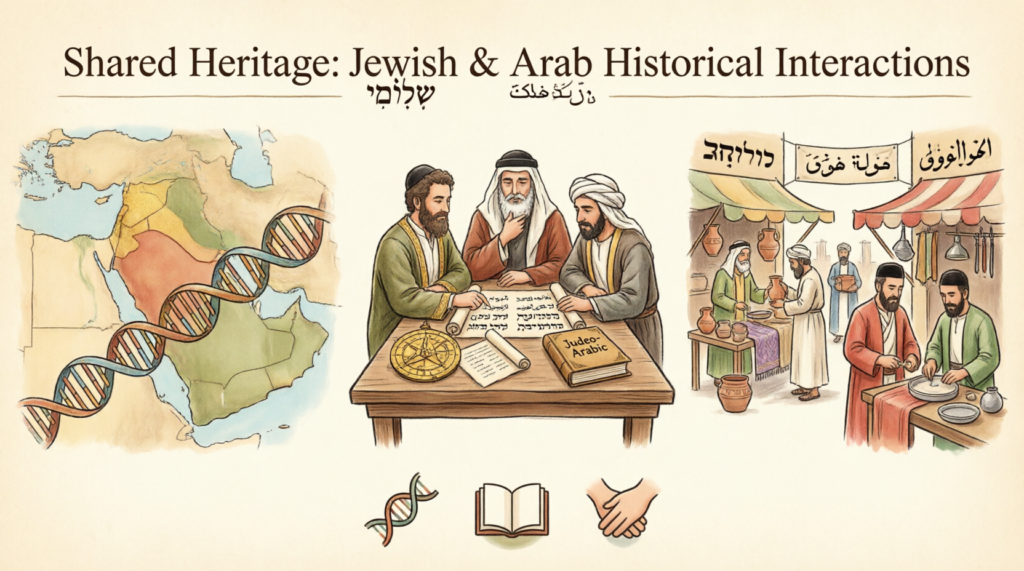
Beyond Conflict – The Shared History of Jewish and Arab Peoples
When we think of the Middle East today, headlines often focus on division. But history tells a different story. For millennia, Jewish and Arab populations have been connected by shared ancestry, intertwined cultures, and collaborative institutions.
This post simplifies complex historical and genetic research to highlight three key areas of connection: biology, early Islamic history, and cultural symbiosis.
🧬 1. Biological Continuity – A Shared Genetic Root
Modern genetics confirms what historians have long suspected: Jewish and Levantine Arab populations share a common ancestral foundation that predates modern religious or national classifications.
The Science of Ancestry
High-resolution population genetics (including Y-chromosome and paleogenomic sequencing) show that both groups draw substantial ancestry from a common Near Eastern gene pool rooted in the ancient Fertile Crescent. PubMed | Semantic Scholar
- Haplogroup J Dominance: Male lineages in both Jewish and Middle Eastern Arab groups are predominantly characterized by Haplogroup J (J1 and J2). Y-DNA Haplogroups by Ethnic Group
- Close Proximity: The modal Y-chromosome haplotypes of Palestinian and Galilee Arab populations sit in close mutational proximity to the Cohen Modal Haplotype (CMH), a signature associated with the Jewish priestly lineage. BYU ScholarsArchive Study
- Ancient Substrate: Approximately two-thirds of paternal lineages in Levantine Arab populations trace back to the same indigenous Neolithic and Bronze Age substrate shared with historical Jewish populations. Shared Genetic Heritage
Genetic Profile Overview
| Population Group | Primary Y-DNA Haplogroups | Ancestral Profile |
|---|---|---|
| Palestinian & Levantine Arabs | J1 (~55%), J2 | Core Levantine Neolithic/Bronze Age substrate + post-7th century Arabian gene flow |
| Jewish Populations | J1 (~40%), J2, E1b1b, R1b1 | Middle Eastern ancestral core + varying local admixture |
| Bedouin Communities | J1 (~65%) | High frequency of early Southern Levantine & Arabian pastoralist lineages |
Key Takeaway: Ethno-religious boundaries were historically constructed through social and political factors, not fundamental biological separation.
📜 2. Pre-Islamic Arabia & The Constitution of Medina
Long before the rise of Islam in the 7th century, Jewish communities were integrated into the tribal and political structures of the Arabian Peninsula. When Arabian Jews and Muslims Lived in Peace
Jewish Life in Arabia
- Political Prominence: By the 4th century CE, the Himyarite Kingdom (Yemen) converted to Judaism.
- Northern Hijaz: Established Jewish tribes (Banu Qaynuqa, Banu Nadir, Banu Qurayza) dominated agriculture and crafts in oases like Yathrib (Medina) and Khaybar.
- Cultural Integration: These communities adopted the Arabic language and tribal customs while maintaining their faith.
The Constitution of Medina (622 CE)
When Prophet Muhammad migrated to Yathrib, he drafted a groundbreaking civic agreement known as the Constitution of Medina. Constitution of Medina | Analysis
- One Community (Ummah): It created a single political community including Muslims, pagan Arabs, and Jewish clans.
- Religious Freedom: Clause 25 stated: “The Jews of the Banu ‘Auf are one community with the believers; the Jews have their religion and the Muslims have theirs.”
- Mutual Defense: All parties were required to fund the defense of Yathrib and assist one another against common foes.
Although political unity later fractured due to geopolitical conflicts, this document established the foundational model for integrating protected non-Muslim communities (dhimmi) into Islamic governance.
🌍 3. The Golden Age – Judeo-Arabic Cultural Symbiosis
Following the expansion of the Arab-Islamic empires (7th–8th centuries), an estimated 90% of the world’s Jews lived within Islamic domains by 800 CE. This proximity sparked an intellectual golden age.
The Rise of Judeo-Arabic
Jewish communities adopted Arabic as their daily language, creating Judeo-Arabic
- Combined Classical Arabic structure with Hebrew/Aramaic vocabulary.
- Written primarily in Hebrew script.
- Used for philosophy, law, commerce, and biblical commentary. Judeo-Arabic Literature
Intellectual Collaboration
Jewish scholars actively participated in the Islamic Golden Age, adopting methods from Islamic theology (Kalam) and philosophy (falsafa). Judeo-Arabic Literature
| Scholar | Region | Major Contribution |
|---|---|---|
| Saadia Gaon (882–942) | Abbasid Iraq | Applied Islamic rationalist methods to Jewish theology; standardized Judeo-Arabic writing. Genizah Fragment of Saadia’s Translation |
| Bahya ibn Paquda | Al-Andalus | Blended Islamic Sufi ethics with Jewish moral philosophy (Duties of the Heart). |
| Moses Maimonides (1138–1204) | Spain/Egypt | Reconciled Aristotelian philosophy with Jewish law (Guide for the Perplexed). |
The Lost Literary World of Judeo-Arabic
Economic Integration: The Cairo Genizah
Over 300,000 document fragments from Old Cairo reveal Medieval Judeo-Arabic Culture
- Joint Jewish-Muslim-Christian commercial networks across the Mediterranean.
- Shared business partnerships and agricultural ventures.
- Use of both rabbinic (beit din) and Islamic (sharia) courts for contracts.
🏛️ 4. Ottoman Era: Pluralism & Institutional Coexistence
From the 14th to the 20th century, the Ottoman Empire managed religious diversity through specific legal frameworks that allowed for coexistence. History of Jews in the Ottoman Empire
The Dhimma & Millet Systems
- Dhimma: Jews (and Christians) were classified as “People of the Book,” granted protection of life and worship in exchange for a poll tax (jizya).
- Millet System: Non-Muslim communities were organized into autonomous administrative units. The Jewish millet was led by the Hakham Bashi (Chief Rabbi), allowing internal self-governance over family law and education. Ottoman Empire and the Jews
Economic Guilds (Esnaf)
Ottoman trade guilds were often multi-confessional, including Muslim, Jewish, and Christian artisans. Masters of Trade
- Regulated production, pricing, and apprenticeships.
- Jewish artisans held leadership roles in metalworking, textiles, and international trade.
- Jewish financiers and translators played key roles in imperial administration and European-Ottoman commerce. The Levant Company and the Jews
✅ Conclusion: Three Enduring Themes
Understanding the intersections of Jewish and Arab history highlights that these societies have been structurally interconnected long before modern geopolitical divisions.
- Linguistic & Philosophical Symbiosis: Judeo-Arabic created a shared intellectual medium enabling deep cross-cultural exchange.
- Institutional Flexibility: Legal frameworks (Dhimma, millet, guilds) balanced hierarchy with autonomy, enabling religious minorities to preserve internal systems while participating in shared economic life.
- Genetic Continuity: Paleogenomics confirms shared Levantine ancestry, proving that later differentiation resulted from political, religious, and social factors, not biological separation. Genetic Proximity Study
📚 Further Reading & Sources
Genetics & Paleogenomics
- PubMed: High-resolution Y chromosome haplotypes
- Semantic Scholar: Israeli and Palestinian Arab Haplotypes
- ResearchGate: Geographic Substructure Study
Early Islamic History
- Wikipedia: Constitution of Medina
- Times of Israel: Tawhid and Jews in the Constitution of Medina
- ResearchGate: Muhammad, The Jews and the Constitution of Medina
Judeo-Arabic Culture & Literature
- Wikipedia: Judeo-Arabic
- Jewish Virtual Library: Judeo-Arabic Literature
- Beit Avi Chai: The Lost Literary World of Judeo-Arabic
- The Medieval Judeo-Arabic Culture
Ottoman History & Economics