Jan Hus stands as one of the most consequential figures in the history of the Czech lands. A university master, preacher, and religious reformer, he was executed as a heretic at the Council of Constance in 1415. Yet his death did not extinguish his influence. Instead, it ignited a movement that reshaped Bohemia’s religious life, political identity, and relationship with the wider Latin West for generations. Understanding Hus requires more than treating him as a mere precursor to Martin Luther. His significance lies in the specific conditions of late medieval Bohemia: a kingdom with a strong sense of linguistic and cultural distinctiveness, a powerful university, deep tensions between Czech and German elites, and a church widely perceived as corrupt and foreign-dominated.
Bohemia on the Eve of Reform
In the late fourteenth and early fifteenth centuries, the Kingdom of Bohemia was one of the most advanced and prosperous territories of the Holy Roman Empire. Under Charles IV (r. 1346–1378), Prague had become an imperial capital, the seat of a major university founded in 1348, and a center of Gothic culture. Charles’s son Wenceslaus IV inherited a kingdom that was wealthy but politically fragile. The Western Schism (1378–1417), which produced rival popes in Rome and Avignon (and later a third in Pisa), undermined papal authority across Europe and gave reformers ammunition. In Bohemia, resentment focused on the wealth and moral failings of the higher clergy, the dominance of German masters at the University of Prague, and the practice of selling indulgences.
Into this environment stepped John Wycliffe’s ideas, transmitted through Bohemian students who had studied at Oxford and through the circulation of manuscripts. Wycliffe’s emphasis on the Bible as the ultimate authority, his critique of clerical wealth, and his questioning of certain sacramental practices found a receptive audience among Czech masters who already felt culturally marginalized within their own university.
Hus’s Career and Message
Born around 1370–1372 in the village of Husinec in southern Bohemia, Jan Hus studied at the University of Prague, earned the degree of master of arts, and was ordained a priest. By the early 1400s he had become a popular preacher at the Bethlehem Chapel in Prague’s Old Town, an institution deliberately founded for preaching in the Czech language. There he delivered sermons that combined moral exhortation with pointed criticism of simony, clerical immorality, and the commercialization of salvation.
Hus was not a systematic theologian in the mold of later reformers. His core positions included:
- The supreme authority of Scripture over human tradition and papal decrees when the two conflicted.
- The demand that the church return to apostolic poverty and moral purity.
- The conviction that the true church consisted of the predestined, not simply of those in hierarchical communion with Rome.
- Support for communion under both kinds (bread and wine) for the laity—an issue that would become central to the later Hussite movement.
He stopped short of rejecting transubstantiation or the sacrificial character of the Mass in the radical way some later Protestants would. His primary targets were practical abuses and the claim that the pope and hierarchy stood above correction by Scripture and conscience.
Tensions escalated after 1409, when the Kutná Hora Decree shifted voting power at the University of Prague decisively toward the Czech nation, prompting an exodus of German masters. Hus emerged as a leading Czech voice. When he continued to preach against indulgences proclaimed in support of a papal crusade, he was placed under interdict and eventually forced to leave Prague. In 1414 he accepted an invitation—backed by a safe-conduct from Emperor Sigismund—to defend his views at the Council of Constance.
Trial, Execution, and the Crisis of Authority
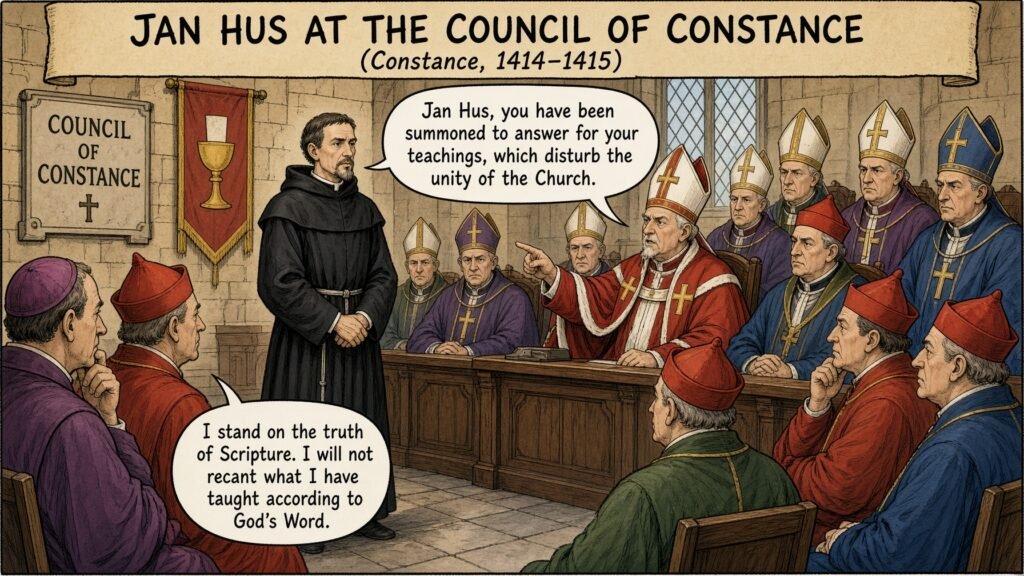
The Council of Constance (1414–1418) had multiple purposes: ending the schism, reforming the church “in head and members,” and dealing with heresy. Hus was treated as a heretic from the outset. Despite the imperial safe-conduct, he was imprisoned, subjected to prolonged interrogation, and pressed to recant propositions drawn from his writings and from Wycliffe. He refused to repudiate teachings he believed were consistent with Scripture and the early church. On 6 July 1415 he was condemned and burned at the stake outside the city walls. His ashes were scattered in the Rhine to prevent the collection of relics.
The execution produced immediate outrage in Bohemia. Many Czechs regarded the safe-conduct as having been violated and saw Hus as a martyr murdered for defending the truth and the honor of the Czech nation. University masters, lower clergy, and significant portions of the nobility and urban population rallied around his memory. Within a few years the demand for reform hardened into a revolutionary program.
The Hussite Revolution and Its Consequences
The defenestration of Prague in 1419—when radical Hussites threw royal officials from the windows of the New Town Hall—marked the beginning of open conflict. The subsequent Hussite Wars (roughly 1419–1434) were both a civil war and a series of crusades launched by the papacy and Sigismund against the “heretical” kingdom. The movement fractured into factions:
- Utraquists (moderate Calixtines), who sought communion in both kinds, reform of clerical morals, and a degree of national ecclesiastical autonomy while remaining within a broader Catholic framework.
- Taborites and other radical groups, who developed more communal, apocalyptic, and anti-hierarchical practices, rejecting much of the traditional sacramental and hierarchical order.
Despite repeated crusading armies, the Hussites repeatedly defeated superior forces through innovative tactics, high morale, and the effective use of wagon fortresses (vozová hradba). The wars devastated parts of the country but also demonstrated that a determined national-religious movement could resist both imperial and papal power.
The eventual settlement, the Compacts of Basel (1436), granted limited concessions—most importantly communion under both kinds—and allowed a form of Utraquist church life to continue in Bohemia. Full reconciliation with Rome never occurred. Bohemia remained religiously distinctive until the forced re-Catholicization that followed the Battle of White Mountain in 1620.
Hus’s Place in Bohemian Historical Memory
Hus’s role in Bohemian history operates on several interlocking levels.
Religious reformer. He established a native tradition of biblical preaching and moral critique of the institutional church that persisted in Utraquism and later influenced the Unity of the Brethren (Unitas Fratrum). This tradition kept alive the principle that Scripture and conscience could stand against hierarchical authority—an idea that would reappear in the sixteenth-century Reformation.
National symbol. In a kingdom where language, university politics, and resentment of German cultural dominance were already live issues, Hus became a martyr for Czech identity. Nineteenth-century Czech nationalists, during the National Revival, elevated him as a proto-national hero who had resisted both ecclesiastical and foreign domination. Tomáš Garrigue Masaryk and other founders of Czechoslovakia invoked his legacy. July 6 remains a public holiday in the Czech Republic.
Political catalyst. The crisis surrounding his trial and death accelerated the breakdown of traditional authority structures in Bohemia. The Hussite period demonstrated that popular religious conviction, allied with segments of the nobility and towns, could challenge both the emperor and the pope. It also left a legacy of confessional division and military innovation that shaped Central European politics for a century.
Ambiguous legacy. Hus was not a modern democrat or a secular nationalist. He remained a medieval Catholic in many of his theological assumptions and accepted the reality of hierarchical order even while criticizing its abuses. The radicalism of some of his followers—iconoclasm, social leveling, and sustained warfare—went far beyond anything he personally advocated. Catholic historiography long treated him as a dangerous heretic; only in recent decades have more nuanced assessments emerged within Catholic scholarship, acknowledging both his moral seriousness and the procedural injustices of his trial.
Broader Implications
Hus’s career illustrates the explosive potential that arises when university learning, vernacular preaching, national feeling, and genuine spiritual discontent converge. Bohemia in the early fifteenth century was not unique in experiencing these pressures, but the combination proved particularly potent. The failure of the Council of Constance to resolve the underlying issues of authority and reform helped set the stage for the more successful break with Rome a century later under Luther, who openly acknowledged his debt to the “Bohemian” martyr.
For Bohemian history specifically, Hus marks a decisive turning point. Before him, the kingdom was a loyal, if sometimes restive, part of Latin Christendom and the Empire. After him, it developed a distinct confessional and national trajectory that lasted until the Habsburg reconquest of the seventeenth century. Even after the re-imposition of Catholicism, the memory of Hus continued to function as a counter-narrative of Czech resistance and moral independence.
In the end, Jan Hus matters not only because he died for his convictions, but because those convictions—and the manner of his death—forced Bohemia to confront fundamental questions about the sources of religious authority, the relationship between nation and church, and the limits of obedience to distant powers. The answers the Czech lands gave to those questions shaped their history for centuries afterward.