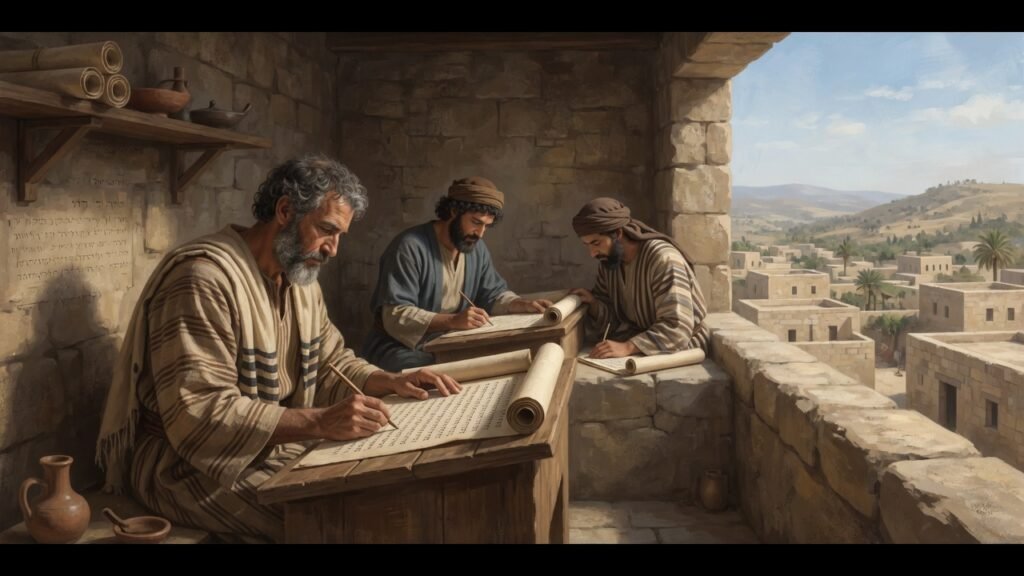
The conviction that all Scripture is divinely inspired has shaped Christian faith and practice for nearly two thousand years. It holds that the Bible is not simply a product of human religious insight or cultural development, but the very Word of God, breathed out by Him and delivered through human authors under the direction of the Holy Spirit. This understanding affirms that the 66 books of the Protestant canon carry divine authority and are fully reliable in everything they teach.
The Biblical Claim to Inspiration
The clearest declaration appears in 2 Timothy 3:16-17:
“All Scripture is inspired of God and beneficial for teaching, for reproving, for setting things straight, for disciplining in righteousness, so that the man of God may be fully competent, completely equipped for every good work.”
The Greek word theopneustos (“God-breathed”) points to divine origin. Scripture does not merely contain inspired ideas; it proceeds from God Himself. The verse emphasizes that this applies to all Scripture, the entire body of sacred writings.
This claim is reinforced throughout the Bible. The apostle Peter explained that “no prophecy was ever borne by the will of man, but men spoke from God as they were moved by holy spirit” (2 Peter 1:20-21). Jesus treated the Hebrew Scriptures as unbreakable and authoritative (Matthew 5:17-18; John 10:35), and the New Testament writers consistently quoted the Old Testament as the living Word of God.
Historical Recognition of Divine Inspiration
The understanding that Scripture is divinely inspired did not emerge in later centuries as a theological theory. It was present from the earliest days of God’s people and developed through both biblical testimony and the lived experience of the congregations.
In the Old Testament period, the writings of Moses were immediately received as coming from God (Exodus 24:3-4; Deuteronomy 31:24-26). Later prophets and writers appealed to these earlier Scriptures as authoritative. When the prophets spoke, they frequently introduced their messages with “Thus says the Lord,” signaling that their words carried divine weight rather than personal opinion.
By the time of Jesus and the apostles, the Hebrew Scriptures (what some Christians call the Old Testament) were already regarded as inspired and authoritative. Jesus repeatedly appealed to them as the unbreakable Word of God, and the apostles quoted them as the very voice of the Holy Spirit (Acts 1:16; Hebrews 3:7). When the New Testament writings began to appear, they were quickly recognized as carrying the same divine authority. The apostle Peter referred to Paul’s letters as “Scripture” (2 Peter 3:16), placing them on the same level as the Old Testament writings.
In the generations that followed, early Christian leaders and writers defended the divine inspiration of these writings against both pagan critics and heretical groups. They quoted the Scriptures extensively and treated them as the final standard of truth. They pointed to fulfilled prophecy, the unity of the message, and the transformative power of the writings as evidence of their divine source.
The process of recognizing which books belonged in the canon was gradual and careful. Christians did not arbitrarily choose books; they recognized those writings that bore the marks of inspiration, apostolic origin or close association with the apostles, doctrinal consistency with the rest of Scripture, and widespread acceptance and use among the congregations. By the late second century, lists such as the Muratorian Fragment already reflected a core collection very close to the 66 books recognized today. Formal statements by later councils simply confirmed what had already been widely accepted through use and spiritual discernment.
Throughout the history of the congregations, believers continued to affirm divine inspiration for the same reasons the early congregations did: the Scriptures’ own claims, the testimony of Jesus and the apostles, centuries of fulfilled prophecy, remarkable unity across diverse authors, and the witness of the Holy Spirit in the hearts of believers. During the Protestant Reformation in the sixteenth century, leaders such as Martin Luther and John Calvin strongly emphasized sola Scriptura Scripture alone as the final authority, precisely because they were convinced it was divinely inspired and therefore superior to human tradition. John Calvin particularly highlighted the internal testimony of the Holy Spirit, by which God convinces believers that the Bible is His Word.
In later centuries, as higher criticism began to question traditional understandings, many scholars and theologians responded by carefully restating and defending the historic doctrine of plenary verbal inspiration. Confessions such as the Westminster Confession of Faith (1646) summarized the longstanding conviction that the original Scriptures were “immediately inspired by God” and preserved by His providence.
In every era, the reasons people understood the Scriptures to be divinely inspired remained remarkably consistent: the Bible’s own testimony, its fulfillment of prophecy over long periods of time, its preservation through opposition, its internal harmony, and the witness of the Holy Spirit in the hearts of believers.
What Divine Inspiration Means
Divine inspiration means that God is the ultimate Author of Scripture. Human writers served as the instruments, but the Holy Spirit superintended the process so that the words recorded were exactly what God intended to communicate.
This does not require mechanical dictation in every case. The writers retained their distinct personalities, styles, cultural contexts, and vocabularies. A shepherd like Amos writes differently from a king like David or a physician like Luke. Yet the Holy Spirit ensured that what they wrote accurately conveyed God’s message without error in the original manuscripts.
Inspiration is therefore understood as both verbal (extending to the very words) and plenary (applying to all of Scripture). It guarantees that what the Bible affirms, whether historical narrative, moral command, prophecy, poetry, or doctrinal teaching, is true and reliable.
The Process of Divine Inspiration
Scripture was produced over roughly 1,600 years by approximately forty human authors from widely varying backgrounds. Despite this diversity, the process involved the active work of the Holy Spirit.
Some sections involved direct revelation or the recording of words spoken by God. Others involved careful research or personal experience under divine guidance. The result is a book that is simultaneously fully human and fully divine, God’s Word expressed in human language.
Evidence Supporting Divine Inspiration
Those who affirm the full inspiration of Scripture point to multiple converging lines of evidence.
Fulfilled Prophecy
The Bible contains hundreds of specific predictions fulfilled in detail. Prophecies concerning the Messiah’s birthplace, suffering, death, and resurrection were written centuries in advance. Prophecies spanning long periods of time about ancient empires were fulfilled exactly as stated. The precision of these fulfillments is presented as strong evidence of supernatural origin.
Scientific Foreknowledge
Written in times of limited scientific understanding, Scripture contains statements that align with later discoveries, the earth “hanging upon nothing,” the water cycle, the spherical shape of the earth, and principles of hygiene that anticipated modern understanding.
Historical and Archaeological Corroboration
Archaeology has repeatedly confirmed people, places, and events once questioned by critics, supporting the Bible’s reliability as a historical document.
Unity Amid Diversity
Despite being written over many centuries by authors of vastly different backgrounds and in three languages, the Bible maintains one harmonious theme: God’s redemptive purposes for humanity, centered on Christ.
Moral Candor and Integrity
Scripture honestly records the failures of its heroes and maintains high moral standards even when those standards condemn the people through whom it was written.
Transformative Power
The Bible has demonstrated unique power to change lives and influence cultures while enduring centuries of opposition.
Implications for Believers
If all Scripture is God-breathed, several important conclusions follow:
- Authority: Scripture holds final authority over human tradition, philosophy, and personal opinion.
- Sufficiency: It thoroughly equips the believer for every good work. Nothing essential for faith and godly living is lacking.
- Practical Benefit: Scripture is profitable for teaching truth, exposing error, correcting wrong thinking, and training in righteousness.
- Reverent Approach: Because it is God’s Word, Scripture deserves careful, humble, and prayerful study, with attention to context and the overall harmony of its message.
Nuances and Common Questions
Inspiration does not mean every sentence is a direct quotation from God. Much of the Bible records historical events, conversations, poetry, and the writers’ own reflections. What matters is that everything the text affirms is true and reliable.
Difficult passages are addressed through careful study of context, language, genre, and the progressive nature of revelation. Many apparent tensions resolve when passages are examined closely and read in light of the whole of Scripture.
The canon of 66 books was recognized by early Christians as those writings that bore the marks of inspiration and were received by the congregations under the guidance of the Holy Spirit.
Conclusion
The doctrine of the divine inspiration of all Scripture rests on the Bible’s own testimony, the witness of Jesus and the apostles, and centuries of recognition by God’s people. From the earliest days, believers have understood these writings as God-breathed because of their self-claims, fulfilled prophecy, remarkable unity across diverse authors, and the witness of the Holy Spirit in the hearts of believers.
This conviction invites every reader to approach the Bible not merely as an ancient religious text, but as the living Word of God that is “beneficial for teaching, for reproving, for setting things straight, for disciplining in righteousness.” Those who take this view seriously often discover that diligent, prayerful engagement with Scripture leads to deeper faith, clearer understanding, and genuine transformation.
The invitation remains open: examine the Scriptures for yourself. The claim that “all Scripture is inspired of God” is ultimately an invitation to hear the voice of God speaking through His Word.