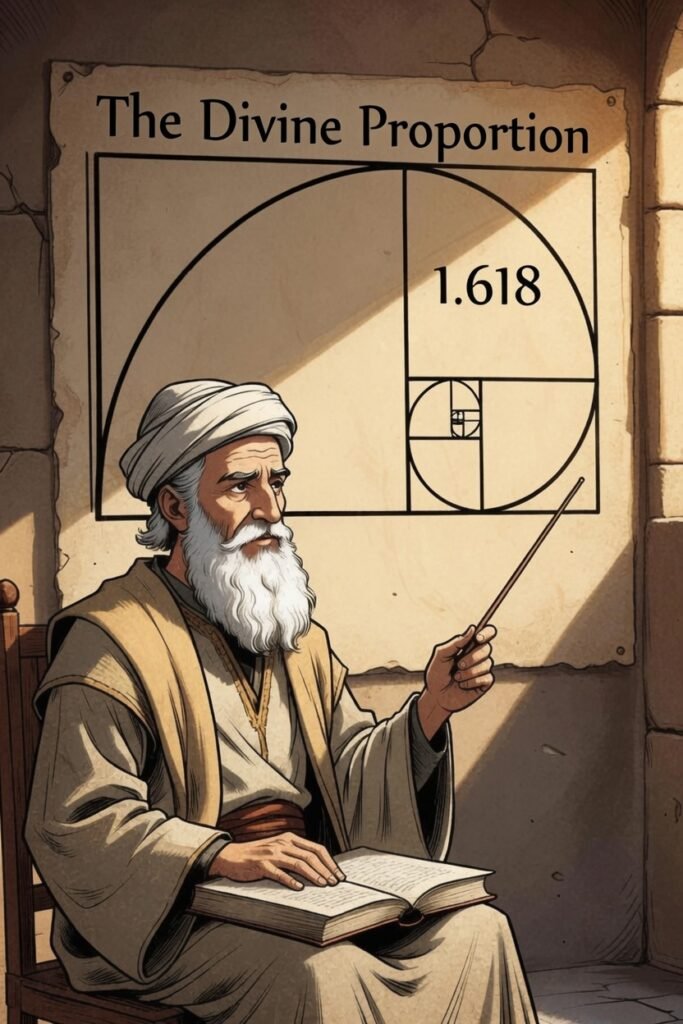
Few concepts in mathematics possess the quiet, almost mystical power of the Divine Proportion, also known as the golden ratio or golden section. Denoted by the Greek letter φ (phi), it is an irrational number approximately equal to 1.6180339887… that appears at the intersection of geometry, biology, art, and aesthetics. It has been called “divine” not merely for its beauty, but because it seems to encode a principle of harmony that recurs across scales, from the microscopic to the cosmic.
The Mathematical Heart
A defining property: φ satisfies φ² = φ + 1. If you construct a rectangle with sides in this ratio (a “golden rectangle”) and remove a square from the longer side, the remaining rectangle is again golden—perfect self-similarity that continues infinitely. This recursive quality links it directly to the Fibonacci sequence (1, 1, 2, 3, 5, 8, 13, 21…), where the ratio of consecutive terms converges to φ as the numbers grow larger.
The golden spiral, formed by drawing quarter-circles inside successive golden rectangles, embodies this endless nesting.
Nature’s Efficient Architecture
Nowhere does the Divine Proportion feel more alive than in the living world, where Creation favors efficient solutions.
In sunflowers, pinecones, pineapples, and Romanesco broccoli, seeds or scales arrange in opposing spirals whose counts are consecutive Fibonacci numbers (commonly 34 and 55, or 55 and 89). This packing is not decorative, it is optimal. The golden angle (approximately 137.5°, or 360°/φ) ensures that each new leaf, floret, or seed emerges at a position that minimizes overlap and maximizes sunlight and space.
The chambered nautilus constructs its shell as a logarithmic spiral that approximates the golden spiral, adding chambers in a self-similar progression as it grows. Similar patterns appear in the branching of trees, the arrangement of leaves along stems (phyllotaxis), and even the spiral arms of certain galaxies, approximations born of physical and biological constraints rather than conscious design.
These occurrences are not universal, but they are recurrent enough to suggest that φ represents a particularly efficient solution to problems of growth, packing, and resource distribution under natural selection.
History, Art, and the Renaissance “Divine” Label
The term “Divine Proportion” (divina proportione) was popularized by the Franciscan friar and mathematician Luca Pacioli in his 1509 treatise De Divina Proportione, illustrated with exquisite drawings of polyhedra by his friend and collaborator Leonardo da Vinci.
Pacioli attributed five “divine” qualities to the ratio: its uniqueness, its ineffability (it cannot be expressed rationally, like the divine), and its role in the structure of the cosmos. Earlier, Euclid had described the division of a line “in extreme and mean ratio” in his Elements (c. 300 BCE), but the aesthetic elevation came much later.
Leonardo’s Vitruvian Man is frequently cited as an embodiment of golden proportions, though the human body’s actual measurements vary widely and the drawing reflects a blend of classical ideals rather than strict φ application.
Nuances, Myths, and Measured Reality
Popular culture often overstates the golden ratio’s presence. Claims that the Parthenon was deliberately designed as a golden rectangle, or that the Great Pyramid encodes φ precisely, or that the human navel divides the body in exact golden proportion, largely date to 19th-century romanticization rather than ancient practice or precise measurement.
Careful analysis shows many such “discoveries” rely on selective framing, approximate measurements, or confirmation bias. The Parthenon’s harmony arises more from optical refinements (subtle curves and entasis) and simple integer ratios than from φ.
Psychologist Gustav Fechner and his 19th-century experiments did find that many people prefer rectangles close to the golden ratio, and modern theories suggest our visual system processes such proportions efficiently. Yet beauty remains contextual, cultural, personal, and multifaceted. The golden ratio is a powerful tool, not a universal law of aesthetics.
Why It Endures
The Divine Proportion fascinates because it sits at the crossroads of the divine and the ineffable. It is mathematically inevitable in certain geometries (pentagons, dodecahedra, icosahedra), biologically essential in growth patterns, and perceptually pleasing to many observers. It offers a tangible example of self-similarity and recursive order emerging from simple rules, echoes of the fractal geometry that describes coastlines, clouds, and blood vessels.
In an age dominated by data, algorithms, and artificial intelligence, the golden ratio reminds us that God’s work in its elegance often lies in proportion rather than complexity. It bridges the quantifiable and the felt, the engineered and the organic.
As the Spanish poet Rafael Alberti wrote in his ode “To the Divine Proportion”:
To you, marvelous discipline,
medium, extreme reason of beauty…
mysterious fountain of measure
that the harmonious Universe originates.
The Divine Proportion helps to explain everything beautiful. Where it appears, whether in a sunflower’s seed head, a nautilus’s chamber, or a well-composed canvas, it whispers of an underlying coherence that feels, to many, almost sacred.
What hidden proportions or patterns have you noticed in the world around you?