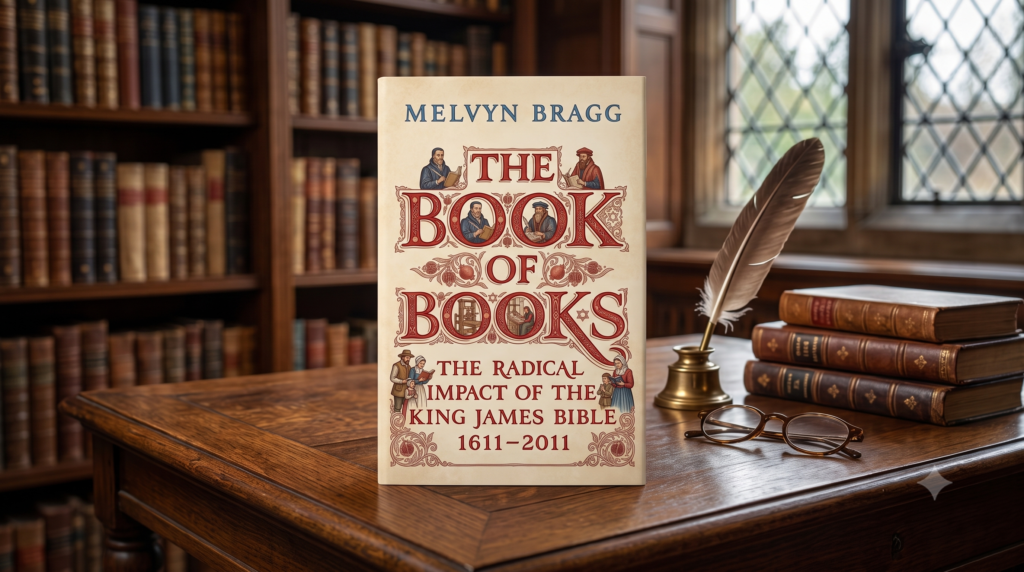
The Book of Books: The Radical Impact of the King James Bible 1611–2011 by Melvyn Bragg is an elegant, passionate, and highly readable tribute to one of the most influential texts in the English-speaking world. Published in 2011 to mark the 400th anniversary of the King James Version (also known as the Authorised Version), the book does not attempt a dense scholarly reconstruction of the translation’s creation. Instead, Bragg turns his considerable gifts as a storyteller, broadcaster, and cultural historian toward something broader and more compelling: the extraordinary afterlife of that translation and the way its cadences, imagery, and ideas helped shape language, literature, politics, social reform, and democratic ideals across four centuries.
Bragg opens with the historical backdrop, the Hampton Court Conference, the earlier groundwork laid by William Tyndale (whose English renderings supplied a large proportion of the final text), and the political and religious pressures of early Stuart England, before moving swiftly into the book’s real subject: impact. He is less interested in the committee rooms of 1604–1611 than in what happened once those words entered the bloodstream of English culture. The result is a wide-ranging, often exhilarating survey that moves from the English Civil Wars and the founding of New England to the abolition of slavery, the rise of democratic thought, the shaping of modern English prose, and the quiet daily presence of biblical phrasing in ordinary speech.
One of the book’s greatest strengths is its treatment of language. Bragg shows how the King James Bible furnished English with a vast store of memorable expressions that remain current: “the apple of his eye,” “a man after his own heart,” “sour grapes,” “the land of the living,” “go the extra mile,” “pride goes before a fall,” and countless others. More than a catalogue of idioms, this is an argument about the Bible’s role in stabilising and elevating the literary language. Bragg writes with evident affection for the translation’s oral qualities, its balance, rhythm, and capacity to be memorised and spoken aloud, qualities that made it both a liturgical and a popular possession.
Literature receives equally generous attention. Bragg traces the Bible’s influence on Milton’s grand architecture of language, on Bunyan’s plain yet resonant prose, and on later writers as varied as D. H. Lawrence, T. S. Eliot, Emily Dickinson, and Toni Morrison. He is particularly good at conveying how the text supplied not only stories and metaphors but a moral and imaginative vocabulary that writers could inhabit, challenge, or transform. The discussion never feels forced; Bragg’s own long engagement with English literature and his earlier work on the history of the language give the literary chapters an easy authority.
Perhaps the most ambitious sections concern politics and society. Bragg argues that the widespread availability of Scripture in a powerful vernacular translation helped democratise religious and political authority. He points to the radical potential released when ordinary people could read and interpret the text for themselves, an impulse visible in the English Civil Wars, in the rhetoric of American independence, and in the campaigns of figures such as William Wilberforce and the Quakers against slavery. The chapter on slavery is especially thoughtful: Bragg acknowledges that both defenders and opponents of the institution claimed biblical sanction, yet he carefully shows how the language of justice, equality before God, and liberation eventually proved more potent on the side of abolition. He also notes the Bible’s role in social reform more broadly, including education and the charitable work of figures such as Octavia Hill.
Bragg writes as someone shaped by the King James Bible from childhood. He is neither a doctrinal apologist nor a detached sceptic; he is a cultural observer who believes the text’s influence has been, on balance, profoundly generative. There is a warmth and personal investment in the writing that never tips into mere nostalgia. Even when he turns to modern secular critics, his tone remains engaged rather than merely defensive. The book is popular history at its best: accessible without being simplistic, enthusiastic without being uncritical, and wide-ranging without losing coherence.
Of course, a single volume cannot cover every scholarly debate or regional variation in the Bible’s reception. Bragg’s emphasis falls on the English-speaking world and on the positive catalytic effects of the translation. Readers seeking exhaustive textual criticism or a more sceptical accounting of the Bible’s darker appropriations will find other books better suited to those purposes. Yet that is not the task Bragg set himself. He set out to demonstrate the scale and durability of the King James Bible’s cultural force, and in this he succeeds admirably.
The Book of Books is, above all, a generous book. It invites readers, believers, agnostics, and non-believers alike to recognise how deeply a single translation has entered the shared imaginative and linguistic inheritance of English speakers. Bragg’s prose is clear, energetic, and often eloquent; his storytelling keeps the pages turning. For anyone interested in the hidden architecture of modern English culture, or simply in the long life of a great book, this is a rewarding and respectful celebration. It leaves the reader with a renewed sense of how words, once set free in the right form, can continue to shape the world for centuries.