A Reflection on Patience, Judgment, and the Kingdom of God
One of Jesus’ most thought-provoking parables appears in the Gospel of Matthew, chapter 13, verses 24 to 30, with its interpretation following in verses 36 to 43. Known as the Parable of the Wheat and the Weeds (or Tares), this story offers profound insights into the nature of God’s kingdom, the problem of evil, and the ultimate hope of redemption.
The Story
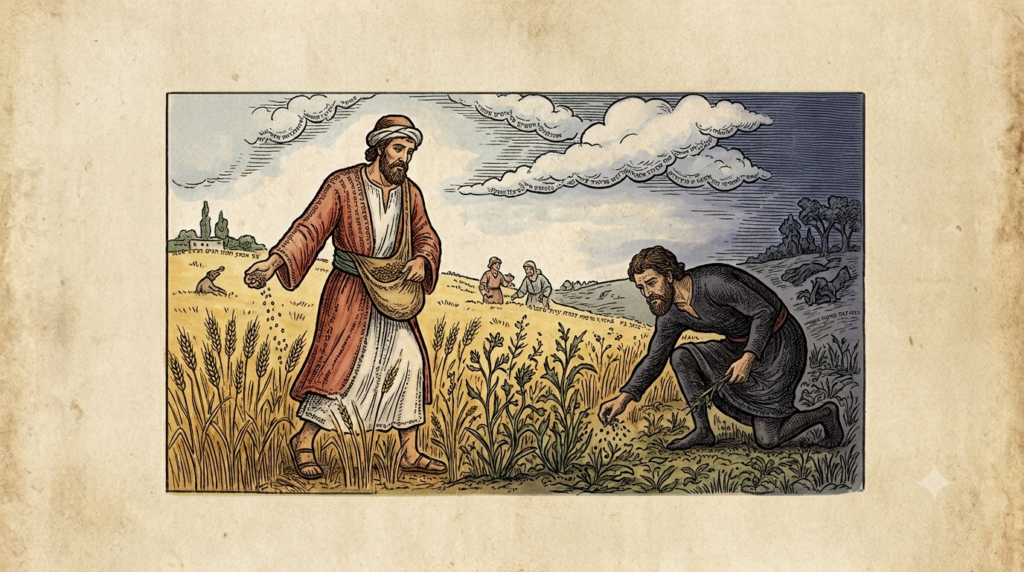
Jesus tells of a farmer who sows good seed in his field. But while everyone is sleeping, an enemy comes and sows weeds among the wheat. When the plants sprout, the servants notice the weeds mixed in with the wheat and ask the master if they should pull them up. The master wisely replies: “No, because while you are pulling the weeds, you may uproot the wheat with them. Let both grow together until the harvest. At that time I will tell the harvesters: First collect the weeds and tie them in bundles to be burned; then gather the wheat and bring it into my barn.” (Matthew 13:29–30)
The Meaning
Later, Jesus explains the parable to his disciples. The field is the world, the good seed represents the children of the kingdom, and the weeds are the children of the evil one. The enemy is the devil, the harvest is the end of the age, and the harvesters are angels. At the final judgment, the weeds will be separated from the wheat, the righteous will shine like the sun in God’s kingdom, while the wicked will face destruction.
Key Themes
1. The Coexistence of Good and Evil
The parable acknowledges a reality we all experience, that evil exists alongside good in our world. The kingdom of God is not yet fully realized, it grows in a field where the enemy has sown his own seeds. This doesn’t mean God is indifferent to evil, but that his timeline for dealing with it is different from ours.
2. Divine Patience
The master’s refusal to uproot the weeds immediately is an act of mercy and patience. Rushing to judgment could harm the wheat. In the same way, God’s delay in final judgment is not negligence, it is forbearance, giving time for repentance and for the wheat to fully mature. As the Apostle Peter later wrote, “The Lord is not slow in keeping his promise… Instead he is patient with you, not wanting anyone to perish, but everyone to come to repentance” (2 Peter 3:9).
3. Human Limitations in Judgment
The servants are eager to act, but the master knows they cannot reliably distinguish wheat from weeds, especially early on, when the two plants look remarkably similar. This is a humbling reminder that we are not equipped to be final judges of others. Our attempts to “purify” the church or the world by force often do more harm than good, uprooting the very people God is nurturing.
4. The Certainty of Final Judgment
While the parable emphasizes patience, it does not minimize justice. The harvest will come. There will be a clear separation, and the consequences are real. This dual emphasis, mercy now, justice later, shapes how Christians are called to live, that is with hope, but also with sober awareness that our choices matter eternally.
Application for Today
In an age of polarization and outrage, this parable calls us to a different posture. We are tempted to see ourselves as the servants, eager to identify and remove the “weeds” around us. But Jesus invites us to trust God’s timing and focus on our own growth in righteousness. We are called to be wheat, to bear fruit, to reflect God’s love, and to leave final sorting to the One who sees all things clearly.
At the same time, the parable is not a call to passivity in the face of injustice. Jesus elsewhere commands his followers to confront sin within the community (Matthew 18:15–17). The distinction is between discernment within the congregation and final judgment, which belongs to God alone.
Conclusion
The Parable of the Wheat and the Weeds is both a comfort and a challenge. It comforts us that evil will not have the last word. It challenges us to patience, humility, and faith in God’s perfect timing. In a world where good and evil are tangled together, we are invited to grow where we are planted, trusting that the harvester knows his own.