
Hebrew
In 1753 and 1754 the Paris booksellers Antoine-Claude Briasson and Laurent Durand issued four large folio volumes containing the whole Hebrew Bible, a new Latin translation, and the Greek books that the…
30 min read

Hebrew
In the Badische Landesbibliothek at Karlsruhe there is a Hebrew manuscript of the Prophets that has been known since the nineteenth century as the Codex Reuchlinianus, after the German humanist Johann Reuchlin,…
28 min read

Hebrew
The printed Hebrew Bible carries a dense system of small signs placed beneath, within and above its letters. These signs, which record the vowels and the musical accents of the text, are…
21 min read

Hebrew
For any reader transitioning from the extensive narrative prose of Genesis or Kings to the opening folios of the Psalter in a classical Tiberian Masoretic codex, the graphic landscape of the Hebrew…
47 min read

Hebrew
In the second-century days of Rabbi Yosi and his colleagues, so the Babylonian Talmud tells us, the sages of Yavneh wished to put the Book of Ecclesiastes into the canon and to…
29 min read

Hebrew
Every printed Hebrew Bible uses the Tiberian vowel points: dots and dashes set mostly beneath the letters, worked out by the Masoretes of Tiberias in the early Middle Ages. For several centuries…
22 min read

Hebrew
When Leah’s maid Zilpah bears Jacob a son, Leah names him Gad. The Hebrew text of Genesis 30:11 records her words in a way that puzzles every new reader of a Hebrew…
21 min read
Hebrew
The Aleppo Codex, in Hebrew Keter Aram Tsova, the Crown of Aleppo, was written, or more accurately completed, in the closing decades of the tenth century CE. The traditional scholarly window places…
21 min read
Hebrew
The text of the Hebrew Bible, as it now sits between the covers of a printed Mikraot Gedolot or a single-volume Hebrew Tanakh, looks deceptively clean. Page after page of square Aramaic…
23 min read
Hebrew
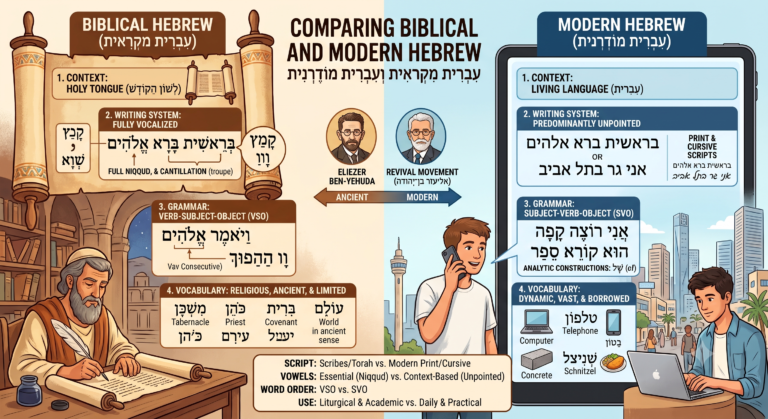
While a Modern Hebrew speaker can pick up a Isaiah scroll and decode a shocking amount of it, a feat an English speaker trying to read Beowulf could only dream of, they…
3 min read
Hebrew
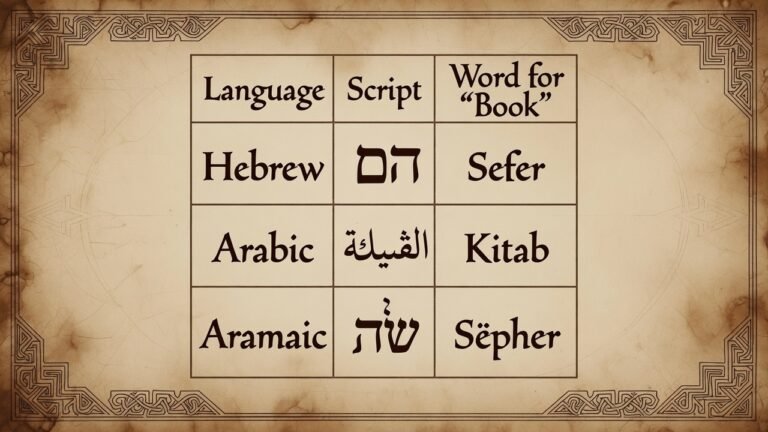
The trilateral (or triconsonantal) root system is the defining morphological feature of Semitic languages (Arabic, Hebrew, Aramaic/Syriac, Geʿez/Amharic/Ethiopian Semitic, and their ancient relatives like Akkadian, Ugaritic, and Phoenician). It is a classic…
4 min read
Hebrew
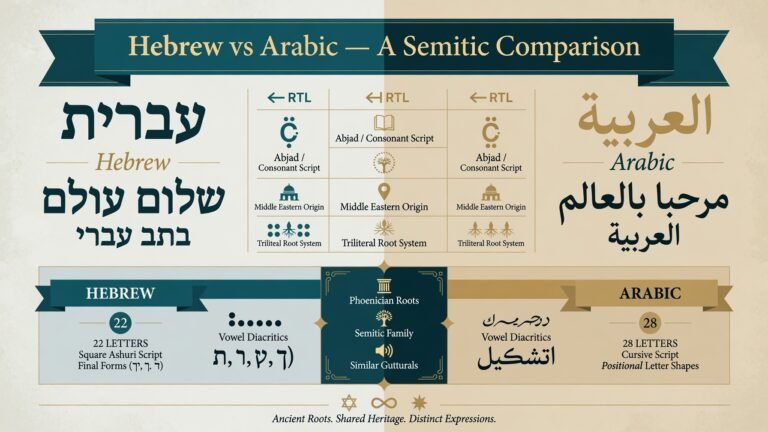
Arabic and Hebrew, two vibrant languages of the Middle East, stand as close relatives within the Semitic branch of the Afro-Asiatic language family. Emerging from a common Proto-Semitic ancestor thousands of years…
5 min read

Hebrew
The Hebrew Bible, as we encounter it today in printed editions, features a text rich with tiny dots, dashes, and marks surrounding the ancient letters. These are the niqqud (נִקּוּד, “pointing” or…
5 min read

Hebrew
Cantillation, known in Hebrew as ta’amim (tastes or reasons) or in Yiddish as trop, refers to the traditional melodic chanting of the Hebrew Bible in Jewish liturgy. These systems use a set…
4 min read

