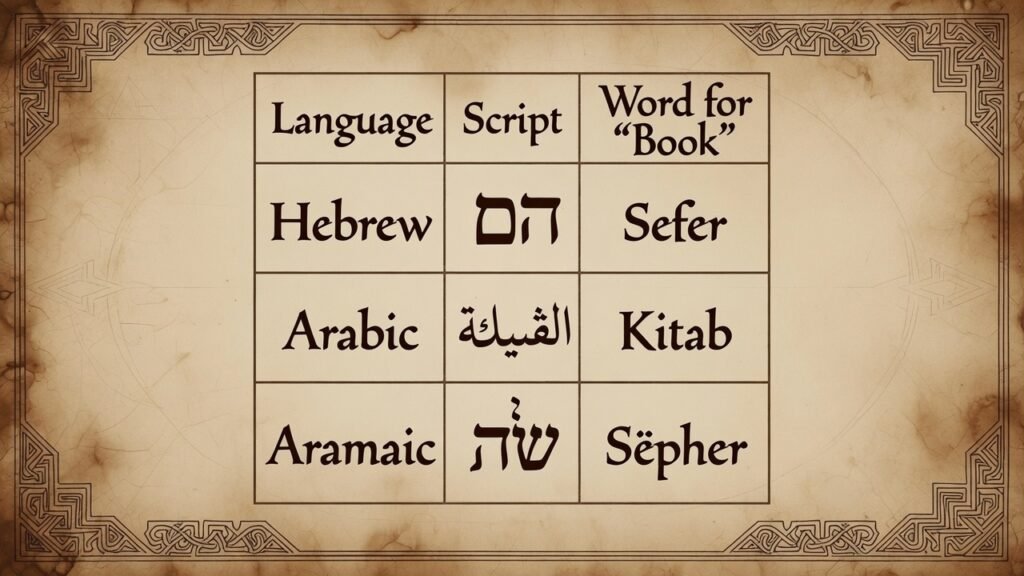
The trilateral (or triconsonantal) root system is the defining morphological feature of Semitic languages (Arabic, Hebrew, Aramaic/Syriac, Geʿez/Amharic/Ethiopian Semitic, and their ancient relatives like Akkadian, Ugaritic, and Phoenician). It is a classic example of non-concatenative or root-and-pattern (templatic) morphology, in stark contrast to the concatenative (prefix/suffix) systems dominant in Indo-European languages like English or Latin.
Core Mechanism: Root + Pattern
Most lexical words (verbs, nouns, adjectives, participles) derive from an abstract root consisting of three consonants (radicals), conventionally notated as C₁-C₂-C₃ or √C₁C₂C₃. The root carries the core semantic field but is not pronounceable by itself, it is a discontinuous skeleton.
A fixed pattern (Arabic wazn / awzān or Hebrew mishqal/binyan) supplies:
- Vowels (and sometimes length or gemination)
- Possible additional consonants (prefixes like m-, t-, infixes, or suffixes)
- The overall prosodic template (syllable structure)
The root consonants slot into the pattern in order, “filling the blanks.” This interleaving creates families of semantically related words from one root. The script (abjad) typically writes only consonants; vowels appear via diacritics (ḥarakāt in Arabic, niqqud in Hebrew) or are inferred from context.
Classic example: Root k-t-b (ك ت ب / כ ת ב) — core meaning “write” / “writing” / “something written”
Arabic derivations (using the root كتب):
- kataba كَتَبَ — “he wrote” (Form I, basic)
- kitāb كِتَاب — “book” / “scripture”
- kātib كَاتِب — “writer” / “scribe”
- maktab مَكْتَب — “desk” / “office”
- maktūb مَكْتُوب — “written” (thing) / “letter” / “destined”
- kutub كُتُب — “books” (plural)
- kataba in other forms yields “correspond,” “dictate,” “subscribe,” etc.
Hebrew (root כתב, with b/v allophony):
- katav כָּתַב — “he wrote”
- kotev כּוֹתֵב — “writer” (active participle)
- ktav כְּתָב — “writing” / “script” / “orthography”
- Related concepts often use other roots (e.g., sefer סֵפֶר “book” from s-p-r “count/recount”), but the system is parallel.
Another high-frequency shared root: s-l-m / sh-l-m (“wholeness,” “peace,” “safety,” “submission”)
- Arabic: salām سلام (peace/greeting), islām إسلام (submission/Islam), muslim مسلم (one who submits/Muslim), salima سَلِمَ (to be safe).
- Hebrew: shalom שלום (peace), shalem שלם (whole/complete), hishtalem השתלם (to complete/pay).
These illustrate semantic clustering: one root generates an entire conceptual network.
Verb Derivation Systems (The Most Productive Patterns)
Semitic languages use dedicated verbal stems/forms that systematically alter valency, aspect, voice, or Aktionsart (causative, intensive, reflexive, reciprocal, passive, etc.).
Arabic has ten primary “measures” or forms (I–X), traditionally modeled on the dummy root f-ʿ-l (“to do”). Each has characteristic patterns for perfect/imperfect, active/passive, and derived nouns (masdar, participles, nouns of place/instrument).
Typical functions (with k-t-b or general examples):
- Form I (faʿala): Basic, simple action (kataba — he wrote).
- Form II (faʿʿala): Intensive, causative, or denominative (kattaba — he made [someone] write / taught writing).
- Form III (fāʿala): Reciprocal or conative (kātaba — he corresponded with).
- Form IV (afʿala): Causative (aktaba — he dictated).
- Form V (tafaʿʿala): Reflexive of II (takattaba — he subscribed / registered himself).
- Form VI (tafāʿala): Reciprocal/reflexive of III.
- Form VII (infaʿala): Passive or middle of I (inkataba — it was written / he subscribed).
- Form VIII (iftaʿala): Reflexive with effort or middle (iktataba — he copied for himself).
- Form X (istafʿala): Seeking/requesting (istaktaba — he asked someone to write).
Forms IX and others are rarer (colors, defects, etc.). Not every root uses all forms; some are lexicalized.
Hebrew uses seven main binyanim (building patterns), with analogous functions (qal/paʿal = basic; piʿel = intensive/factitive; hifʿil = causative; hitpaʿel = reflexive/reciprocal; etc.).
Historical Development and Origins
The system is ancient and characteristic of Proto-Semitic (reconstructible to at least the late 4th millennium BCE). Many roots show clear cognates across branches:
- bayt- → Arabic bayt, Hebrew bayit (“house”)
- šalām- → Arabic salām, Hebrew shalom (“peace”)
- malik- → Arabic malik, Hebrew melekh (“king”)
- ʾil- → Arabic ilāh/Allāh, Hebrew El (“god/deity”)
Origin theories:
- Many scholars argue triradicals largely expanded from earlier biradical (two-consonant) roots via “extenders” (third consonants added for phonetic or semantic reasons).
- One influential view links the dominance of three consonants to adaptation to abjad writing (consonant skeletons only): three distinct consonants reduce homophony and aid readability when vowels are unwritten.
- Medieval grammarians (Arabic 8th century onward; Judah Ḥayyūj for Hebrew, 10th–11th century) formalized root theory.
Quadriliteral roots (four consonants) exist but are secondary: often reduplications (zilzāl “earthquake” from z-l-z-l), loans, or derived from triradicals. They use fewer verbal patterns.
Weak roots (containing w, y, or hamza/glottals) show phonological irregularities (assimilation, elision, compensatory lengthening) but still follow the system.
Linguistic Significance and Implications
- Economy and expressiveness: A small set of roots + productive patterns generates vast vocabulary with transparent semantic relations. New concepts (science, technology, politics) are readily coined by fitting roots into existing patterns, key to Modern Hebrew revival and Arabic adaptation to modernity.
- Semantic fields: Related ideas cluster (e.g., writing-related words from k-t-b). This aids etymology, lexicography (dictionaries often root-organized), and language learning.
- Comparative power: Shared roots and patterns allow reconstruction of Proto-Semitic and illuminate Afro-Asiatic relations (though other branches like Chadic or Cushitic show more biradicals or different systems).
- Challenges and nuances:
- Not every word derives from a triradical (particles, some pronouns, heavy borrowing).
- Some roots have multiple unrelated meanings (accidental homophony).
- Consonant co-occurrence restrictions exist (e.g., roots rarely combine consonants of similar articulation).
- Learners must internalize dozens of patterns and handle weak-verb irregularities.
- In living languages, colloquial dialects sometimes simplify or innovate beyond Classical patterns.
Modern Usage and Pedagogical Notes
In Modern Hebrew, the system was consciously leveraged during language revival (late 19th–20th century) for neologisms while preserving historical continuity. In Arabic, it supports both Classical study and contemporary technical terminology across 20+ countries. Aramaic/Syriac traditions and Ethiopian Semitic languages maintain it robustly.
For learners, resources emphasize mastering high-frequency roots (a few hundred cover much of the core lexicon) alongside the major patterns. Dictionaries (e.g., Hans Wehr for Arabic, or root-based Hebrew lexica) and tools that parse roots/patterns are invaluable.
In short, the trilateral root system is not merely a grammatical curiosity but a profound organizing principle that shapes how speakers of Semitic languages conceptualize, derive, and innovate meaning, linking sound, script, history, and cognition in a uniquely economical and interconnected way. It remains one of the most elegant and productive morphological systems known.