England in the late 14th century was a powder keg. Decimated by the Black Death and financially drained by the Hundred Years’ War, the populace was increasingly resentful of a wealthy, landed Catholic Church. Into this volatile environment stepped a movement that would lay the theological groundwork for the English Reformation over a century later: The Lollards.
Rather than relying on elite academic debates, the Lollards took their radical message directly to the towns and villages of England through an unprecedented, underground preaching campaign.
The Architect – John Wycliffe
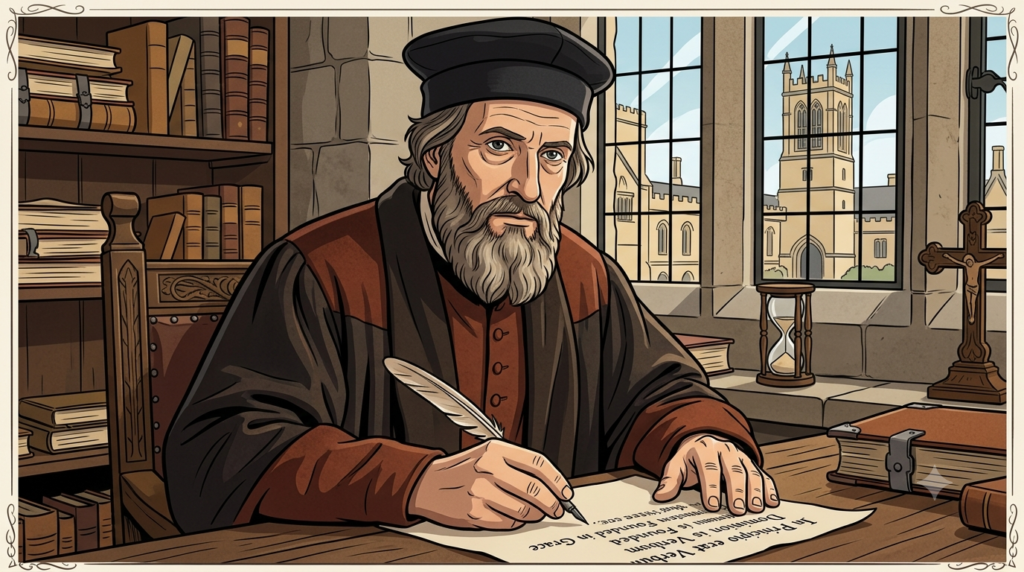
The intellectual engine behind the Lollard movement was John Wycliffe, a formidable theologian and philosopher at Oxford University. Wycliffe did not set out to create a peasant rebellion, his initial critiques were aimed squarely at the corruption and wealth of the clergy.
Wycliffe’s theology was deeply subversive to medieval Church authority. He argued three main points that fueled the preaching campaign:
- Dominion is Founded in Grace: Legitimate authority (both secular and religious) depends on the moral state of the person holding it. A corrupt priest or pope, therefore, had no true authority.
- Rejection of Transubstantiation: Wycliffe argued against the doctrine that the bread and wine of the Eucharist physically transformed into the body and blood of Christ, viewing it as unscriptural and a means for priests to claim supernatural power.
- The Supremacy of Scripture: He believed the Bible, not the Pope or Church tradition, was the ultimate authority, and crucially, that it should be accessible to all Christians in their native tongue.
The “Poor Priests” Hit the Road
To bypass the established Church hierarchy, Wycliffe and his early followers began sending out itinerant preachers, often referred to as “Poor Priests.”
Clad in simple, undyed russet robes and traveling barefoot, these men stood in stark contrast to the opulence of the higher clergy. They walked from village to village, setting up in town squares, churchyards, or private homes when local priests locked them out of the parish churches.
Their sermons were delivered entirely in Middle English. To a peasantry accustomed to hearing the Mass muttered in Latin, a language they did not understand, the directness of Lollard preaching was revelatory. They spoke of a personal relationship with God that didn’t require purchasing indulgences or paying tithes to enrich distant bishops.
The Threat of the Vernacular
The most dangerous weapon the Lollard preachers carried was the Wycliffe Bible. Translated from the Latin Vulgate into Middle English by Wycliffe’s circle, it was the first complete English translation of the Scriptures.
Because the printing press had not yet been invented, these Bibles were painstakingly copied by hand. The Lollard preachers would read directly from these manuscripts during their secret conventicles (gatherings). By putting the text into the hands of laypeople, the Lollards effectively stripped the Church of its monopoly on salvation and interpretation. If a peasant could read the words of Christ themselves, they could quickly see the disparity between the poverty of the Apostles and the wealth of the 14th-century Church.
The Crackdown: Milestones of Suppression
The ecclesiastical and secular authorities recognized the existential threat the Lollards posed. The state moved to brutally crush the campaign.
The Blackfriars Synod
1382
An earthquake interrupted this church council, which both sides claimed as a sign of divine favor. The synod officially condemned Wycliffe’s teachings, forcing many of his Oxford followers to recant or flee.
Death of John Wycliffe
1384
Wycliffe dies of a stroke in his parish at Lutterworth. Because he had not yet been formally excommunicated, he was buried in consecrated ground.
De haeretico comburendo
1401
Parliament passes a devastating statute (“On the Burning of Heretics”) specifically targeting Lollards. It legally authorized the burning of unrepentant heretics at the stake. William Sawtrey, a Lollard priest, became the first victim.
Arundel’s Constitutions
1407-1409
Archbishop Thomas Arundel bans the translation of the Bible into English and forbids preaching without a bishop’s license, directly outlawing the Lollards’ primary campaign.
The Oldcastle Revolt
1414
Sir John Oldcastle, a Lollard sympathizer and former friend of King Henry V, leads a failed rebellion. This forever associates Lollardy with treason, stripping the movement of its remaining aristocratic support and driving it entirely underground.
The Underground Legacy
Following the Oldcastle Revolt, the Lollard preaching campaign ceased to be a public movement. It fragmented into small, secretive networks of artisans, merchants, and lower-class workers reading illicit English manuscripts behind closed doors.
Yet, the campaign was never fully eradicated. When the ideas of Martin Luther began arriving at English ports in the 1520s, they found a population in regions like Kent, Sussex, and East Anglia already primed for religious reform. The Lollards’ illicit sermons and smuggled English Bibles had kept the embers of dissent burning for over a century, providing the kindling that would eventually ignite the English Reformation.