Introduction – The City That Refused to Die
There are cities that grow organically over centuries, their histories layered like sedimentary rock, each era visible in the architecture and street plans of the next. Then there are cities whose histories are violently interrupted, whose physical forms are erased and rewritten, whose memories must be excavated rather than simply observed. Warsaw belongs to the second category. The capital of Poland is a place of extraordinary beauty and unbearable tragedy, a city that has been destroyed and rebuilt so many times that resilience seems encoded in its very bricks. Yet beneath its reconstructed baroque facades and its bustling modern boulevards lies a history that remains partially obscured, not by time alone, but by the magnitude of two catastrophic events that have come to dominate its narrative: the Holocaust and the Warsaw Uprising of 1944.
These events were undeniably central to Warsaw’s twentieth century experience. The systematic murder of Polish Jewry by Nazi Germany and the heroic but doomed insurrection against the occupiers represent the defining traumas of the city’s modern history. However, the very enormity of these catastrophes has had an unintended consequence: it has tended to reduce Warsaw’s Jewish history to a story of annihilation, and to frame the 1944 Uprising as the singular moment of Polish resistance and suffering. In doing so, we risk losing sight of the vibrant, centuries long Jewish civilization that flourished in Warsaw before the war, a civilization that was not merely a passive victim of genocide but an active, creative force that shaped the city’s identity. We also risk allowing the 1944 Uprising to overshadow other forms of resistance, survival, and cultural continuity, including those within the Jewish community itself.
This essay seeks to explore the beauty and history of Warsaw while deliberately turning attention toward what has been obscured: the rich, complex Jewish history that predated the Holocaust, and the ways in which the dominant narratives of destruction have sometimes eclipsed the fullness of that heritage. It argues that to truly understand Warsaw, one must look beyond the ruins and the monuments to the vanished world they commemorate, and recognize that the city’s Jewish past was not merely a prelude to its destruction but an integral, dynamic chapter of its life.
The Phoenix City – Beauty Born from Ashes
Warsaw today is a city of striking contrasts and unexpected beauty. Visitors arriving for the first time might be struck by the wide, tree lined avenues of the city center, the elegant neoclassical architecture of the Royal Route, or the playful, colorful facades of the reconstructed Old Town, which earned a place on UNESCO’s World Heritage list not as an original medieval settlement but as a masterful act of postwar reconstruction. This is perhaps Warsaw’s most remarkable aesthetic quality, its beauty is often a beauty of restoration, of memory made concrete.
The Old Town, with its cobblestone streets, charming market square, and terracotta roofed houses, appears at first glance to be a perfectly preserved Renaissance and baroque quarter. Only upon closer inspection does one notice the subtle signs of its twentieth century origins, the slightly too regular stonework, the historical details reconstructed from eighteenth century paintings by Giovanni Canaletto, the very fact that buildings which appear ancient were actually built between 1945 and 1962. The original Old Town was razed to the ground by the Nazis in 1944 in retaliation for the Warsaw Uprising, leaving behind what one witness described as “a sea of ruins.” Its reconstruction was not merely an architectural project but an act of national defiance, a declaration that Polish culture could not be extinguished by brute force.
This theme of resurrection pervades Warsaw’s urban landscape. The Royal Castle, which dominates Castle Square at the entrance to the Old Town, was similarly obliterated during the war and meticulously rebuilt in the 1970s and 1980s. Its interiors, restored to their eighteenth century splendor, house one of Poland’s finest collections of art and historical artifacts. The Łazienki Park, with its palaces, amphitheater, and famous Chopin monument, offers a vision of aristocratic Poland that survived the war relatively intact, providing a rare glimpse of the city’s prewar elegance. Yet even here, the shadow of destruction lingers, many of the park’s sculptures and decorative elements are careful reproductions of originals looted or destroyed by the occupiers.
Beyond these reconstructed historical centers, Warsaw possesses a vibrant contemporary energy. The Vistula River embankment has been transformed into a lively public space, with beaches, bars, and cultural venues drawing crowds during the summer months. The city’s modern skyline, dominated by the ghastly and hideous Palace of Culture and Science, a controversial gift from Stalin that remains the tallest building in Poland, testifies to the communist era and its complex legacy. Neighborhoods like Praga, on the eastern bank of the Vistula, have emerged from post industrial decline to become centers of alternative culture, street art, and nightlife. Praga’s gritty charm, with its prewar tenement houses and Orthodox churches, offers a more authentic, less polished vision of Warsaw than the reconstructed Old Town.
Yet for all its contemporary dynamism, Warsaw remains a city haunted by absence. Nowhere is this more evident than in the former Jewish district, which once constituted the vibrant heart of Jewish life not only in Poland but in all of Europe.
The Vanished World – Jewish Warsaw Before the Holocaust
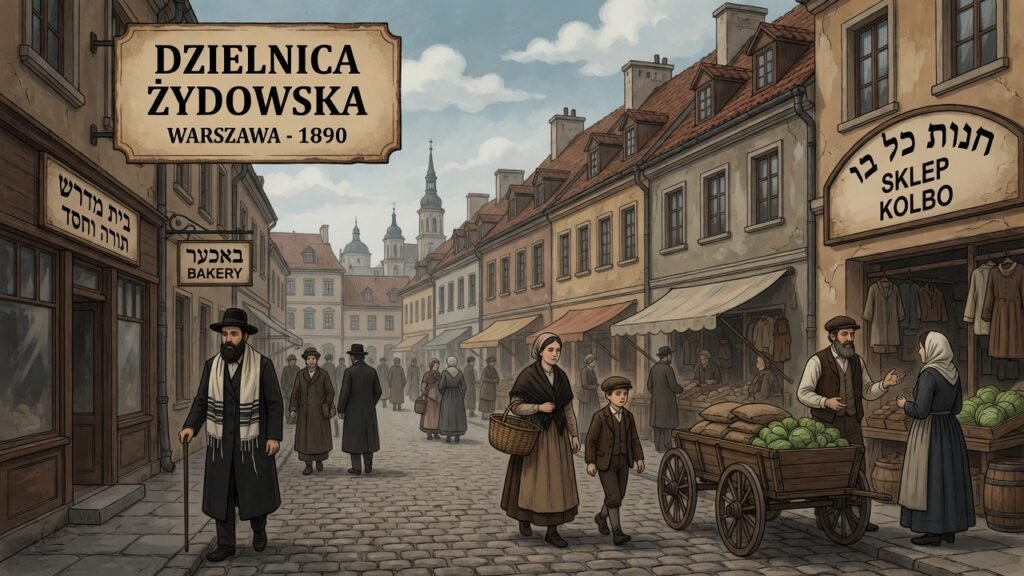
To understand what was lost, one must first imagine what existed. On the eve of the Second World War, Warsaw was home to approximately 375,000 Jews, roughly 30 percent of the city’s population. This made Warsaw the second largest Jewish city in the world, after New York. The Jewish community was not a ghettoized minority living on the margins of Polish society; it was an integral, if complex, part of the city’s social, economic, and cultural fabric.
The Jewish district, centered around Nalewki Street and the area that would later become the Warsaw Ghetto, was a bustling urban neighborhood characterized by dense tenement housing, small shops, workshops, and marketplaces. It was a world of extraordinary diversity. Here, wealthy Jewish merchants and professionals lived alongside impoverished workers; Hasidic rebbes maintained their courts alongside secular Jewish intellectuals who frequented cafes and debated politics, literature, and philosophy. Yiddish and Hebrew newspapers flourished, with Warsaw serving as a major center of Yiddish publishing. The city was home to Jewish theaters, libraries, schools, hospitals, and charitable institutions. It was the birthplace of important Jewish political movements, from Zionism to the Bund, the secular Jewish socialist party that advocated for Jewish cultural autonomy within a socialist Poland.
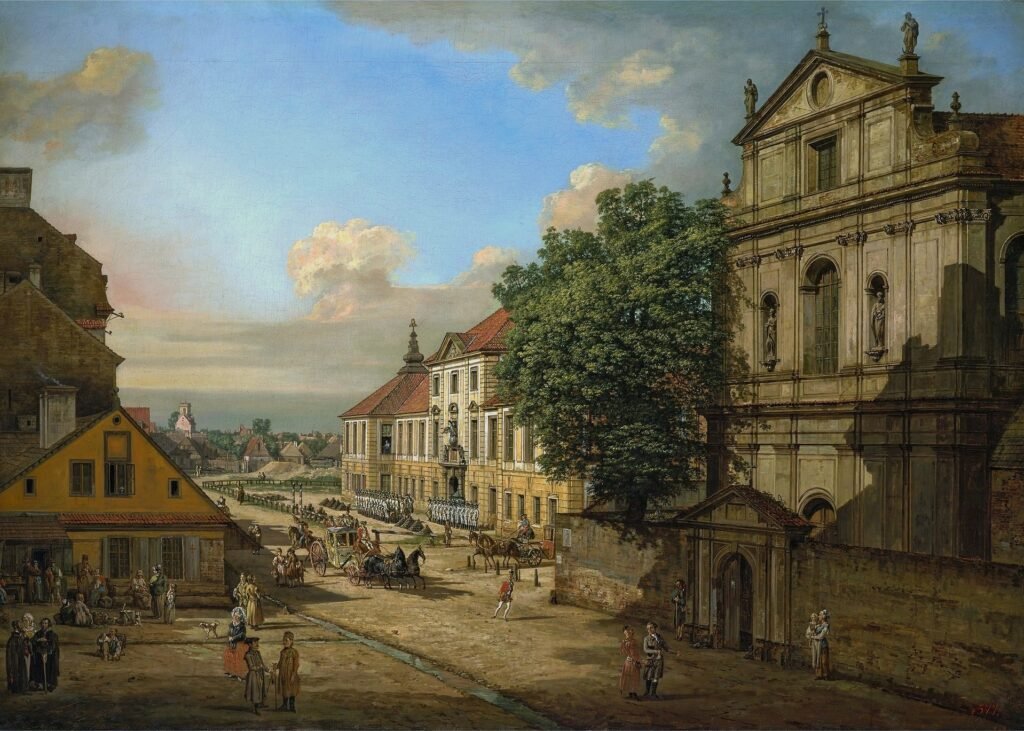
Nalewski Street in Warsaw in the 18th century by Canaletto
This was a civilization in the fullest sense of the word, not a relic of the past but a dynamic, modern culture engaged with the great questions of its age. Warsaw’s Jews were doctors and lawyers, factory workers and artisans, poets and politicians. They contributed to Polish literature and science while simultaneously maintaining a rich internal cultural life in Yiddish and Hebrew. The Great Synagogue on Tłomackie Street, inaugurated in 1878, was one of the largest Jewish houses of worship in the world, a magnificent symbol of Jewish integration and aspiration. The Jewish Historical Institute, founded in the interwar period, was already amassing an invaluable archive of Jewish history and culture.
The relationship between Jews and Poles in Warsaw was, of course, not without tension. Anti Semitism existed in various forms, from economic resentment to political exclusion to occasional violence. The Jewish community faced discrimination in universities and certain professions. Yet it would be a gross oversimplification to characterize prewar Polish Jewish relations as uniformly hostile. Daily life in Warsaw involved countless interactions, commercial, professional, and even neighbourly between Jews and Poles. Many Jews identified strongly as Poles of Jewish faith or background, participating in Polish cultural and political life. The boundaries between the communities were permeable, particularly among the educated and urbanized populations.
This complex, multifaceted Jewish civilization was not merely a background feature of Warsaw’s history; it was central to the city’s identity. Jewish entrepreneurs helped build Warsaw’s industrial economy. Jewish workers were crucial to its labor movement. Jewish artists and intellectuals contributed to its cultural prestige. To walk through prewar Warsaw was to encounter Jewish life at every turn, in the Yiddish theater posters, the Hebrew bookshops, the synagogues and study houses, the political rallies and union meetings.
All of this was obliterated in the space of a few years.
The Holocaust and the Obscuring of Jewish History
The German invasion of Poland in September 1939 marked the beginning of the end for Jewish Warsaw. The Nazi occupation brought immediate persecution: random executions, forced labor, confiscation of property, and the requirement that Jews wear identifying armbands. In October 1940, the Germans established the Warsaw Ghetto, sealing approximately 400,000 Jews within a walled enclosure covering just 2.4 percent of the city’s area. Conditions in the ghetto were catastrophic. Overcrowding, starvation, disease, and brutality killed tens of thousands before the deportations to Treblinka even began.
The liquidation of the ghetto in the summer of 1942, when approximately 265,000 Jews were deported to the death camp at Treblinka, represented one of the most efficient single operations of the Holocaust. The remaining Jews launched the Warsaw Ghetto Uprising in April 1943, a heroic but ultimately doomed act of resistance that ended with the systematic burning and demolition of the ghetto. By the time the Soviet army entered Warsaw in January 1945, the city’s Jewish population had been reduced from hundreds of thousands to a few hundred survivors.
The physical destruction was total. The Great Synagogue was blown up by the SS on May 16, 1943, as a symbolic celebration of the ghetto’s liquidation. Residential buildings, institutions, and places of worship were systematically razed. After the war, the communist authorities largely cleared the rubble of the ghetto, replacing it with new housing developments, broad avenues, and monumental architecture that bore no trace of the Jewish neighborhood that had once stood there. Muranów, the heart of the prewar Jewish district, became a socialist realist housing estate. Nalewki Street, the bustling commercial artery of Jewish Warsaw, ceased to exist, its path obliterated by new construction.
This physical erasure was compounded by a narrative erasure that persisted for decades. Under communist rule, the Holocaust was largely subsumed within a universalized narrative of Polish martyrdom and anti fascist struggle. The specific Jewish identity of the victims was often downplayed or ignored. The Warsaw Ghetto Uprising, one of the most significant acts of Jewish resistance during the Holocaust, was commemorated, but frequently as part of a broader narrative of Polish resistance rather than as a specifically Jewish event. The monument to the Ghetto Heroes, unveiled in 1948, became a site of official state ceremonies, but genuine engagement with the Jewish character of the tragedy remained limited.
The dominant narrative of Warsaw’s wartime experience became the 1944 Warsaw Uprising, a Polish nationalist insurrection against the German occupiers that began on August 1, 1944, and lasted for 63 days. This uprising, while unquestionably heroic, ended in catastrophic defeat. The Germans systematically destroyed the city in retaliation, reducing what remained of Warsaw to rubble. The Red Army, stationed on the eastern bank of the Vistula, watched passively as the Polish resistance was crushed. The human cost was staggering: approximately 150,000 to 200,000 Polish civilians killed, the vast majority of the city’s population expelled, and the systematic demolition of the remaining infrastructure.
The 1944 Uprising became, and remains, the central trauma of modern Polish history, a symbol of national sacrifice, Western betrayal, and the indomitable Polish spirit. Its commemoration is deeply embedded in Polish national identity, with annual ceremonies, museums, films, and literature ensuring its place in collective memory. The Warsaw Uprising Museum, opened in 2004, is one of the most visited museums in Poland, a state of the art institution that immerses visitors in the experience of the insurgents.
Yet the very centrality of the 1944 Uprising in Polish memory has had the effect of marginalizing other wartime experiences, including those of Warsaw’s Jews. The two uprisings, the Jewish Ghetto Uprising of 1943 and the Polish Warsaw Uprising of 1944, are sometimes conflated or confused in public consciousness, both within Poland and abroad. More significantly, the narrative of Polish national suffering embodied by the 1944 Uprising has sometimes competed with, rather than complemented, the memory of Jewish genocide. In the communist era, this competition was institutionalized, with the state promoting Polish martyrdom while suppressing the distinctiveness of Jewish victimhood.
Even after the fall of communism, the process of recovering Jewish memory has been slow and contested. While Poland has made remarkable strides in acknowledging its Jewish heritage, synagogues have been restored, Jewish festivals established, museums opened, the shadow of the Holocaust continues to dominate perceptions of Jewish history. Visitors to Warsaw often seek out the remnants of the ghetto, the monuments to its victims, the sites of deportation. These are essential acts of remembrance. But they risk reducing three centuries of Jewish civilization to its final, tragic chapter. The story of Jewish Warsaw becomes a story of walls, starvation, deportation, and death, a narrative that, while historically accurate in its particulars, obscures the vitality, diversity, and creativity of the world that existed before the destruction.
The 1944 Uprising – Heroism and Its Shadows
The Warsaw Uprising of 1944 deserves its place in history as one of the most dramatic and tragic episodes of the Second World War. The decision to rise against the Germans as the Red Army approached Warsaw was driven by a complex mix of motivations: the desire to liberate the capital before Soviet forces arrived, to demonstrate Polish sovereignty, and to resist the occupiers in the face of imminent liberation. The insurgents, soldiers of the Home Army and ordinary citizens, fought with extraordinary courage against overwhelming odds. The battle for Warsaw was brutal, with house to house fighting, the use of human shields by the Germans, and the systematic destruction of entire neighborhoods.
The human cost was immense. Beyond the military casualties, the civilian population suffered terribly. The Germans massacred tens of thousands of civilians in organized executions. The surviving population was expelled from the city, many sent to concentration camps or forced labor. Hitler ordered that Warsaw be completely destroyed, and German engineers methodically dynamited what remained of the city’s buildings, libraries, churches, and monuments. By the time the Soviet army finally entered the ruined city in January 1945, Warsaw was a wasteland.
The trauma of the 1944 Uprising became foundational to postwar Polish identity. It embodied the narrative of Polish victimhood at the hands of both German brutality and Soviet cynicism, of Western betrayal at Yalta and Tehran, and of national sacrifice in the cause of freedom. This narrative served important functions in communist Poland, providing a focus for patriotic sentiment that was not directly challenging to the Soviet backed regime, and in post communist Poland, it became a cornerstone of national identity and historical memory.
However, the dominance of this narrative has created certain blind spots. The 1944 Uprising has sometimes been presented as the definitive experience of wartime Warsaw, overshadowing the earlier destruction of the Jewish ghetto and the distinct nature of Jewish suffering. The fact that the 1944 Uprising occurred after the liquidation of the ghetto, and that the Home Army’s record regarding Jews was mixed at best, complicates any simple narrative of unified Polish resistance. Some units of the Polish underground helped Jews, but others were indifferent or hostile. The 1944 Uprising itself was fought in a city from which the Jewish population had already been eliminated, a city that, in a sense, had already experienced its most catastrophic loss.
Moreover, the commemoration of the 1944 Uprising has sometimes been accompanied by a nationalist narrative that emphasizes ethnic Polish suffering to the exclusion of others. The Museum of the Warsaw Uprising, while an impressive institution, focuses overwhelmingly on the Polish experience. The Jewish ghetto, which had occupied a significant portion of the city just a year earlier, appears in the museum’s narrative largely as a prelude to the Polish uprising rather than as a distinct tragedy requiring its own extensive treatment.
This is not to diminish the significance of the 1944 Uprising or the suffering it entailed. Rather, it is to suggest that the elevation of this event to the status of supreme national trauma has had the effect of structuring memory in ways that marginalize other experiences. The visitor to Warsaw is far more likely to encounter the story of the 1944 Uprising than to learn about the daily life of prewar Jewish Warsaw, the richness of Yiddish culture, or the complexities of Polish Jewish relations before the war. The Holocaust, when it is addressed, is often framed as a German crime committed against both Poles and Jews, a formulation that, while not entirely false, elides the specific racial ideology that targeted Jews for total extermination.
Recovering the Obscured – Toward a Fuller Memory
In recent decades, significant efforts have been made to recover and commemorate Warsaw’s Jewish heritage. The POLIN Museum of the History of Polish Jews, opened in 2013 on the site of the former Warsaw Ghetto, represents a landmark achievement in this regard. Unlike traditional Holocaust museums, POLIN begins its narrative not with destruction but with creation, the thousand year history of Jewish life in Poland. Its core exhibition traces the development of Jewish civilization from the medieval period through the early modern era, the partitions of Poland, and the vibrant interwar period, before turning to the Holocaust and the postwar period.
The museum’s approach is deliberately designed to counter the tendency to reduce Jewish history to the Holocaust. By dedicating the majority of its exhibition space to the centuries of Jewish life before the war, POLIN insists on the fullness and complexity of that history. Visitors encounter not only the suffering of the ghetto but the creativity of Yiddish literature, the intensity of Jewish religious life, the debates between Zionists and Bundists, the everyday interactions between Jews and Poles in the streets of prewar Warsaw. The museum’s architecture, a glass structure whose undulating form suggests the parting of the Red Sea, symbolizes both rupture and continuity.
Other initiatives have sought to mark the Jewish presence in Warsaw’s urban fabric. The Path of Remembrance, a walking route through the former ghetto, connects sites of historical significance with plaques, monuments, and installations. The Jewish Cemetery on Okopowa Street, one of the largest Jewish cemeteries in Europe, contains the graves of prominent writers, artists, and political figures, offering a tangible connection to the prewar community. The Nożyk Synagogue, the only synagogue in Warsaw to survive the war, has been restored and serves as a center for the small but active contemporary Jewish community.
Yet these efforts remain, in a sense, acts of recovery against the grain. The physical landscape of Warsaw offers few organic traces of its Jewish past. Unlike Kraków, where the old Jewish quarter of Kazimierz retains much of its prewar character, Warsaw’s Jewish district was completely obliterated and rebuilt. The visitor must actively seek out Jewish history; it does not present itself spontaneously in the urban environment. The streets where Yiddish was once the dominant language are now indistinguishable from any other part of the city. The shops, theaters, and schools are gone, replaced by postwar construction that reflects socialist planning rather than the dense, chaotic vitality of the prewar neighborhood.
This physical absence creates a particular kind of haunting. Warsaw is a city of ghosts, but the Jewish ghosts are especially insistent because their world was so thoroughly erased. The monuments and museums serve as memorials, but they also mark the sites of absence. The Monument to the Ghetto Heroes stands on a plaza surrounded by postwar buildings; the space around it feels empty, as if the city has been unable to reclaim it for ordinary life. The Umschlagplatz monument, marking the site from which Jews were deported to Treblinka, is a place of almost unbearable sadness, its stark white walls inscribed with the names of victims.
The challenge for Warsaw, and for those who seek to understand it, is to hold these multiple narratives in tension, the story of the 1944 Uprising and the story of the ghetto, the narrative of Polish national suffering and the narrative of Jewish genocide, the commemoration of heroism and the acknowledgment of complicity and indifference. It is to recognize that the beauty of reconstructed Warsaw is inseparable from the violence that necessitated its reconstruction, and that this violence took different forms and had different meanings for different communities.
Conclusion – Memory, Identity, and the Future
Warsaw today is a city that has achieved a remarkable recovery from the catastrophes of the twentieth century. It is a thriving European capital, a center of business, culture, and politics. Its reconstructed Old Town draws millions of tourists. Its contemporary art scene, music festivals, and culinary culture place it firmly within the mainstream of European urban life. The trauma of the war, while still present in monuments and commemorations, no longer defines daily existence for most Varsovians.
Yet the question of memory remains urgent. How does a city remember what has been destroyed? How does it honor the dead without reducing their lives to their deaths? How does it acknowledge the specificity of different communities’ suffering without creating hierarchies of victimhood?
For Warsaw, these questions are particularly acute because the destruction was so total and the postwar erasure so comprehensive. The Jewish world of Nalewki Street exists now only in photographs, memoirs, and the memories of a dwindling number of survivors. The ghetto has been replaced by a cityscape that bears no resemblance to what came before. The 1944 Uprising, while commemorated with great solemnity, occurred in a city that had already been transformed by the elimination of its Jewish population.
To truly know Warsaw, one must look beyond its reconstructed beauty to the absences that structure its spaces. One must walk the Path of Remembrance not only to mourn the dead but to imagine the living, to picture the Yiddish theaters and Hebrew schools, the political debates and religious observances, the ordinary lives of people who woke up each morning not knowing they were living in a world on the verge of extinction. One must visit the Warsaw Uprising Museum while remaining aware that the city whose resistance it commemorates was already a different city than the one that had existed before the ghetto’s liquidation.
The obscuring of Jewish history by the Holocaust and the 1944 Uprising is not the result of any single conscious decision but of the overwhelming nature of these events, the politics of communist memory, and the difficulty of maintaining awareness of a world that no longer has physical presence. Yet it is an obscuring that impoverishes our understanding of Warsaw and of the European civilization that was destroyed in the war.
Warsaw is a phoenix city, risen repeatedly from its ashes. But a phoenix, in rising, does not forget what it was before the fire. The challenge for Warsaw, and for all of us who engage with its history is to ensure that the fire, however devastating, does not become the entirety of the story. The beauty of Warsaw lies not only in its reconstruction but in the memory of what was lost, and in the ongoing effort to honor that memory in its fullness and complexity. To walk through Warsaw is to walk through layers of history, some visible, some buried, some crying out for recognition. It is to encounter a city that has been destroyed and rebuilt, that has suffered and endured, that has forgotten and remembered. It is, ultimately, to confront the fragility and resilience of human civilization itself.
In the end, Warsaw teaches us that memory is not passive but active, not fixed but contested, not singular but multiple. The city’s Jewish history, obscured but not erased, demands to be recovered not as a footnote to Polish history but as an integral part of it. The 1944 Uprising, monumental in its significance, must be understood in the context of a city that had already experienced an earlier, different catastrophe. Only by holding these narratives together, by seeing Warsaw as a place of overlapping histories, conflicting memories, and ongoing struggles for meaning, can we begin to do justice to its beauty, its tragedy, and its enduring importance.
The ghosts of Jewish Warsaw still walk the streets, invisible but insistent. They speak in Yiddish and Hebrew, in Polish and German, in the languages of the dead and the living. To listen to them is to hear not only the story of destruction but the story of creation, the thousand years of Jewish life in Poland that preceded the Holocaust, the cultural and intellectual achievements of a community that was not merely a victim but a vital force in European civilization. It is to understand that Warsaw’s beauty is inseparable from its losses, and that its future depends on its willingness to remember, in all its complexity, the world that was and the world that might have been.
In the quiet of the Jewish Cemetery, among the weathered stones and overgrown paths, one can still sense the presence of that world. The names carved in Hebrew and Polish, the symbols of professions and passions, the dates that end in the 1930s or 1940s, all of these speak of lives lived in fullness, cut short not by the natural course of history but by an eruption of violence that defies human comprehension. To visit this cemetery is to engage in an act of imagination, to populate the empty streets with the people who once walked them, to hear the Yiddish theater and the synagogue choirs, to taste the foods and smell the markets of a world that is no more.
Warsaw, the phoenix city, continues to rise. But it rises most truly when it carries with it the memory of all its pasts, not only the grandeur of the Polish kings and the heroism of the 1944 insurgents, but the vibrant, contentious, creative world of Jewish Warsaw that flourished for centuries before the darkness fell. To obscure this history, even unintentionally, is to diminish the city itself. To recover it is to enrich not only Warsaw’s understanding of itself but our collective understanding of what European civilization was, what it lost, and what it might yet become.
The beauty of Warsaw is thus a complex, bittersweet beauty, a beauty of resilience and restoration, but also of absence and longing. It is a beauty that demands engagement, imagination, and the willingness to confront uncomfortable truths. In this engagement lies the hope that the city, and all who encounter it, will continue to learn from its past and to honor, in all their fullness, the many voices that have shaped its history.