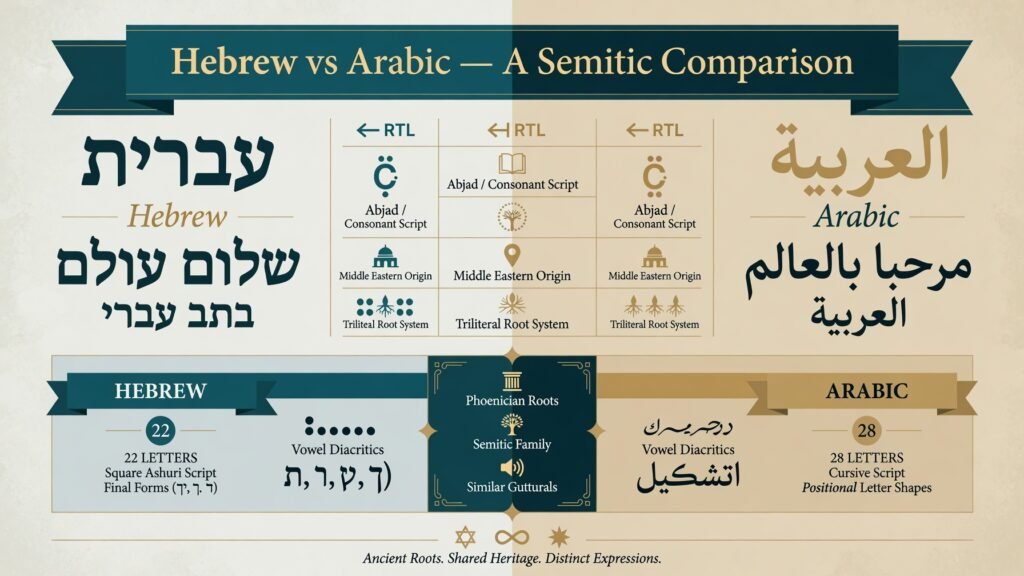
The Linguistic Kinship of Arabic and Hebrew: Shared Roots and the Masoretic Legacy
Arabic and Hebrew, two vibrant languages of the Middle East, stand as close relatives within the Semitic branch of the Afro-Asiatic language family. Emerging from a common Proto-Semitic ancestor thousands of years ago, they exhibit profound structural, phonetic, and lexical similarities that have fascinated linguists, historians, and scholars of religion for centuries. These parallels are not merely academic curiosities; they illuminate cultural exchanges, particularly during the Masoretic period (roughly 6th–10th centuries CE), when Jewish scholars, working under Islamic rule, vocalized and standardized the Hebrew Bible while drawing on Arabic linguistic traditions.
This blog post explores these similarities and their interplay in the Masoretic era, highlighting how shared Semitic heritage facilitated scholarly innovation amid historical upheaval.
Deep Structural Similarities: Roots, Grammar, and Phonetics
At the heart of both languages lies the triconsonantal (or triliteral) root system, a hallmark of Semitic morphology. Words derive from a core of three (sometimes four) consonants that carry a basic semantic meaning. Vowels, prefixes, suffixes, and patterns then modify this root to express nuances like tense, voice, number, or derivation.
- Classic Example: The Root K-T-B (Writing)
- Hebrew: כָּתַב (katav, “he wrote”), כְּתוּבָה (ketubah, “marriage contract” or written document), כּוֹתֵב (kotev, “writer”).
- Arabic: كَتَبَ (kataba, “he wrote”), كِتَاب (kitāb, “book”), كَاتِب (kātib, “writer”).
This system enables remarkable productivity and lexical overlap. Cognates abound for everyday concepts: “peace” (Hebrew shalom / Arabic salām), “king” (melekh / malik), “house” (bayit / bayt), “son” (ben / ibn), and “name” (shem / ism). Estimates suggest lexical similarity around 50–60% for basic vocabulary.
Phonology reveals further kinship, especially in guttural sounds produced in the throat—rare in many language families but central to both: Hebrew ע (ʿayin) and Arabic ع (ʿayn); ח (chet) and خ or ح. Both are abjads (consonantal scripts written right-to-left), where short vowels are typically omitted in everyday writing and supplied by diacritics (Hebrew niqqud, Arabic harakat) when precision is needed, such as in sacred texts.
Grammar shares features like:
- Gender (masculine/feminine) and number (singular, dual in Arabic, plural) marking on nouns and verbs.
- Complex verb conjugations reflecting person, tense/aspect, mood, and voice.
- Definite articles (Hebrew ha-, Arabic al-).
Differences exist, Arabic retains more Proto-Semitic sounds and has a richer case system in its classical form, while Hebrew evolved distinct paths under Canaanite influences, but the family resemblance is unmistakable. An Arabic speaker can often intuit Hebrew roots, and vice versa, especially in religious or literary contexts.
The Masoretic Period: Standardization Amid Cultural Exchange
The Masoretes (“Masters of Tradition”) were Jewish scholars, primarily in Tiberias (Palestine) and Babylonia, who between the 6th and 10th centuries CE developed systems of vowel points, cantillation marks (for chanting), and marginal notes (masorah) to preserve the accurate reading and transmission of the consonantal Hebrew Bible text. This effort culminated in the authoritative Masoretic Text (e.g., the Aleppo Codex and Leningrad Codex), which underpins most modern Hebrew Bibles.
This period coincided with the rise and expansion of Islam (7th century onward). Jewish communities in the Levant, Iraq, and North Africa lived under Muslim rule, where Arabic became the lingua franca of administration, scholarship, philosophy, and daily life for many Jews (often called Judaeo-Arabic when written in Hebrew script). This environment profoundly shaped Masoretic and related activities.
Key connections include:
- Karaite Innovations and Arabic Script Transcriptions: Karaite Jews (who emphasized scriptural literalism over rabbinic tradition) played a significant role in Masoretic transmission. In the 10th–11th centuries, they produced Hebrew Bible manuscripts transcribed into Arabic script, complete with Tiberian vocalization signs. These “Karaite transcriptions” modeled Quranic manuscripts in layout, using Arabic orthographic conventions (e.g., more matres lectionis for vowels) to better align the written form with the oral reading tradition. This reflected a convergence of Jewish and Islamic scribal practices, aiding precise preservation in an Arabic-dominant world.
- Grammatical Scholarship and Arabic Models: Hebrew grammar as a systematic discipline emerged in this era, heavily influenced by Arabic grammatical traditions (e.g., the Basran school). Pioneers like Saadia Gaon (882–942 CE), a Babylonian Gaon and polymath, wrote the earliest Hebrew grammars and lexicons (Agron, etc.) in Arabic or Judaeo-Arabic, comparing Hebrew roots to Arabic cognates for clarification. Saadia’s Arabic translation of the Pentateuch (Tafsir) adapted Islamic exegetical terms while defending Jewish interpretations, blending languages seamlessly. Later Karaite grammarians like Abū Yaʿqūb Yūsuf ibn Nūḥ and Abū al-Faraj Hārūn further systematized morphology and syntax, drawing on Masoretic notes and Arabic models. Treatises like Hidāyat al-Qāriʾ (“Guide for the Reader”) blended Masoretic vocalization with grammatical rules.
- Broader Intellectual Cross-Pollination: Jewish scholars engaged Arabic philosophy, poetry (maqama genre influencing Hebrew literature), and linguistics. The Masoretes’ meticulous counting of letters, words, and verses echoed a precision also valued in Quranic preservation. Arabic provided a living model for analyzing a sacred language, helping standardize Hebrew pronunciation amid dialectal shifts and diaspora.
The Masoretic vocalization system itself may show subtle Arabic influences in some signs or approaches, though its core was indigenous. Overall, Arabic served as a bridge: enabling Jews to articulate Hebrew scholarship in a shared intellectual milieu while reinforcing Jewish distinctiveness.
Historical Context and Implications
The Masoretic period was one of resilience. After the Babylonian Exile and Roman destructions, Hebrew was primarily liturgical and scholarly; Aramaic and later Arabic were vernaculars. By vocalizing the text, the Masoretes “froze” its reading for eternity, countering potential corruption. Arabic speaking Jewish elites, fluent in both, leveraged similarities to deepen exegesis e.g., using Arabic cognates to elucidate rare Hebrew words.
Nuances and Edge Cases:
- Not all Masoretes were Karaites; the ben Asher family (central to the Tiberian tradition) likely followed rabbinic Judaism.
- Influences were bidirectional but asymmetrical, Hebrew scholarship adapted Arabic tools more than vice versa.
- Regional variations existed (Tiberian vs. Babylonian systems), and transcriptions sometimes mixed scripts or vowel usages.
- Modern implications: These parallels aid language learners today and inform comparative Semitics, biblical textual criticism (e.g., via Dead Sea Scrolls), and interfaith dialogue.
Why It Matters Today
In an era of renewed interest in Semitic roots, whether for biblical study, linguistics, or cultural understanding, the Arabic-Hebrew connection underscores shared Abrahamic heritage. The Masoretes’ work, enriched by Arabic scholarship, ensures the Hebrew Bible’s fidelity across millennia. Exploring these languages reveals not just linguistic mechanics but living threads of history, resilience, and intellectual exchange.
Whether you’re a student of Torah, Quran, or linguistics, the next time you encounter a guttural “ʿayin” or a familiar root like S-L-M (peace), remember: these are echoes of an ancient family tree, carefully tended in the Masoretic gardens.
Further Reading: Geoffrey Khan’s works on Karaite transcriptions; Saadia Gaon’s Tafsir; comparative Semitic studies. Sources drawn from linguistic analyses and historical scholarship.