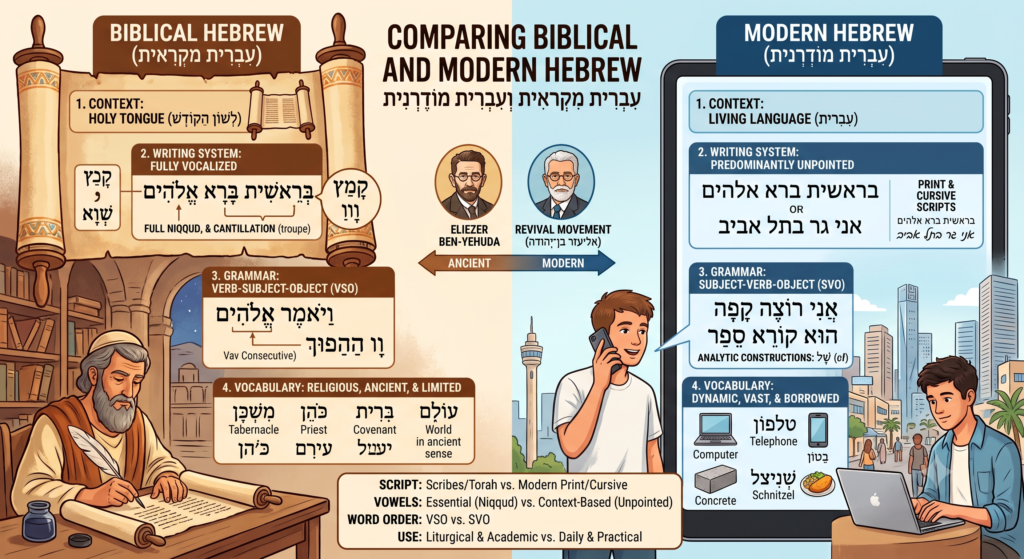
While a Modern Hebrew speaker can pick up a Isaiah scroll and decode a shocking amount of it, a feat an English speaker trying to read Beowulf could only dream of, they would still find the experience deeply alien.
When Hebrew was revived as a spoken language in the late 19th and early 20th centuries, linguists didn’t just copy the Bible. They took the ancient vocabulary, streamlined the grammar to fit modern brains, and blended it with the layout of European languages.
The evolutionary gap between Biblical Hebrew (BH) and Modern Israeli Hebrew (MH) comes down to three major shifts: tense, word order, and modern invention.
1. The Grammatical Shift – Re-engineering Time
The most profound differences aren’t the words themselves, but the structural plumbing of the language.
From Aspect to Tense
- Biblical Hebrew didn’t actually have a past, present, and future tense. Instead, it operated on an aspectual system: actions were either perfect (completed) or imperfect (incomplete/ongoing). Context told you when it happened.
- Modern Hebrew tossed this out and adopted a Western European approach to time: strict past, present, and future tenses. To create a present tense, MH repurposed the old biblical “participle” (which used to mean things like “a person who guards”) and turned it into “guards/is guarding.”
The Death of the “Time-Traveling” Vav
- In BH, there is a famous grammatical feature called the Vav Conversive. If you attached the prefix Ve- (“and”) to a past-complete verb, it flipped it into the future. Attached to a future-incomplete verb, it flipped it to the past. It’s the engine of biblical narrative (e.g., Va-yomer = “And he said”).
- In MH, this is completely dead. A Vav at the start of a word simply means “and.” No temporal gymnastics required.
Changing the Sentence Layout
- BH is classically a VSO (Verb-Subject-Object) language. Sentences usually lead with the action: “Created God the heavens…”
- MH shifted to a European SVO (Subject-Verb-Object) layout: “God created the heavens…”
2. Vocabulary: Recycling and Borrowing
Biblical Hebrew has a beautifully concise vocabulary of roughly 8,000 unique words, perfectly suited for agriculture, theology, and ancient warfare. Modern Hebrew has well over 100,000 words. Bridging that gap required massive creativity.
Semantic Recycling
The Academy of the Hebrew Language frequently combs the Bible for obscure, highly specific words and gives them a high-tech makeover:
| Concept | Biblical Meaning | Modern Meaning |
| Chashmal (חַשְׁמַל) | A mysterious, glowing angelic substance in the Book of Ezekiel. | Electricity |
| Monit (מוֹנִית) | Derived from a biblical root meaning “to count.” | Taxi (as it counts the fare) |
| Mechonit (מְכוֹנִית) | Derived from a biblical base meaning “base” or “fixture.” | Car / Automobile |
| Akvish (עַכָּבִישׁ) | The literal ancient word for a spider. | The Internet / The Web (in modern idioms) |
Slang and Global Infiltration
While BH is linguistically “pure” Semitic, MH is a melting pot. It is heavily influenced by English, Arabic, Russian, and Yiddish. An Israeli today might use Arabic for exclamation (Yalla! – Let’s go!), Yiddish/Russian for chaos (Balagan – a total mess), and English for technology (Download-ti – I downloaded).
3. Pronunciation: The European Influence
Because Modern Hebrew was largely revived by European Jewish immigrants (Ashkenazim), the phonetic landscape of the language changed drastically.
- Loss of Gutturals: Biblical Hebrew was rich with distinct throat sounds. Letters like Ayin (ע) and Alef (א) sounded completely different. In modern speech, they are almost entirely identical and silent.
- The “R” Sound: The biblical Resh (ר) was a rolled, tongue-tipped “R” (similar to Spanish or Arabic). Modern Hebrew uses a uvular, back-of-the-throat “R,” heavily influenced by German and Yiddish phonology.
The Takeaway: Think of Biblical Hebrew as classical, operatic Latin, and Modern Hebrew as street-smart Italian. The ancient DNA is entirely visible, but the modern iteration has been streamlined, quickened, and globalized for the 21st century.