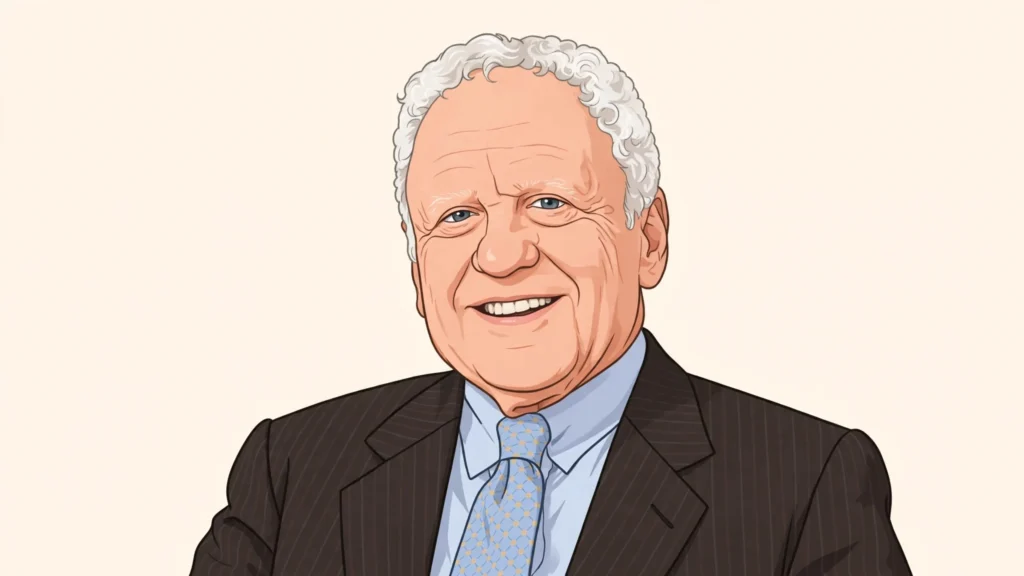
Alfred Henry Moses (born July 24, 1929, in Baltimore, Maryland) is an American attorney, diplomat, and Jewish communal leader whose career encompasses corporate law, White House service under President Jimmy Carter, and high-level diplomacy. A Dartmouth graduate and Georgetown Law alumnus with U.S. Navy service, Moses practiced for decades at Covington & Burling and co-founded the Promontory Financial Group. His most enduring contribution, however, lie in the preservation of one of the Jewish people’s most precious textual treasures, the Codex Sassoon, for public access and study.
The Codex Sassoon – Background and Significance
MS Sassoon 1053 (Codex S1) is the earliest nearly complete surviving manuscript of the Hebrew Bible (Tanakh). Produced in the late ninth or early tenth century CE on high-quality sheepskin parchment in an elegant early Oriental square script, it contains all twenty-four books with only twelve leaves missing—preserving roughly 92% or more of the biblical text. Arranged in three columns per page, it features the complete Masoretic vocalization (nekudot), cantillation accents (teamim), and marginal annotations (Masorah parva fully; magna on select pages). A subsequent editor aligned many notes more closely with the authoritative Ben Asher Tiberian tradition, citing the Aleppo Codex.
The codex occupies a pivotal position in biblical textual history, bridging the fragmentary Dead Sea Scrolls and the standardized medieval codices of the tenth century and later (including the Aleppo Codex and the complete Leningrad Codex of 1008/1009 CE). Its survival through centuries of upheaval, from early medieval Levant merchant families, to thirteenth-century communal dedication at the Makisin synagogue in northeastern Syria, rescue circa 1400 amid the town’s destruction and entrustment under oath to Salama ibn Abi al-Fakhr, and five centuries of obscurity under Ottoman rule, renders it both a scholarly treasure and a symbol of Jewish textual endurance.
The 2023 Acquisition and Permanent Legacy
In the modern period the codex passed through notable collections. David Solomon Sassoon purchased it in Ankara for £350 in 1929 and cataloged it as MS 1053. His heirs sold it in 1978 to the British Rail Pension Fund ($320,000); it resided at the British Library and was exhibited publicly only once. In December 1989 it was sold at Sotheby’s Zurich (hammer £2.035 million) and shortly thereafter acquired privately by Jacqui Safra for approximately $4.19 million. Safra held it for thirty-four years, allowing scholarly study and commissioning radiocarbon dating that confirmed its early medieval origin.
When Safra consigned the manuscript to Sotheby’s New York in early 2023 (estimate $30–50 million), Jewish scholars and leaders feared it might again disappear from public view. Alfred H. Moses, then 93, determined to secure it for the Jewish people. He placed an irrevocable pre-bid of $32.5 million. On May 17, 2023, after a brief bidding contest, he won with a $33.5 million hammer price; the final cost including premiums and fees reached $38.1 million, then a record for the most expensive bound book or manuscript sold at auction. He purchased it sight unseen and examined it for the first time two weeks later at Sotheby’s.
Moses donated the codex to the American Friends of ANU for the ANU – Museum of the Jewish People in Tel Aviv. He deliberately chose this institution so the manuscript would belong to the Jewish people broadly, rather than to any sovereign state’s national collection. Wrapped in protective Tyvek and secured in a custom container, it traveled in the cockpit of an El Al flight to Tel Aviv on October 5, 2023. Public display was postponed after the October 7, 2023 attacks and ensuing war; the permanent exhibition opened on May 29, 2025, with the codex displayed open to the Ten Commandments (Deuteronomy 5:6–21).
Legacy – Stewardship of People and Text
Alfred H. Moses’s acquisition of the Codex Sassoon represent parallel expressions of a single commitment: ensuring Jewish survival, both physical and cultural, across generations of threat and displacement. His pragmatic diplomacy rescued thousands of lives and protected a historic synagogue; his decisive action at auction preserved an irreplaceable witness to the Hebrew Bible and returned it to public stewardship in a museum dedicated to the Jewish people as a whole. Both efforts close loops of history, the ancient codex whose six-hundred-year displacement he ended. Together they affirm that individual resolve, grounded in historical awareness and executed with skill, remains a powerful force for continuity and renewal.
Modern Custodial History of the Codex Sassoon
| Year | Event / Custodian | Price (Nominal) | Notes |
| 1929 | David Solomon Sassoon purchases in Ankara | £350 | Cataloged as MS 1053 in Ohel Dawid collection |
| 1978 | British Rail Pension Fund via Sotheby’s Zurich | $320,000 | Held at British Library; exhibited publicly once (1982) |
| 1989 (Dec) | Jacqui Safra (after Sotheby’s auction) | ~$4.19 million | Private storage 34 years; radiocarbon dating performed |
| 2023 (May 17) | Alfred H. Moses (for ANU Museum) | $38.1 million (incl. fees) | Auction record; donated for permanent public display |
Note: Earlier prices are as reported in historical accounts; inflation-adjusted values for pre-2023 transactions would be substantially higher. The 2023 figure set a record for the most expensive bound manuscript or book sold at auction at the time.
Selected Sources
• Codex Sassoon 1053 – Wikipedia (en.wikipedia.org/wiki/Codex_Sassoon_1053)
• Sotheby’s New York auction records and contemporary coverage of the May 17, 2023 sale