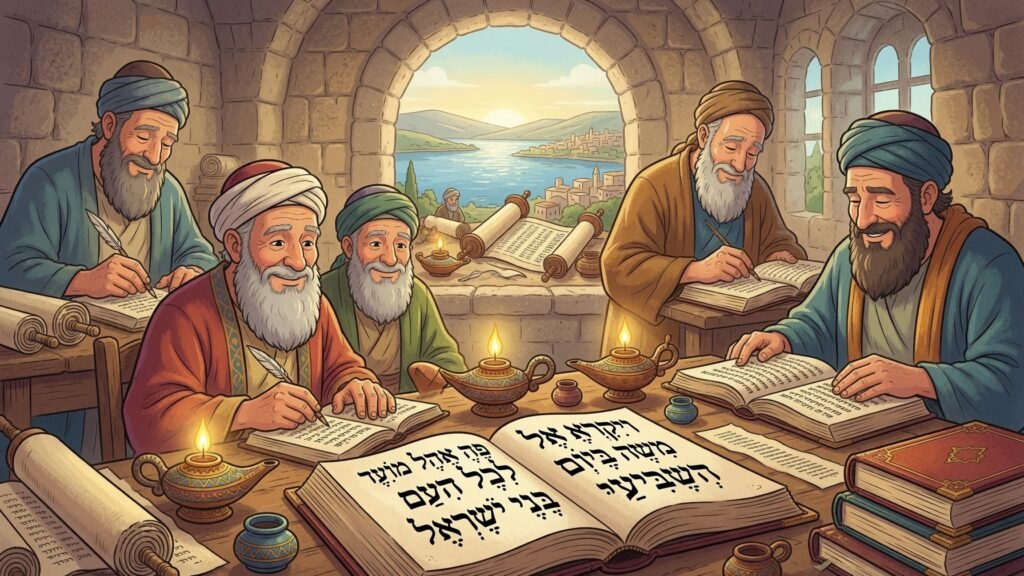
The Masoretes (from Hebrew masorah, meaning “tradition”) were Jewish scholar-scribes active primarily between the 6th and 10th centuries CE in centers like Tiberias (in Galilee) and the Babylonian academies. Their monumental task was not to discover or reconstruct lost “original” Hebrew Bible texts (the autographs from the biblical authors’ era), but to preserve, standardize, and safeguard the received text with extraordinary precision for future generations. They inherited a largely fixed consonantal skeleton and added systems of vowel points (niqqud), cantillation/accents (te’amim), and extensive marginal notes (masorah) to codify pronunciation, public synagogue reading, and textual integrity.
They did not have direct access to the ancient autographs, these had vanished centuries earlier through natural decay, wars, exiles, and repeated copying. Instead, they worked with the living chain of transmission available in their time, carefully copied manuscripts and longstanding oral reading traditions.
Pre Masoretic Textual History – From Plurality to Proto-Masoretic Stability
Biblical books were composed over many centuries (roughly 12th–2nd centuries BCE, with ongoing editing and transmission). In the Second Temple period (especially the last centuries BCE), there was significant textual plurality. The Dead Sea Scrolls (DSS) from Qumran reveal multiple textual traditions existing side-by-side, some close to the later Masoretic Text (MT), others closer to the Septuagint (Greek translation), the Samaritan Pentateuch, or independent forms.
A more standardized tradition called the proto-Masoretic Text (or pre-Masoretic) emerged and gained dominance, particularly associated with circles linked to Jerusalem Temple authorities and later rabbinic Judaism. This stabilization was likely gradual rather than the result of a single dramatic event or “council.” After the Temple’s destruction in 70 CE:
- Other centers of textual diversity (like Qumran) were lost or marginalized.
- Groups that preserved alternative traditions (Samaritans, early Christians using the Septuagint) largely separated from mainstream rabbinic Judaism.
- The proto-MT became the dominant surviving tradition.
By the time the Masoretes began their work (around the 6th century CE), the consonantal text was already highly stable. Differences between their base text and the later standard codices (like the Leningrad Codex) are minimal, often around 2% or less in careful analyses. They were guardians of a received tradition, not innovators creating a new one from scratch.
How the Masoretes Accessed and Worked with the Texts
The Masoretes gained access through established Jewish institutions of learning, synagogues, and scribal networks in Palestine and Babylonia. Key mechanisms included:
- Existing manuscripts and codices: They gathered, compared, and collated authoritative handwritten copies (scrolls and early codices) available in their communities. These represented generations of meticulous copying by earlier scribes (soferim). Strict rules governed copying, and scribes avoided writing even a single letter from memory and checked work rigorously.
- Oral reading traditions: The written consonants had long been accompanied by a living oral tradition of how the text was pronounced and chanted in public reading (qere). This was especially important because ancient Hebrew texts were unpointed (no vowels written). The Masoretes codified this oral heritage into written vowel signs and accents. Different regional reading traditions existed (Tiberian, Babylonian, Palestinian), and they documented variants.
- Comparison and majority principle: When manuscripts differed, they compared multiple reliable copies and often followed the majority reading from authoritative sources. Rabbinic literature preserves stories (e.g., three variant scrolls in the Temple court) illustrating this approach: choose the reading supported by two out of three reliable witnesses. The Masoretes applied similar methods and recorded discrepancies in the masorah notes rather than altering the main text.
- Centers of activity
- Tiberias (Galilee) — Home of the influential Ben Asher family. Moses ben Asher produced the Cairo Codex of the Prophets (~895 CE). His son Aaron ben Moses ben Asher refined the system further and is associated with the Aleppo Codex (~930 CE), widely regarded as the pinnacle of Masoretic achievement. Maimonides later praised it highly for Torah scroll preparation.
- Babylonia — Developed a parallel (but slightly different) tradition associated with the Ben Naphtali school. The Tiberian (Ben Asher) system ultimately prevailed and forms the basis of the standard MT today.
- Statistical and preservative techniques: They counted letters, words, and verses in each book (noting the middle letter or word) as checks against error. The masorah (small notes in margins or at the end of books) flagged unusual spellings, rare forms, kethiv/qere (written vs. read forms, often for euphemism or tradition), and Eastern vs. Western (Babylonian vs. Palestinian) differences.
They produced codices (bound books) with full vocalization and notes for study and reference. Sacred Torah scrolls for synagogue use remained unpointed and followed strict rules.
Key Outcomes and Surviving Witnesses
The work culminated in authoritative codices that became the standard:
- Aleppo Codex (associated with Aaron ben Asher): Revered for precision; partially damaged in 1947.
- Leningrad Codex (1008/9 CE, by Samuel ben Jacob): Most complete surviving example of the Ben Asher tradition; serves as the base text for modern critical editions like Biblia Hebraica Stuttgartensia (BHS) and Biblia Hebraica Quinta (BHQ).
These preserve a text remarkably close to what existed centuries earlier in its consonantal form.
Nuances, Debates, and Scholarly Perspectives
- No direct access to autographs: Claims in some medieval sources about extremely ancient scrolls (e.g., linked to Ezra or the Temple) are generally considered legendary or unverified. The transmission relied on careful human copying and oral tradition over a millennium or more.
- Textual criticism today: The MT is an outstanding witness to one ancient tradition (proto-MT) and is remarkably faithful within that line. However, it is not always the “original” reading. DSS and other versions sometimes preserve earlier or alternative forms (examples: Deuteronomy 32:8 “sons of Israel” in MT vs. “sons of God/Elohim” in some DSS and Septuagint; 1 Samuel 1:24 “three bulls” in MT vs. “three-year-old bull” elsewhere). Scholars use MT alongside other witnesses for reconstruction.
- Tiberian dominance: The Ben Asher Tiberian system won out over Babylonian and Palestinian variants due to its precision and endorsement by figures like Maimonides. Some cross-influence occurred.
- Purpose and mindset: The Masoretes were not textual critics seeking the “earliest” text in a modern sense. They were preservers of the sacred received tradition “as far as possible” from what had come down to them. Their masorah notes often highlight difficulties rather than resolving them by conjecture.
- Edge cases: Minor ongoing variations existed even among Masoretic manuscripts (hence the value of comparing codices). The vocalization system itself was an innovation of the Masoretic period, though based on much older oral practice. After their era, the tradition became even more fixed in printed editions.
In summary, the Masoretes “gained access” by inheriting and rigorously safeguarding a highly stabilized textual tradition through scribal copying, institutional centers of learning, and oral transmission chains that stretched back to the late Second Temple period. Their achievement was one of the most successful efforts in human history to preserve a large body of ancient sacred literature with fidelity. The resulting Masoretic Text remains the foundation for Bible study and a cornerstone for biblical scholarship worldwide.
Modern critical study benefits enormously from their work while also consulting earlier witnesses like the Dead Sea Scrolls for a fuller picture of textual history.