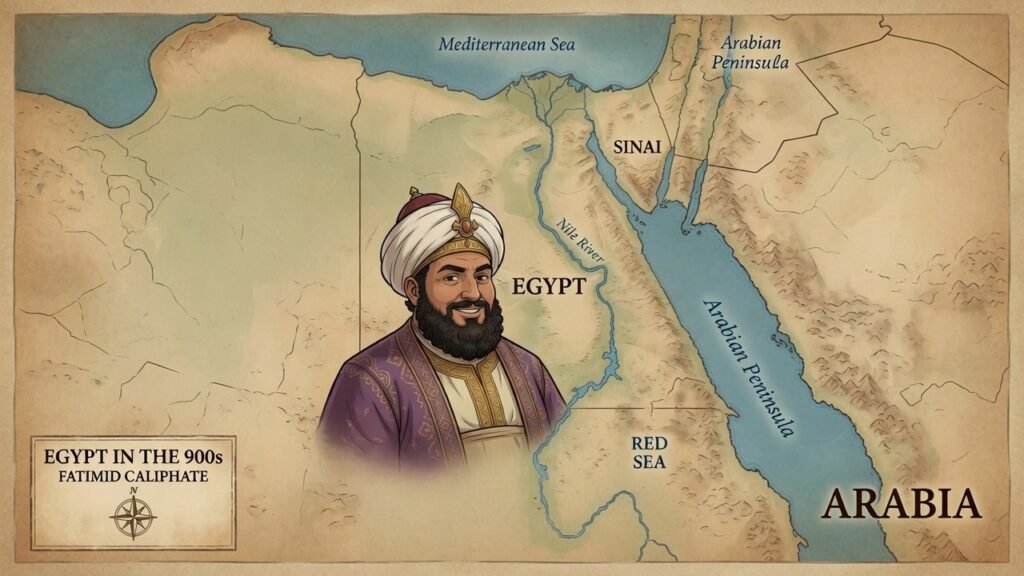
Biblical exegesis under the Fatimids was marked above all by the flowering of systematic Karaite commentary in Judeo-Arabic, produced in a relatively tolerant environment that afforded Jewish communities significant autonomy.
The Fatimid Caliphate (909–1171), an Ismaili Shiʿi dynasty that ruled from North Africa and, after 969, from Cairo over Egypt, Palestine, and parts of Syria, generally treated Jews as protected dhimmīs. While the Covenant of ʿUmar theoretically imposed restrictions, Fatimid practice was often pragmatic and comparatively lenient, especially outside the turbulent reign of al-Ḥākim (996–1021). Jews enjoyed communal self-government, economic opportunity, and intellectual space. The Cairo Geniza preserves extensive documentary evidence of this world, revealing both Rabbanite and Karaite communities that interacted politically and socially even while engaging in sharp polemics.
Jerusalem, conquered by the Fatimids around 970, became a major center of Karaite scholarship. The “Mourners of Zion” (Avelei Zion) settled there, combining penitential piety focused on the ruined Temple with intensive biblical study. This setting fostered the “Golden Age” of Karaism in the tenth and early eleventh centuries, during which Karaites produced the most ambitious program of continuous biblical commentary yet seen in Jewish tradition.
Karaite Exegetical Achievements
Karaite scholars rejected the binding authority of the Oral Torah as understood by the Rabbanites and insisted on returning to Scripture itself (miqra). Under Fatimid rule they developed sophisticated methods of interpretation that combined close philological attention, rationalist theology (often in dialogue with Muʿtazilī kalām), historical contextualization, and literary sensitivity.
Salmon ben Yeruḥam (or Salmon ben Jeroham; active mid-tenth century) stands as an early major figure. A fierce polemicist against Saadia Gaon and Rabbanism, he composed the rhymed Hebrew Sefer Milḥamot Adonai (“Book of the Wars of the Lord”) and wrote Arabic commentaries and translations on Psalms, Lamentations, Song of Songs, Ecclesiastes, Esther, and parts of Isaiah. His Lamentations commentary is especially revealing: he reads the book both as a historical response to the Babylonian destruction and as spiritual instruction for Jews living in exile under Islamic rule, blending exegesis with homily and pietistic exhortation.
Yefet ben ʿEli ha-Levi (Japheth ben Ali; fl. second half of the tenth century, died early eleventh century) is the towering figure of the period. Born in Basra, he settled in Jerusalem and produced Arabic translations and extensive commentaries on virtually the entire Hebrew Bible, the first Jew known to have attempted a comprehensive running commentary of this scope. His method prioritizes the plain sense (peshat) while subjecting it to the test of reason. He pays careful attention to grammar, lexicography, narrative structure, historical setting, and theological coherence. Anthropomorphic language is often explained metaphorically when it conflicts with a rational conception of God; at the same time he resists excessive allegorization. He engages Rabbinic traditions (sometimes without attribution), polemicizes against Rabbanite positions, and addresses Muslim and Christian claims. His work preserves many otherwise lost earlier interpretations and was later excerpted, abridged, and cited even by some Rabbanite scholars, including Abraham ibn Ezra.
Other Karaites of the Jerusalem school, such as those associated with the circle of Yūsuf ibn Nūḥ and Abū al-Faraj Hārūn, continued this tradition into the early eleventh century, refining grammatical and exegetical tools.
Methodological Features and Intellectual Context
Karaite exegesis under the Fatimids was characteristically:
- Literal and contextual: Preference for the plain meaning within the literary and historical setting of the text.
- Rationalist: Strong influence of Muʿtazilī ideas regarding divine unity, justice, and the created nature of speech; rejection of corporealism.
- Philological: Growing attention to Hebrew grammar and lexicography, often in dialogue with contemporary Arabic linguistic science.
- Polemical yet absorbent: Frequent attacks on Rabbanite reliance on Oral Torah, yet selective use of rabbinic material and awareness of other interpretations.
- Programmatic: Commentaries frequently served communal goals, strengthening Karaite identity, promoting piety among the Mourners of Zion, and defending scripturalist principles.
The choice of Judeo-Arabic (Arabic written in Hebrew characters) made the work accessible within the broader Islamicate intellectual world while remaining internal to Jewish discourse.
Rabbanite Activity and Intercommunal Relations
Rabbanite Jews under the Fatimids continued the Gaonic tradition, focusing more on Talmud, legal responsa, and communal administration than on new systematic biblical commentaries of the Karaite type. Saadia Gaon’s earlier Arabic Bible translations and commentaries remained highly influential. The Palestinian Yeshiva and, later, Egyptian communal leadership (including the office of raʾīs al-yahūd, Head of the Jews) provided institutional frameworks. Geniza evidence shows that Rabbanites and Karaites often cooperated in practical matters, political representation before the Fatimid authorities, financial support, and even intermarriage in some cases—despite fierce ideological rivalry. Accusations of “heresy” were situational rather than a permanent structural barrier.
Broader Significance
The Fatimid period was decisive for the history of Jewish biblical interpretation. Karaite scholars transformed the commentary genre, establishing models of continuous, reasoned, linguistically informed exegesis that influenced later medieval Jewish work in both the Islamic world and Europe. Their extensive output, preserved in manuscripts and Geniza fragments, constitutes one of the richest surviving bodies of medieval Jewish scriptural interpretation.
At the same time, the Fatimids’ own Ismaili missionaries occasionally engaged in taʾwīl (esoteric interpretation) of biblical stories for internal Muslim or missionary purposes, illustrating a wider Mediterranean culture of scriptural rereading. Jewish exegesis, however, developed largely on its own terms within the protected space the dynasty afforded.
In short, under Fatimid rule Jewish scholars, especially Karaites in Jerusalem and Egypt, produced a body of biblical commentary that was ambitious in scope, sophisticated in method, and deeply shaped by the intellectual currents of the Islamic world while remaining firmly rooted in the Hebrew Bible. This achievement represents one of the high points of medieval Jewish engagement with Scripture.
Yefet ben ʿEli (Japheth ben Ali ha-Levi; fl. second half of the tenth century, active in Jerusalem) developed one of the most systematic and influential rationalist approaches to biblical exegesis in medieval Judaism. As the preeminent Karaite commentator of the “Golden Age,” he produced Arabic translations paired with continuous, verse-by-verse commentaries covering nearly the entire Hebrew Bible. His method fused a strong preference for the plain sense of the text with rigorous subordination of that sense to reason, drawing heavily on the intellectual climate of the Islamic world, particularly Muʿtazilī kalām, while remaining firmly within a scripturalist Karaite framework.
Core Principle: The Literal Sense Judged by Reason
Yefet’s fundamental commitment was to the ẓāhir (outward, apparent, or plain meaning) of Scripture. He insisted that every word has a determinate sense grounded in ordinary linguistic usage, literary conventions, and context. This represented a deliberate turn toward peshat (plain-sense interpretation) that distinguished the Jerusalem Karaites from earlier midrashic or highly allegorical tendencies.
Crucially, the plain sense was never absolute. It had to be tested against reason. In a characteristic formulation (reflected in his comments on Daniel and elsewhere), one should not abandon the plain meaning of the words of God or the prophets “save where the plain meaning is obscure or unacceptable, being contradicted by reason or by (other) unambiguous text.” When the literal reading produced absurdity, contradiction with clear passages, or conflict with rational theology (especially divine unity and incorporeality), figurative interpretation (taʾwīl, majāz, or “expansion” of meaning) became legitimate and necessary.
This produced a controlled rationalism: reason serves as a critical filter and corrective rather than an independent source of truth that could override Scripture. The Bible remains the supreme authority, but human intellect is indispensable for determining its correct meaning.
Muʿtazilī Influence and Theological Rationalism
Yefet’s terminology, conceptual framework, and theological priorities are characteristically Muʿtazilī, even though he sometimes polemicized against the Muʿtazila themselves. Key shared emphases include:
- Absolute divine unity (tawḥīd) and simplicity.
- Divine justice and human moral responsibility/free will.
- Rejection of anything that implies corporeality, change, or imperfection in God.
Anthropomorphic and anthropopathic language—God’s “hand,” “face,” “eyes,” “sitting on the throne,” “descending,” jealousy, joy, or other emotions—was routinely treated as figurative. Literal readings were rejected because they conflicted with reason’s knowledge of God’s transcendence. Yefet explained such expressions as accommodations to human language or as metaphors for divine power, knowledge, providence, or action. Similar strategies appear in Saadia Gaon and in broader Islamic and Jewish rationalist traditions, but Yefet applied them with consistency across his vast corpus.
This rationalist theology shaped more than isolated verses. It influenced how he handled narrative coherence, prophetic authority, and eschatology. For example, he generally rejected precise calculations of the “end of days,” arguing that such knowledge is inaccessible, while still offering cautious interpretive possibilities in places such as Haggai when the text invited them.
Differentiated Application: Law versus Narrative
A notable nuance in Yefet’s method is the distinction between legal and narrative material. Commandments and legal passages tended to receive strict literal interpretation, in keeping with Karaite scripturalism and a desire to derive halakhah directly from the text without rabbinic mediation. Narrative sections (qiṣaṣ), by contrast, allowed greater flexibility. Here Yefet sometimes departed from the most obvious reading in order to align the stories with Muʿtazilī moral values—divine justice, the moral exemplarity of biblical figures where possible, and the rejection of arbitrary or unjust divine action.
Classic illustrations include his treatments of David’s census (2 Samuel 24 / 1 Chronicles 21) and the Bathsheba episode (2 Samuel 11–12, with Psalm 51). In these cases he worked to reconcile the narratives with principles of individual responsibility and divine equity, sometimes softening or recontextualizing elements that, taken at face value, raised moral or theological difficulties. This selective non-literalism in narrative was not arbitrary allegorizing; it remained constrained by linguistic and contextual considerations and served the broader goal of a rationally coherent Scripture.
Linguistic, Historical-Literary, and Contextual Tools
Yefet’s rationalism was operationalized through concrete exegetical techniques:
- Close attention to Hebrew grammar, etymology, syntax, and lexicography.
- Analysis of literary structure, rhetorical devices, juxtaposition of passages, and narrative development.
- Historical contextualization: reconstructing the social and historical setting of prophetic oracles or stories on the basis of internal biblical evidence.
- Comparison of parallel texts and consideration of alternative interpretations (including Rabbinic and earlier Karaite views), which he often quoted and then rejected when they failed the tests of reason or plain sense.
- Translation practice that frequently prioritized fidelity to the Hebrew wording, sometimes at the expense of elegant Arabic, precisely to preserve the textual data on which rational analysis operated.
He was not rigidly isolationist. He drew on Targumic renderings, occasionally utilized rabbinic material (often without attribution), and engaged the wider intellectual environment, yet he subordinated all of it to his scripturalist and rational criteria. He rejected excessive philosophical allegorization while still employing reasoned figurative interpretation where required.
Broader Context, Strengths, and Limitations
Yefet’s method emerged in the Fatimid-era Karaite community of Jerusalem, a setting of relative intellectual openness that facilitated engagement with Arabic-Islamic learning. It exemplifies the broader oriental Jewish turn toward systematic, reasoned commentary in Judeo-Arabic. His approach influenced later Karaite writers and was cited by some Rabbanite scholars (notably Abraham ibn Ezra, who quotes him repeatedly).
Strengths include methodological consistency, linguistic seriousness, theological coherence, and the production of a near-complete biblical commentary that preserved and evaluated a wide range of earlier opinions. Limitations include the tension inherent in any “reason-constrained literalism”: the criteria for when reason overrides the plain sense can appear selective, especially in narrative, and his Muʿtazilī-inflected theology sometimes shaped readings in ways that modern historical-critical readers would find anachronistic. He remained a traditionalist in accepting the divine origin and essential unity of Scripture even while applying sophisticated critical tools to its interpretation.
In sum, Yefet ben ʿEli’s rationalist methods represent a mature synthesis of Karaite scripturalism and Islamicate rational theology. By making the plain sense of the text the starting point while insisting that it stand the test of reason, he helped establish standards of coherent, linguistically grounded, theologically responsible exegesis that left a lasting mark on Jewish biblical interpretation.