

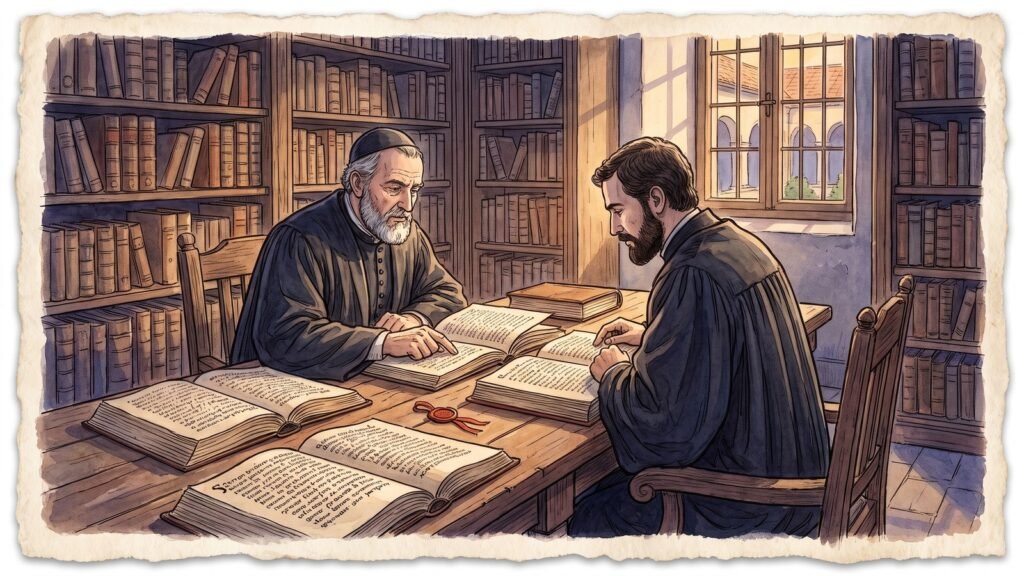
In the second half of the eighteenth century two scholars, working independently in Oxford and Parma, undertook the most ambitious surveys of Hebrew biblical manuscripts that had ever been attempted. Benjamin Kennicott, a fellow of Exeter College, Oxford, organised a collation of hundreds of manuscripts and early printed editions of the Hebrew Bible, financed by public subscription and carried out over two decades by collators in Britain and across Europe. Its results were published in two folio volumes at Oxford in 1776 and 1780 under the title Vetus Testamentum Hebraicum cum variis lectionibus.1 Giovanni Bernardo De Rossi, professor of oriental languages at the University of Parma and the owner of one of the largest private collections of Hebrew manuscripts in Europe, followed with his Variae lectiones Veteris Testamenti, printed in four volumes by Giambattista Bodoni at Parma between 1784 and 1788, and a supplementary volume in 1798.23 The two works remain the largest collections of variant readings from medieval Hebrew manuscripts ever published. Their findings were not those that their promoters had expected, and the conclusions drawn from them shaped the study of the Hebrew text for the following two centuries.
At a glance
- 1718: Benjamin Kennicott is born at Totnes in Devon.
- 1753: He publishes The State of the Printed Hebrew Text of the Old Testament Considered, arguing that the printed text contains errors that manuscripts can correct.
- 1760: Encouraged by Thomas Secker, he begins a general collation of Hebrew manuscripts supported by public subscription.
- 1760–1769: Annual reports record the progress of the work in Britain and abroad, with collators including Paul Jacob Bruns.
- 1776–1780: Vetus Testamentum Hebraicum cum variis lectionibus is published at Oxford in two volumes.
- 1783: Kennicott dies at Oxford.
- 1784–1788: Giovanni Bernardo De Rossi publishes Variae lectiones Veteris Testamenti at Parma in four volumes, printed by Bodoni.
- 1798: De Rossi’s supplementary Scholia critica appears.
- 20th–21st centuries: The two collations are reprinted and digitised, and projects begin to encode Kennicott’s apparatus electronically.
This article describes the origins of Kennicott’s project, the organisation and execution of the collation, the controversies it provoked, the complementary work of De Rossi and the significance of the results for the history of the Hebrew text. The earlier history of the printed Hebrew Bible is described in the articles on Daniel Bomberg’s Venice press and Jacob ben Hayyim and the Second Rabbinic Bible, and the work of an earlier critic of the printed text, Jedidiah Solomon Norzi, in the article on Norzi and the Minhat Shai.
The question of the integrity of the Hebrew text
The debate that gave rise to Kennicott’s project had its roots in the controversies of the sixteenth and seventeenth centuries. Protestant theologians had insisted that the Hebrew text was the authoritative form of the Old Testament, and many of them held that it had been preserved without significant error. Catholic scholars, and some Protestants, argued on the contrary that the Hebrew text had suffered in transmission and that it could be corrected from the ancient versions, especially the Septuagint and the Latin Vulgate, and from the Samaritan Pentateuch. The debate was sharpened by the publication of the polyglot Bibles, which placed the versions beside the Hebrew and made their differences visible, and by the work of critics such as Louis Cappel, whose Critica sacra of 1650 argued that the Hebrew text could be emended from the versions and by conjecture.
By the middle of the eighteenth century the question had acquired a practical dimension. The printed Hebrew Bible derived ultimately from a small number of early editions, and the most widely used editions of the period, such as that of Everard van der Hooght published at Amsterdam in 1705, followed the textual tradition of the Rabbinic Bibles. No systematic attempt had been made to compare the printed text with the large number of medieval manuscripts preserved in European libraries. For the New Testament, by contrast, scholars such as John Mill and Johann Jakob Wettstein had collected variant readings from Greek manuscripts on a large scale. The absence of a comparable work for the Hebrew Bible was widely felt, and it was this gap that Kennicott set out to fill.4
Kennicott and The State of the Printed Hebrew Text
Benjamin Kennicott was born at Totnes in Devon in 1718 and educated at Oxford, where he became a fellow of Exeter College. He later held the posts of Radcliffe Librarian and canon of Christ Church, and he died at Oxford in 1783.5 His interest in the Hebrew text was first expressed publicly in a dissertation published in 1753 under the title The State of the Printed Hebrew Text of the Old Testament Considered. The first part of the work compared the parallel passages in 1 Chronicles 11 and 2 Samuel 5 and 23, where the same lists and narratives appear in two forms, and argued that many of the differences between them were the result of errors in transmission rather than deliberate variation.6 The second part contained observations on some seventy Hebrew manuscripts preserved in Oxford and elsewhere, with extracts of the variants and mistakes that Kennicott had found in them.7
The argument of the dissertation was that the printed Hebrew text was not free from error, that the manuscripts contained readings that could correct it, and that a systematic collation of all available manuscripts was necessary before the text could be properly established. This was a direct challenge to the view that the Hebrew text had been preserved intact, and it was received with hostility by some readers. It also brought Kennicott to the attention of those who supported a critical approach to the text, and it led to the proposals that resulted in the collation.8
The evidence of parallel passages
The method of Kennicott’s first dissertation deserves closer attention, because it shows the kind of reasoning that led him to doubt the integrity of the printed text. The books of Samuel and Chronicles contain many passages that narrate the same events or reproduce the same lists, and the Chronicler’s account of David’s reign draws extensively on material that also appears in Samuel. The account of David’s anointing as king over all Israel at Hebron, for example, appears in almost identical words in 2 Samuel 5 and 1 Chronicles 11.9 Where two such passages differ, the differences may be the result of deliberate revision by the later writer, or of errors in the transmission of one or both texts.
The list of David’s warriors in 2 Samuel 23 and 1 Chronicles 11 provides some of the most striking examples. The first warrior is named in the two passages in forms that differ considerably, and the description of his exploit differs in the number of men he is said to have slain.10 Kennicott examined such differences one by one and argued that many could be explained as the confusion of similar letters, the omission of words or the misreading of numbers by copyists. His conclusion was that if the two passages, which must originally have agreed, now differed in these ways, then the text had suffered errors in transmission, and that similar errors were likely elsewhere where no parallel passage allowed them to be detected.11 The argument was not new in principle, but Kennicott pressed it with unusual thoroughness, and he used it to justify the search for manuscript evidence that might restore the original readings.
The organisation of the collation
Kennicott’s principal patron was Thomas Secker, bishop of Oxford and later archbishop of Canterbury. In the first of his annual accounts of the collation, published in 1760, Kennicott recorded that Secker had first urged him to undertake the work in 1757 and had chiefly persuaded him in 1760 to give his life to it. He printed an extract from a letter of 10 March 1758, written from the Deanery of St Paul’s, in which Secker expressed the wish that the Hebrew manuscripts at Oxford should be collated and judged Kennicott the fittest person to do so.12 The University of Oxford and many individuals subscribed to support the work, and Kennicott published a list of subscribers with each annual account. The first list shows the university among the subscribers with a contribution of forty pounds.13
The collation was organised in an unusual way. Kennicott did not attempt to collate every manuscript himself. Instead he devised a method by which collators could compare a manuscript with a printed standard text and record every variation, and he employed collators in Britain and abroad to apply it. The standard text chosen for comparison was the edition of van der Hooght. The annual accounts record the progress of the work year by year, the manuscripts collated, the libraries visited and the patrons who assisted.14
The scale of the undertaking grew as it proceeded. In the account for 1761 Kennicott reported that the number of Hebrew manuscripts known in Great Britain and Ireland had reached one hundred and nineteen, and later one hundred and twenty-one, after the addition of a manuscript purchased at Constantinople and given to him by Sir James Porter, the British ambassador there.15 In a later account he estimated the number of manuscripts known abroad at 336, of which 117 were in Italy, 87 in Germany, 70 in France, 32 in Holland, 20 in Spain and 10 in Switzerland, Denmark and Sweden, giving a total with the British manuscripts of 460, which he expected to reach 500. He expressed the hope that the work might include the readings of all of them, so that the Old Testament would not be left, like the New, subject to “Appendix after Appendix”.16
Kennicott’s first account also set out the case for undertaking the work in Britain. He observed that between four and five hundred Hebrew manuscripts were known to exist, and that England possessed more than any other country, with at least one hundred and ten preserved in the universities of Oxford and Cambridge and in the British Museum. Among these were seven copies of the Samaritan Pentateuch, which he regarded as valuable for correcting the printed Samaritan text, then based on a single manuscript in France. Since the country was so rich in manuscripts collected at great expense, he argued, it would be honourable to set an example by publishing a work long desired by the learned in all nations.17
Collators and patrons abroad
The foreign collations required diplomatic assistance as well as scholarly labour. Kennicott’s accounts record the help of British ambassadors and residents in many European capitals, who obtained permission for manuscripts to be collated and arranged for the transmission of collations to Oxford. The most important of the foreign collators was the German scholar Paul Jacob Bruns, who travelled extensively on Kennicott’s behalf and collated manuscripts in Germany, Italy and elsewhere. One account records that two famous manuscripts formerly belonging to Johannes Reuchlin, then in the library of the margrave of Baden-Durlach at Karlsruhe, had been entrusted to Bruns for collation.18
Access to some collections was obtained only with difficulty. Kennicott’s accounts refer to the manuscripts in the Vatican Library and to the efforts made to obtain collations of them, as well as to manuscripts in Florence, Paris, Turin and other cities.19 The support of rulers, including the king of Sardinia and the king of Denmark, is also recorded. The project thus became an international enterprise, drawing on the networks of eighteenth-century diplomacy and scholarship, and its progress was followed with interest in learned circles across Europe.20
The model of the New Testament
Kennicott’s project was conceived in the light of the work that had already been done on the Greek New Testament. John Mill’s edition of 1707 had assembled some thirty thousand variant readings from Greek manuscripts, versions and patristic citations, and its publication had provoked controversy because the number of variants seemed to some readers to call the reliability of the text into question. Johann Jakob Wettstein’s edition of 1751–1752 had added further evidence and introduced a system of sigla for manuscripts that became standard. Kennicott was aware of these precedents and referred to them in his accounts, and his remark about appendix after appendix reflects his wish to avoid the piecemeal accumulation of evidence that had characterised work on the New Testament.21
The analogy was in some respects misleading. The manuscripts of the Greek New Testament differ among themselves in ways that reflect distinct textual traditions, and the collection of their variants made it possible to classify them into families and to reconstruct the history of the text. The manuscripts of the Hebrew Bible collated by Kennicott proved to be much more uniform, so that the same methods yielded far less. This difference, which became clear only as the collation proceeded, is one of the most important results of the project. The history of the printed Greek text is treated on this site in the article on printed Greek Bibles.
Controversy
The collation was controversial from the start. Some critics objected to the principle that the Hebrew text needed correction, which they regarded as undermining the authority of Scripture. Others questioned Kennicott’s methods and judgement. Thomas Rutherforth, Regius Professor of Divinity at Cambridge, published in 1761 a letter to Kennicott criticising his defence of the Samaritan Pentateuch and his second dissertation, which he described as injudicious and inaccurate in many instances.22 Kennicott had argued that the Samaritan Pentateuch preserved readings superior to those of the Masoretic text in certain places, a view that aroused particular opposition.23
Opposition also came from the followers of John Hutchinson, a group of English theologians who held that the Hebrew text, read without the vowel points, contained hidden philosophical and theological truths, and who resisted any suggestion that its consonantal text was corrupt. Kennicott’s critics among them attacked both his project and his competence. William McKane, in a study of Kennicott published in 1977, examined these controversies and Kennicott’s responses to them, and assessed his work as that of a dedicated researcher whose achievement should be judged in the light of the methods available in his time.24
The edition of 1776–1780
The results of the collation were published in two folio volumes at Oxford, the first in 1776 and the second in 1780. The volumes printed the Hebrew text according to the edition of van der Hooght, without vowel points, and gave below it an apparatus listing the variant readings found in the manuscripts and editions collated, each identified by a number.25 The second volume concluded with a Dissertatio generalis, a general dissertation in which Kennicott described the history of the project, the manuscripts and editions used, the methods of collation and the conclusions he drew from the results.26
The decision to omit the vowel points was deliberate. Kennicott’s collation concerned the consonantal text, and he regarded the vowels as a later addition, in line with the view argued by Elias Levita and discussed in the article on the vowel-point controversy. The apparatus therefore recorded differences of letters, including the presence or absence of vowel letters, the omission or addition of words, and differences of word order, but not differences of vocalisation or accentuation. This limitation was later criticised, since the medieval manuscripts preserve important evidence for the vocalisation and accentuation of the text.27
What the collation showed
The collation produced an enormous number of variant readings. The great majority, however, proved to be of a minor kind: differences in the use of vowel letters, obvious scribal errors, and variations that could be explained by the conventions of particular scribes. Readings that affected the sense of the text were relatively rare, and many of them were attested in only one or a few manuscripts. The manuscripts, it emerged, were remarkably uniform. They derived from a common tradition, the Masoretic tradition, and their variations were variations within that tradition rather than evidence of an older and different text.2829
This result disappointed those who had hoped that the manuscripts would provide a means of correcting the Hebrew text in the way that the versions seemed to promise. Kennicott himself did not abandon his view that the text contained errors, and he continued to argue for the value of certain readings. But the cumulative evidence of the collation suggested that the medieval manuscripts could not take the critic behind the Masoretic text to an earlier form. For that purpose other evidence was needed: the ancient versions, the Samaritan Pentateuch, and, much later, the Dead Sea Scrolls. The uniformity of the medieval manuscripts became one of the established facts of textual criticism of the Hebrew Bible.30
Individual readings from Kennicott’s apparatus nevertheless continued to attract attention. Scholars have discussed particular cases in which a reading attested in Kennicott’s manuscripts agrees with an ancient version or with a Dead Sea Scroll, and in which it may preserve an older form. Stig Norin, for example, discussed an important Kennicott reading in 2 Kings 18:13 in 1982.31 Such cases are rare, but they show that the apparatus retains value as a record of the medieval evidence.
De Rossi and the Parma collation
Giovanni Bernardo De Rossi was born in 1742 in Piedmont and became professor of oriental languages at Parma, where he taught for half a century. He assembled a collection of Hebrew manuscripts and printed books of exceptional size and quality, which after his death passed to the Biblioteca Palatina in Parma, where it remains. De Rossi was critical of Kennicott’s collation, which he regarded as incomplete and in some respects inaccurate, and he undertook his own collation partly to supplement and correct it.32
De Rossi’s Variae lectiones Veteris Testamenti appeared in four volumes between 1784 and 1788, printed by Bodoni at Parma. The first volume contained prolegomena and a clavis codicum, a key describing the manuscripts and editions used, followed by the variants for Genesis, Exodus and Leviticus. The second volume covered the remaining books of the Pentateuch and the Former Prophets, the third the Latter Prophets and the Five Scrolls, and the fourth the remaining books of the Writings, with a preliminary dissertation on the value, utility and use of the collation and an appendix of additions.3334 A fifth volume, the Scholia critica, published in 1798, provided supplements and additions.35
De Rossi’s approach differed from Kennicott’s in several respects. He did not reprint the full text but presented variants selectively, focusing on readings he regarded as significant. He included variants of vocalisation and accentuation as well as of consonants, which Kennicott had omitted. He compared the manuscript readings with the Samaritan text and the ancient versions, as the title of his work states, and he discussed their value in critical notes. And he drew extensively on his own collection, which included many manuscripts that Kennicott’s collators had not seen.3637 The two works are therefore complementary, and later scholars have generally used them together.
The printing of De Rossi’s collation by Giambattista Bodoni is itself of interest. Bodoni was the most celebrated printer of his age, director of the ducal press at Parma and the designer of typefaces that bear his name. His involvement gave the work a typographical distinction that matched its scholarly importance, and it reflected the patronage of the court of Parma, which supported both De Rossi’s research and Bodoni’s press. The collaboration between a Hebraist and a printer in a small Italian duchy produced one of the great works of eighteenth-century biblical scholarship.38
Reception and use
The two collations were received as monuments of learning and became standard works of reference. Their findings influenced the critical editions of the Hebrew Bible produced in the nineteenth and twentieth centuries, which cited readings from Kennicott and De Rossi in their apparatuses. The first editions of Rudolf Kittel’s Biblia Hebraica, discussed in the article on Biblia Hebraica Quinta and its predecessors, made use of such readings. In the course of the twentieth century, however, the emphasis of textual criticism of the Hebrew Bible shifted. The discovery of the Dead Sea Scrolls provided manuscripts a thousand years older than those collated in the eighteenth century, and the study of the great Tiberian codices, such as the Aleppo Codex and the Leningrad Codex, made it possible to establish the Masoretic text on the basis of its best witnesses.
In this context the readings of the late medieval manuscripts collated by Kennicott and De Rossi came to be regarded as of limited value for the reconstruction of the text. Most of them are later than the great codices and depend on the same tradition, and their variants are generally secondary. Their importance lies rather in what they show about the transmission of the Masoretic text in the later Middle Ages, about the practices of scribes in different regions and about the uniformity of the tradition. They also remain a resource for the study of individual readings and for the history of the text in particular communities.39
Both works have been reprinted in modern times. A reprint of De Rossi’s collation appeared at Amsterdam in 1969, and a further reprint was published by Gorgias Press in 2012.4041 Digitised copies of both works are freely available. In recent years, projects have begun to encode Kennicott’s apparatus electronically, so that its data can be searched and analysed by computer. Luigi Bambaci, for example, has described a rule-based parsing system designed to convert Kennicott’s printed apparatus into a structured digital form.42
The Kennicott Bible
Kennicott’s name is attached not only to his collation but also to one of the most celebrated Hebrew manuscripts in Britain. The Kennicott Bible, now in the Bodleian Library at Oxford, is a richly illuminated Hebrew Bible completed at La Coruña in north-west Spain in 1476, shortly before the expulsion of the Jews from Spain. It was acquired for Oxford on Kennicott’s advice and has borne his name ever since. The manuscript has been described in the Bodleian Library Record and elsewhere, and it is regarded as one of the finest examples of Hebrew book art from medieval Spain.43 Its association with Kennicott is a reminder that his work brought many Hebrew manuscripts to the attention of scholars and collectors.
The significance of the eighteenth-century collations
The collations of Kennicott and De Rossi were the culmination of the early modern effort to establish the text of the Hebrew Bible by the comparison of manuscripts. They were made possible by the growth of libraries, the development of scholarly networks and the willingness of patrons to fund large collaborative projects. Their methods, though limited by the standards of later scholarship, were systematic and their scope was unprecedented. They demonstrated what could be learned from the comparison of late medieval manuscripts and, equally important, what could not.44
The principal lesson of the collations was negative but fundamental: the medieval manuscripts of the Hebrew Bible represent a single, remarkably stable tradition. This conclusion, which has been confirmed by later research, has shaped the approach of textual critics to the Hebrew text ever since. It explains why modern critical editions concentrate on the earliest and best Masoretic manuscripts and on evidence outside the Masoretic tradition, such as the versions and the Dead Sea Scrolls, rather than on the mass of later manuscripts. It also bears witness to the care with which the Masoretic tradition was preserved by the scribes of the Middle Ages.45
Assessment
Benjamin Kennicott and Giovanni Bernardo De Rossi devoted much of their lives to collecting the variant readings of medieval Hebrew manuscripts. Kennicott’s collation, published at Oxford in 1776–1780 after two decades of work funded by subscription and carried out by collators across Europe, recorded the consonantal variants of hundreds of manuscripts and editions against the printed text.4647 De Rossi’s collation, published at Parma in 1784–1788 with a supplement in 1798, added the evidence of many further manuscripts, including those of his own collection, and recorded variants of vocalisation and accentuation as well as consonants.4849
The collations showed that the medieval manuscripts were remarkably uniform and that their variants were, for the most part, minor. This finding disappointed some of the hopes that had inspired the work, but it established a fact of lasting importance for the study of the Hebrew Bible. The two collations remain standard works of reference, monuments of eighteenth-century scholarship and a record of the medieval transmission of the Masoretic text in the age before the discovery of the Dead Sea Scrolls.50
Notes
- Benjamin Kennicott (ed.), Vetus Testamentum Hebraicum cum variis lectionibus, 2 vols (Oxford: Clarendon Press, 1776–1780), vol. 1 and vol. 2. ↩
- Giovanni Bernardo De Rossi, Variae lectiones Veteris Testamenti, 4 vols (Parma: Bodoni, 1784–1788). ↩
- De Rossi, Scholia critica in Veteris Testamenti libros (Parma, 1798), the supplementary fifth volume; see the description of the Philo Press reprint (Amsterdam, 1969). ↩
- Benjamin Kennicott, The Ten Annual Accounts of the Collation of Hebrew MSS of the Old Testament; Begun in 1760, and Compleated in 1769 (Oxford, 1770). ↩
- Anselm C. Hagedorn, “Kennicott, Benjamin”, Encyclopedia of the Bible and Its Reception (Berlin: De Gruyter); William McKane, “Benjamin Kennicott: An Eighteenth-Century Researcher”, Journal of Theological Studies n.s. 28 (1977), pp. 445–464. ↩
- Benjamin Kennicott, The State of the Printed Hebrew Text of the Old Testament Considered (Oxford, 1753), title page and part 1. ↩
- Benjamin Kennicott, The State of the Printed Hebrew Text of the Old Testament Considered (Oxford, 1753), part 2. ↩
- William McKane, “Benjamin Kennicott: An Eighteenth-Century Researcher”, Journal of Theological Studies n.s. 28 (1977), pp. 445–464. ↩
- 2 Samuel 5:1–3; 1 Chronicles 11:1–3. ↩
- 2 Samuel 23:8; 1 Chronicles 11:11. ↩
- Benjamin Kennicott, The State of the Printed Hebrew Text of the Old Testament Considered (Oxford, 1753), title page and part 1. ↩
- Benjamin Kennicott, The Ten Annual Accounts of the Collation of Hebrew MSS of the Old Testament; Begun in 1760, and Compleated in 1769 (Oxford, 1770), account for 1760, on the encouragement of Thomas Secker and his letter of 10 March 1758. ↩
- Benjamin Kennicott, The Ten Annual Accounts of the Collation of Hebrew MSS of the Old Testament; Begun in 1760, and Compleated in 1769 (Oxford, 1770), account for 1760, list of subscribers. ↩
- Benjamin Kennicott, The Ten Annual Accounts of the Collation of Hebrew MSS of the Old Testament; Begun in 1760, and Compleated in 1769 (Oxford, 1770). ↩
- Benjamin Kennicott, The Ten Annual Accounts of the Collation of Hebrew MSS of the Old Testament; Begun in 1760, and Compleated in 1769 (Oxford, 1770), accounts for 1761 and later, on the number of Hebrew manuscripts in Great Britain and Ireland. ↩
- Benjamin Kennicott, The Ten Annual Accounts of the Collation of Hebrew MSS of the Old Testament; Begun in 1760, and Compleated in 1769 (Oxford, 1770), estimate of manuscripts known abroad (Italy 117, Germany 87, France 70, Holland 32, Spain 20, and 10 in Switzerland, Denmark and Sweden). ↩
- Benjamin Kennicott, The Ten Annual Accounts of the Collation of Hebrew MSS of the Old Testament; Begun in 1760, and Compleated in 1769 (Oxford, 1770), account for 1760, sections V–VI, on the manuscripts in Oxford, Cambridge and the British Museum and the seven copies of the Samaritan Pentateuch. ↩
- Benjamin Kennicott, The Ten Annual Accounts of the Collation of Hebrew MSS of the Old Testament; Begun in 1760, and Compleated in 1769 (Oxford, 1770), on the collations made abroad, including the work of Paul Jacob Bruns and the Reuchlin manuscripts at Karlsruhe. ↩
- Benjamin Kennicott, The Ten Annual Accounts of the Collation of Hebrew MSS of the Old Testament; Begun in 1760, and Compleated in 1769 (Oxford, 1770), on the Vatican and other foreign libraries. ↩
- Benjamin Kennicott, The Ten Annual Accounts of the Collation of Hebrew MSS of the Old Testament; Begun in 1760, and Compleated in 1769 (Oxford, 1770). ↩
- Benjamin Kennicott, The Ten Annual Accounts of the Collation of Hebrew MSS of the Old Testament; Begun in 1760, and Compleated in 1769 (Oxford, 1770), estimate of manuscripts known abroad (Italy 117, Germany 87, France 70, Holland 32, Spain 20, and 10 in Switzerland, Denmark and Sweden). ↩
- Thomas Rutherforth, A Letter to the Reverend Mr. Kennicott (1761). ↩
- Benjamin Kennicott, The Ten Annual Accounts of the Collation of Hebrew MSS of the Old Testament; Begun in 1760, and Compleated in 1769 (Oxford, 1770), on the Samaritan Pentateuch. ↩
- William McKane, “Benjamin Kennicott: An Eighteenth-Century Researcher”, Journal of Theological Studies n.s. 28 (1977), pp. 445–464. ↩
- Benjamin Kennicott (ed.), Vetus Testamentum Hebraicum cum variis lectionibus, 2 vols (Oxford: Clarendon Press, 1776–1780), vol. 1 and vol. 2. ↩
- Benjamin Kennicott (ed.), Vetus Testamentum Hebraicum cum variis lectionibus, 2 vols (Oxford: Clarendon Press, 1776–1780), vol. 1 and vol. 2, vol. 2, Dissertatio generalis. ↩
- Benjamin Kennicott (ed.), Vetus Testamentum Hebraicum cum variis lectionibus, 2 vols (Oxford: Clarendon Press, 1776–1780), vol. 1 and vol. 2, vol. 2, Dissertatio generalis. ↩
- William McKane, “Benjamin Kennicott: An Eighteenth-Century Researcher”, Journal of Theological Studies n.s. 28 (1977), pp. 445–464. ↩
- Anselm C. Hagedorn, “Kennicott, Benjamin”, Encyclopedia of the Bible and Its Reception (Berlin: De Gruyter). ↩
- Anselm C. Hagedorn, “Kennicott, Benjamin”, Encyclopedia of the Bible and Its Reception (Berlin: De Gruyter). ↩
- Stig Norin, “An Important Kennicott Reading in 2 Kings XVIII 13”, Vetus Testamentum 32 (1982), pp. 337–338. ↩
- Giovanni Bernardo De Rossi, Variae lectiones Veteris Testamenti, 4 vols (Parma: Bodoni, 1784–1788), vol. 1, prolegomena and clavis codicum. ↩
- Giovanni Bernardo De Rossi, Variae lectiones Veteris Testamenti, 4 vols (Parma: Bodoni, 1784–1788). ↩
- De Rossi, Variae lectiones, vol. 4, preliminary dissertation on the value and use of the collation. ↩
- De Rossi, Scholia critica in Veteris Testamenti libros (Parma, 1798), the supplementary fifth volume; see the description of the Philo Press reprint (Amsterdam, 1969). ↩
- Giovanni Bernardo De Rossi, Variae lectiones Veteris Testamenti, 4 vols (Parma: Bodoni, 1784–1788), vol. 1, prolegomena and clavis codicum. ↩
- De Rossi, Variae lectiones, vol. 4, preliminary dissertation on the value and use of the collation. ↩
- Giovanni Bernardo De Rossi, Variae lectiones Veteris Testamenti, 4 vols (Parma: Bodoni, 1784–1788). ↩
- Anselm C. Hagedorn, “Kennicott, Benjamin”, Encyclopedia of the Bible and Its Reception (Berlin: De Gruyter). ↩
- De Rossi, Scholia critica in Veteris Testamenti libros (Parma, 1798), the supplementary fifth volume; see the description of the Philo Press reprint (Amsterdam, 1969). ↩
- De Rossi, Variae lectiones Veteris Testamenti, reprint, vol. 1 (Piscataway, NJ: Gorgias Press, 2012). ↩
- Luigi Bambaci, “Digitizing an Eighteenth Century Collation of Hebrew Manuscripts: A Rule-Based Parsing System for Automatically Encoding Critical Apparatus”, 2020 6th IEEE Congress on Information Science and Technology (2021), pp. 198–203. ↩
- “The Kennicott Bible”, Bodleian Library Record 6 (1957), pp. 341–342; C. Roth, “An Additional Note on the Kennicott Bible”, Bodleian Library Record 6 (1961), pp. 659–662. ↩
- William McKane, “Benjamin Kennicott: An Eighteenth-Century Researcher”, Journal of Theological Studies n.s. 28 (1977), pp. 445–464. ↩
- Anselm C. Hagedorn, “Kennicott, Benjamin”, Encyclopedia of the Bible and Its Reception (Berlin: De Gruyter). ↩
- Benjamin Kennicott (ed.), Vetus Testamentum Hebraicum cum variis lectionibus, 2 vols (Oxford: Clarendon Press, 1776–1780), vol. 1 and vol. 2. ↩
- Benjamin Kennicott, The Ten Annual Accounts of the Collation of Hebrew MSS of the Old Testament; Begun in 1760, and Compleated in 1769 (Oxford, 1770). ↩
- Giovanni Bernardo De Rossi, Variae lectiones Veteris Testamenti, 4 vols (Parma: Bodoni, 1784–1788). ↩
- De Rossi, Scholia critica in Veteris Testamenti libros (Parma, 1798), the supplementary fifth volume; see the description of the Philo Press reprint (Amsterdam, 1969). ↩
- Anselm C. Hagedorn, “Kennicott, Benjamin”, Encyclopedia of the Bible and Its Reception (Berlin: De Gruyter). ↩