

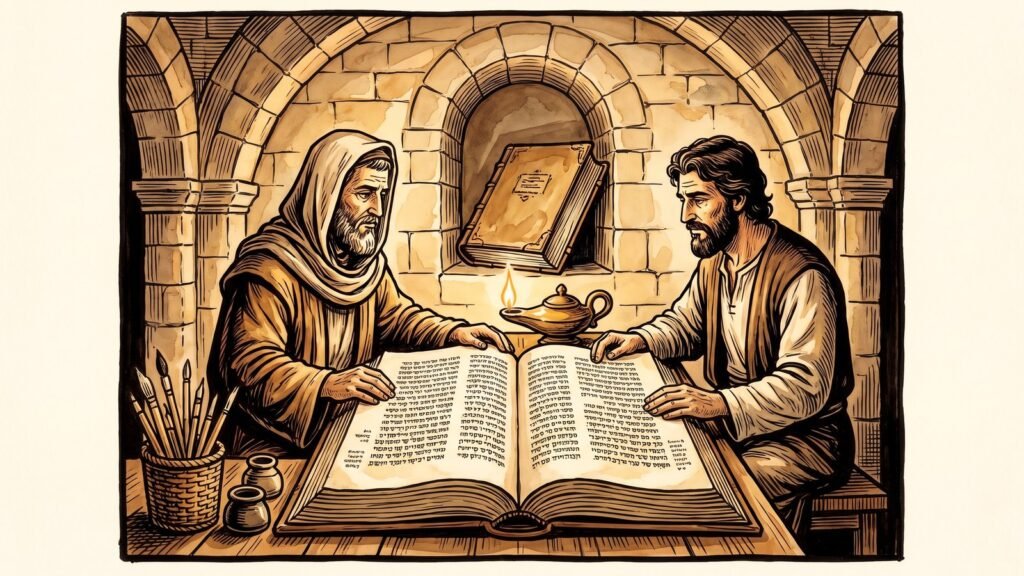
Inside the Shrine of the Book in Jerusalem, in a sealed chamber kept at a constant temperature, rests a book with no beginning. Two thirds of it survive. The Pentateuch is gone, along with long stretches of the Prophets and Writings, and the surviving leaves begin in the middle of one book and stop before the last. It is nonetheless the single most authoritative object in the history of the Hebrew Bible: the manuscript to which medieval copyists turned when they wanted to know whether the consonants, the vowel points, the cantillation marks and the marginal Masoretic notes in front of them were right. It was consulted by Maimonides, ransomed from one empire, carried across Asia in a crate, and rescued from a burning synagogue by men who smuggled it out under their robes. This is its story, which is also the story of how a written scripture came to be treated not as literature but as an object of conservation.
A Book Made in Tiberias
The Aleppo Codex was written in Tiberias, on the western shore of the Sea of Galilee, at some point in the closing years of the ninth century or the opening years of the tenth. That dating is not a guess based on paleography alone, though the script is distinctive enough to be recognised anywhere. It rests on a comparison between manuscripts. The scribe of the Aleppo Codex, Shlomo ben Buya’a, also wrote a Pentateuch that survives today in the Russian National Library in Saint Petersburg as MS Evr II B17, and that manuscript carries a dated colophon placing its completion in 929. When scholars compared the hands, the two proved to be the same. The dating of the Aleppo Codex therefore follows the dating of a document, not an impression.
The division of labour between the two men responsible for the book is unusual and has generated a great deal of argument. Shlomo ben Buya’a appears to have copied the consonantal text, the skeleton of the Hebrew Bible. Aaron ben Moses ben Asher, the last and most distinguished member of a family of Tiberian grammarians, then verified the consonants against his own authorities, applied the vowel points and the cantillation signs, and supplied the apparatus of marginal notes. That is the traditional account, and it was written down in a dedication that has not survived. Some scholars have argued that Ben Asher may have supervised rather than personally executed the vocalisation, and that the posthumous attribution of the work to him was added later precisely because his name carried more authority. On the other side, the smoothness and consistency of the pointing across all three volumes have been read as evidence of a single hand with total control. It remains genuinely uncertain, and it is worth saying so plainly: what is not uncertain is that this book was made under the direction of the man who defined how the Hebrew Bible has been read for a thousand years.
Physically, the codex as it survives is a large and handsome object. Each page measures roughly thirty-three centimetres high by twenty-six and a half wide, which is a folio of some heft. The biblical text is laid out in three columns, a layout inherited from Late Antique practice, and the leaves are written on parchment in a square script of considerable regularity. Around the text blocks runs the Masorah: the massive body of critical annotation that records how often each word occurs, which spellings are permitted and which forbidden, and where the anomalies lie. The Masorah magna runs in small characters above and below the columns; the Masorah parva, a commentary on the commentary, crowds the inner and outer margins in a tiny hand that the reader is expected to magnify mentally rather than physically.
It is worth dwelling on what the Masorah actually is, because it is the part of the book that most reliably demonstrates that this was not an act of piety but an act of scholarship. The Masorah magna is a vast corpus of annotations running the entire length of the Bible, recording, among other things, how many times a given word or construction occurs and under which spellings. It functions as a checksum. If a scribe copying a new Bible arrives at a word and has three manuscript traditions in front of him saying it appears forty-one times, the number acts as an independent check on which reading to follow. When Ben Asher’s copyist found that a word occurred an unusual number of times, the marginal annotation told him so, and he could investigate rather than simply choose. The Masorah parva, the second-level commentary, records the reasoning behind many of those decisions, including cross-references to places where a given form appears or is expected. Together they make the codex not merely a text but an argument about a text, laid down in the same hand that copied it.
There is a third layer, smaller and stranger, usually referred to as the Masorah finalis, a set of notes appended to the ends of books. Some of these record things that are not philological at all: that the book contains so and so many verses, that its opening letters follow a certain acrostic, that a particular tradition holds the book should not be read in a certain year. It is a reminder that the Masoretes were doing something wider than error correction. They were building a portable memory of the whole scripture, a device for holding the totality of the text in mind so that any individual scribe, working alone on a single quire in a single town, could check their work against the whole. That is an institutional technology as much as a scholarly one, and it is the reason the Masoretic Text has proved so durable.
Originally the work was bound in three volumes rather than one, which is the conventional description even though the binding no longer exists. Estimates of the original page count vary considerably. Ben-Zvi, who reconstructed the book in the middle of the twentieth century, put it at around 380 pages; later work has produced larger figures, and the number most often quoted today is 487. The variance is not a detail to be waved away. It tells us that nobody has ever been able to count what was lost, because what was lost was never assembled in one place to be counted. The estimates are inferences from the physical dimensions of the surviving text block, and reasonable people have made different inferences.
Why This Text Won
The Aleppo Codex is authoritative because it won a competition that was genuinely, and for a long time genuinely unresolved. In the tenth century Tiberias had more than one school of Masoretic scholarship, and the two that mattered most were named after two men: Ben Asher and Ben Naphtali. They were not merely colleagues who occasionally differed. They represented different systems of pointing, different judgements about which readings were correct, and different authorities behind those judgements. The differences between their positions have been counted, and the figure usually given is around 875, of which roughly nine tenths concern the placement of cantillation marks and the remainder concern vowel points and consonantal spelling. Nine tenths sounds like a pedantic disagreement. In a tradition where the correct reading of a word determines how it is said aloud in the synagogue, pedantry was the entire point.
The debate became institutional. Around 930, a scholar named Samuel ben David, also known as Samuel the Letters, circulated a letter that is one of the most valuable documents in the history of Masoretic studies. It reported that he had discovered a long list of errors in a Bible scroll belonging to the Ben Naphtali tradition, and that when he took his findings to Joshua ben Ga’ab, the head of the Tiberian academy, Joshua examined them and confirmed them. The list of corrections then circulated widely, and it is the reason we know the precise shape of the disagreement. Almost every item in it concerns the accentuation, and almost every item is a place where a Ben Naphtali manuscript differs from what Ben Asher’s school had decided.
It would be convenient to say that Ben Asher simply won. What happened is more complicated and more interesting. Ben Asher’s system became dominant because it had an exemplar: a book, this book, that could be consulted, collated against, and copied. A rule without a copyable model remains a rule among the initiated. A rule attached to a document travels. Once the Aleppo Codex arrived in Cairo, and then in Aleppo, copyists in Jerusalem, Cairo, Aleppo, and eventually across Spain and Italy had a physical object to work from. The Karaite communities, who had no reason to defer to a rabbinate and who had their own textual traditions, used it heavily. Their chronicles preserve early references to it, and it became, in the words of one account, the copy that was used for the correction of books. The authority of the Aleppo Codex is therefore not a claim about which theory of pointing was more correct. It is the authority of a well-used document.
Its standing was reinforced from outside the Masoretic world. Maimonides, working in the twelfth century, adopted Ben Asher’s text as the standard against which he checked his own transcriptions, and said so. That endorsement mattered enormously, and it is worth being careful about what it did and did not mean. Maimonides did not accept the Masorah wholesale as revelation. He was a rationalist about method and he objected in strong terms to those who treated marginal notes as binding law. What he accepted was the practice: a system of collation so thorough that a working scholar could reasonably treat its output as reliable. That is a narrower and in some ways a more durable kind of authority than the one his more literal followers claimed for him.
The relationship between the Aleppo Codex and the Karaite communities deserves separate mention, because it complicates any simple story of a rabbinate imposing a text on dissenters. The Karaites had their own well-developed textual tradition, their own masorah, and a well-earned reputation for textual scholarship of their own. They used the Aleppo Codex heavily, precisely because it was the best tool available, and they did so without conceding that the authority behind it lay in the rabbinic academy. The codex travelled through networks that did not respect the boundaries the later historiography would draw. Its earliest documented readers and its most devoted were frequently people whose relationship to the Tiberian establishment was adversarial. A manuscript can be authoritative without its custodians sharing the theology of its author, and this one was.
William Wickes later reproduced a page of the manuscript in the front matter of his 1877 study of the Masorah, and a missionary, J. Segall, published photographic reproductions of the pages carrying the Ten Commandments in 1910. Those two publications did more than any other single act of scholarship to make the codex a visible object to European biblical critics. Alexander Russell, a British traveller, was shown the manuscript some time before 1753 and left an account of it. By the time the twentieth century arrived, the Aleppo Codex was not a hypothesis or a report but an object with a pedigree, and its pedigree was excellent.
Five Centuries in Aleppo
The route the book took after Tiberias is reconstructed with varying confidence. It is generally held that it moved south to Egypt and was kept in Cairo, possibly in a Karaite synagogue, and that it reached Jerusalem before travelling on to Aleppo. Whatever the exact sequence, it spent the bulk of its documented life in Syria, in the custody of the Aleppo Jewish community. It was kept in a wooden box in a vault known as the Cave of Elijah, beneath the floor of the ancient synagogue, on a stone pedestal, under a veil maintained as a matter of sanctity.
That arrangement tells you almost everything about how the manuscript was regarded. It was not consulted casually. It was brought up, opened, checked, and put back. Yitzhak Ben-Zvi, later the second president of the state of Israel and one of the great scholars of Jewish communities in the Islamic world, travelled to Aleppo in 1935 hoping to persuade the community to transfer the codex to Jerusalem. He failed. By then the manuscript had acquired a halo of local history and folklore so dense that several accounts credited it to Ezra himself, the biblical scribe. A book that is believed to have been written by the author of the Pentateuch is not a research object. It is an heirloom. The distinction matters, because it shaped the decisions made eleven years later.
There is a grim symmetry here that is worth stating plainly, because it is easy to miss. The community’s instinct in 1935, and in 1947, was the same instinct: protect the object at all costs, from the state, from the scholars, from anyone who might mishandle it. That instinct is the reason the codex still exists at all. It is also the reason that when the Alexandrian scholars wanted to work on it in the 1980s they could not get access for years, and why the arguments over ownership between the Ben-Zvi Institute and the Aleppo community have never been fully settled in public. A manuscript held sacred does not enter the scholarly process gracefully. It has to be disenchanted first, and even then only in public, and slowly.
Ben-Zvi did not give up. He continued to press for the codex’s transfer, and the document he eventually received in 1958 was the culmination of more than two decades of quiet diplomatic work by a scholar who happened to be a head of state. That the route ran through a smuggler in a washing machine rather than through official channels is one of the more instructive contrasts in modern manuscript history: the most visible legal ownership of the object and the actual chain of custody are not the same thing, and in this case the second is the more interesting of the two.
The Night the Synagogue Burned
On 29 November 1947, one day after the United Nations General Assembly voted in favour of partitioning Palestine, the anti-Jewish riots that were already raging across Syria reached Aleppo. The Great Synagogue of Aleppo was set alight. The date is fixed in almost every account. What happened to the codex in the hours and days afterwards is not, and the discrepancies are instructive rather than merely confusing.
The Aleppo elders’ official line was that the book had been burned. That account was adopted by the international press and repeated for years. It has a certain logic to it: a codex of that status, if it could not be hidden, would certainly have been destroyed by a mob that had just ransacked the synagogue around it. But when the surviving leaves were examined scientifically after their arrival in Jerusalem, they showed no burn marks at all. The dark discolouration on many pages turned out on analysis to be the result of fungal growth rather than heat. The fire had not touched the manuscript.
That finding transformed the story from a tragedy into a mystery. If the codex was not burned, then somebody had saved it, and the interesting question became who, when, and how much of it survived. Several accounts emerged, and they do not agree.
According to one, the surviving material was hidden for roughly a decade in the storeroom of Ibrahim Effendi Cohen, an Aleppo Jew. According to another, members of the community cut leaves out of the codex on the night of the fire in an attempt to carry out the most important passages, which is the account given by Shahoud Baghdadi, son of Asher Baghdadi, the sexton of the synagogue, who said that he and his father found the volume torn apart on the floor immediately after the riots and gathered what they could. Ya’akov Hazan, once treasurer of the community, said in 1961 that he had seen the codex several weeks after the damage and that only a few sheets were missing. Rabbi Isaac Shchebar, who left Aleppo in 1952, said in 1989 that he had seen it just before he left and that it was almost complete.
These accounts point in the same direction. The leaves were removed by Jewish hands, and the removals were not completed. The gaps in the official story are consistent with a hurried salvage operation in which some people took what they judged essential and others took what they could carry, and nobody had time to compile an inventory.
The exit itself has its own competing versions. The name most often attached to it is that of Murad Faham, a Syrian Jew, who is said to have found the bulk of the manuscript on the synagogue floor disguised as a Bedouin, and who a decade later strapped it under his robe and crossed into Turkey. From Turkey it is said to have been wrapped in towels and shipped in a washing machine. Shlomo Zalman Shragai of the Jewish Agency, who received the codex first, testified that it was complete or nearly complete at the time. In January 1958 it reached President Yitzhak Ben-Zvi and was placed in the hands of the Ben-Zvi Institute. The president had worked for years to bring it to Israel, and he reportedly took it into his personal custody before it was formally entrusted to the institute. Ben-Zvi died in September 1958.
The Missing Leaves
When the codex arrived, it had 294 pages, inscribed on both sides. The Pentateuch had largely disappeared: a few pages of Genesis, and the closing chapters of Deuteronomy. The largest gap lay between Deuteronomy 28:17 and Canticles 3:11, and it was there that most of the sheets had been taken. Some 40 per cent of the manuscript was gone, and it is now close to a century since it was last known to have been complete.
Two leaves have since turned up, and their histories are worth telling because they show what actually happened. A complete page from the Book of Chronicles surfaced in the 1980s in the possession of an Aleppine family living in New York; the family said it had been found on the floor of the Great Synagogue on the day of the fire, and it was handed over in 1982. A fragment from the Book of Exodus, carrying part of the line in which God tells Pharaoh to let his people go, was traced to Sam Sabbagh of Brooklyn, who had found it on the synagogue floor and carried it for decades in his wallet as a good-luck charm. After his death in 2000 it took several years of negotiation with his family for it to be brought to Israel, and it was donated to the Ben-Zvi Institute in 2007. A scan was sent rather than the object itself.
These two recoveries changed the argument in two directions at once. They proved that leaves left the synagogue and that some of them survived outside Aleppo for decades, which undercuts the official story. They also proved that at least two people independently believed the fragments belonged to the codex, which is not nothing, because identifying a scrap of Hebrew on a synagogue floor as a leaf of a particular famous manuscript is not a trivial identification. Tawil and Schneider, the authors of the standard modern study of the manuscript, have argued that the missing leaves may still exist and have collected the circumstantial evidence in support of that view. The Ben-Zvi Institute has mounted searches and public appeals on the same premise.
It is worth being clear about what is not known. Nobody knows how many leaves were taken, by how many people, or where they went. Nobody has produced a leaf that is disputed. The possibility that a substantial portion of the Aleppo Codex is sitting in an unmarked box somewhere is not a scandal but a fact, and it is one of the more haunting facts in manuscript studies: that the most authoritative Hebrew Bible in the world is a book whose absence is documented in outline only.
Rebuilding the Text
The response of scholarship has been to treat the losses as a problem of reconstruction rather than a reason for despair. Two lines of work ran in parallel, and both mattered.
The first was physical. When the manuscript came to the West, the few surviving Pentateuch pages were the only direct evidence anyone possessed of what Ben Asher’s text looked like at that point in the Pentateuch. Moses Goshen-Gottstein’s facsimile, published by the Hebrew University in 1976 after roughly twenty years of work, was the first full reproduction of the surviving pages. Its importance lay in what it allowed scholars to see directly: a single hand producing a single consistent text across the entire Bible, which Goshen-Gottstein argued was itself unprecedented. He went further, arguing from the few surviving pages that the Aleppo Codex was indeed the Ben Asher manuscript referred to in later sources as the exemplar of Tiberias. That claim, which nobody could test before the codex was actually examined, turned out to be defensible once the codex was opened for study in the late 1980s and installed in the Shrine of the Book.
The second was textual. Mordechai Breuer, who was denied direct access to the codex, undertook to reconstruct the missing Masoretic text from other early manuscripts. When the reconstruction was checked against the pages that survived, it matched with a precision that surprised people who had not expected such a method to work. Breuer’s approach was then used in the Mossad Harav Kook editions, of which the Torah appeared in 1977, the Prophets in 1979, the Writings in 1982, and a complete one-volume Tanakh in 1989. These were the first editions to supply a reconstruction of the letters, vowels and accent marks for the missing portions of the Aleppo text, and they made the codex usable for study even where it is physically silent.
The printing history matters because the book is a product of print as much as of scribes. Blocks began to be carved in 1593, the year of Li Shizhen’s death in a different tradition altogether, by Hu Chenglong in Jinling, present-day Nanjing. The Jinling edition is the source text for every later edition, and it was inscribed in 2011 on the UNESCO Memory of the World Register. A Jiangxi reprint followed in 1603, and after that the editions multiply. A Wulin edition of 1640 substantially recut the illustrations, and later printings added further images. By the 1885 Weigu Hall edition, published by Zhang Shaotang with four hundred illustrations, the book had become a publishing property. A manuscript that had once been consulted by lifting it out of a stone vault was now something you could buy.
Digital images have completed the transformation. The codex is now reachable by anyone with an internet connection, which removes the last reason a scholar would need to be in the same city as a particular shelf. The remaining scholarly problems are the ones that images cannot solve: which leaves are missing, whether they exist, and what should be done about them.
It is worth being precise about what digitisation has and has not changed. It has not made the manuscript less sacred. The conditions under which it may be consulted remain restrictive, and a scan is a record of access rather than a substitute for it. What it has changed is the scale on which collation can happen. A question that once required a scholar to travel to Jerusalem and to schedule weeks in a controlled environment can now be put to specialists and students in dozens of countries simultaneously. The Aleppo Codex, produced at enormous labour by a small group of people around one man in one town, is now available as a research resource to an unbounded number of people. That is a genuine democratisation of access, and it happened without anyone deciding to make it happen; it followed from the technology.
The same technology has also sharpened the problem of the missing leaves. Digital images of the 294 surviving pages allow any researcher anywhere to check a suspected fragment against the known state of the manuscript. If a leaf of the Aleppo Codex turns up, or is rumoured to turn up, it can be identified quickly and with far more confidence than was possible when identification depended on a handful of specialists examining a scrap in person. This is one of the few areas of manuscript studies where increased access has probably increased the real chance of recovery rather than diluting it.
Why the Codex Still Matters
It is tempting to treat the Aleppo Codex as a closed question, a solved problem that modern scholarship has absorbed. Nothing could be further from the truth. Textual criticism in the last half century has moved steadily away from the assumption that the Masoretic Text is a single stable object with a single correct form, towards a model in which the Hebrew Bible circulated as a family of related but distinct textual witnesses, and in which the differences between them may be ancient rather than the result of later corruption. The Aleppo Codex has not been superseded. It has been reclassified. It is the most reliable witness we have to one particular and immensely influential way of transmitting that family, and it remains the reference point against which that transmission is measured.
That is a strange kind of authority for a fragment. The manuscript has no complete beginning and no complete end, it has been consulted by perhaps a dozen people in its own lifetime, and its most famous modern advocate was for years refused permission to open it. Yet the book that is missing still governs how the text is read. Every critical edition of the Hebrew Bible produced in the last two hundred years has had to state its relationship to Ben Asher’s tradition in order to be taken seriously. The Aleppo Codex is the reason a gap in the Pentateuch matters, rather than being a curiosity.
It is also, in the end, a story about care. A community kept a box in a vault for five hundred years. Men carried a volume out of a burning building and cut leaves out of it in the dark. A caravan of conspirators moved it across a frontier in a washing machine. A scholar who had spent his whole life trying to bring it home died within months of getting it. The scriptorium in Tiberias that made it did something that has never been repeated at that scale since: it took a text that people had been copying badly for centuries, checked every consonant, vowel and accent against an authority, and then wrote the result down once, so that every scribe after could check against them instead of against their memory. That is the whole argument of the manuscript in a sentence. It is not a monument to what people believed. It is an instrument for finding out whether they were right.
There is a lesson in that sentence which belongs to anyone who works with records rather than with monuments, and it is not a sentimental one. The Aleppo Codex was not saved because it was beautiful, though it is beautiful. It was saved because it was useful. Men cut leaves out of it in a burning building not for their aesthetic value but because those leaves contained information that could not be recovered anywhere else, and that mattered more than the integrity of the object as a whole. When two fragments eventually surfaced, they were recognised by content rather than by appearance, because a scrap of Hebrew on a synagogue floor carries no markers of its own. Its identification depended entirely on the fact that somebody had long ago recorded what the text ought to say, in enough detail to make recognition possible.
That is what a critical apparatus does. It is not decoration. It is the thing that makes the surviving fragment interpretable, and it is why the marginal notes that crowd the Aleppo Codex still matter to readers who could not care less about the relative merits of Ben Asher and Ben Naphtali. Every well-documented manuscript in the world is a small number of artefacts protected by a large amount of metadata. The Aleppo Codex happens to be a case where the metadata is more valuable than the artefact, and where a large fraction of the artefact is simply gone. The metadata is still intact. That is why the book, incomplete and mute across its most important gaps, is still in active scholarly use four hundred years after Maimonides consulted it, and still the yardstick against which the Hebrew Bible is measured.
References
- The Aleppo Codex — Yad Izhak Ben-Zvi, Jerusalem, ongoing research database
- Aleppo Codex — Grokipedia, retrieved October 2026
- The Crown of Aleppo: The Largest and Most Important Manuscript of the Bible — Hayim Tawil and Bernard Schneider, Jewish Publication Society, Philadelphia, 2010
- Masoretic Text — Grokipedia, retrieved October 2026
- The Aleppo Codex: The Vicissitudes of the Aleppo Codex — Aleppo Codex research site
- Bringing back the Aleppo Codex — Jewish Telegraphic Agency, 9 December 2007
- Scholars hunt missing pages of ancient Bible — Associated Press via NBC News, 2008
- Review: The Aleppo Codex, ed. Mordechai Breuer — Review of Biblical Literature, Pontifical Biblical Institute
- Facsimile Edition of Aleppo Codex Published by Hebrew U. — Jewish Telegraphic Agency, 12 July 1976
- Aleppo Codex, c. 930 — Center for Online Judaic Studies
- The Aleppo Bible Codex: The Crowning Achievement of the Master of the Massora Aaron ben Asher — Magnes Press, Hebrew University of Jerusalem
- That in Aleppo Once — Jewish Review of Books
- Aleppo Codex — Encyclopaedia Britannica