

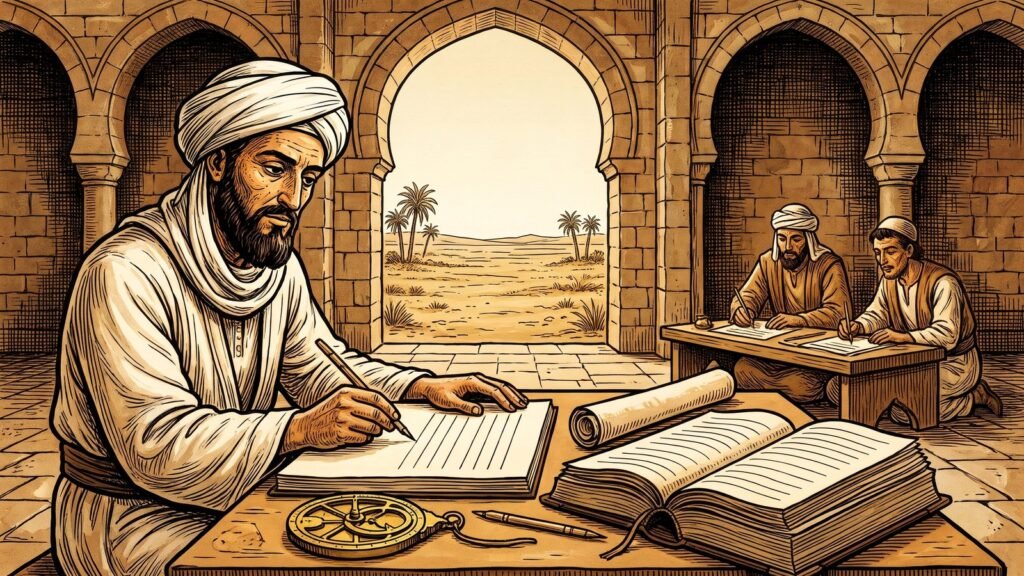
Moses ben Maimon was born in Cordoba in 1138, the son of a judge who was still a refugee from the Almohad conquest of his city when the boy began to learn the law and the Arabic philosophy of the Andalusian schools. By the time he died in Fustat in December 1204 he had written the Mishneh Torah in Hebrew, the Guide for the Perplexed in Arabic, a shelf of Galenic medicine, and a correspondence running to hundreds of letters. Almost nothing survives in his own hand, so the life has to be reconstructed from other people’s copies, from a handful of autograph leaves in the Cairo Genizah, and from the testimony of later readers who argued bitterly about what he meant.
A Family in Exile
Cordoba in the 1130s was one of the great centres of Jewish learning in the Islamic world, and the household into which Maimonides was born belonged to that world rather than standing outside it. His father, Maimon ben Joseph, was a dayyan, a recognised court judge, and he was the boy’s principal teacher; Maimonides’ mother died in childbirth, so the two of them were left to raise a family of boys in a city where scholarship and commerce were the roads to honour. The boy learned the Scriptures and the rabbinic tradition from his father and, later, from the written authorities of the previous generation. In the code he would call Isaac Alfasi and Joseph ibn Migash “my teachers”, a formula that was later mistaken for the claim that they had been his masters in person; no evidence survives of any formal apprenticeship to the philosophers of Cordoba either, and the report that he studied with Averroes appears to be a later confusion.
What the household did possess, besides a father’s judgement, was the family’s working knowledge of Arabic. It was an asset of the first importance in the Andalusian academies, where the philosophical curriculum of Aristotle, al-Farabi and Avicenna was taught in that language, and it was the one skill the family could carry with it when everything else was taken away. Maimonides was writing Arabic from boyhood: an essay on logic, and another on Aristotle’s metaphysics, both composed in Arabic while he was still in his teens, and a treatise on the Jewish calendar written when he was about twenty-three at the request of an unnamed friend. The subjects show the two currents of his education running side by side, the law and the philosophy, each with its own technical vocabulary and its own literature. He also inherited from his father the habit of a court, since a judge’s household is a household of documents, precedents and disputes, and the son turned out to be exactly the man to reduce a mountain of conflicting rulings to a single ordered instrument.
The calm of that world ended in 1148, when the Almohads took the city. Their movement, founded on a Berber reading of the faith that Ibn Tumurt had preached and that Abd al-Mu’min carried into the Peninsula, abolished the protected status that non-Muslim communities had held under the earlier rulers. Jews and Christians in the south were given a choice between conversion and exile, and the choice was made at the point of a sword; converts were made to wear clothing that marked them out, so that the authorities could keep watch on them. Maimonides was a boy of ten or eleven. The family chose exile, and chose it repeatedly: they moved about the southern districts of the Peninsula and then across North Africa for the better part of a decade, before settling in Fez, where they arrived by about 1158 or 1160. There Maimonides found a teacher in Judah ha-Kohen ibn Susan, whose death in 1165 is generally taken to have prompted the family’s next departure. They travelled to Acre, arriving on 16 May 1165, and in October of that year Maimonides walked to the Temple Mount in Jerusalem and on to the Cave of the Patriarchs at Hebron.
Egypt was the next stage and the last. The family reached Alexandria and then Fustat, the old city on the Nile opposite Cairo, where a small synagogue in the bend of the river later took his name. It was also in Egypt that the family fortunes failed. The elder brother, David, had built the household’s security on trading ventures in the Indian Ocean, and a shipwreck destroyed the capital on which the family depended; the exact year is uncertain, but the effect was not. With the money gone, Maimonides turned to medicine for a living, and in doing so entered the profession that would eventually place him in the household of Saladin’s vizier. He also took on the communal leadership that the Egyptian Jews offered him, being appointed head of the community in Fustat about 1171, replaced after a dispute in 1173, and restored to the office in 1195. The chronicler Abraham bar Hillel, who did not like him, nevertheless called him “the light of east and west and unique master and marvel of the generation”, and credited his leadership with the ransoming of Christian captives taken by the Crusaders.
What the household produced was not only the son who became famous. Maimonides’ brother David, a merchant, died before him and left him a business to administer; his own sons, David and Abraham, were given the education their father had been denied, and the elder, David, would commission the Hebrew translation of the Guide that made his father’s work readable across the Mediterranean. The family had lost a city, a language, a trade route and a fortune, and had gained instead a set of habits that shaped everything Maimonides wrote: a taste for a settled legal text that could replace what had been scattered, a conviction that the law had to be intelligible rather than merely authoritative, and a habit of moving between languages, disciplines and courts that never left him.
The Young Codifier
The first book Maimonides finished on his own account was a commentary on the Mishnah, begun in Spain and carried forward during the family’s wanderings, and completed in Arabic around 1168. It is the work of a young man in his late twenties, and it is where the thirteen principles of belief first appear in his writing, in the course of an exposition of the law of the Sanhedrin. It also shows the method he would keep: the received tradition is treated as authoritative, its sources are named, and where practical law is unaffected he dissents in plain language.
The Mishneh Torah is a different kind of book, and it was made for a different public. A code is not a commentary; it is a single authoritative instrument that can be consulted without going back to the commentaries, and Maimonides set out to write one for the whole of Jewish law, deriving every rule either from the written text of the Torah or from the received interpretation of it. The work was compiled in the decade between 1170 and 1180, in Fustat, and it is arranged in fourteen books running from the Book of Knowledge to the Book of Judges. Its opening book is not a book of ritual but of philosophy and ethics, setting out the principles of belief before it sets out any law at all, which tells the reader at once what kind of instrument this is meant to be. The introduction complains, in measured terms, that in Maimonides’ own day the wisdom of the learned had thinned, that the earlier compilations had become hard to follow, and that the result was that law had to be consulted at second hand and through dispute; the code’s purpose is to make the law “systematically known to all” in plain language and terse style.
The contents follow from that purpose, and they are arranged with a scholar’s instinct for the order of study. The introduction proper states the transmission of the oral Torah, lists the positive and the negative commandments, and then sets out how the commandments are to be organised, which is the programme for the whole work. The first book sets out the principles of belief, the duty of study, the treatment of idolatry and of repentance, and the theory of the moral traits on which the books that follow depend; then come the Book of Love and the fixed prayers, the Book of Times with the reckoning of the calendar and the festivals built upon it, the law of persons, the sanctuary and its worship, the book of acquisitions, the laws of the courts, and the last book, which ends with the coming of the Messiah, who is to restore sovereignty to Israel, establish peace among the nations, and lead the world in the study of science and philosophy, without making people rich, altering the Torah or working miracles. The ambition is visible in each choice. A code that begins with metaphysics and ends with political theology is not arranging material for convenience; it is arguing that law is the visible form of a philosophy of conduct, and that a court is as much a school of character as a place where disputes are settled.
One of the strangest facts about the code is the language it is written in. Maimonides had already established himself as an author in Arabic, and his earlier work on the Mishnah was composed in Judeo-Arabic for readers who thought in that language; when a friend suggested that the Mishneh Torah be put into Arabic as well, the reported answer was that he would rather have his Arabic writings translated into Hebrew than the reverse. The choice was not merely aesthetic. A code is a book of rules for a community, and the community’s language was Hebrew: a text in the sacred tongue could be recited, memorised, glossed and carried from one synagogue to the next, and it could be quoted in a court without the intermediate of a translation. The consequence is that the most influential Jewish legal work of the Middle Ages was also its best piece of sustained legal Hebrew, written in a style deliberately modelled on the Mishnah rather than on the ornate register of the philosophers.
His Arabic books were written for a different audience, and the choice there was equally deliberate. The philosophical and medical works had to be legible in the world in which they were composed, where the arguments of Aristotle, al-Farabi and Avicenna were conducted in Arabic and could not be answered in a language their opponents did not read. Accounts of his intention generally agree that the Guide was written in Arabic so that it could take part in the philosophical conversation of the Islamic world and not only in the disputes of the rabbinic academies, and the enthusiasm with which the rabbis of Lunel wrote to ask for a Hebrew version of it shows how far outside the circle of its first readers it was meant to reach. Across his career Maimonides moved deliberately between tongues, sometimes writing in one and translating into the other himself, and in the Guide he returns to the Hebrew of Scripture with a philologist’s attention, taking single words such as the “she’el” of Ezekiel’s vision and the divine attributes as the starting points of an argument.
The code was never accepted without a fight, and the fight began at once. The sharpest and most durable opponent was Abraham ben David of Posquieres, whose notes on the code are printed beside it in nearly every edition and who found fault with Maimonides rule by rule, arguing that several of the master’s rulings were wrong. Others, such as his cousin Nahmanides, took up the same complaint in the next generation, and the controversy over the code ran for centuries. Maimonides met it in his own fashion. He accepted criticism where it was right, and the copy of the code that carries his own corrections shows a writer revising as he went rather than dictating a finished instrument. His argument with his critics was never about authority but about method: a code that gives a reason for each rule can be argued with, while an anthology of rulings cannot.
The Physician
Medicine was for Maimonides a trade as well as a discipline, and it came to him because the family’s capital had sunk. He read medicine in Spain and in Fez in the Galenic tradition as it had been received and elaborated in Arabic medicine, drawing on the Canon of Avicenna, the writings of al-Razi, and above all the work of the Cordoban physician Ibn Zuhr, whose son he had met and heard teach. No record of a formal course of training survives, and his own hint is that he read before “the elders before whom I have read”; what distinguishes his writing is the habit of testing inherited statements against observed cases, and his insistence that the physician must win the cooperation of the patient, the attendants and the surroundings as well as doing what is right himself. His practice was wide, covering asthma, diabetes, hepatitis and pneumonia among many other conditions, and he insisted throughout on moderation, regimen and the care of the whole person rather than the treatment of a single organ.
The medical corpus is substantial and was translated into Hebrew within a generation, which is one reason it survives at all. The Medical Aphorisms of Moses, called Pirke Moshe in Hebrew and Fusul Musa in Arabic, is the most voluminous of his medical books: fifteen hundred aphorisms arranged in twenty-five chapters, each dealing with a different area of medicine, from anatomy and physiology to diagnosis and the causes of disease. Beside it stand a commentary on the aphorisms of Hippocrates, in which his own views are interspersed with the text; a discourse on asthma, written for a patient whose headaches were so violent that he could not wear a turban; a treatise on the cause of the collapse of the organs, on haemorrhoids, whose Hebrew translation was made by Moses ben Samuel ibn Tibbon in 1244 and was reprinted several times in the nineteenth century, at Prague in 1838, at Jerusalem in 1885 and at Warsaw in 1886; and the Regimen of Health, written in 1198 for the Ayyubid prince al-Malik al-Afdal, Saladin’s eldest son, which treats of diet, hygiene and drugs for the use of someone with no physician at hand and closes with an hour-by-hour account of the day of the sultan it was written for.
His standing at court came with that practice. According to the medical biographer Fred Rosner, Maimonides was appointed court physician in 1174, at the age of thirty-nine, to the vizier al-Qadi al-Fadil, regent of Egypt during the sultan’s absence on campaign; other accounts place the appointment later and describe him serving Saladin himself and then the Ayyubid house. Richard the Lionheart is said to have invited him to become personal physician during the Third Crusade, an offer Maimonides declined. The court work was of a piece with his medicine: the questions put to him were not only those of the sick body, and Rosner records the sultan asking his physician to advise him on the matter of his own potency, a request Maimonides answered in the measured language of a man who treats kings as other men. The better-known evidence for the texture of his working day is a letter he wrote in 1199 to Samuel ibn Tibbon, the Provencal scholar who was then translating the Guide into Hebrew. Maimonides describes returning from the palace exhausted and hungry to find the antechambers full, “Jews and Gentiles, nobles and common people, judges and policemen, friends and enemies”, so that he would heal them and write prescriptions for their illnesses until the evening, and would then be “extremely weak”.
Medicine was not an interruption of the philosophical work but part of it. His treatise on the moral traits treats the regulation of the passions as the physician treats the body, and the two analogies are held together deliberately: the law trains character, and the law is to the soul what regimen is to the body. He insists that intellectual work is impossible for a person who is sick, undisciplined or living in fear of bodily harm, which is why the care of health comes first in his practical teaching, and why the laws of diet, rest and the hours of the day matter to a man whose business is the perfection of his reason. He is also careful to mark the boundary between the two disciplines, observing that while the physician treats the particular person who comes before him, the law can only treat the general case, which is why the law is not tied to time and place but the treatment is. William Osler, writing at the end of the nineteenth century, called him prince of physicians; the judgement is generous, but the treatises on asthma, diet, haemorrhoids and regimen, written by a man with a caseload of kings and a code of law behind him, are still there to be read.
The Guide for the Perplexed
The book began as a letter. Maimonides addressed it to Joseph ibn Judah ibn Aknin, a poet and scholar who had come to him from Alexandria, worked through astronomy and then logic with him, pressed him for explanations he had not intended to give, and was finally taught the esoteric material in the prophetic books by hints and suggestions. When the pupil left, Maimonides told him in the prefatory letter that their discussions had prompted him to compose the treatise “for you and for those who are like you, however few they may be”, and that he had divided it into chapters to be sent as each was completed. The result is a work in three parts, written in Judeo-Arabic, generally dated to the decade between the completion of the code and about 1190, when the final reorganisation was made.
The Guide has two declared objects, and they are the two halves of its method. The first is to explain the words of the prophetic books that perplex a religious man who has been persuaded by philosophy and cannot now accept the plain sense of the text without damage to his faith; the second is to explain the figures in the prophets that are read literally by the careless and allegorically by the learned but still not understood. To do this Maimonides had to write for readers at different depths, and the levels run through the book like the courtyards of the palace he describes in its final chapters: the outer court for the multitude, an inner court for those who can follow an argument, and the innermost for the few who have mastered the sciences. The famous distinctions between what is true, what is necessary for the training of the many, and what is prudent for the few follow from the same premise. It is a book that asks the reader to look at a Hebrew word rather than to accept a category, and it argues that the plainest reading of the Bible, taken literally, gives a God with a body, which is a form of idolatry.
The three parts carry the argument in order. The first treats the divine attributes and the proofs for the existence of God, and works towards a negative theology in which every positive description of God is shown to be either false or equivocal, since nothing that can be predicated of a created thing may be predicated of the Creator without distortion. It also turns, with some asperity, on the arguments of the Muslim theologians, whose proofs of creation and providence Maimonides thought could be shown to be weaker than they claimed. The second part is metaphysical and prophetic in turn: it treats the faculty of imagination, the conditions of prophecy, and the sciences on which a philosopher must be trained before he can be allowed near the secrets of the prophetic books. The third part is the longest and the most practical, dealing with providence, with the law, and with the parable of the palace in which the three courts stand, before ending with the perfection of the soul and the coming of a teacher who will bring the nations to the study of science. On the question of creation Maimonides is careful to rest his position on faith rather than on demonstration, and the modesty of that refusal is characteristic of a book that is trying to persuade without pretending to a proof it does not have.
What makes the book dangerous is that Maimonides says as much. In the preface he warns that a work like this becomes “a target for every foolish conceited person to discharge the arrows of folly at him”, and he sets out seven reasons why an author may need to contradict himself or to conceal his meaning, of which he claims two. The first is that a teacher must speak at the level of a pupil who is not yet ready for the whole truth; the second is that a writer may have to open a discussion on one assumption and then reopen it on another, and the plain reader must not be allowed to notice the join. He justifies his own arrangement by a claim that the truths should be “at one time apparent, and at another time concealed”, so that the book cannot be read straight through by the wrong person. The book is thus sharp in both senses. It is a demonstration, an argument pressed step by step from the meaning of a word to the limits of what can be known; and it is a weapon that cuts both ways, since a text that declines to explain itself plainly can be turned against its author as easily as for him.
The reception in the century after his death was therefore never straightforward. The Guide was banned in some quarters and burned in others. In 1232 Solomon of Montpellier, David b. Saul and Jonah Gerondi persuaded the rabbis of northern France to ban the study of philosophy outright, the Guide and the Book of Knowledge of the code among the works named, and Maimonides’ books were burned by the Dominicans in the same year; the dispute flared again in Provence in the following years, with David Kimhi, Nahmanides and others among the participants. The Talmudic attack on Maimonides became the sharpest weapon in that campaign, and the quarrel was fought with the instruments of the legal academy as well as with philosophical argument. In 1305 a limited ban on the study of philosophy was imposed in Barcelona, where Abba Mari Astruc had made a virtue of it. On the other side stood readers who made the book their own: the Ibn Tibbon and Anatoli families made their name on both sides of the dispute, and Samuel ibn Tibbon, the translator, furnished the Hebrew version with a commentary in which the way to read the Guide becomes a matter of principle rather than of guesswork. The scholars who followed, from Joseph Caspi and Moses Narboni in the fourteenth century to Leo Strauss in the twentieth, disagreed about everything except that the book was hiding something.
And then there were the Christians. The Guide entered the Latin scholastic world in the thirteenth century, and by 1220 it was being read in Toledo by Jewish and Christian scholars together. The translation known as the Dux neutrorum carried the whole book into Latin, and a partial version, the Liber de parabolis et de mandatis, made in 1223 and 1224, has been shown to be the joint work of Samuel ibn Tibbon and Michael Scot, the Scottish astrologer who worked at the court of Frederick II and was one of the most important translators of Arabic philosophy into Latin. Thomas Aquinas, Bonaventure, Albert the Great and Meister Eckhart all knew the Guide in Latin; the first complete printed Latin edition, made in Paris in 1520, appeared under the title Dux seu Director dubitantium aut perplexorum, and Buxtorf’s Doctor Perplexorum followed in Basle in 1629. The book that had been written as a private letter to one pupil in Alexandria became a text in the universities of Paris, Bologna and Cologne, and its influence can be traced far beyond them, in the work of Spinoza, Leibniz and Newton as well.
The Manuscript Trail
Since so little of Maimonides’ own writing survives, the manuscripts do the work of a portrait. The Cambridge University Library holds an autograph letter from him to a judge, mentioning Abu’l-Fakhr and Abu’l-Mahasin, and the Taylor-Schechter Genizah collection also yielded, in 2002, a short message in Judeo-Arabic that was recognised as his: it has no signature and its first lines are missing, but the handwriting appears identical to that of other documents written by Maimonides, and it closes with the formula “u-shelomkha yirbeh”, may your well-being increase, which he regularly used at the end of his letters and responsa. The identification was clinched by a sentence in the fragment that cites the view that a person is judged by others according to his deeds and his knowledge, expressly stated in his own law code, the Book of Knowledge, Hilkhot Teshuvah 4 and 9. The leaf measures 11.7 by 7.3 centimetres and is written in semi-cursive Judeo-Arabic on paper; on the reverse are honorific titles, presumably for the recipient, who may have been Solomon ben Yefet. Cambridge also holds the first page and other portions of the Guide in the original Arabic, leaves of the commentary on the Mishnah, responsa and private letters. Sixty Maimonidean documents out of more than 140,000 Genizah fragments is a thin harvest for so productive a writer, and the discovery of a single new one is still treated as an event.
The most important manuscript in Europe is in Oxford. Bodleian Library MS Huntington 80 is the authorised copy of the code, and on folio 165r it carries the note that made its reputation: “Corrected against my own book – I, Moses, son of Rabbi Maymun of blessed memory.” A later owner, Eleazar son of Perahya, directed in his will that this and the other volumes of the code, now lost, should never be sold but kept available so that any scholar might correct his own copy against them, borrowing the volume he needed and leaving a bond for its value until he had done so. Copies made between the thirteenth and sixteenth centuries state that they were corrected from that same authorised exemplar, and David ibn Zimra, rabbi of Cairo in the early sixteenth century, wrote that he had examined the old manuscripts of Cairo, the city of his master, and a corrected manuscript said to have been corrected from one that had been corrected by Maimonides himself, and that was still to be found in Aleppo. The phrase “corrected against my own book” is the ordinary business of a law code in a world without printing, and the story of Huntington 80 is the story of that business at its most literal. The volume is also the practical basis of the code’s textual history, since the first two books it contains, the Book of Knowledge and the Book of Love, were used for the 1981 English edition of the code published from the Oxford manuscript.
Printing changed the scale of the problem rather than solving it. The edition that fixed the text in the minds of students for the best part of a century was the four-volume Warsaw printing of 1881, which carried the classical commentaries with the code and was reprinted many times in numerous places over more than a hundred years; its volumes are still consulted as the received text, and they are the copy that most readers of the Mishneh Torah have in front of them. The scholarly turning point came in the middle of the twentieth century, when a series of scientific editions began to be printed from the manuscripts rather than from the received books: the edition of Rabbi Shabsai Frankel set the classical commentators in full and relegated the early manuscript variants to the margins and to an apparatus, the edition of Yosef Qafih based its text mainly on the Yemenite manuscripts with a commentary surveying the older discussions, and the fourteen-volume Rambam Meduyyak, finished in 2021, prints the Warsaw text beside the manuscript readings so that every divergence can be seen. The variations are not trivial. Maimonides revised his own book as he worked, so that copies taken from an earlier state do not carry his later corrections, and Christian censors in Spain and Portugal cut whole passages out of manuscripts, sometimes leaving the gaps visible. A code that claims to be the law cannot be a stable text; the manuscripts are where its instability is recorded.
Nor was the code the only kind of book that travelled. The copyist’s workshop and the illuminator’s hand were as much part of the transmission as the author, and the most famous surviving manuscript of the Guide is a luxury object rather than a working text: the Copenhagen Maimonides, a codex of 352 pages written and illuminated in Catalonia in 1348, whose main illuminator is generally identified as Ferrer Bassa, the head of a Barcelona workshop. Samuel ibn Judah ibn Tibbon’s introduction to the translation stands on folio 4a and the Guide itself begins on folio 9a, so that the text of the argument arrives already framed by the account of how it is to be read; the manuscript was acquired by the Royal Danish Library in 1732. It is a book made to be admired, and its survival tells us that the Guide, for all its warnings about concealment, was also a prestige object in the communities that received it. The Hebrew translations multiplied in the same way, and so did the Latin ones, with a learned public on either side of the Mediterranean reading the same book in different scripts and for different reasons.
The two books travelled on completely different routes, and the difference explains why they were read so differently. The Mishneh Torah is a book of practice in a sacred language, written for a community, copied and carried from Fez to Cairo to Provence, printed and reprinted until it was a physical object in every study, and quoted in court and in the synagogue for eight hundred years. The Guide is a book of argument in the language of the philosophical schools, written for a handful of readers, and it entered the world only through its translators. Samuel ibn Tibbon’s Hebrew of 1204 was made with Maimonides’ own son David in mind, and Ibn Tibbon prefaced it with an account of how it must be read, so that the commentary and the text arrived together and have never been separated. Judah al-Harizi made a second Hebrew version in the early thirteenth century, more elegant and, as most scholars think, less accurate. The Latin versions belong to yet another public, that of the university, and the Latin Middle Ages read Maimonides for the sake of the philosophy rather than the law, which is why a book whose author intended it for a single pupil in Alexandria ended up being printed in Paris and translated into Hebrew in Provence and discussed in Barcelona. One of them was a working manual for a community, portable, copied, printed and obeyed. The other was a letter, and it was read as a letter, by people who had to be trusted with it.
References
- Maimonides – Kenneth Seeskin, Stanford Encyclopedia of Philosophy, first published 2006, substantive revision 18 November 2024
- Maimonides – Internet Encyclopedia of Philosophy
- Maimonides – Grokipedia
- The Guide for the Perplexed – Grokipedia
- Mishneh Torah – Grokipedia
- Maimonides’ Code of Jewish Law – Bodleian Libraries, Maimonides project site
- Bodleian Library MS. Huntington 80, Mishneh Torah (Sefer ha-Mada, Sefer Ahavah) – Digital Bodleian
- Genizah Fragments, Number 44: a new find attributed to Maimonides – Taylor-Schechter Genizah Research Unit, Cambridge University Library, October 2002
- Cairo Genizah: autograph letter by Maimonides to a judge (T-S AS 1/49) – Cambridge Digital Library
- Guide for the Perplexed, the Copenhagen Maimonides – Royal Danish Library
- The Work of Maimonides: The Mishneh Torah and the Guide for the Perplexed – Jewish Virtual Library
- Maimonidean Controversy – Encyclopaedia Judaica, Jewish Virtual Library
- The Guide for the Perplexed – translated by M. D. Friedlaender, Project Gutenberg, 1904
- The Guide for the Perplexed: Translator’s Introduction – M. D. Friedlaender, Wikisource
- Moses Maimonides: Biographic Outlines – Fred Rosner, PubMed Central
- Mishneh Torah (Warsaw, 1881), four volumes – Internet Archive
- Rambam Meduyyak: a precise Mishneh Torah, preface – Rabbi Nachum Rabinovitch
- “Members of the Covenant of the Guide”: Reading Maimonides in Christian Toledo – Lucy K. Pick, Traditio 78 (2023): 215-61
- Maimonides Latinus and a Thirteenth-Century Textual Community of Jewish and Christian Readers – Lucy Pick, OMS Lecture, Oxford Research Centre in the Humanities, 8 February 2022
- Moses Maimonides and the Latin Middle Ages – Diana Di Segni, PhD thesis, University of Cologne, 2016