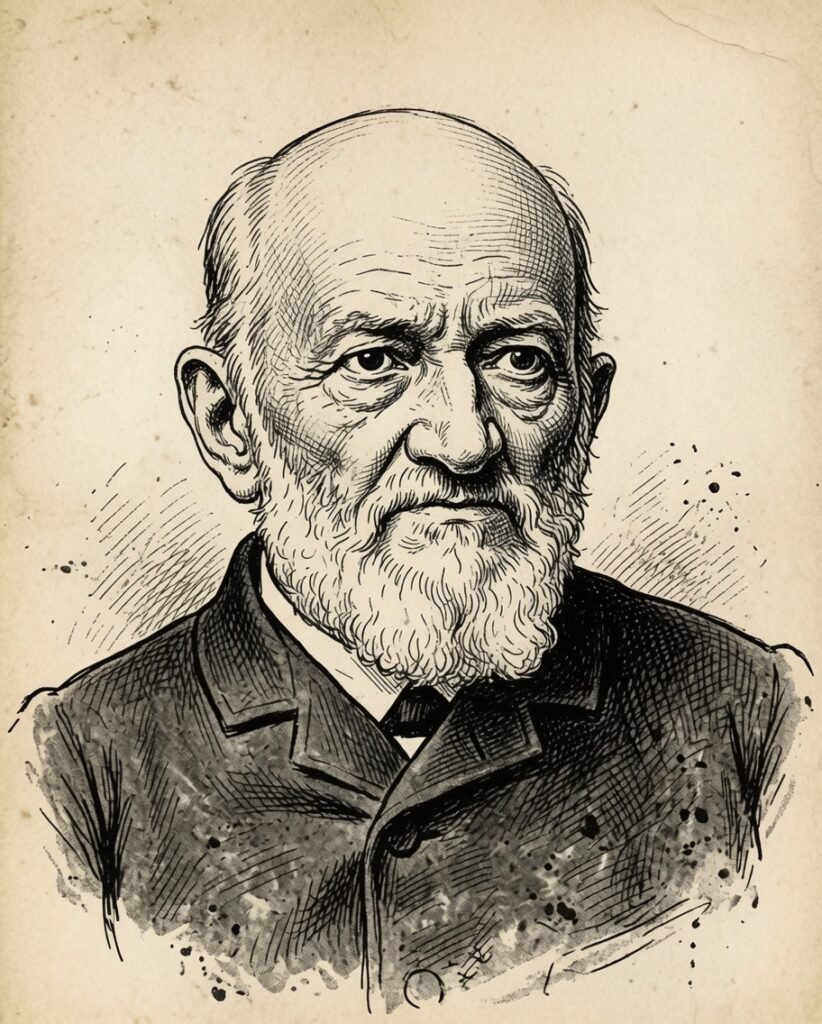
Moritz Steinschneider (1816, 1907) was the kind of scholar who spent decades quietly building the scaffolding that later generations would stand on. A Moravian Jew who became the leading Hebrew bibliographer of his age, he turned the scattered, often chaotic records of Jewish books and manuscripts into something orderly and usable. His catalogs and surveys did not just list things, they made it possible to study Jewish literature, including the Hebrew Bible and its long chain of commentaries and translations, with real precision.
He was not a biblical commentator or a source critic. What he gave the field was something more basic and more durable, trustworthy maps of the territory.
Early years and the pull of two worlds
Born in Prostějov, then Prossnitz, in Moravia in 1816, Steinschneider grew up in a household that already mixed traditional Talmud study with an appetite for secular learning. His father was a knowledgeable Talmudist who also valued practical knowledge. An uncle, Gideon Brecher, was a physician and writer who encouraged wider horizons. At six he was sent to a regular public school, an unusual step for a Jewish boy at the time, and later entered the yeshiva of Nehemiah Trebitsch, following his teacher to Nikolsburg. By his late teens he had moved to Prague, studying both Talmud and modern subjects, then spent time in Vienna and Leipzig, where he worked on Arabic with Heinrich Fleischer and collaborated with Franz Delitzsch on a Karaite philosophical text.
He picked up languages easily, Hebrew, Arabic, Syriac, Latin, and several European tongues, and began publishing small pieces while still young. There was even a brief flirtation with a group interested in early Zionist ideas in the late 1830s, though he stepped away when it struck him as unrealistic. In 1843 he received rabbinical ordination back in Prossnitz, but he never pursued a conventional rabbinic career. By 1845 he had settled in Berlin, the city that would remain his base for the rest of his life.
The Bodleian commission that shaped everything
The turning point came in 1848. That year he finally secured Prussian citizenship and, more importantly, received the commission to catalog the Hebrew printed books in Oxford’s Bodleian Library. He spent four summers there, producing the massive Catalogus Librorum Hebræorum in Bibliotheca Bodleiana (1852, 1860). It ran to roughly 3,100 pages and set a new standard: detailed entries on authors, editions, dates, and locations, with careful attention to the early Hebrew presses. The work established his reputation almost overnight and remains a reference point today.
From that point on, cataloging became his central occupation. He went on to describe the Hebrew manuscripts in Leiden, Munich, Hamburg, and Berlin. These were not dry inventories. Steinschneider examined the books physically where he could, noted their contents, identified anonymous works, corrected earlier attributions, and traced connections across collections. In the Berlin catalog, for example, he created clear sections for Bibles, biblical commentaries and translations, legal texts, philosophy, poetry, and polemics, making the material far easier for later researchers to navigate.
What his work actually did for Bible scholarship
Steinschneider’s contribution to biblical studies was indirect but foundational. He did not write new commentaries or weigh in on the Documentary Hypothesis. Instead, he made the existing evidence legible.
His catalogs documented Hebrew Bible manuscripts and early printed editions with unusual care, noting variants in layout, accompanying Targumim, and the layers of medieval commentary that surrounded the text. When scholars later wanted to study how Rashi, Ibn Ezra, or Kimḥi were transmitted, or how Arabic translations of the Bible circulated among Jews in the Islamic world, they could turn to Steinschneider’s descriptions rather than starting from scratch. His 1858 work on the Alphabetum Siracidis, Ben Sira, added to knowledge of wisdom literature that sits just outside the canonical Hebrew Bible. The great survey “Jüdische Literatur” (1850, later translated into English and Hebrew) placed biblical exegesis within the broader sweep of Jewish writing from the eighth to the eighteenth century, showing how interpretation evolved alongside philosophy, law, and poetry.
Perhaps most significantly, his 1893 study Die hebräischen Übersetzungen des Mittelalters traced how Jewish scholars had rendered Arabic and Greek works into Hebrew, including texts that touched on biblical themes and methods. It showed Jews as active participants in the transmission of knowledge across religious and linguistic boundaries. In an era when many Christian scholars still treated Jewish sources as marginal or derivative, Steinschneider’s work insisted on their centrality and complexity.
He did all of this with a resolutely factual style. He distrusted grand theories and ideological overlays. If a manuscript’s date or authorship was uncertain, he said so plainly rather than forcing a conclusion. That restraint sometimes made his writing feel austere, but it also gave it lasting value. Later scholars could build on his data without having to undo speculative frameworks.
Teaching, daily work, and a long life
To support himself he taught for decades at the Veitel-Heine-Ephraim’sche Lehranstalt in Berlin, where both Jewish and Christian students came to hear him. Among his pupils were men who would shape Jewish scholarship in the next generation, Solomon Schechter, Ignaz Goldziher, Alexander Marx, and others. He also directed a Jewish girls’ school for twenty years and worked as an assistant librarian at the Prussian Royal Library. These were not glamorous posts, but they gave him steady access to books and a measure of independence.
He married Auguste Auerbach in 1848 and raised a family while producing an enormous body of work, much of it published in his own periodical, Hebräische Bibliographie. Late in life he received honorary titles and doctorates, but he had never chased academic preferment. He turned down offers to teach at rabbinical seminaries, preferring the relative freedom of his Berlin posts.
In old age he remained clear-eyed. At eighty-six he wrote a preface that reads like a quiet agnostic statement. He died in Berlin in January 1907 at ninety.
Why he still matters
Steinschneider’s real achievement was to treat Jewish literature, including its biblical core, as something that could be studied with the same tools and seriousness applied to any other tradition. By organizing the material so thoroughly, he made comparative work possible: between Jewish and Arabic philosophy, between different streams of biblical interpretation, between manuscript traditions scattered across Europe.
His catalogs are no longer the last word. Modern projects have corrected and expanded them, but they remain the starting point for anyone who needs to know what actually exists in a given collection. The recent efforts to translate and update parts of his Hebrew Translations volume show that scholars still find the underlying research indispensable.
What feels most human about him is the sheer persistence. He spent summers in Oxford, years compiling entries by hand, and decades teaching while holding down other jobs, all without the institutional support that later generations of Jewish studies scholars would take for granted. The result was not flashy, but it was durable. He left behind the kind of scholarship that does not age quickly because it was built on careful observation rather than fashionable ideas.
In the end, Steinschneider did not reinterpret the Bible for his time. He made it possible for others to study how Jews had been interpreting it for centuries, accurately, across languages, and without pretending the record was simpler than it actually was. That quieter kind of contribution is easy to overlook, but it is the kind that scholarship still rests on.