

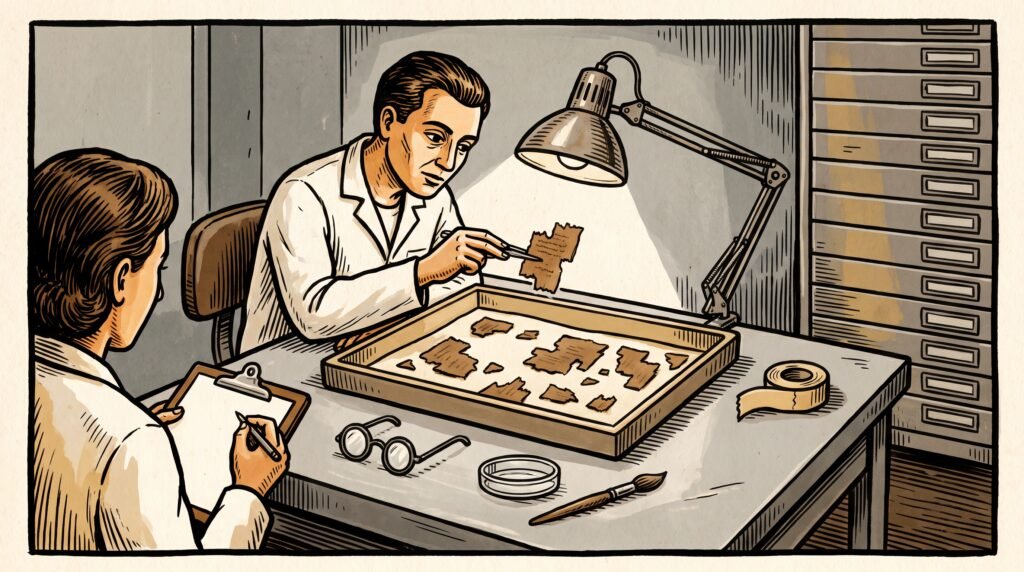
Four scraps of papyrus, the smallest no larger than a thumbnail, are the remains of a codex that, for a few years in the middle of the twentieth century, was claimed to be the oldest surviving Christian manuscript in the world. They were bought in Cairo in the summer of 1934 from a dealer named Maurice Nahman, out of a sealed envelope that still carried the unbroken wax seals of the Egyptian Antiquities Service, and they were put into the British Museum in a series that carried the name of a dead English landowner who had never set foot in Egypt. The largest of the four is about the size of a postcard; two of them carry short narratives of Jesus that are not in any of the four canonical Gospels; one of those narratives has no parallel anywhere in Christian literature; and one of the fragments was not identified as part of the same codex until 1987, when a German papyrologist working in Cologne recognised it in a collection three thousand kilometres away. The story of how they got here, and of what happened to them once they arrived, is one of the best examples in the whole history of the subject of how a text is created by the accidents of collection, cataloguing and argument.
The group is called Egerton Papyrus 2, or P. Lond. Christ. 1, and the text reconstructed from it has become known as the Egerton Gospel. It is sometimes described as one of the earliest Christian manuscripts, and that is true. It is sometimes described as a fragment of an unknown Gospel, and that is also true, though the phrase conceals a great deal of argument. What it is not is what a great many secondary accounts say it is, and the confusion is worth clearing up at the start, because it is the same confusion that runs through a great deal of writing about early Christianity: the assumption that what survives in a library must have been an important book, and that the importance of a book is visible in what survives of it.
The Envelope with the Seals Still on It
The British Library keeps the paperwork, and the paperwork is extraordinary. The file is Add MS 89298, and item 1/15 within it is correspondence about the purchase of papyri between Idris Bell, then Keeper of Manuscripts at the British Museum, Campbell Bonner, Samson Eitrem, Frank Robbins and Theodore Cressy Skeat, together with the original envelope that contained the fragments. The envelope is the point. Its face carries the seals of the Service of Antiquities of Cairo, and a note records that it was put into Bell’s hands by Maurice Nahman, with the seals still unbroken, on 21 July 1934. That is a remarkable thing to have survived at all, because a sealed envelope from the Egyptian antiquities market is the closest thing the antiquities trade has to a chain of custody, and the chain of custody here runs from an Egyptian government office, through a dealer in Cairo, to a museum in London, in a single unbroken chain, with the physical evidence of it in the form of wax that nobody thought to break and re-seal.
The purchase itself was unusual, and the reason for that was administrative rather than scholarly. The setting for that purchase is worth a paragraph of its own, because the market these fragments passed through was created in the previous thirty years and shaped everything that happened to them afterwards. From the 1890s the antiquities trade in Egypt expanded enormously, driven by European and American collectors, and the antiquities dealers of Cairo and Alexandria became the brokers through which almost every significant find from Upper Egypt passed into private collections. The Egyptian state responded with registration laws, with the Antiquities Service and with export controls, and the controls were real: the seals on the envelope that carried these fragments are the visible evidence of a system that was trying, with limited means and limited consistency, to keep track of what was leaving the country. The dealer was not a villain in this story so much as the point at which a legal and an illegal economy overlapped. Maurice Nahman sold through the machinery of the Antiquities Service, with its seals, and what the museum received was a group of objects whose find-spots nobody had thought to record, because for most of the papyri on sale there was no find-spot to record. The seal tells you that the object left Egypt properly. It does not tell you where in Egypt it was found, or in what circumstances, or whether it was ever part of a larger codex that was broken up for sale. In 1934 the ordinary purchase grant for the British Museum was suspended, and the money came instead from the Bridgewater Fund. The papyri therefore could not be entered as a new series, and so they were placed in an existing collection, which is how fragments of a Greek Gospel codex and a leaf of a liturgical book came to be filed under the name of the Earl of Ellesmere. Francis Egerton, first Earl of Ellesmere, had collected a very large number of medieval manuscripts, and the British Museum bought them in two tranches in the middle of the nineteenth century. His name was already a brand in the catalogue, standing for Latin, Irish and Anglo-Saxon codices, charters, topographical works and accounts. It was about as good a home as could be found for a scrap of a second-century gospel, and the decision was made for budgetary rather than scholarly reasons. The fragments were numbered Egerton Papyrus 1, Egerton Papyrus 2, and so on.
The group was divided, and this is the point at which the fragments became a problem rather than a treasure. Some of the papyri acquired in the 1934 purchases were retained by the British Museum and some went to Merton College, Oxford, which has had a papyrus interest since the days of Grenfell and Hunt. The separation of a manuscript across two institutions on the basis of an administrative decision, with no regard to whether the pieces belonged together, is a recurring feature of the history of the subject and it has the unhappy consequence of making the reconstruction of a text into an exercise in correspondence. What the museum held and what Merton held had to be brought together before anyone could ask whether they belonged to the same book.
There is an even more consequential separation, and it was made much later. Around the middle of the twentieth century the British Museum and the British Library were two separate institutions, and the manuscripts were divided between them: the library took the printed books and the museum kept the manuscripts and the papyri. When the British Library was created in 1973 and the collections were reunited under one roof, the Egyptians became a single collection again and the gaps in the shelfmarks were, in principle, closable. The same thing happened to the dealer. Maurice Nahman did not simply sell a box of papyri into the dark; his lot was catalogued, photographed and published, and within a year the fragments were in print. That speed is part of why this group is still so visible in the literature, and it is worth comparing with the Joshua Roll, whose parts are still scattered across a dozen institutions after more than a century.
A Gospel Nobody Had Written Down
The text itself is very small, and the shape of what survives should be stated precisely before anything is said about what it means. P. Egerton 2 consists of four fragments of a papyrus codex, written in a single column, in a documentary-looking Greek hand of the sort used for business and private letters rather than for literary books. The two substantial pieces measure roughly 11.5 by 9.4 centimetres and 12 by 9.9 centimetres. A third is a narrow strip of 6.2 by 2.5 centimetres. The fourth, as the catalogue records with some economy, contains a single letter. The pages of the original codex, when complete, would have been perhaps 15 to 20 centimetres in height, on the evidence of the related codex fragments published alongside them. Whether there was a single column or two, and how much survives of each leaf, is a matter of reconstruction rather than observation.
What the fragments contain is four episodes, and they are episodic in a way that matters. The first is Jesus’s rejoinder to those who accuse him of breaking the sabbath and of not being able to do what he does, telling them to search the Scriptures and to question the man who said that God had spoken to him. The second is the attempt to stone Jesus, frustrated, and the arrest that follows, together with the healing of a leper. The third is the question put to Jesus by the Pharisees about whether it is lawful to give tribute to the authorities that rule over them, and his answer. The fourth is a miracle worked at or by the Jordan, in terms so fragmentary that the interpretation is largely a matter of reconstruction, and which is generally taken to be an illustration of the parable about the seed that grows secretly while the farmer sleeps.
That fourth episode is the famous one. It has no parallel in the canonical Gospels, and it is one of the reasons the fragment attracted so much attention; whatever else one thinks of it, it shows that the text was telling stories about Jesus that the four canonical Gospels do not tell, and that those stories were circulating in Egypt in a form somebody thought worth copying out. It also has a quality that scholars have noticed: it is the kind of story that a teacher would expand with an illustrative example, which is precisely what the fragment appears to be, a teacher taking a known parable and attaching a story to it. That is the ordinary way in which sayings collections grow, and it is worth holding on to, because the alternative assumption – that we are looking at the lost remains of a definitive early Gospel – has driven a great deal of overreach.
The second and third episodes, by contrast, are recognisably close to the canonical material without being verbatim. The leper story is in all three Synoptics and, in a different form, in John. The tribute question is in all three Synoptics. But the wording is different, the order is different, and the narrative details do not match: in the Egerton text the attempt to stone Jesus is frustrated in a way that has no parallel, and the sequence of stoning, arrest and healing does not reproduce any of the four. The Greek used for “Lord” in one fragment was noted by the first editors as being specially characteristic of Luke, which raised a question that has never gone away: is this a source Luke used, or a text that depends on Luke, or a coincidence of idiom?
What the fragments are not is a continuous narrative. The physical evidence deserves more precision, because it constrains every reading of the text. The hand is a cursive documentary Greek of the kind used for contracts, receipts and private letters, not the careful book hand of a professional scribe. That in itself is a datum of some weight. A codex of gospel sayings copied out in a documentary hand suggests a working object, made for use rather than for display, and possibly made by someone who was not a professional scribe at all. The writing is laid out in a single column, and the surviving fragments preserve lines of about twenty-four to twenty-eight letters, which is generous for a documentary hand and consistent with a codex page of a little over fifteen centimetres in height. The text runs on without any divisions, without titles, without an author, and without any indication of where one episode ends and the next begins. There is no colophon, no subscription, no closing rubric and no marker of any kind. Everything known about the shape of this book has been inferred from where the fragments happen to break. There is no gospel of the birth, no account of the ministry in sequence, no passion narrative. What we have is a codex of disconnected sayings and stories, arranged by an editor whose principles we cannot now reconstruct, containing material that overlaps the canonical Gospels and material that does not. Whether that codex was itself copying an earlier lost gospel, or was making use of the same oral traditions that the canonical evangelists used, or was doing both, is the central question, and it is a question about the transmission of the Jesus tradition in the second century rather than about the survival of a particular book.
The Earliest Manuscript in the World
When the fragments were published, the sensation was immediate. H. Idris Bell and T. C. Skeat, the two most senior officials of the British Museum’s manuscript department, edited them in 1935 under the title Fragments of an Unknown Gospel and Other Early Christian Papyri, with a set of plates, and dated the codex to about the middle of the second century. The claim was extraordinary. If it was right, the Egerton Gospel was older than any surviving copy of any book that would end up in the New Testament, older than the oldest fragment of John in the Rylands Library, and the earliest physical witness to Christian writing of any kind. It was a genuine sensation, and the response was immediate in both directions: the argument that followed in the Bulletin of the John Rylands Library, where C. H. Dodd published his study of the new gospel in the same year, was one of the most productive exchanges in the field.
The British Museum itself was careful. In the official description the fragments are dated to the middle of the second century, which is a claim about the manuscript rather than about the text, and the distinction is one the first editors blurred. In 1987 the German papyrologist Michael Gronewald identified a small fragment in the papyrus collection of the University of Cologne, numbered P. Koln VI 255, as belonging to the same codex: it joins to the bottom of the first of the London fragments and adds portions of six lines to each side. At the same time Gronewald argued that the hand was later than Bell and Skeat had thought, pointing to a hooked form of the apostrophe that was not in general use until the end of the century, and proposing a date of about 200. The rejoinder, from the other direction, was that hooked apostrophes do appear earlier in other hands, so that a date in the middle of the second century remains arguable.
This is the pattern of most manuscript dating, and it is worth naming the mechanics of it. A manuscript is dated by its handwriting, not by its contents. Palaeographers compare the shapes of letters, the forms of ligatures, the spacing, the way a scribe writes a particular letter at speed or the way a particular scribe does something unusual. A single feature can move a date by fifty years. It is an argument between specialists, conducted over photographs, and it is not resolvable by any amount of general plausibility. Which is why the British Library, having digitised the fragments and published them in high resolution, has been able to keep the date as a range rather than a point, and why the safest formulation is a manuscript of the later second or early third century, preserving a text that may be older.
The international catalogue for such things now dates the group to between 150 and 250, with the possibility of an Oxyrhynchus provenance noted, and that range is the honest one. What is striking is how quickly the claim was overtaken. The Rylands fragment of John, published in the same year as the Bell and Skeat volume and by the same journal, was already by then being dated to the second quarter of the second century, and it has since been pushed earlier still. Within a decade, C. H. Dodd’s careful argument had established that the Egerton text was not a lost gospel of the first century but a collection of traditions circulating in the second, and the sensation of 1935 had become one more data point in a running argument. The episode is a good example of how the history of Christian manuscripts is not a story of discovery but a story of revised dates. Manuscript specialists are not in the business of crowning the oldest thing in the room. They are in the business of moving the furniture, and the direction of travel over the last century has consistently been backwards, towards later dates and towards the recognition that the earliest manuscripts are not necessarily the most significant ones. It is also, incidentally, a reminder of why the British Museum was careful in its own catalogue to date the codex to the middle of the second century rather than repeating the more dramatic claim of the editors. What is not honest, and what appears in a great many popular accounts, is the phrase “the oldest Christian manuscript in the world”, which is repeated without the qualification that made it true in 1935 and is probably false now. A papyrus fragment of the Gospel of John in the Rylands Library, which the same journal published in the same period and which this journal has already described, is earlier on most reckonings; and in any case the question only makes sense if one assumes that the oldest surviving fragment is the oldest surviving text, which is not a kind of statement that can be made about the first century and should not be made about the second.
What an Unknown Gospel Means
The larger question raised by the fragments is how much of early Christianity was written down, and in what form. If a codex of gospel sayings and stories was in circulation in Egypt around 150, then the written gospel was not a rarity and not a single thing. The gospels that won out were not the only gospels; they were the gospels that were copied widely enough, defended strongly enough, or fitted the institution that emerged around them. The point was put with characteristic sharpness by Helmut Koester and John Dominic Crossan, who argued that the Egerton text shows a form of the Jesus tradition independent of all four canonical gospels, and the more cautious version of the same claim, that the fragment represents a source or sources independent of the Synoptic material and very likely authentic in part.
Against that stands the standard argument, which is that almost all non-canonical gospels are secondary, dependent and late. The gospels that survive from the second century are overwhelmingly harmonisations, rearrangements and expansions of Matthew, and their tendency is to add, not to preserve. On this view the Egerton text is a collection of traditions that somebody assembled, most of which had already been written down elsewhere, with variations and small inventions, and the leper story and the Jordan miracle are evidence of the creativity of individual teachers rather than of an alternative gospel tradition.
The problem with that argument, which was pressed from the beginning, is that it assumes the model that the canonical gospels represent the mainstream and everything else is the margin. The discovery of the Dead Sea Scrolls in the middle of the twentieth century, in a library full of books that did not win, made that assumption much harder to hold in its strong form. If a sect in the desert could write, copy and organise libraries of books for a century and a half, and if the reason we know about them is an accident of climate and a dealer with a good eye, then the possibility that a second-century codex of sayings and stories was simply one of several traditions in circulation has to be taken seriously. The Egerton Gospel is not proof that the lost gospels were equal to the four that won, and it would be poor history to treat it as such. But it is solid evidence that the winning gospels were not the only gospels, and that the process by which they won was partly a matter of institutions rather than of literary merit.
It is also worth being precise about what kind of object this is. A codex of short gospel sayings, arranged without narrative continuity, is close in form to the Sayings Gospel of Thomas and to the kind of collection that a travelling teacher might use as a working text, a prompt book of things to say and stories to tell. It is close also to the sayings collections that Paul knew and that the letter to James seems to allude to. These are not failed gospels in the sense of being degraded versions of the four; they are a different genre, and the question of their relationship to the canonical gospels may not be a question of dependence at all, but of function.
One detail has carried more weight than it deserves. The fragments themselves are kept in a custom mount at the British Library, and they are tiny enough that a single leaf of the codex could be held in one hand with room to spare. Their edges are ragged and their fibres are exposed, which is the ordinary condition of papyrus that has been rolled, folded or reused; there are worm-holes in the margins and the surface is creased where the codex was closed. Four small fragments of this kind would ordinarily have been of no more than epigraphic interest. Their value is not in their survival but in what they were written on and what was written, and in the accident of their purchase and publication. It is worth saying plainly that the discipline of this field does not consist of finding lost books. It consists of taking four scraps that a dealer sold in a sealed envelope in 1934, and reading them properly for eighty years. The parallel with the Sayings Gospel of Thomas is the obvious one to draw, and it is more productive than it first appears. Thomas survives in a single twelfth-century Coptic manuscript found in the library of the Egyptian monastery of Nag Hammadi in 1945, and what it contains is a collection of sayings of Jesus without narrative frame, exactly of the kind that the Egerton codex may be. The two objects are worlds apart in date, language and circumstance, and the Coptic manuscript that carries Thomas is a thousand years younger than the papyrus that carries the Egerton text. But the form is the same, and the form is the point: the saying-gospel was a genre. Paul knew such collections, and the letter to James appears to allude to one. A second-century teacher in Egypt who wanted a working text of things to say about Jesus would have found one already in circulation, and would have copied from it, and would have added his own story to illustrate a parable already in it, which is exactly what the Jordan miracle appears to be. On that reading the fragment is not a relic of a lost rival gospel but a small sample of the ordinary working material of early Christianity, and the surprise of the discovery is not that a lost gospel has been found but that a commonplace thing has been found in a condition good enough to read. That is a smaller claim than the one that made the newspapers in 1935, and it is the one that has survived. The word used for “Lord” in one fragment was judged by the first editors to be characteristic of Luke, and from that a genealogy of dependence was built. In the second century, the choice between a divine title and a human one in a narrative about Jesus was the sharpest available test of how Christian a text was, and the answer matters. But the argument runs in both directions: a second-century writer using the divine title may be demonstrating that this text knows the canonical gospels, or may be demonstrating that it does not, and the same phrase can be evidence of dependence or of independence depending on what the writer is trying to be. That is a real difficulty in the subject, not a scholarly failure, and it is the reason that the most careful modern study of the group, Lorne Zelyck’s 2019 monograph, spends as much time on the physical fragments and the archival history as on the text.
The Other Egertons
The fragments did not arrive alone, and the volume that published them also published three other items from the same purchase. Egerton Papyrus 1 is a leaf of the Greek Old Testament book of Chronicles, which is a plain enough object but a reminder that the dealer was selling a mixed lot and that the Gospel fragments were, for a moment, just four objects among many. Egerton Papyrus 3 is a set of fifteen small fragments from two leaves of a papyrus codex written in two columns, which Bell and Skeat described as fragments of a Gospel commentary and dated to the early third century, calling them one of the earliest surviving manuscripts of Christian theological literature. And there is a leaf from a liturgical book, a reminder that the early Christian book trade and the early Christian worship were connected by more than subject matter.
The name Egerton also stands for a great deal else, and the shelfmark system preserves the seams. The British Library’s catalogue of digitised manuscripts lists, under the same head, a series of charters, a run of Latin and Irish medieval manuscripts, the two papyri, and rolls of medieval accounts such as the expenses of John Harcourt in Staffordshire in 1467. The collection grew by accretion over two centuries and was never a coherent library. That is normal for manuscript collections, and it has an important consequence: a shelfmark is a fact about the history of a collection, not a description of a book. When the Egyptian antiquities market needed somewhere to put a Greek gospel codex in 1934, the answer was a label that had belonged to a Derbyshire landowner for the better part of a century, and the fact that the fragments carry that name tells us about British museum funding, and about the Egyptian export trade, and about nothing whatever about the text.
That is the most durable lesson of the group. The imaging itself is the other durable thing, and it was slow in arriving. The British Library announced the digitisation of selected key papyri only in 2013, and the Egerton Gospel was among the first group, with the Gospel of Thomas fragment, a Latin deed of the sale of a slave boy with its seals intact, an Old Latin Genesis leaf from a parchment codex, and a fragment of Sophocles. That is a modest list, but it marks the moment when the study of Greek papyri changed gear, because from that point the argument could be conducted on the object. A palaeographical date that rested on a halftone plate in a 1935 monograph could be checked by anyone with a magnifying glass; a date that rests on a high-resolution digital image can be checked by anyone with a laptop, and the check can be repeated by other people. The objections to Gronewald’s redating of the codex, for instance, were made against the appearance of a single letterform, and they can be made against the letterform itself. This is the quiet revolution that has done more for the reliability of manuscript dating than any theoretical advance, and it is the reason that a group of four scraps of papyrus discovered in 1934 can still sustain an active scholarly literature. The four fragments preserve a handful of episodes that a second-century teacher in Egypt thought worth copying, and one of those episodes is unique. Everything else about them – the shelfmark, the acquisition, the dating, the claim to be the oldest book in Christendom – belongs to the history of how we found them and what we made of them. The British Library has now digitised the group and published high-resolution images of the papyrus, which means that the questions that remain can at least be argued from the object itself rather than from a photograph in a 1935 monograph. That is a genuine advance in the way this kind of subject is done, and it is the reason the fragments are worth the attention they still attract nearly a century after they were dug out of an envelope in Cairo.
References
- Fragments of an Unknown Gospel and Other Early Christian Papyri — H. Idris Bell and T. C. Skeat, London, Trustees of the British Museum, 1935
- The New Gospel Fragments — British Museum, 1951, digitised copy at Internet Archive
- Digitised Manuscripts — British Library, catalogue of digitised items, revised 10 October 2025
- Add MS 89298/1/15, Correspondence regarding the acquisition of papyri, with the sealed envelope from the Service of Antiquities, Cairo — British Library, Archives and Manuscripts Catalogue
- The Egerton Gospel (Egerton Papyrus 2 plus Papyrus Koln VI 255) — Lorne R. Zelyck, Brill, 2019
- London, British Library, P. Lond. Christ. 1 (P. Egerton 2), and Cologne, Papyrus Koln VI 255 — NASSCAL, accessed 31 October 2026
- Category: Egerton Gospel — Wikimedia Commons, accessed 31 October 2026
- Egerton Gospel — Early Christian Writings, accessed 31 October 2026
- One of Our Earliest Gospels from Outside the New Testament: The Egerton Papyrus — John W. Ehrman, Ehrman Blog, accessed 31 October 2026
- The Egerton Gospel — British Library, collection item, accessed 31 October 2026
- Egerton Gospel — Wikipedia, Wikipedia, accessed 31 October 2026
- Gospel of Thomas — Wikipedia, Wikipedia, accessed 31 October 2026