

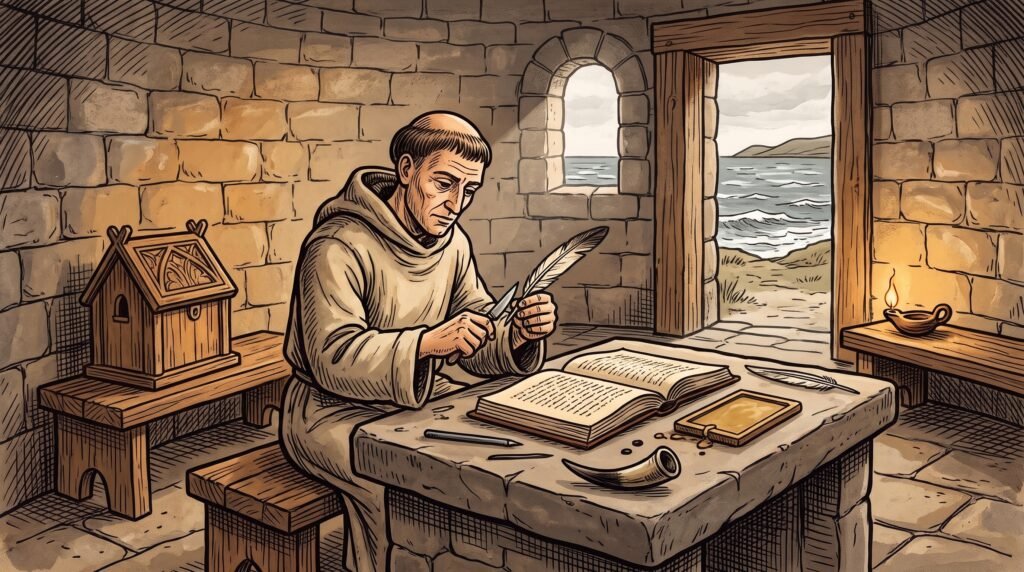
Two books are usually described when the Book of Deer is discussed, and they are not the same book. The first is a pocket gospel of the tenth century: eighty-six leaves of parchment, small enough to be carried, written in the insular minuscule of the Irish schools, carrying the four Gospels in Latin with a good deal of Irish peculiarity in the text, and decorated with four full-page evangelist portraits. On its own terms this is a thoroughly Irish object. The closest parallels in the world – the Book of Mulling, the Book of Dimma, the Garland of Howth, the Codex Usserianus primus – are all Irish, and nothing about the making of the Book of Deer says that it was made in Scotland. Most scholars, however, place its copying in Scotland.
The second book is a set of marginal notes in Gaelic, added a century or more later to the margins and blank pages of the volume. There are seven of them, in as many as five hands. They record the foundation of the monastery of Deer by Columba and Drostan; five grants of land; an immunity from dues; and a Latin breviate, or brieve, of King David I in favour of the “clerici de Der” – the clerics of Deer. One of them is dated to the eighth year of David I’s reign, which is 1131 or 1132. These notes were written at one place and only one place, because they are the archive of one monastery. They are the oldest surviving written Gaelic in Scotland.
What makes the combination exceptional is the order of it. The book was written first as scripture, and only later became a record. Here is a working object – a text for reading, probably for private use rather than for the liturgy – and here, two centuries later, is the scribal estate of a monastery scribbled into its margins because that is where the monks had a pen and a spare half-hour. No Gaelic in Scotland is older. Nothing written in Scotland is thought to be older, and the manuscript itself is generally regarded as the earliest surviving piece of writing produced in Scotland. And it was found, in Cambridge, in 1860, by a librarian who had recognised that the book in front of him was not what the catalogue said it was – after two centuries in which it had been credited to the wrong shelfmark in the wrong library.
Found in Cambridge in 1860, and Lost in Scotland First
The misattribution has to be described precisely, because it is the kind of error that is instructive rather than merely careless. For much of the nineteenth century the Book of Deer was cited as a National Library of Scotland manuscript, Adv.MS.19.3.1. That shelfmark is in fact a late fifteenth-century paper manuscript of Lydgate’s Life of Our Lady, a copy of a Middle English poem about the Virgin, and it has nothing whatever to do with Deer, with Gaelic, or with Scotland’s earliest writing. The two objects had been confused because both were associated with the same name in the same century, and because a shelfmark is a far more durable piece of information than a description. A mistaken attribution is easy to make and hard to unpick, because once a manuscript has a citation, every subsequent scholar is reading the citation rather than the book.
The correct identification was made by Henry Bradshaw, in the University Library at Cambridge, in 1860. The book had been in Cambridge for well over a century by then. Its earlier history is a sequence of private collections: it was acquired by Thomas Gale in 1695, it passed to John Moore, the Regius Professor of Greek and later Bishop of Ely, who died in 1714, and from Moore it was presented to the University in 1715 by George I. It was a country gentleman’s book in the late seventeenth century and a royal gift in the early eighteenth, and it stayed in the University Library for the next hundred and forty-five years without anybody working out what it was. Bradshaw did that work in 1860, and the Deer material was published soon afterwards in John Stuart’s edition of 1869 for the Spalding Club. The two acts – the identification and the edition – are the moment at which a marginal scribble in a small Irish gospel book became the earliest surviving writing of Scotland.
The printing history of the notes carries the same irony. Whitley Stokes set the texts out in 1866, and Cosmo Innes produced a facsimile in 1867 – in the National Library of Scotland’s own series of facsimiles, a series founded to reproduce the manuscripts the Library believed it held. John Stuart’s edition for the Spalding Club came in 1869, with the Latin gospel texts and the Gaelic notes together. The texts have been worked over repeatedly since: MacBain in 1885, Fraser in 1938, and Kenneth Jackson, whose edition of 1972 is the basis of the electronic text now in general use. The first of those were produced while the misattribution was still standing, and the accuracy of the reading has improved as the hands have been understood rather than as the shelfmark has been corrected.
The manuscript is Cambridge University Library MS Ii.6.32. That is the shelfmark, and it should be given as such. The book was later lent back to its own region and displayed at Aberdeen Art Gallery, so that it could be seen in Scotland for the first time in a very long time, with the digitisation available page by page for anyone who could not travel to see it. The loan is a small thing, but it says something that the shelfmark history had concealed: this is a Scottish object that spent three centuries in England and only became recognisably Scottish when it was found.
There is a second and less comfortable truth in the provenance. The Book of Deer did not come from Deer. The monastery at Old Deer in Aberdeenshire is the place where the marginal notes were made, in the twelfth century; the earlier provenance of the Gospel book is a separate question, and the corpus of Irish manuscript studies has proposed another foundation, at Cenne in County Offaly, as the place from which the book may have come before it travelled north. Whatever the answer, the relationship is the right way round for the essay’s purposes. The book was made somewhere in the Irish world and carried to Scotland; the monastery of Deer then made the book its own, and used it – in the margins of a gospel book, where there was no other paper to hand – as the place where it kept its accounts.
The Book Itself
The Book of Deer is a small book with a complicated interior. It is eighty-six parchment folios, the leaves measuring 157 by 108 millimetres, with a written area of about 108 by 71 millimetres and between twenty-two and six lines to the page – the variation is worth noting, because a change in line count across a codex usually marks a change of hand or a change in the unit of copying. The ruling is done in hard point, the dry incised lines of a stylus rather than the ruled lines of a pen, which places the book in the insular tradition of book-making; the second folio is unnumbered, a small piece of evidence about how the book was assembled and collated. The script is the Irish minuscule of the period, of the kind that can be read by anyone trained in the tradition of Insular hands.
The contents run in an order that tells the reader what kind of book this is. They begin with excerpts from Matthew, on folios 1 to 15, which carry not the whole Gospel but the passages a reader might most want – the infancy narratives and the opening of the teaching. Then the whole of Mark, on 16v to 27v. Then, on 28v and 29, something that does not belong to a gospel book at all: the Officia divina pro infirmis, an office for the visitation of the sick, which is the single most distinctive thing in the manuscript and the part of it that no other gospel book has. Its rubrics are unique, and it preserves the rubrical detail of a piece of Irish liturgy that is otherwise difficult to reconstruct. Then excerpts from Luke, on 29v to 40, and then the whole of John, on 41v to 84v, which is the only complete Gospel in the book. The collection closes with the Symbolum Apostolorum, the Apostles’ Creed, on folio 85.
Four evangelist portraits face the openings, on folios 1v, 16v, 29v and 41v – one for each of the four texts that open a section, Matthew, Mark, Luke and John. They are the ornament of the book, and they are what makes it a familiar object to anyone who has handled an Insular gospel book: full-page figures in the Insular manner, with the heavy frame of interlace and the flattened, formal treatment of the head and shoulders that marks the style. The book ends, like most books of its kind, with a request for a prayer for the scribe’s soul.
The Latin text is a mixed thing, and mixedness is the point of it. It is the Vulgate, or a Vulgate-related text, but not a pure one: it carries Irish peculiarities, the readings and spellings and grammatical habits that a scriptorium working in Irish hands would produce, and they are scattered through the text rather than concentrated in one place. This is the ordinary condition of a book copied in Ireland from an exemplar of some authority, and it is the reason that such manuscripts are indispensable to the study of the Latin Bible. A manuscript that reproduces its exemplar exactly tells you about the exemplar. A manuscript that reproduces it with the local habits showing through tells you about the exemplar and about the place, and about the century, in one document.
As for its date, the catalogue entries give a range – the codicological description records it as ninth century, second half, to tenth century, first half, with the hand current from about 850 to 1000 – and most scholars put the copying in the tenth century, in the first half of it. The Book of Deer is therefore a book of roughly 900, produced in Scotland, and its marginalia are of the early twelfth century. The gap between them is the whole of the essay’s subject, and it should be stated clearly at the outset rather than blurred: the book is tenth century and the Gaelic is twelfth, and no part of the Gaelic was part of the book when it was made.
An Irish Book in the Scottish Manner
It is worth being precise about the class of book this is, because the class explains almost everything else about it. The Book of Deer is a pocket gospel – an euangelium, in the sense in which that word was used in the early medieval West for a personal book of the gospels carried about by an owner rather than set on an altar. It is not a liturgical book. It is not a lectionary, and it does not function as one; there are no readings laid out for the year, and its presence in the argument is as a gospel book and nothing more. Its size, at 157 by 108 millimetres, its selection of material, its appendices and its closing prayer for the scribe all belong to the private devotional genre, and the parallels for that genre are unambiguous: the Book of Mulling, Trinity College Dublin MS 60; the Book of Dimma; the Garland of Howth, Trinity College Dublin MS 56; the Codex Usserianus primus. Every one of them is Irish.
The contrast with the other end of the Insular spectrum is instructive. The great gospel books of the seventh and eighth centuries – the Book of Durrow, the Lindisfarne Gospels, the Book of Kells, and the Book of Armagh itself – were made for the liturgy and for the glory of the house that made them, and they are objects of the highest order. The Book of Deer is not in that class at all. Its illuminations are four evangelist portraits and little else; beyond them the book is unadorned, apart from later marginal additions showing human figures, animals and birds. Its text is a working Latin with local habits showing through. It is the book of a monk who wanted a gospel to read and had the parchment to hand, and the smallness of it is a fact about devotion rather than about poverty.
And yet the consensus of the scholarship places the copying in Scotland, even though the genre, the parallels and the character of the hand are Irish. That is a tension rather than a contradiction, and the most likely resolution is the ordinary one: the scriptorium tradition that produced such books in the Irish world was shared, and its practitioners moved. Whatever the mechanism, the outcome is a manuscript that is Irish in every respect of its form and that is generally assigned to a place in the north. The Gaelic marginalia confirm the destination even though they say nothing about the origin: by the early twelfth century the book was in Aberdeenshire, and it stayed there.
One item in the contents deserves a note on its own, because it is both the most unusual thing in the manuscript and the easiest to misdescribe. The Officia divina pro infirmis, on folios 28v to 29, is an office for the visitation of the sick – a service, not a set of scripture readings – and its rubrics are, so far as is known, without parallel. It preserves the working detail of a piece of Irish practice that would otherwise be very hard to reconstruct, because offices of this kind were written to be used and then were not written down. It is also worth saying what this is not: it is not a claim that the Book of Deer carries the earliest musical notation in Scotland. Irish musical notation, where it exists at all, belongs to the twelfth century and later, and the Deer volume does not carry it. The office survives in text, with its rubrical instructions, not in song.
The Oldest Written Gaelic in Scotland
What makes the Book of Deer more than a well-made small book is the writing in its margins. In the blank spaces left beside and between the lines of the Latin text, and on the pages where the text does not reach, there are seven short notes in Irish, written in as many as five hands and at various dates. They are the earliest surviving written Gaelic in Scotland, and the manuscript that carries them is the earliest surviving piece of writing produced in Scotland.
The notes are not translations and they are not commentaries on the text they sit beside. They are the archive of the monastery of Deer, and they are the ordinary business of an institution that has land, wants it confirmed, and needs to be able to prove what is owed to it. One records the foundation of the house: that Columba and Drostan came to the place, that Drostan was made abbot, that the land was given, and that the community asked to be treated as clerics – the phrase the notes preserve for them is the “clerici de Der”. Others record five separate grants of land, and an immunity from the dues that would otherwise fall on the community. And one preserves the most valuable document of all: a Latin breviate, or brieve, of King David I, in favour of the clerics of Deer. One of the entries is dated to the eighth year of David’s reign, which is to say 1131 or 1132.
The first of the seven is the foundation story, and it repays reading closely because it shows a legal claim and a miracle welded into one another. Columba and Drostan, the son of Coscrach, came from Iona to Aberdour, and Bede the Pict was mormaer of Buchan when they arrived; Bede gave them that monastery free of mormaer and toisech until Doomsday. At the second monastery Columba asked Bede for it and was refused. Then Bede’s son fell sick and was all but dead, and the mormaer came to the clerics and asked them to pray, giving them land from Cloch in Tiprat as far as Cloch Peitte Meic-Garnait; the prayer was made and the boy recovered. Whereupon Columba gave Drostan the monastery and blessed it, leaving the curse that whoever should come against it should not be full of years or of success. Drostan wept at the parting, and Columba said: “Let Deer be its name from this on.”
The second note, the longest of the seven, is a roll of grants. Comgell son of Aed gives from Oirte as far as Puridene; Muiredach son of Morgann gives Pett Meic-Garnait and the field of Toiche Teimne; Matain son of Cairell, and Cu Liú son of Baithin, give the dues of their offices; and a string of others follows. Each grant quenches, in the formula of the charters, the dues that would otherwise fall on the land and confirms the holding to Drostan and to Columba. The note closes with the blessing of the Lord on every mormaer and every toisech who complies with it, and on their descendants after them – and with a curse on anyone who comes against it. The third note is a grant made for the consecration of a church, with a bond to Cormac, bishop of Dunkeld, in the eighth year of the reign of David, and it is witnessed by a bishop of Aberdeen, an abbot of Brechin and a judge. The witnesses are named and the year is given from inside the document. These are not oral traditions written down late. They are documents, and they date themselves.
The whole of that is what the earliest Gaelic in Scotland consists of. Not a verse of scripture, not a homily, not a charm against illness. A foundation story, a set of land grants, an exemption from taxes, and a royal writ. The monks who wrote them were doing the work that monasteries do: they were keeping accounts, securing title, and making sure that the next generation could find the documents. They did it in the margins of a gospel book because that was where a pen and some parchment happened to be, and because a book that was already the property of the community was the right place to keep what the community needed to remember.
It is worth holding on to how strange that is, and how ordinary. A monastic foundation does not set up an archive and a scripture does not expect to become one. What happened at Deer in the twelfth century is that a working book became a working archive, and that the archive outlived the book entirely: the Gaelic notes are in a manuscript, but the rights they record were exercised in the world, over fields, against neighbours, by people who were mostly not thinking about the gospel text that surrounded them. John is running from 41v to 84v on the leaves where some of this was written. The words on the page are the words of the evangelist; the words in the margin are the words of the mormaer and the king; and the second set has turned out to be the older evidence of Scottish writing.
The practical consequences of this habit are visible across the whole manuscript. The marginal notes are written in the margins of a text that was already being used for reading, and they have been added at different times, by different hands, without any attempt at uniformity – which means the book passed through the community over a long period, accumulating records as it went. The notes also preserve, in the Latin brieve, a document of a kind that would otherwise be entirely lost: the terms on which a twelfth-century Scottish monastery held its land were usually transmitted in copies, and copies were made in churches that had no reason to preserve a grant to a house of the north. That this one survives is the accident of a monastery that wrote its records on the one book it had to hand, and of a binding that kept the two together for eight hundred years.
The Book of Armagh, and What a Named Manuscript Looks Like
The best comparison for the Book of Deer is another Irish manuscript of the same order of ambition that survives by a comparable accident of history: the Book of Armagh, Trinity College Dublin MS 52, written in 807 by a monk named Ferdomnach for the use of St Patrick. It is a composite manual – a book assembled rather than copied straight through – and it gathers together the Life of St Patrick, the falsely-breviate of Patrick, the Life of St Martin, a commentary on the psalms, and a poem on the Trinity. That list is the shape of what a house needed to keep: a saint’s life, a document, another saint’s life, a working scriptural commentary, and a piece of theology.
Two things about the Book of Armagh make it the right foil for the Book of Deer. The first is that it names its scribe. Ferdomnach signs his work, and the manuscript is dated by that fact rather than inferred from a hand: 807 is not a scholarly estimate but a datum. The second is the falsely-breviate, the document in the Armagh that purports to be a grant by Patrick himself and that is not – the judgement is in the name the scholars have given it. A community inserted a legal document into a book in order to give the document the authority of antiquity, and the book was the place where such things were kept, because a book was what the library had and what the charter-hood was preserved in.
Compare that with Deer. The Book of Deer’s tenth-century scribe is unknown; the book carries no date; its Gospel text is a mixed Latin Vulgate with Irish habits showing through; and the legal documents that give the monastery its memory are not forgeries but the real thing, written in a working hand into whatever space was left over. The Book of Armagh announces itself – scribe, date, patron, contents – and the Book of Deer does not announce anything. It was not made to be a record of anything. It was made to be read, and it became a record only because a community found it useful and wrote on it. That is the difference between a manuscript with an author and a manuscript with a afterlife, and it is why the Book of Deer is a harder and more interesting object than the Book of Armagh, however fine the Armagh’s contents.
What Gaelic Scriptural Marginalia Mean
The notes themselves belong to a recognisable kind of writing. They are not a stray hand that wandered onto a blank leaf; they are charters and memoranda, the documents by which a monastery held its land, and they are written in the formulaic language of such documents – grants confirmed, dues quenched, curses pronounced against whoever came against them. One of them ends with the blessing of the Lord on every mormaer and every toisech who complied with it, and their descendants. Another records a gift of land made for the consecration of a church, with a bond to the bishop of Dunkeld and a list of witnesses that includes a bishop of Aberdeen and an abbot of Brechin. These are the formulae of Irish and Scottish charter material, and the monks who wrote them were doing exactly what their neighbours in Ireland and elsewhere were doing: they were securing title and they were recording it.
It is worth setting the Book of Deer in the wider body of early Irish writing, and also worth being careful about the boundaries of that body. The earliest substantial written Gaelic is not the Deer notes but the prose that surrounds them in the tradition: the material associated with the tract on the Mass, and the notes on the psalms, which belong to the same twelfth-century milieu but are preserved in other manuscripts. The Book of Deer’s distinction is not that it holds the beginning of Irish prose. It is that it holds the earliest surviving written Gaelic in Scotland, and that what it holds is not a translation of scripture but a set of legal and devotional annotations around scripture. Other libraries in Ireland have their earliest prose; Scotland has this. And it has it in the margins of a Gospel book, in a script in which most of the readers of this essay will not read a word, on the pages where the Word was supposed to be.
It is worth being precise about the kind of evidence this is, because it is not the kind that textual criticism usually wants. The marginalia say nothing whatever about how Matthew or John was copied, and they would be useless in a critical apparatus. What they do supply is evidence of use – evidence that a book was kept in a community, written on, and read, and evidence of what that community needed to record. That is a different order of testimony from the one that a discipline organised around texts is built to gather, and it is testimony that is easily discarded because it sits outside the apparatus. The Book of Deer is one of the clearest cases in British manuscript history of a book whose marginalia matter more than its text; and the reason they matter more is that they are the only evidence we have of a community doing the ordinary business of living, rather than of a community doing the extraordinary business of copying a sacred book well.
Two other comparisons sharpen the point. The Perth Martyrology – the great twelfth-century collection of the deaths of Irish saints, which survives in the National Library of Scotland – is the other great monument of early Gaelic written in a monastery for the house’s own purposes, and it is a reminder that the medieval library was not divided into a shelf for scripture and a shelf for business. And there was a psalter of St Columba at Deer, of which we have no manuscript at all: it is known only from later references and from the Deer tradition, and it is exactly the kind of book that a monastery might write on the blank leaves of another book rather than copy out entire. The point of mentioning these is not that they are better or worse witnesses. It is that the earliest Gaelic in Scotland is, on the whole, the paperwork of small communities in a new political order rather than the work of a literary tradition, and in the Book of Deer it has been preserved by accident, in the margins of a book that was already old when the first of those monks picked up his pen.
One detail in the last of the seven notes is worth ending on, because it shows how completely the two functions of the book had merged. The Latin brieve of David I, which stands among the Gaelic memoranda, declares that the clergy of Deer are to be quit and immune from all lay service and improper exaction, sicut in libro eorum scribtum est – as it is written in their book – and adds that they proved the claim in argument at Banff and swore it at Aberdeen. The king’s writ does not cite a charter in the archive, because for this community there was no separate archive. The book was the archive. The Gospel text was the page the record was written on, and the writ that protected the community’s freedom referred the reader back to the very leaves where the community had written down what it was owed.
So the question the Book of Deer asks is not a strange one, and the answer turns out to be quite ordinary. What happens to scripture when a monastery starts keeping accounts in it? Nothing happens to the scripture. It goes on being read; that is why the book was made. But the book acquires a second life, and the second life turns out to be the more durable one, because accounts outlive the people who need them and scripture does not. The text that has carried the most weight in the history of this manuscript is not the Latin of the Gospels but the Gaelic of the margins, and the manuscript that carries the oldest writing of Scotland is a book that was found, in a university library in England, in 1860, under the wrong shelfmark.
References
- Western Medieval Manuscripts: Gospel Book (The Book of Deer), MS Ii.6.32, full digitisation — Cambridge Digital Library, Cambridge University Library, accessed 2 November 2026
- Western Medieval Manuscripts: Gospel Book (The Book of Deer), MS Ii.6.32, description — Cambridge Digital Library, Cambridge University Library, accessed 2 November 2026
- Anglo-Saxon Manuscripts, subject guide to the collection — Cambridge University Library, accessed 2 November 2026
- Corpus of Medieval and Renaissance Manuscripts, catalogue entry for Cambridge University Library MS Ii.6.32 — Cambridge University Press, excerpt PDF, 2020, accessed 2 November 2026
- Oldest Scottish manuscript to go on display in Aberdeen — University of Cambridge, accessed 2 November 2026
- Scotland’s oldest surviving manuscript goes on display at Aberdeen Art Gallery — Aberdeen City Council, 7 July 2022, accessed 2 November 2026
- Historical perspective for the Parish of Old Deer — Gazetteer for Scotland, University of Edinburgh and Royal Scottish Geographical Society, accessed 2 November 2026
- The Gaelic Notes in the Book of Deer, text G102007 — Corpus of Electronic Texts of Ireland, University College Cork, accessed 2 November 2026
- The Confession of Saint Patrick, text L201060, whose manuscript description records the Book of Armagh as Dublin, Trinity College 52, written c. 807 by Ferdomnach — Corpus of Electronic Texts of Ireland, University College Cork, accessed 2 November 2026
- Celtic chant — A. Buckley, Grove Music Online, 2001, PDF, accessed 2 November 2026
- The Book of Deer — Encyclopaedia Britannica, accessed 2 November 2026
- Archives and Manuscript Catalogue — National Library of Scotland, accessed 2 November 2026
- National Library of Scotland collection, manuscript descriptions — International Old-Script Study, Irish Script on Screen, DIAS and Trinity College Dublin, accessed 2 November 2026
- Trinity College Dublin collection, manuscript descriptions — International Old-Script Study, Irish Script on Screen, DIAS and Trinity College Dublin, accessed 2 November 2026
- Medieval Irish manuscripts, subject strength — Trinity College Dublin Library, accessed 2 November 2026
- Gospel books — Trinity College Dublin, History of Art Research, accessed 2 November 2026
- In Tune: Early Music Treasures — Trinity College Dublin Library, accessed 2 November 2026
- Dublin, Trinity College, MS 52, the Book of Armagh: codicological description — Codices, van Hamel, accessed 2 November 2026
- The Dublin Codex — Confessio, accessed 2 November 2026