

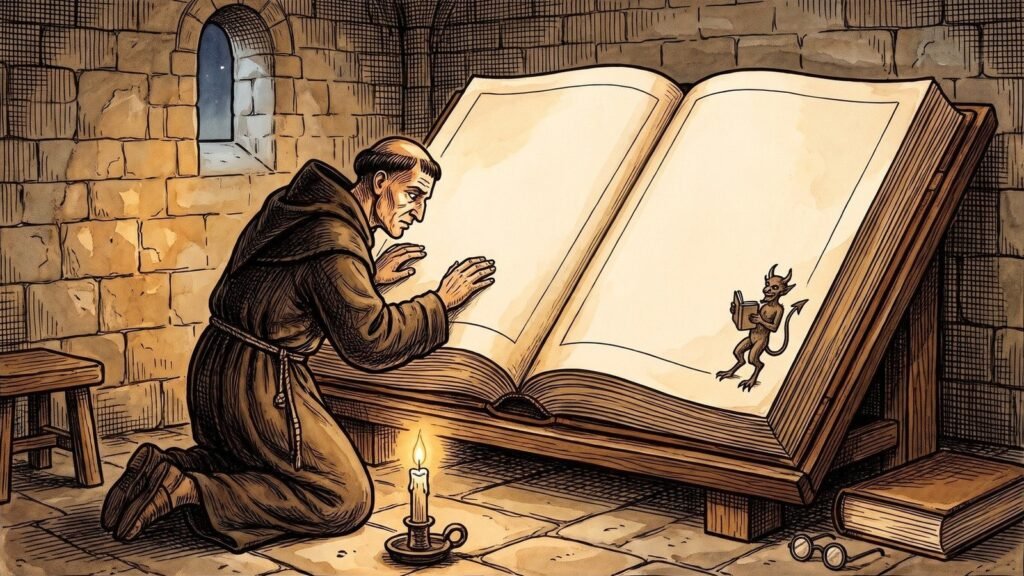
In the National Library of Sweden in Stockholm there is a Latin manuscript so large that two people are needed to lift it. Its leaves measure close to ninety centimetres in height and fifty in width, its wooden boards are covered in white leather, and the whole volume weighs about seventy-five kilograms. It is known as the Codex Gigas, the “giant book”, and more popularly as the Devil’s Bible, after a full-page picture of the devil that faces a picture of the Heavenly City near the end of the volume. It was written in Bohemia in the first decades of the thirteenth century, apparently by a single scribe, and it contains a complete Latin Bible together with a library of other works: the histories of Josephus, the encyclopedia of Isidore of Seville, a collection of medical treatises, the chronicle of Cosmas of Prague, a calendar, a necrology and a number of shorter texts, including formulas of exorcism. This article describes the book, its contents and its history, the place of its biblical text in the transmission of the Latin Bible, and the legends that have grown up around it.12
At a glance
- 1204–1230: Probable period of writing, inferred from the calendar and necrology; the work is the product of one scribe in Bohemia.
- Before 1295: The book belongs to the small Benedictine monastery of Podlažice in eastern Bohemia.
- 1295: The codex is recorded as pledged to the Cistercian monastery of Sedlec and then acquired by the Benedictines of Břevnov.
- 15th–16th centuries: The book is kept at the Benedictine monastery of Broumov.
- 1594: Emperor Rudolf II has the codex brought to his collections at Prague Castle.
- 1648: Swedish troops take it from Prague as booty in the last months of the Thirty Years’ War.
- 1697: The codex survives the fire of Tre Kronor castle in Stockholm; tradition says it was thrown from a window.
- 2007–2008: The book is lent to Prague and exhibited at the National Library of the Czech Republic.
The Book and Its Making
Size and Materials
The Codex Gigas now consists of 310 leaves of parchment. A count of the gatherings shows that it once had about 320, and that the missing leaves were removed from a single place near the end, where a text is known to have stood. The parchment has traditionally been described as made from the skins of about 160 animals, a figure which depends on the size of the hides and the method of folding and which should be taken as an estimate rather than a count. Each page is written in two columns of more than a hundred lines, in a script whose letters are only a few millimetres high, so that a very large quantity of text is contained within the volume despite its relatively modest number of leaves.34
The present binding dates from the nineteenth century. It preserves the general form of the medieval book, with heavy boards and metal fittings, but the covering and much of the sewing are later replacements. The size of the volume has itself shaped its history. A book of this weight could not easily be carried, read on the knee or lent from house to house; it was designed to lie on a lectern or a table in a religious house and to serve as a permanent reference work for the community. At the same time its size made it a natural object of display and of curiosity, and from the late Middle Ages onwards it was valued as a marvel as much as for its contents.5
One Scribe
The most remarkable feature of the manuscript, after its size, is the uniformity of its writing. Palaeographers who have examined the whole volume have concluded that the text was written by one hand from beginning to end. The letter forms, the spacing, the ruling and the system of abbreviation remain consistent across hundreds of pages, with none of the changes of hand that are normal in large medieval books, in which several scribes usually divided the work between them. The decoration also appears to belong to one campaign. The impression is of a single person working steadily over a long period according to a plan settled at the outset.67
How long such a task would have taken is a matter of estimate. Calculations based on the number of lines a professional scribe could write in a day have suggested that the writing alone would have required several years of continuous work, and that the whole undertaking, including the preparation of the parchment, the rubrication and the painting of the initials, may have extended over a decade or two. Such estimates are necessarily approximate, since nothing is known directly of the scribe’s working conditions. They are useful chiefly as a corrective to the legend, discussed below, that the book was written in a single night.89
Date and Place
The manuscript carries no colophon giving a date, and its age has to be inferred from its contents. The calendar includes saints whose cult was established or confirmed in Bohemia at the beginning of the thirteenth century, among them Saint Procopius, the founder of the Sázava monastery, who was canonised in 1204. The necrology, a list of names of the dead to be remembered in prayer, records persons who died in the 1220s, but does not record others whose deaths would be expected to appear if the book had remained in use at the same house for longer. On this evidence the writing is generally placed between about 1204 and 1230.1011
The first known owner was the Benedictine monastery of Podlažice, near Chrudim in eastern Bohemia, whose ownership is recorded in a note in the manuscript. Podlažice was a small and poor house, and some scholars have doubted that it could have provided the resources for a book on this scale; others have pointed out that a single dedicated scribe, working over many years, would not have needed a large scriptorium. In the necrology there is an entry for a certain Herman, described as a recluse (inclusus), and it has been suggested that he may be the scribe. The identification is attractive, since an enclosed monk would have had both the solitude and the time for such a task, but it rests on circumstantial evidence and cannot be proved.1213
The Contents
The Bible
About half the book is occupied by the Bible. The Old Testament stands at the beginning, followed by other works, with the New Testament placed later in the volume, so that the scriptural text is divided rather than continuous. The great majority of the biblical books are given in the Latin translation associated with Jerome and known as the Vulgate, which by the thirteenth century had long been the standard Bible of the Western church.1415
Two books, however, are different. The Acts of the Apostles and the Revelation of John are not given in the Vulgate text but in an older Latin translation, one of the forms of the version that scholars call the Vetus Latina or Old Latin. Before Jerome’s revision at the end of the fourth century, Latin-speaking Christians read a variety of translations made independently in North Africa, Italy and elsewhere, and these continued to be copied for some books long after the Vulgate had become dominant. The Codex Gigas is therefore one of the late witnesses to a text that otherwise survives chiefly in older and more fragmentary manuscripts.1617
In the standard lists of Old Latin manuscripts the Codex Gigas is cited by the abbreviation gig. Its text of Acts was published in 1879 by the Norwegian scholar Johannes Belsheim, together with that of Revelation, and it has since been used in critical editions of the Greek New Testament as evidence for an early form of the Latin text. Its text of Acts is of special interest because it agrees in many places with readings attested by the Latin Christian writer Lucifer of Cagliari in the fourth century, which suggests that the Bohemian scribe was copying, at one or more removes, an exemplar that preserved a text current in Italy or Sardinia nearly nine centuries earlier.181920
Why a thirteenth-century Bohemian book should contain these two books in an Old Latin form is not known with certainty. The most likely explanation is that the scribe used more than one exemplar for the Bible, and that the exemplar available to him for Acts and Revelation had preserved the older translation. Mixed Bibles of this kind, in which the text of individual books came from different sources, were not unusual in the earlier Middle Ages, before the standardisation of the Latin Bible associated with the University of Paris in the thirteenth century. The Codex Gigas thus documents, at a late date, a state of affairs which had been much more common before the twelfth century.2122
Josephus and Isidore
Between the Old and New Testaments the scribe placed two works of the Jewish historian Flavius Josephus in Latin translation: the Antiquities of the Jews, which retells the history of Israel from the creation to the eve of the war with Rome, and the Jewish War, which describes the revolt of 66 to 70 and the destruction of Jerusalem. Josephus was read in the medieval West as a supplement to the Bible, providing narrative detail for the period of the Second Temple and the setting of the New Testament. His placement between the Testaments in the Codex Gigas reflects this understanding of his work as a bridge between the two.2324
The scribe also included the Etymologies of Isidore of Seville, the encyclopedic work compiled in the early seventh century, which explains the origin of words and through them gives an account of grammar, rhetoric, mathematics, medicine, law, theology, natural history, geography and the practical arts. The Etymologies were among the most widely copied books of the Middle Ages, and their presence in the Codex Gigas indicates the scale of the plan: the book was intended not only as a Bible but as a compendium of the learning a religious community might need.2526
Medicine, Chronicle and Calendar
A further section contains a group of medical texts, commonly known collectively as the Ars medicinae, a collection of treatises on diagnosis, the pulse, urine, fevers and remedies that was used in monastic and cathedral schools before the rise of the universities. Monasteries provided care for the sick within their own communities and often for others, and such a collection would have been practical as well as learned.2728
The book also contains the Chronicle of the Czechs by Cosmas, dean of the cathedral of Prague, who died in 1125. Cosmas’s work is the earliest narrative history of Bohemia, beginning with legendary accounts of the settlement of the land and the foundation of the Přemyslid dynasty and continuing into the author’s own lifetime. Its inclusion gives the Codex Gigas a local and national dimension: alongside the history of Israel and the encyclopedic knowledge of the Latin world, the community that used the book could read the history of its own country.2930
Near the end of the volume come a calendar with the feasts of the saints, a necrology, and a series of shorter texts. These include formulas of exorcism and charms against illness and misfortune, and a form of confession. The texts of exorcism have contributed to the book’s later reputation, but they belong to a recognised genre of medieval liturgical and devotional literature and are not exceptional in themselves. The leaves that were cut out of this part of the book are thought to have contained the Rule of Saint Benedict, the foundational text of Benedictine monastic life; why they were removed, and when, is not known.3132
The Pictures
Decoration
The decoration of the Codex Gigas is restrained in relation to its size. Its main element is a series of initials at the beginnings of books and sections, some extending the full height of the page, decorated with interlaced stems, leaves, flowers, birds and animals in red, blue, green, yellow and, in a few places, gold. There are also smaller pictures within the Josephus section, including a portrait of the author and circular diagrams associated with the account of creation. The style is that of Romanesque book painting in central Europe, and it has been compared with other Bohemian manuscripts of the late twelfth and early thirteenth centuries.3334
The Heavenly City and the Devil
The two most famous pages face one another in the later part of the book. On the left is a picture of the Heavenly City, the new Jerusalem of the book of Revelation, shown as an enclosed city of towers and buildings in red, ochre and green, without human figures. On the right, on the recto of folio 290, is a full-page figure of the devil. He is shown alone, squatting with his arms raised, with a green head, red horns, two red tongues, clawed hands and feet, and a white loincloth spotted with red marks in the manner of ermine. He stands between two towers in an otherwise empty space.3536
The juxtaposition is deliberate. The devil faces the city from which he is excluded, and the two pages present, side by side, the alternatives of salvation and damnation. Their position near the confession and the texts of exorcism suggests that they were intended to accompany a section concerned with sin, repentance and protection from evil. Images of the devil were common in medieval art, but they usually appear in narrative scenes, tempting saints, tormenting the damned or contending for souls. The Codex Gigas figure is unusual in being a full-page portrait without any narrative setting, and it is this unusual presentation, combined with the size of the book, that has made it so widely known.3738
The Legend
The story that gives the manuscript its popular name is first recorded long after the book was made, and it exists in several versions. In the version most often repeated, a monk who had broken his vows was condemned to be walled up alive. To avoid this punishment he promised to write in a single night a book that would bring lasting glory to his monastery and contain all human knowledge. As midnight approached and he saw that he could not finish, he called on the devil, who completed the work in exchange for his soul, and the monk added the devil’s portrait in gratitude.3940
The legend appears to have developed from features of the book itself: its exceptional size, the regularity of its script, which seemed to some observers beyond human capacity, the portrait of the devil and the texts of exorcism. The word inclusus in the necrology, which in its original sense refers to a recluse who had chosen enclosure as a form of religious life, may also have contributed, since it could be misread as a reference to someone imprisoned as a punishment. Historians treat the story as folklore, but it has been important in the reception of the book, attracting visitors and readers who would otherwise have shown little interest in a thirteenth-century Latin compendium.4142
The Travels of the Book
Bohemian Monasteries
The later medieval history of the Codex Gigas can be followed in notes in the manuscript and in documents relating to the houses that owned it. In 1295 the book was pledged by Podlažice to the Cistercian monastery of Sedlec, near Kutná Hora. It was then acquired from Sedlec by the Benedictine abbey of Břevnov, near Prague, which according to the tradition recorded in the book redeemed it in order to keep it in Benedictine hands. Within the Břevnov community it passed to the daughter house of Broumov in north-eastern Bohemia, where it was kept for much of the fifteenth and sixteenth centuries.4344
These were troubled centuries in Bohemia. The reform movement associated with Jan Hus, who was burned at the Council of Constance in 1415, led to the Hussite wars of the 1420s and 1430s, in which many monasteries were attacked or destroyed. Podlažice itself did not survive the Hussite period, and Břevnov suffered heavily. The removal of the Codex Gigas to Broumov, which lay close to the border with Silesia, may have helped to preserve it during this period, although the details of its movements are not fully documented.4546
Rudolf II
In 1594 the codex was taken to Prague at the request of the Emperor Rudolf II, who had made Prague Castle the centre of his court and of one of the most famous collections of the age. Rudolf collected paintings, sculpture, scientific instruments, natural specimens and curiosities of every kind, and he was particularly interested in works that combined learning with marvels. A giant book associated with the devil and containing texts of medicine and exorcism was well suited to such a collection. Sources state that the transfer from Broumov was presented as a loan, but the book did not return to the monastery.474849
Swedish Booty
The Codex Gigas remained at Prague Castle after Rudolf’s death in 1612 and through the first three decades of the Thirty Years’ War. In July 1648, in the last months of the war, Swedish troops under the command of Hans Christoph von Königsmarck captured the district of Prague on the left bank of the Vltava, including the castle, while negotiations for peace were already far advanced. The imperial collections in the castle were systematically removed and shipped to Sweden as booty. Among the paintings, sculptures and manuscripts taken was the Codex Gigas, which was brought to Stockholm and placed in the royal library of Queen Christina.505152
In May 1697 the royal castle of Tre Kronor in Stockholm was destroyed by fire, and a large part of the royal library was lost. The Codex Gigas survived. According to the account usually given, it was thrown from a window to save it from the flames, and some damage to the binding and the loss of a few leaves have been attributed to this episode, although the evidence for the details is not conclusive. After the fire the book remained in the royal library, which later became the National Library of Sweden.535455
The Codex Gigas in Modern Times
In the nineteenth and twentieth centuries the codex became the object of systematic study. Belsheim’s edition of the Old Latin Acts and Revelation in 1879 brought it into the discussion of the Latin Bible, and its text was incorporated into the critical work of later editors, including the Vetus Latina Institute at Beuron in Germany, which publishes the standard edition of the Old Latin evidence. Historians of Bohemia used its copy of Cosmas and its calendar and necrology, and art historians studied its decoration in the context of central European Romanesque painting.565758
The question of the book’s return has been raised in Czech public life on several occasions, and the codex has acquired a symbolic importance in the Czech Republic as part of the cultural heritage lost in the Thirty Years’ War. In 2007 and 2008 it was lent by the National Library of Sweden to the National Library of the Czech Republic and exhibited in Prague, more than three and a half centuries after it had been taken from the city. The exhibition attracted very large numbers of visitors and was accompanied by a scholarly publication which brought together the results of recent research on the manuscript.5960
In Stockholm the book is now kept under controlled conditions and is displayed in the library’s exhibition space. The whole manuscript has been photographed and made available in digital form, so that scholars and the public can examine it page by page without handling the original. Digitisation has made the Codex Gigas one of the most accessible medieval manuscripts in the world, and it has encouraged further research on its script, its decoration and its texts.6162
The Codex Gigas and the Latin Bible
For the history of the Bible the Codex Gigas is significant in three ways. First, as a witness to the Old Latin text of Acts and Revelation, it preserves a form of the Latin New Testament that had been displaced in most places by Jerome’s revision many centuries earlier. Its readings form part of the evidence from which scholars reconstruct the early Latin translations and, through them, the Greek text that their translators used. The survival of such a text in a Bohemian manuscript of the thirteenth century shows how long older translations could continue to be copied in particular centres.636465
Second, the book illustrates the variety of the Latin Bible before the thirteenth century. The Vulgate itself was not a fixed text in the early Middle Ages. Its manuscripts differed in the order of books, the prefaces they contained and their readings, and many contained books or sections from older translations. The Codex Gigas belongs to this period of diversity, which came to an end only gradually with the spread of the Paris Bible and, much later, with the official editions of the Vulgate published at Rome in the late sixteenth century.6667
Third, the Codex Gigas shows how the Bible could be placed at the centre of a wider body of knowledge. In this book the scriptures are surrounded by history, natural science, medicine, chronicle and practical devotion, arranged in an order that suggests a view of the world in which sacred history, the history of the Jews, the knowledge of the ancients, the history of Bohemia and the care of body and soul formed a single whole. It is an expression in physical form of the medieval idea of the Bible as the foundation of all learning.6869
Conclusion
The Codex Gigas is famous chiefly for its size and for the legend of its creation, but its importance extends beyond these. It is the work of one scribe of exceptional patience in early thirteenth-century Bohemia, a library in a single volume that combines the Latin Bible with the major reference works of its time. Its text of Acts and Revelation preserves a translation older than the Vulgate, and its history follows the fortunes of Bohemia from the Benedictine monasteries of the Přemyslid kingdom, through the Hussite wars and the court of Rudolf II, to the plunder of Prague at the end of the Thirty Years’ War. Today, kept in Stockholm and available to readers everywhere in digital form, it remains both a monument of medieval book production and a witness to the long transmission of the Latin scriptures.707172
Notes
- Grokipedia, “Codex Gigas”. ↩
- Kamil Boldan, Michal Dragoun, Dušan Foltýn, Jindřich Marek and Zdeněk Uhlíř, Codex Gigas: The Devil’s Bible. The Secrets of the World’s Largest Book (Prague: Národní knihovna České republiky, 2007). ↩
- Grokipedia, “Codex Gigas”. ↩
- National Library of Sweden (Kungliga biblioteket), “The Codex Gigas”. ↩
- Kamil Boldan, Michal Dragoun, Dušan Foltýn, Jindřich Marek and Zdeněk Uhlíř, Codex Gigas: The Devil’s Bible. The Secrets of the World’s Largest Book (Prague: Národní knihovna České republiky, 2007). ↩
- National Library of Sweden (Kungliga biblioteket), “The Codex Gigas”. ↩
- Kamil Boldan, Michal Dragoun, Dušan Foltýn, Jindřich Marek and Zdeněk Uhlíř, Codex Gigas: The Devil’s Bible. The Secrets of the World’s Largest Book (Prague: Národní knihovna České republiky, 2007). ↩
- Kamil Boldan, Michal Dragoun, Dušan Foltýn, Jindřich Marek and Zdeněk Uhlíř, Codex Gigas: The Devil’s Bible. The Secrets of the World’s Largest Book (Prague: Národní knihovna České republiky, 2007). ↩
- Grokipedia, “Codex Gigas”. ↩
- Kamil Boldan, Michal Dragoun, Dušan Foltýn, Jindřich Marek and Zdeněk Uhlíř, Codex Gigas: The Devil’s Bible. The Secrets of the World’s Largest Book (Prague: Národní knihovna České republiky, 2007). ↩
- Grokipedia, “Codex Gigas”. ↩
- Kamil Boldan, Michal Dragoun, Dušan Foltýn, Jindřich Marek and Zdeněk Uhlíř, Codex Gigas: The Devil’s Bible. The Secrets of the World’s Largest Book (Prague: Národní knihovna České republiky, 2007). ↩
- Grokipedia, “Codex Gigas”. ↩
- See also “The Latin Vulgate and Jerome’s Translation of the Bible” on this site. ↩
- Grokipedia, “Codex Gigas”. ↩
- Grokipedia, “Vetus Latina”. ↩
- See also “The Vetus Latina and the First Latin Bibles” on this site. ↩
- Johannes Belsheim, Die Apostelgeschichte und die Offenbarung Johannis in einer alten lateinischen Übersetzung aus dem “Gigas librorum” auf der königlichen Bibliothek zu Stockholm (Christiania: Malling, 1879). ↩
- Bruce M. Metzger, The Early Versions of the New Testament: Their Origin, Transmission, and Limitations (Oxford: Clarendon Press, 1977). ↩
- H. A. G. Houghton, The Latin New Testament: A Guide to Its Early History, Texts, and Manuscripts (Oxford: Oxford University Press, 2016). ↩
- Bonifatius Fischer, “Das Neue Testament in lateinischer Sprache”, in Kurt Aland, ed., Die alten Übersetzungen des Neuen Testaments, die Kirchenväterzitate und Lektionare (Berlin: de Gruyter, 1972), 1–92. ↩
- H. A. G. Houghton, The Latin New Testament: A Guide to Its Early History, Texts, and Manuscripts (Oxford: Oxford University Press, 2016). ↩
- Grokipedia, “Josephus”. ↩
- Grokipedia, “Codex Gigas”. ↩
- Grokipedia, “Isidore of Seville”. ↩
- Kamil Boldan, Michal Dragoun, Dušan Foltýn, Jindřich Marek and Zdeněk Uhlíř, Codex Gigas: The Devil’s Bible. The Secrets of the World’s Largest Book (Prague: Národní knihovna České republiky, 2007). ↩
- Kamil Boldan, Michal Dragoun, Dušan Foltýn, Jindřich Marek and Zdeněk Uhlíř, Codex Gigas: The Devil’s Bible. The Secrets of the World’s Largest Book (Prague: Národní knihovna České republiky, 2007). ↩
- Grokipedia, “Codex Gigas”. ↩
- Cosmas of Prague, The Chronicle of the Czechs, trans. Lisa Wolverton (Washington, DC: Catholic University of America Press, 2009). ↩
- Grokipedia, “Codex Gigas”. ↩
- Kamil Boldan, Michal Dragoun, Dušan Foltýn, Jindřich Marek and Zdeněk Uhlíř, Codex Gigas: The Devil’s Bible. The Secrets of the World’s Largest Book (Prague: Národní knihovna České republiky, 2007). ↩
- National Library of Sweden (Kungliga biblioteket), “The Codex Gigas”. ↩
- Grokipedia, “Codex Gigas”. ↩
- Kamil Boldan, Michal Dragoun, Dušan Foltýn, Jindřich Marek and Zdeněk Uhlíř, Codex Gigas: The Devil’s Bible. The Secrets of the World’s Largest Book (Prague: Národní knihovna České republiky, 2007). ↩
- Grokipedia, “Codex Gigas”. ↩
- National Library of Sweden (Kungliga biblioteket), “The Codex Gigas”. ↩
- Kamil Boldan, Michal Dragoun, Dušan Foltýn, Jindřich Marek and Zdeněk Uhlíř, Codex Gigas: The Devil’s Bible. The Secrets of the World’s Largest Book (Prague: Národní knihovna České republiky, 2007). ↩
- Grokipedia, “Codex Gigas”. ↩
- Grokipedia, “Codex Gigas”. ↩
- Kamil Boldan, Michal Dragoun, Dušan Foltýn, Jindřich Marek and Zdeněk Uhlíř, Codex Gigas: The Devil’s Bible. The Secrets of the World’s Largest Book (Prague: Národní knihovna České republiky, 2007). ↩
- Kamil Boldan, Michal Dragoun, Dušan Foltýn, Jindřich Marek and Zdeněk Uhlíř, Codex Gigas: The Devil’s Bible. The Secrets of the World’s Largest Book (Prague: Národní knihovna České republiky, 2007). ↩
- Grokipedia, “Codex Gigas”. ↩
- Kamil Boldan, Michal Dragoun, Dušan Foltýn, Jindřich Marek and Zdeněk Uhlíř, Codex Gigas: The Devil’s Bible. The Secrets of the World’s Largest Book (Prague: Národní knihovna České republiky, 2007). ↩
- Grokipedia, “Codex Gigas”. ↩
- See also “Jan Hus and Bohemian History” on this site. ↩
- Kamil Boldan, Michal Dragoun, Dušan Foltýn, Jindřich Marek and Zdeněk Uhlíř, Codex Gigas: The Devil’s Bible. The Secrets of the World’s Largest Book (Prague: Národní knihovna České republiky, 2007). ↩
- R. J. W. Evans, Rudolf II and His World: A Study in Intellectual History, 1576–1612 (Oxford: Clarendon Press, 1973). ↩
- Grokipedia, “Rudolf II, Holy Roman Emperor”. ↩
- Kamil Boldan, Michal Dragoun, Dušan Foltýn, Jindřich Marek and Zdeněk Uhlíř, Codex Gigas: The Devil’s Bible. The Secrets of the World’s Largest Book (Prague: Národní knihovna České republiky, 2007). ↩
- Grokipedia, “Battle of Prague (1648)”. ↩
- Peter H. Wilson, Europe’s Tragedy: A History of the Thirty Years War (London: Allen Lane, 2009). ↩
- Grokipedia, “Thirty Years’ War”. ↩
- Grokipedia, “Tre Kronor (castle)”. ↩
- Grokipedia, “National Library of Sweden”. ↩
- National Library of Sweden (Kungliga biblioteket), “The Codex Gigas”. ↩
- Johannes Belsheim, Die Apostelgeschichte und die Offenbarung Johannis in einer alten lateinischen Übersetzung aus dem “Gigas librorum” auf der königlichen Bibliothek zu Stockholm (Christiania: Malling, 1879). ↩
- Bonifatius Fischer, “Das Neue Testament in lateinischer Sprache”, in Kurt Aland, ed., Die alten Übersetzungen des Neuen Testaments, die Kirchenväterzitate und Lektionare (Berlin: de Gruyter, 1972), 1–92. ↩
- H. A. G. Houghton, The Latin New Testament: A Guide to Its Early History, Texts, and Manuscripts (Oxford: Oxford University Press, 2016). ↩
- Kamil Boldan, Michal Dragoun, Dušan Foltýn, Jindřich Marek and Zdeněk Uhlíř, Codex Gigas: The Devil’s Bible. The Secrets of the World’s Largest Book (Prague: Národní knihovna České republiky, 2007). ↩
- National Library of Sweden (Kungliga biblioteket), “The Codex Gigas”. ↩
- National Library of Sweden (Kungliga biblioteket), “The Codex Gigas”. ↩
- Grokipedia, “National Library of Sweden”. ↩
- Grokipedia, “Vetus Latina”. ↩
- Bruce M. Metzger, The Early Versions of the New Testament: Their Origin, Transmission, and Limitations (Oxford: Clarendon Press, 1977). ↩
- H. A. G. Houghton, The Latin New Testament: A Guide to Its Early History, Texts, and Manuscripts (Oxford: Oxford University Press, 2016). ↩
- Bonifatius Fischer, “Das Neue Testament in lateinischer Sprache”, in Kurt Aland, ed., Die alten Übersetzungen des Neuen Testaments, die Kirchenväterzitate und Lektionare (Berlin: de Gruyter, 1972), 1–92. ↩
- See also “The Latin Vulgate and Jerome’s Translation of the Bible” on this site. ↩
- Kamil Boldan, Michal Dragoun, Dušan Foltýn, Jindřich Marek and Zdeněk Uhlíř, Codex Gigas: The Devil’s Bible. The Secrets of the World’s Largest Book (Prague: Národní knihovna České republiky, 2007). ↩
- Grokipedia, “Isidore of Seville”. ↩
- Grokipedia, “Codex Gigas”. ↩
- Kamil Boldan, Michal Dragoun, Dušan Foltýn, Jindřich Marek and Zdeněk Uhlíř, Codex Gigas: The Devil’s Bible. The Secrets of the World’s Largest Book (Prague: Národní knihovna České republiky, 2007). ↩
- H. A. G. Houghton, The Latin New Testament: A Guide to Its Early History, Texts, and Manuscripts (Oxford: Oxford University Press, 2016). ↩