

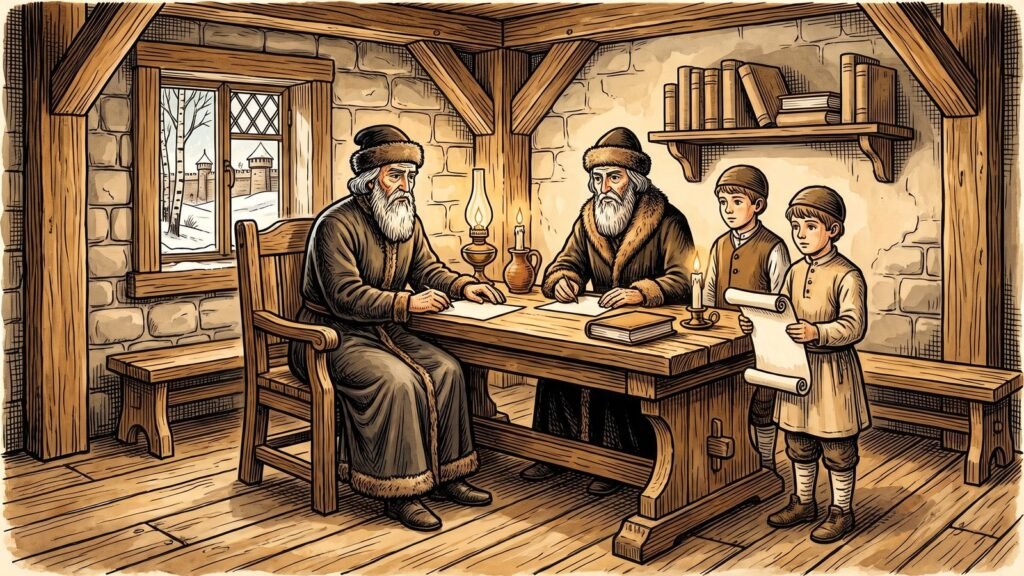
In the royal Exchequer accounts compiled at Westminster for the Michaelmas audit of 1181—the twenty-seventh regnal year of King Henry II of England—the clerk of the Pipe Roll inscribed a terse, extraordinary entry under the revenues of London and Middlesex: Ysaac Ruffus et Ysaac de Russie et Ysaac de Beuerl’ Judei reddunt compotum de .x. m. ut sint quieti de calumpnia quod dicebantur cambuisse. Across the expanse of medieval Latin administrative documentation, this line provides the earliest indisputable archival testimony of an individual from Kievan Rus’ residing within the Angevin realm. Decades later, across the English Channel or in the thriving scholarly enclave of medieval London, another monument to this traveler was committed to parchment. In the grammatical treatise and Hebrew lexicon Sefer ha-Shoham (“The Book of Onyx”), the English-Jewish lexicographer Moses ben Isaac ha-Nessiah recorded a living philological gloss under the verbal root Y-B-M (י-ב-ם): “And Rabbi Isaac of Chernigov told me that in the language of Tiras, which is Rus’, they call copulation yibbum; and therefore ve-yabbem otah means ‘have intercourse with her.'”
These two fleeting textual coordinates—one preserved on an English royal parchment scroll recording a punitive financial settlement with the Crown, the other embedded in an advanced Hebrew lexicographical codex explaining an archaic biblical idiom through the vernacular phonetics of Old East Slavic—delineate the contours of a singular medieval life. Isaac of Chernigov (known in Hebrew rabbinic literature as Rabbi Yitzhak me-Tsernigov, and in Angevin administrative rolls as Ysaac de Russie) stands at the crossroads of European civilization at the high-water mark of the twelfth century. His life and travels confound the persistent modern historiographical assumption that medieval Eastern European Jewry was an isolated, culturally backward frontier whose history began only with the eastward migration of German-speaking Ashkenazim in the fourteenth and fifteenth centuries. On the contrary, Isaac of Chernigov was the product of a sophisticated, self-conscious, Slavic-speaking Jewish culture flourishing along the Dnieper and Desna rivers—an intellectual community fully integrated into trans-continental mercantile arteries and maintaining vibrant, uninhibited intellectual communication with the rabbinic academies of northern France, the Rhineland, the Byzantine Aegean, and the Abbasid caliphate in Baghdad.
To reconstruct the life, times, and travels of Isaac of Chernigov is to restore a lost chapter of medieval cultural history. It requires an excavation of the sprawling, fortified city of twelfth-century Chernihiv under the turbulent rule of the Olgovichi princely dynasty; an analysis of the Jewish communal presence in Kievan Rus’ from the tenth-century Khazarian Kievian Letter down to the commercial quarter of the Kiev Podol; a reconstruction of the trans-European trade routes of the Via Regia that carried merchants, pilgrims, and scholars from the Black Sea steppes to the English Channel; an investigation of the fiscal and legal status of Jews under the Angevin Empire; and an examination of the unique Judeo-Slavic dialect (Leshon Kena’an) whose phonology Isaac carried into the Anglo-Norman intellectual world. When the Mongol armies of Batu Khan and Subutai stormed across the Dnieper in 1239 and 1240, reducing Chernigov and Kiev to smoking ruins and annihilating the local manuscript libraries, the material archives of Rus’ Jewry were almost entirely obliterated. It is only through the serendipity of western textual preservation—in the Exchequer rolls of London and the Hebrew manuscripts of Oxford and Saint Petersburg—that Isaac’s voice survived, preserving the living memory of a civilization on the edge of the medieval world.
Twelfth-Century Chernigov: Citadel, Princes, and the Desna Corridor
To understand the intellectual and social formation of Isaac of Chernigov, one must first reconstruct the urban and geopolitical environment from which he emerged. In the late twelfth century, Chernigov (modern Chernihiv, situated in northern Ukraine approximately one hundred and forty kilometers northeast of Kiev) was not a peripheral provincial outpost. It was the capital of the vast and immensely wealthy Principality of Chernigov, an autonomous Rurikid realm that encompassed vast territories stretching from the middle Desna across the Seim River to Kursk, Starodub, Novgorod-Seversky, and the distant forest fringes of Murom and Ryazan. At its twelfth-century zenith, Chernigov was one of the largest and most heavily fortified urban centers in all of Eastern Europe, rivaling Kiev and Novgorod in population, territorial ambition, and architectural monumentality.
The city occupied a strategic promontory on the high, terraced bluffs rising above the right bank of the Desna River at its confluence with the small Strizhen stream. The topography of Chernigov was organized into a concentric hierarchy of defensive enclosures and functional quarters that mirrored the aristocratic and mercantile structure of Kievan Rus’. At the southwestern apex of the bluffs stood the Detinets (the princely citadel), enclosed by deep ravines, monumental earthen ramparts crowned with oak palisades, and massive defensive towers. Within this inner sanctum rose the stone monuments of princely authority: the palace complex of the ruling dynasty and the Spaso-Preobrazhensky (Transfiguration of the Savior) Cathedral. Founded around 1034 by Prince Mstislav the Bold (son of Vladimir the Great) and completed after his death in 1036, the Transfiguration Cathedral was one of the earliest and most imposing stone ecclesiastical structures in Rus’, its Byzantine brick-and-mortar masonry, octagonal stair towers, and frescoed interior designed to broadcast imperial majesty across the river valley. In the 1120s, the citadel was further enriched by the construction of the Boris and Gleb Cathedral, a harmonious single-domed basilica that served as the dynastic burial vault of the Chernigov princes.
Adjoining the citadel was the Okolny Grad (the “Encompassing City” or outer fortified town), an expansive urban plateau enclosed by an enormous rampart system that extended for over six kilometers. Here resided the boyar nobility, high administrative officials, senior druzhina retainers, and the upper tiers of the ecclesiastical hierarchy. Beyond the ramparts, spreading along the low-lying floodplain between the bluffs and the Desna, lay the sprawling Podol (the lower commercial town and artisans’ quarter). Archaeological excavations conducted in the Chernihiv Podol have revealed dense networks of timber log cabins, paved wooden streets, metalworking foundries, glassmaking kilns, bone-carving workshops, and extensive wharf installations along the riverbank. It was here, in the lively, polyglot commercial district of the Podol and along the market squares flanking the princely ramparts, that foreign merchants congregated, customs duties were collected, and the urban Jewish community was rooted.
Throughout the twelfth century, the political destiny of Chernigov was shaped by the fierce dynastic ambitions of the Olgovichi—the princely house descended from Oleg Svyatoslavich (d. 1115), grandson of Yaroslav the Wise. The Olgovichi were renowned across Rus’ for their relentless, unyielding rivalry with the Monomakhovichi dynasty of Kiev and Pereyaslavl. The Russian primary chronicles—the Hypatian Codex and the Laurentian Codex—depict twelfth-century Chernigov as a center of constant military mobilization and sophisticated diplomatic maneuver. Under powerful rulers such as Vsevolod Olgovich (who seized the grand princely throne of Kiev in 1139), Svyatoslav Olgovich (d. 1164), and Svyatoslav Vsevolodovich (prince of Chernigov from 1164 to 1177, and subsequently grand prince of Kiev until 1194), Chernigov maintained extensive diplomatic alliances not only with neighboring Rus’ principalities but also with the nomadic Polovtsy (Cumans) of the southern Pontic steppes, the Kingdom of Poland, the Kingdom of Hungary, and the Byzantine court in Constantinople.
Crucially, Chernigov’s economic vitality depended upon its position along the great riverine trade network of the Desna corridor. The Desna was a majestic, navigable waterway that served as a vital arterial link between the central Dnieper basin and the immense forest zones of northeastern Europe. By traveling up the Desna, river flotillas could access the Seim, Oster, and Bolva rivers, navigating portage routes that connected directly into the Upper Volga and Oka river systems. Downstream, the Desna emptied into the Dnieper just north of Kiev, providing direct access to the Black Sea, Byzantium, and the overland routes leading to Central Europe. Down these rivers moved the primary wealth of the northern forests: high-value pelts of sable, ermine, marten, and black fox; enormous quantities of beeswax and forest honey; walrus ivory (“fish teeth”) from the Arctic seas; Slavic captives destined for the Mediterranean slave markets; and amber gathered along the Baltic littorals. In return, the merchants of Chernigov imported Byzantine silks, amphorae of Mediterranean wine and olive oil, fine glassware, glazed pottery, damascene weapons from the Rhineland, and precious silver bullion. Archaeological strata from twelfth-century Chernihiv have yielded an extraordinary quantity of foreign trade goods, including Byzantine imperial lead seals, Islamic silver dirhams, Western European silver deniers, and precision folding balance-scales utilized by long-distance merchants to weigh precious metals. In this cosmopolitan, commercially driven urban hub, a literate, worldly Jewish communal elite found a natural and indispensable role.
The Jewish Presence in Kievan Rus’: From the Kievian Letter to the Zhidove Gate
The existence of an established Jewish community in twelfth-century Chernigov cannot be understood in isolation; it formed part of a continuous, well-documented network of Jewish settlements across the urban centers of Kievan Rus’. For centuries, conventional European historiography viewed the presence of Jews in pre-Mongol Eastern Europe through the distorting lens of late medieval and early modern migrations, assuming that the Jewish communities of Poland, Lithuania, and Ukraine were created ex nihilo by German Jews fleeing the Rhineland massacres of the Crusades and the Black Death. A generation of modern epigraphic, archival, and archaeological discoveries has entirely dismantled this misconception, revealing that long before the demographic expansion of German Ashkenaz, a vibrant, indigenous, Slavic-speaking Jewish population had established deep roots in the lands of the eastern Slavs.
The foundation stone of modern documentary scholarship on Rus’ Jewry is the famous Kievian Letter, discovered in the Cairo Genizah by Norman Golb in 1962 and subsequently published in a landmark 1982 study co-authored with the eminent Turkologist Omeljan Pritsak. Written on parchment in an elegant, professional early tenth-century square Hebrew script, the document is an official letter of recommendation issued by the Jewish community of Kiev (inscribed in the text as Qiyyoḇ, קייוב) on behalf of one of their members, Mar Jacob bar Hanukkah. Jacob had stood surety for a loan contracted by his brother from non-Jewish creditors; when the brother was robbed and murdered on a commercial journey, the creditors cast Jacob into chains until the community redeemed him by paying sixty coins, leaving forty coins outstanding for which Jacob was sent abroad to solicit charitable assistance from foreign Jewish communities.
The historical implications of the Kievian Letter are profound. Paleographically dated to the first half of the tenth century (around 930 CE), it constitutes the earliest surviving indigenous written document produced in the city of Kiev, predating the Christianization of Vladimir the Great by more than half a century. More importantly, the onomastic analysis of the eleven communal signatories reveals a remarkable socio-cultural fusion: alongside traditional biblical and Hebrew names (such as Abraham the Parnas, Isaac the Parnas, and Moses bar Muravitsa), several signatories bear distinct Slavic and Khazarian names, including Gostata (a recognized Old Slavic name, attested frequently in Novgorod birchbark charters), Gwryt, Manas, and Kufin. At the bottom left corner of the parchment, an official scribe stamped a brief inscription in Khazarian runic script consisting of six characters, interpreted by Pritsak as a Turkic endorsement meaning “I have read [it].” The Kievian Letter establishes beyond debate that tenth-century Kiev possessed a fully organized Jewish community governed by administrative officers (parnasim), literate in rabbinic Hebrew epistolography, and integrated into both the Slavic population and the Khazar Khaganate, whose empire had long controlled the middle Dnieper trade routes before the rise of the Rurikid Scandinavian princes.
By the eleventh and twelfth centuries, the Jewish community of Kiev was a permanent and prominent feature of the urban topography. The Old Russian primary chronicles, preserved in the Hypatian Codex, provide explicit topographical evidence of this presence. Under the entries for the years 1146 and 1151, the chronicle records the location of the Zhidove (the “Jewish Gate”, Жидовские ворота) in the defensive perimeter of the Upper City of Kiev. This gate, pierced through the monumental earthen ramparts constructed during the reign of Grand Prince Yaroslav the Wise, guarded the western entrance to the aristocratic citadel near the Cathedral of Saint Sophia and the Golden Gate. The existence of a major city gate bearing the name Zhidove indicates that a substantial Jewish residential and commercial quarter was situated immediately adjacent to it, occupying a prestigious sector within the fortified upper city rather than an isolated suburban ghetto.
Furthermore, Russian chronicles and ecclesiastical literature record both the commercial prominence and the occasional social tensions surrounding the Jewish population. In the *Tale of Bygone Years* (*Povest’ Vremennykh Let*), under the famous entry for the year 986 describing the “Examination of the Faiths” by Prince Vladimir Svyatoslavich prior to his conversion, Jewish emissaries from the Khazars arrive in Kiev to debate the merits of monotheistic Judaism against Christian and Islamic delegations. While this narrative contains legendary topoi, it reflects the chronicler’s keen awareness that Judaism was an established, articulate theological presence within the cultural consciousness of the Dnieper realm. A more turbulent episode occurred in the spring of 1113, following the sudden death of Grand Prince Svyatopolk II Izyaslavich. The urban populace of Kiev, aggrieved by heavy fiscal exactions, aggressive state monopolies on the salt trade, and high-interest debt structures, erupted in an insurrection that targeted the estate of the princely military commander (*tysiatsky*) Putyata Vysh漠ich, before turning their fury against the “houses of the Jews” (*poide na zhidove i razgrabisha ya*). The boyar nobility immediately sent an urgent delegation to Pereyaslavl to implore Vladimir Monomakh to enter Kiev and assume the throne, warning him that if he delayed, the rioting mob would not only plunder the Jewish quarter but would advance upon the princely palaces, the boyar estates, and the monasteries. Monomakh arrived, restored order, and enacted comprehensive legislative reforms (codified in the *Ustav Vladimira Vsevolodovicha*, incorporated into the expanded *Russkaya Pravda*), which strictly capped the interest rates that moneylenders could charge on long-term loans, thereby stabilizing credit relations across the principality.
Beyond Kiev and Chernigov, Jewish communities were established along the major transit corridors of Volhynia and Galicia. In Vladimir-in-Volhynia (Volodymyr-Volynskyi), the western gateway of Rus’ leading into Poland and Hungary, chronicle records from 1288 describe the profound communal mourning that attended the funeral of Prince Vladimir Vasilkovich, noting that “the Germans, the Rus’, and the Jews wept” (*nemtsi, i rus’, i zhidove plakhasya*) over the bier of a prince who had protected their commercial privileges. Similarly, in the fortified towns of Peremyshl (Przemyśl), Halych, and Starodub, documentary and responsa literature confirm the presence of Jewish merchants and scholars. The community in Chernigov, flourishing under the protection of the Olgovichi princes, formed an integral part of this network, positioned perfectly to intermediate between the riverine markets of the east and the overland caravan routes leading to Western Christendom.
Trade Arteries and Trans-Continental Mobility: The Radhanites and the Via Regia
The appearance of Isaac of Chernigov in Western Europe and Angevin England cannot be understood as an anomaly; it was the direct outcome of an extraordinarily well-developed system of trans-continental trade routes that knit Eastern Europe into the wider Mediterranean and Atlantic economies. For centuries, Jewish merchants had served as the preeminent trans-Eurasian intermediaries. In the ninth century, the Persian administrative geographer Ibn Khordadbeh, writing in his *Book of Roads and Kingdoms* (*Kitab al-Masalik wa’l-Mamalik*), recorded the celebrated itineraries of the Radhanite Jewish merchants (*al-Radhaniyya*). Ibn Khordadbeh described how these multilingual Jewish merchants—fluent in Arabic, Persian, Greek, Frankish, Spanish, and Slavic—traversed the known world from west to east and back again. One of their primary overland routes commenced in the Frankish heartland of Western Europe, crossed the territory of the Slavs (*Saqaliba*), passed through the capital of the Khazars on the Volga, and continued along the northern shores of the Caspian Sea to Transoxiana, Balkh, and China.
By the twelfth century, although the centralized Khazar empire had collapsed, the European commercial networks had become even more densely institutionalized. The primary commercial highway connecting Eastern and Western Europe was the *Via Regia* (the “King’s Highway”), an ancient trans-European trunk road that ran from the Atlantic ports of Flanders and northern France, through Cologne, Frankfurt, Erfurt, Leipzig, and Breslau (Wrocław), into the Polish royal capital of Krakow. From Krakow, the highway continued eastward through Przemyśl and Vladimir-in-Volhynia, directly terminating at the Golden Gate of Kiev. A parallel southern artery connected the great Danube emporium of Regensburg (Ratisbon) in Bavaria, passing through Prague, Moravia, and southern Poland to the Dnieper basin.
This commercial corridor was heavily frequented by a specialized class of merchants known in Latin sources as *Rusarii* (traders of Rus’) and in contemporary Hebrew rabbinic literature as *holekhei Rusya* (הולכי רוסיא, “those who travel to Rus'”). Regensburg, in particular, served as the primary western clearinghouse for this trade. The merchants of Regensburg maintained a dedicated guild of Rus’ traders, and Jewish merchants played a commanding role within this enterprise. They transported heavy Bavarian pack-trains laden with Rhenish woolens, Flemish dyed textiles, fine metalwork, weapons, and salt across the Bohemian passes into Kiev; on their return journeys, their wagons carried the luxury commodities of the east: precious furs, Russian leather (*yuft*), wax for church tapers, honey, and Byzantine silks acquired in the markets of the Podol.
The legal and logistical realities of these perilous, months-long journeys left an indelible mark on twelfth-century Hebrew rabbinic responsa. The Tosafists of France and Germany frequently adjudicated halakhic questions arising from the hazards of the *holekhei Rusya*. In the responsa of Rabbi Eliezer ben Nathan of Mainz (the *Raban*, c. 1090–1170) and his grandson Rabbi Eliezer ben Joel ha-Levi of Bonn (the *Raviah*, c. 1140–1225), cases are recorded concerning Jewish commercial partnerships traveling in armed caravans to Rus’. Rabbis debated the halakhic permissibility of carrying weapons on the Sabbath when traveling through the dangerous steppes infested with nomadic bandits; the validity of conditional bills of divorce (*gittin*) drafted by merchants embarking on the long road to Kiev to prevent their wives from becoming chained wives (*agunot*) in the event of their disappearance; and the precise ritual procedures for purifying vessels and procuring kosher food while wintering in the Slavic settlements along the Desna and Dnieper.
A vivid, eyewitness account of this commercial highway is preserved in the *Sibuv ha-Rav Petachiah mi-Regensburg* (“The Travels of Rabbi Petachiah of Regensburg”), which recounts the journey undertaken between 1175 and 1180 by Petachiah, a contemporary of Isaac of Chernigov. Petachiah, the brother of the celebrated Tosafist Rabbi Isaac ben Jacob ha-Lavan of Prague, departed Regensburg and journeyed eastward through Poland into “the land of Rus'” (*Eretz Rusya*). He stayed in Kiev, which he described as a great commercial metropolis, before hiring wagons and armed guides to traverse the Black Sea steppe lands, which he termed the “land of Kedar” (the territory of the Polovtsy/Cumans). Petachiah noted with admiration the vast scale of the Rus’ rivers, the hospitality of the local Jewish communities, and the security arrangements negotiated between Jewish merchants and the local Slavic princes. The commercial highway between Kiev, Chernigov, Regensburg, and the West was thus a bustling, well-trodden reality. It was along this very network that Isaac of Chernigov traveled from the banks of the Desna into the heart of Western Europe.
Isaac of Chernigov: Identity, Rabbinic Formation, and Intellectual Milieu
Who was Isaac of Chernigov, and what was his position within the intellectual landscape of medieval Europe? In Hebrew manuscripts, he is consistently accorded the honorific title *Rabbi* (ר’ יצחק מצרניגוב, *Rabbi Yitzhak me-Tsernigov*, occasionally vocalized or transliterated in western texts as *Zernigov*, *Chernigov*, or *Karnigov*). In twelfth-century rabbinic usage, the attachment of a geographical toponym to a scholar’s personal name was not merely a casual geographic descriptor; it was an established convention used to identify an recognized communal authority, halakhic authority, or rosh yeshiva representing a specific geographic region. Just as his contemporaries were known across the academies of Europe as Moses of Kiev, Eliezer of Bohemia, or Isaac of Dampierre, so Isaac carried the name of his native city, Chernigov, as a badge of communal and scholarly standing.
The existence of a scholar of Isaac’s caliber in Chernigov demonstrates that twelfth-century Rus’ possessed its own institutional centers of rabbinic education. To attain the level of grammatical mastery and halakhic literacy reflected in contemporary citations, Isaac must have undergone rigorous training in the Hebrew Bible, the Masoretic apparatus, the Babylonian Talmud, and the foundational grammatical compendia of early medieval Judaism. The curriculum of Jewish education in Rus’ was deeply rooted in the traditional Ashkenazi and Byzantine streams. Communities maintained elementary schools (*batei sefer*) and academies for advanced study (*batei midrash*), supported by the tithes and charitable donations of wealthy merchants engaged in long-distance trade. That an academy flourished in Chernigov is entirely congruent with the city’s political stature under the Olgovichi: a metropolis boasting stone cathedrals, monastic scriptoria, and foreign consular quarters inevitably possessed an educated Jewish communal leadership capable of administering rabbinic courts (*batei din*), supervising commercial contracts, certifying ritual slaughter (*shehitah*), and drafting legal documents in compliance with both rabbinic halakhah and the princely statutes of the *Russkaya Pravda*.
Furthermore, Isaac’s intellectual profile, as illuminated by his surviving citation in *Sefer ha-Shoham*, reveals a scholar who combined traditional rabbinic learning with a remarkable sensitivity to comparative linguistics and the mechanics of the literal sense of scripture (*peshat*). Unlike many of his Ashkenazi contemporaries whose exegesis was heavily weighted toward dialectical Talmudic pilpul or mystical homiletics, Isaac displayed a keen empirical interest in how living vernacular languages could unlock the original, archaic meaning of biblical Hebrew roots. His native linguistic repertoire was trilingual: he possessed complete literary fluency in Biblical and Rabbinic Hebrew; he was versed in the Aramaic of the Targumim and the Talmud; and he spoke the East Slavic vernacular of Kievan Rus’ (Old East Slavic, known in Jewish terminology as *Leshon Kena’an*) as his native mother tongue. It was precisely this unique linguistic equipment that made him such a valuable and fascinating figure when he arrived in the French- and Latin-dominated intellectual circles of Western Europe.
The Western Journey: Traversing Poland, Bohemia, the Rhineland, and France
The circumstances that prompted Isaac to undertake his monumental trans-European journey remain one of the most intriguing questions of twelfth-century Jewish history. Did he travel primarily as a commercial entrepreneur, an emissary representing the Jewish community of Chernigov, a wandering scholar (*maskil*) seeking advanced disputation in the celebrated academies of France and Germany, or as an authorized international agent dealing in financial exchange and precious commodities? The historical evidence suggests that, like many elite figures of medieval Jewish society, Isaac operated simultaneously across several of these domains. In an era when scholarship and commerce were intimately intertwined—when the greatest Tosafists were themselves merchants, vintners, and financiers—a scholar of Isaac’s standing was uniquely equipped to represent communal interests, negotiate letters of credit, and participate in high-stakes financial operations while engaging in scholarly discourse with the rabbinic luminaries of every city he visited.
Isaac’s journey westward from Chernigov followed the established overland and riverine routes. Leaving the bluffs of the Desna, his party would have navigated down to Kiev before striking westward along the northern slopes of the Carpathians. Traveling through Volhynia via the fortified center of Vladimir-Volynskyi, the route crossed the Bug and Vistula rivers into Poland, arriving at Krakow. In the twelfth century, Krakow was rapidly consolidating its role as the premier political and mercantile center of the Piast monarchy. Here, a thriving Jewish community lived under princely charters, operating mints for Polish dukes such as Mieszko III the Old, who struck silver bracteates bearing Hebrew inscriptions (such as *Mieszko Krol Polski* in Hebrew characters)—tangible evidence of the profound integration of Jewish financial experts in early Piast statecraft.
From Krakow, Isaac’s itinerary traversed Silesia, passing through Breslau (Wrocław), before ascending the Sudeten mountain passes into Bohemia. Prague, the jewel of the Bohemian kingdom, was a monumental crossroads for Slavic-speaking Jewry. The Jewish quarter of Prague, situated beneath the ramparts of the Vyšehrad and the Hradčany castle, was celebrated throughout the medieval Jewish world for its deep learning and its adherence to *Leshon Kena’an*. In Prague, Isaac would have found a community that spoke a West Slavic dialect closely related to his own East Slavic speech. Bohemian scholars, such as Rabbi Eliezer ben Isaac of Prague, maintained direct epistolary links with the academies of Germany and France, creating a natural intellectual stepping-stone for a scholar migrating westward.
Continuing westward through the Bohemian Forest, the road brought Isaac into Bavaria, arriving at the Danube metropolis of Regensburg. In the late twelfth century, Regensburg was the undisputed intellectual capital of southern Ashkenaz. It was the home of Rabbi Judah ben Samuel he-Hasid (c. 1150–1217), the charismatic leader and primary author of the mystical and ethical classic *Sefer Hasidim* (“The Book of the Pious”), and the seat of the great Tosafist academy directed by Rabbi Isaac ben Jacob ha-Lavan. In Regensburg, travelers from Rus’ were a familiar and respected sight. The scholars of Regensburg regularly received queries from Kiev and Chernigov, and it was in this Bavarian intellectual crucible that Isaac’s Eastern Slavic insights would have been tested against the emerging pietistic and legal traditions of early Ashkenaz.
From the Danube, the *Via Regia* directed Isaac northwestward across Franconia and the Rhineland, through the historic *ShUM* communities—Speyer, Worms, and Mainz—the ancient cradle of Ashkenazi rabbinic culture. Here, despite the devastating physical traumas of the First Crusade of 1096 and the Second Crusade of 1146, the Rhine academies remained vibrant epicenters of Talmudic analysis. Moving further west into northern France, Isaac entered the heartland of the Tosafist school: Champagne and the Île-de-France. In the academies of Ramerupt, Dampierre, and Paris, founded by the grandsons of Rashi—Rabbenu Tam (Jacob ben Meir, d. 1171) and Rashbam (Samuel ben Meir)—rabbinic scholars were engaged in a revolutionary intellectual enterprise, subjecting the entire corpus of the Talmud to a rigorous, dialectical cross-examination of unmatched brilliance. A visitor from the distant Rus’ frontier, bearing authentic traditions and unique linguistic knowledge from the Slavic east, would have been received in these academies not as an outsider, but as a living witness to the far-flung boundaries of the rabbinic diaspora. Finally, following the well-established commercial highway connecting Paris and Rouen to the Channel ports of Wissant and Calais, Isaac boarded a coastal vessel to cross the Narrow Seas, making landfall on the chalk cliffs of Dover before riding the ancient Roman road of Watling Street into the bustling streets of Angevin London.
Angevin England in 1181: The Exchequer, Henry II, and the Pipe Roll Record of Ysaac de Russie
When Isaac arrived in England during the late twelfth century, he entered one of the most tightly organized, legally distinct, and financially sophisticated societies in medieval Christendom. Under King Henry II (reigned 1154–1189), the first of the Plantagenet monarchs, England had been forged into the administrative core of a vast continental empire—the Angevin realm—stretching from the Scottish border across Normandy, Anjou, Maine, and Touraine to the Pyrenean frontiers of Aquitaine. The English Jewish community, established in the wake of the Norman Conquest of 1066 when William the Conqueror encouraged Jewish financiers and merchants from Rouen to settle in London, occupied a unique and precarious constitutional position. Legally classified as *servi camerae regis* (“serfs of the king’s chamber”), the Jews of England were the direct property of the monarch. They enjoyed royal protection, exemption from municipal tolls, freedom of movement throughout the realm, and internal jurisdictional autonomy under rabbinic law for civil disputes between Jews. In exchange, their entire accumulated wealth was subject to arbitrary royal tallage, and they functioned as the Crown’s indispensable fiscal sponge, accumulating capital through commercial credit and money lending which the king could siphon off at will through taxes, fines, and confiscations.
The institutional mechanism through which the royal revenues were audited was the Court of Exchequer, which convened biannually at Westminster at Easter and Michaelmas. The proceedings of this court were meticulously inscribed by royal clerks upon long parchment membranes sewn together head-to-tail to form the great annual financial rolls known as the *Pipe Rolls* (the *Magnus Rotulus Pipae*). It is within these very rolls, preserved continuously in the Public Record Office in London, that the historical trace of Isaac’s presence in England is permanently captured.
In the Pipe Roll for the twenty-seventh year of the reign of Henry II (1180–1181), under the roll for London and Middlesex, the Exchequer clerk recorded the following transaction:
Ysaac Ruffus et Ysaac de Russie et Ysaac de Beuerl’ Judei reddunt compotum de .x. m. ut sint quieti de calumpnia quod dicebantur cambuisse. In thesauro liberauerunt in .iij. talliis. Et quieti sunt.
— The Great Roll of the Pipe for the Twenty-Seventh Year of the Reign of King Henry the Second, A.D. 1180–1181 (Pipe Roll Society, Vol. 30, London, 1909), p. 159.
Translated into English, this concise administrative entry reads: “Isaac Rufus [the Red] and Isaac of Russia and Isaac of Beverley, Jews, render an account of 10 marks that they may be quit of the accusation that they were said to have exchanged [money/bullion]. They have delivered [the payment] into the treasury in three tallies. And they are quit [discharged].”
This single entry, first brought to modern scholarly attention in 1893 by the Anglo-Jewish historian Joseph Jacobs in his foundational sourcebook *The Jews of Angevin England*, and subjected to exhaustive modern critical analysis by Professor Alexander Kulik of the Hebrew University of Jerusalem, contains a wealth of historical information. Let us dissect its legal, fiscal, and prosopographical dimensions.
First, the appellation *Ysaac de Russie* (Isaac of Russia / Isaac of Rus’) is of paramount importance. In twelfth-century English administrative Latin, the formula *de* followed by a geographical toponym designated an individual’s place of origin, particularly when that individual was a foreigner or a newcomer to the realm. English rolls of the period abound with names such as *Deodatus de Winton* (Winchester), *Benedictus de Lincolnia* (Lincoln), or *Jacobus de Parisiis* (Paris). To designate a Jewish financier in London explicitly as *de Russie* indicated to the Exchequer clerks that this man was universally recognized as hailing from the Rus’ lands—a designation that distinguished him immediately from native Anglo-Norman Jews and French immigrants.
Second, who were his two associates, named alongside him in this collective fine? Both *Ysaac Ruffus* and *Ysaac de Beuerl’* were prominent, well-documented figures within the upper echelon of Anglo-Jewish finance. Isaac Rufus (“the Red”) appears frequently in the Pipe Rolls of Henry II as an important London financier who maintained extensive business transactions with the Crown, the nobility, and the great monastic houses. Isaac of Beverley (*Ysaac de Beuerl’*) was an equally significant financial magnate based in Yorkshire, operating out of the major ecclesiastical and trading center of Beverley, whose business affairs extended across the north of England into Lincolnshire and London. That Isaac of Rus’ was joined in a single legal action with two of the wealthiest and most prominent financiers of the realm proves beyond doubt that he was not an impoverished wanderer or a humble artisan. He was operating at the highest levels of Anglo-Jewish capital markets, participating as an equal partner in major financial ventures alongside the leading figures of the London and Yorkshire Jewries.
Third, what was the nature of the accusation: *calumpnia quod dicebantur cambuisse*? The Latin verb *cambire* (or *cambiare*) refers specifically to the business of money-changing, the exchange of foreign coins, and the purchase and sale of uncoined precious metal bullion. In twelfth-century England, the right of money exchange (*cambium*) was a strictly guarded royal prerogative. The Crown derived substantial revenue from operating official royal exchanges and mints. Unlicensed private exchange of foreign currency—particularly the conversion of Continental silver coins, Byzantine hyperpyra, or Islamic gold into English silver pennies—was treated as a serious fiscal crime bordering on illicit coin-clipping (*tonsorura monetae*) and currency manipulation.
Crucially, the date of this Pipe Roll entry—Michaelmas 1181—provides the exact historical context for the accusation. In the preceding year, 1180, King Henry II had carried out a sweeping, draconian monetary reform of the English coinage: the Great Recoinage of 1180. The old, worn, and heavily clipped “Tealby” pennies, which had circulated since 1158, were demonetized and called in, to be replaced by the newly designed “Short Cross” coinage of standardized weight and silver purity, struck under the supervision of the newly appointed royal master of the mint, the foreign expert Philip Aymar of Tours. During this massive recoinage, the Crown launched aggressive nationwide judicial inquiries into unlawful currency trading, hoarding, and exchange. Hundreds of financiers, goldsmiths, and merchants across England were hauled before the royal justices, accused of having unlawfully exchanged old coins for new bullion or traded in foreign silver without a royal license. It was precisely in the crosshairs of this intense monetary crack-down that Isaac of Rus’, Isaac Rufus, and Isaac of Beverley were caught.
Fourth, the resolution of the case reflects the immense financial power of the defendants. The three men settled the accusation by paying a collective fine of ten marks of silver. In the monetary system of Angevin England, a mark was not a minted coin but an accounting unit of value representing two-thirds of a pound sterling, or thirteen shillings and fourpence (160 silver pennies). A fine of ten marks was equal to £6 13s 4d—a substantial sum of money at a time when an ordinary knight could be maintained in the field for an entire year on approximately twenty to thirty marks. The Exchequer roll records that the payment was made directly into the royal treasury (*In thesauro liberauerunt*) using three wooden tally sticks (*in .iij. talliis*), and that the defendants were formally pronounced “quit” (*Et quieti sunt*)—cleared of all outstanding criminal liability and restored to full legal standing under the king’s peace.
A further, highly suggestive entry appears in the Pipe Roll of the following year (28 Henry II, 1181–1182), where an entry in the Exchequer accounts notes a payment made by a foreign Jewish merchant for a royal license to depart from the realm (*pro licentia recedendi de Anglia*). As historians have noted, having cleared his legal difficulties with the Exchequer, settled his accounts with his partners Isaac Rufus and Isaac of Beverley, and completed his commercial and intellectual mission in England, Isaac was preparing to return across the Channel to the Continent and begin the long journey back to his native Rus’.
The Lexical Breakthrough in Sefer ha-Shoham: The Yabam Gloss and Old East Slavic
While the English Pipe Roll of 1181 establishes Isaac’s physical presence, social stature, and financial activities in Angevin London, an entirely independent Hebrew literary monument illuminates his intellectual brilliance, his linguistic erudition, and his direct engagement with the leading rabbinic scholars of Anglo-Jewry. This monument is *Sefer ha-Shoham* (“The Book of Onyx”), composed in the late twelfth or early thirteenth century by Rabbi Moses ben Isaac ha-Nessiah of London.
Moses ben Isaac ha-Nessiah (known in Latin records as *Magister Moyses Judeus de Londonia*, or Moses of London) was a towering figure in medieval Anglo-Jewish scholarship. He belonged to the preeminent rabbinic and aristocratic family of medieval England. His father, Isaac ben Simeon (Isaac of London), was one of the wealthiest Jewish financiers and communal patrons of the realm; his grandfather was the celebrated rabbinic scholar Simeon ben Joseph of Mainz, who had immigrated to England earlier in the twelfth century. Moses himself was not only a substantial property owner and financier in London and Oxford but also an accomplished grammarian, poet, and halakhic authority. Educated in the sophisticated grammatical traditions of the Spanish-Andalusian school (having mastered the works of Judah ben David Hayyuj and Jonah ibn Janah), Moses composed two foundational works: *Darkhei ha-Nikkud* (“The Principles of Vocalization”), a technical manual on Masoretic accents and vowels, and *Sefer ha-Shoham*, an encyclopedic dictionary and grammatical treatise of the Hebrew language.
Surviving in a primary, authoritative manuscript in the Bodleian Library at Oxford (MS Bodleian Opp. Add. 4to 43) and an auxiliary manuscript in Saint Petersburg, *Sefer ha-Shoham* is organized alphabetically according to the triconsonantal root system established by the Andalusian philologists. Under the letter *Yod*, analyzing the biblical root *Y-B-M* (י-ב-ם)—the root that governs the institution of levirate marriage in Deuteronomy 25:5–10 and the narrative of Tamar and Onan in Genesis 38:8—Moses ben Isaac pauses his formal grammatical exposition to record an exceptional oral communication:
וְיַבֵּם אֹתָהּ: ור’ יצחק מצרניגוב הגיד לי שבלשון תירס, שהוא רוסיא, קורין לביאה יבו”ם, ולפיכך וְיַבֵּם אֹתָהּ – בעול אותה.
“Ve-yabbem otah [Genesis 38:8]: And Rabbi Isaac of Chernigov told me that in the language of Tiras, which is Rus’, they call copulation [biah] yibbum; and therefore ‘ve-yabbem otah’ means ‘have intercourse with her [be’ol otah].'”
— Moses ben Isaac ha-Nessiah, Sefer ha-Shoham, ed. Benjamin Klar (Jerusalem: Mekitze Nirdamim, 1947), p. 64.
The historical, philological, and cultural ramifications of this single sentence are extraordinary. Every component of the passage demands rigorous exegesis.
First, consider the formula of transmission: ve-Rabbi Yitzhak me-Tsernigov higgid li (“And Rabbi Isaac of Chernigov told me”). In medieval Hebrew scholarly discourse, the phrase higgid li indicates direct, personal, oral communication. Moses does not write “I saw in a book” (ra’iti be-sefer) or “I heard in the name of” (shama’ti be-shem); he explicitly states that Isaac of Chernigov communicated this information directly to him in person. This formula provides irrefutable evidence of a face-to-face meeting between the two scholars. Where did this encounter take place? The historical convergence is breathtaking: in 1181, Ysaac de Russie was residing in London, interacting with the leading Jewish figures of the city at precisely the time when the young Moses ben Isaac ha-Nessiah was completing his rabbinic and grammatical training within the elite households of the London Jewish quarter. While it is theoretically possible that they met in northern France during Moses’s study years abroad, the presence of Isaac of Rus’ in London in 1181 recorded in the royal Pipe Rolls provides the most compelling, elegant historical locus for this personal meeting.
Second, examine the geographic and ethnic gloss: she-bi-leshon Tiras, she-hu Rusya (“in the language of Tiras, which is Rus'”). Why does Moses use the biblical name Tiras, and why does he feel compelled to append the explanatory gloss “which is Rus'”? In the Table of Nations in Genesis 10:2, Tiras is listed as the youngest son of Japheth: “The sons of Japheth: Gomer, and Magog, and Madai, and Javan, and Tubal, and Meshech, and Tiras.” In the ancient rabbinic tradition, the identification of Tiras was a matter of varying speculation. The Targum Yonatan and the Jerusalem Targum identified Tiras with Thrace (Trakya), the classical region of the southeastern Balkans. In the Babylonian Talmud (Tractate Yoma 10a), the rabbis debated the identity of the Japhetic nations: “Gomer—this is Germania; Magog—this is Candia; Madai—this is Macedonia; Tubal—this is Beit Uniki; Meshech—this is Mysia; Tiras—Rabbi Simai and the rabbis disagree: one said this is Beit Tiryaki [Thrace], and one said this is Persia [Paras].”
However, during the early Middle Ages, as Jewish geographic horizons expanded northward and eastward into the lands of the Slavs, Jewish scholars systematically mapped the contemporary nations of Europe onto the biblical Table of Nations. Just as Ashkenaz (Genesis 10:3) became the universal designation for the German-speaking lands along the Rhine, Zarephath (Obadiah 1:20) for northern France, Sefarad (Obadiah 1:20) for the Iberian peninsula, and Kena’an for the broader Slavic realms, so the rare ethnonym Tiras was adopted by scholars in Byzantium and Central Europe to designate the lands of Kievan Rus’. This identification was likely influenced by classical geographical echoes (the ancient Greek name for the Dniester River was the Tyras, and the inhabitants along its banks were termed Tyritae), as well as phonetic associations with the Varangians and Thracians. By the twelfth century, Tiras was an elevated, literary Hebrew term for the Rus’ realm. Moses ben Isaac ha-Nessiah, writing in Anglo-Norman England for a readership accustomed to French and Latin geopolitical nomenclature, recognized that his western readers might find the biblical term Tiras obscure; he therefore explicitly glossed it: she-hu Rusya—”which is Rus’.” This gloss demonstrates an absolute, unambiguous identification: Isaac of Chernigov’s mother tongue was the language of Rus’.
Third, and most remarkably, analyze the linguistic and etymological core of Isaac’s gloss: kor’in le-vi’ah yibum (“they call copulation yibbum“). What Slavic word was Isaac citing to his English colleague? As early as 1845, the father of modern Jewish historiography, Leopold Zunz, in his masterpiece Zur Geschichte und Literatur, recognized that Isaac was citing an authentic Slavic root. In 1867, the eminent Russian-Jewish orientalist and philologist Abraham Eliyahu Harkavy published his groundbreaking study Ha-Yehudim u-Sefat ha-Slavim (“The Jews and the Slavic Languages”), in which he subjected Isaac’s gloss to rigorous comparative linguistic analysis. Harkavy, followed in modern scholarship by Roman Jakobson, Henrik Birnbaum, and Alexander Kulik, demonstrated that Isaac was identifying the biblical Hebrew root Y-B-M with the common Slavic verbal root for sexual intercourse: Proto-Slavic *jebti (Old East Slavic jebati / ебати, with the deverbal noun jebъ / jebba, derived from the Proto-Indo-European root *yebh-, “to enter, penetrate, copulate”).
The phonetic and semantic convergence observed by Isaac is astonishing. In the Old East Slavic spoken on the streets of Chernigov in the 1170s, the verb jebati (pronounced with an initial palatal glide [j], followed by a mid-front vowel, the bilabial voiced stop [b], and the verbal infinitive suffix) sounded remarkably close to the Hebrew noun yibbum (יִבּוּם, with its initial glide yod, followed by the bilabial bet). Isaac observed that in the living vernacular of his homeland, this phonetic cluster signified physical sexual intercourse (bi’ah). Armed with this vernacular parallel, Isaac applied it directly to solve a profound exegetical difficulty in the biblical text of Genesis 38:8.
In Genesis 38:8, following the death of Er, Judah commands his second son Onan: Bo el eshet ahikha ve-yabbem otah, ve-haqem zera le-ahikha (“Go in to your brother’s wife, and perform the duty of a levir [ve-yabbem] to her, and raise up seed to your brother”). Traditional commentators struggled with the precise semantic function of the rare pi’el verb ve-yabbem. Did it merely mean “act as a brother-in-law” (treating it as a denominative verb derived from the noun yavam, “brother-in-law”), or did it carry a direct, transitive verbal action? Isaac of Chernigov argued boldly that the primary, root meaning of the verb was physical copulation: ve-yabbem otah – be’ol otah (“‘and perform levirate duty to her’ means ‘have intercourse with her'”). The command was not an abstract social duty; it was a direct injunction to consummate physical coitus in order to impregnate the widow. Isaac utilized his native Slavic vernacular to vindicate the strict, contextual, literal sense (peshat) of the biblical text, demonstrating to his Anglo-Jewish host that living languages beyond the boundaries of Christendom and Islam could shed vital light upon the ancient idioms of the Hebrew Bible.
Comparative Philology and the Exegetical Method
The intellectual method revealed in Isaac’s gloss represents a significant chapter in the history of medieval biblical exegesis. In the twelfth century, Jewish biblical scholarship in Western Europe was dominated by two great regional traditions. In the Iberian peninsula and Provence, the Andalusian-Sephardic school (championed by Abraham ibn Ezra, Joseph Kimhi, and David Kimhi) approached the Hebrew text through the rigorous prism of comparative Semitic philology, systematically utilizing Judeo-Arabic grammar, morphology, and lexicon to illuminate obscure biblical vocabulary. In northern France and the Rhineland, the Ashkenazi school of Rashi and the Tosafists developed an intensely sensitive contextual reading (peshat), frequently utilizing Old French glosses (la’azim, introduced by the formula bi-leshon Tsarefat) or Old High German glosses (bi-leshon Ashkenaz) to clarify botanical, zoological, technical, or domestic terminology for their students.
Isaac of Chernigov’s gloss demonstrates that the Jewish scholars of Kievan Rus’ had developed an analogous, highly sophisticated tradition of Slavic glosses (la’azei Kena’an). Living in an environment where Old East Slavic was the universal medium of daily life, civil administration, and commercial negotiation, Rus’ scholars recognized that their native Slavic tongue possessed its own profound expressive power. Isaac did not view Slavic as a profane or crude dialect unfit for sacred scholarship; on the contrary, he treated it as a legitimate philological tool capable of illuminating the consonantal roots of the Torah.
What makes Isaac’s method so remarkable is that it represents an early, intuitive anticipation of comparative Indo-European and Semitic lexicography. Whereas the Andalusian grammarians compared Hebrew exclusively to Arabic and Aramaic—sister languages belonging to the common Semitic linguistic family—Isaac had the intellectual boldness to draw a direct semantic parallel between a Hebrew verbal root and an Indo-European (Slavic) root. In doing so, he operated within a venerable rabbinic tradition that traced its roots back to the Mishnah and Talmud, where the sages frequently cited Greek, Latin, and Persian vernacular terms to explain difficult biblical words (such as the famous Talmudic dictum in Tractate Rosh Hashanah 26b, where the rabbis did not understand the meaning of the biblical word seratekh until they heard the maidservant of Rabbi Judah the Prince speak Arabic in the marketplace).
When Moses ben Isaac ha-Nessiah incorporated Isaac’s gloss into Sefer ha-Shoham, he granted it the highest stamp of Western academic authority. In the preface to Sefer ha-Shoham, Moses articulates his overarching linguistic philosophy: to construct a definitive, authoritative dictionary that would synthesize the grammatical science of the Spanish school with the acute textual observations of the Franco-German and English sages. That Moses chose to include Isaac’s East Slavic explanation alongside citations from Dunash ben Labrat, Judah Hayyuj, Jonah ibn Janah, Rashi, and Rabbenu Tam proves that he regarded the scholar from Chernigov not as a linguistic curiosity, but as an intellectual peer whose authoritative oral testimony enriched the corpus of Hebrew grammatical science.
Contemporary Intellectual Networks: Moses of Kiev and Petachiah of Regensburg
Isaac of Chernigov was not an isolated intellectual phenomenon; he was part of a vibrant, interconnected generation of twelfth-century Rus’ Jewish scholars who maintained active ties across the known medieval world. To fully appreciate the cultural vitality of Isaac’s milieu, one must examine the careers of his distinguished contemporaries, most notably Rabbi Moses of Kiev and the traveler Petachiah of Regensburg.
The most illustrious contemporary of Isaac in the Dnieper heartland was Rabbi Moses of Kiev (known in Hebrew sources as Rabbi Moshe me-Kiyyov, fl. 1160–1190). Moses of Kiev was an intellectual titan who personified the breathtaking geographic range of twelfth-century Jewish learning. Like Isaac, Moses traveled to Western Europe, where he entered the premier academy of northern France: the yeshiva of Ramerupt, studying directly under the greatest halakhic master of the age, Rabbenu Tam (Jacob ben Meir, grandson of Rashi). In the Tosafist commentaries on the Babylonian Talmud, Moses of Kiev is cited with immense veneration. In the Tosafot to Tractate Berakhot and Tractate Megillah, his halakhic interpretations and liturgical decisions are cited alongside the foremost scholars of France and Germany. Moses was not merely a student; he debated Rabbenu Tam on intricate legal points concerning the writing of bills of divorce (*gittin*) and the ritual requirements of ritual slaughter.
Even more extraordinary were Moses of Kiev’s relations with the Islamic East. Following his studies in northern France, Moses returned to Kiev, from where he maintained direct, epistolary correspondence across thousands of miles with Rabbi Samuel ben Ali ha-Levi, the Gaon and head of the venerable Geonic Academy of Baghdad. In the 1170s and 1180s, Samuel ben Ali was the supreme halakhic authority of the eastern Jewish world, claiming hereditary authority under the Abbasid caliphs. A surviving letter preserved in the Cairo Genizah records a complex halakhic inquiry addressed by Moses of Kiev to the Gaon of Baghdad concerning a disputed levirate marriage (*yibbum*) and the ritual inheritance rights of a widow in Kiev. The letter, composed in elegant, elevated Geonic Hebrew, demonstrates that the Jewish court in Kiev operated as an intellectual bridge between Western Ashkenaz and Eastern Geonic Babylonia, synthesizing the Tosafist dialectic of Champagne with the ancient legal traditions of Baghdad.
Moses of Kiev was also a prolific author in his own right. Medieval booklists and citations confirm that he composed a comprehensive commentary on the Pentateuch (now tragically lost), in which he cited both French Tosafist interpretations and Byzantine Midrashim. Furthermore, he was an accomplished kabbalist and mystic, composing an advanced esoteric commentary on Sefer Yetzirah (“The Book of Creation”), which was cited with deep respect by the thirteenth-century German mystic Rabbi Moses Azriel of Speyer. The intellectual world of pre-Mongol Kiev and Chernigov was thus sophisticated, creative, and fully engaged with both the rationalist-grammatical and mystical currents of twelfth-century Judaism.
A complementary perspective is provided by the travel journal of Petachiah of Regensburg, who passed through Kievan Rus’ between 1175 and 1180—the very decade in which Isaac of Chernigov and Moses of Kiev flourished. Petachiah traveled through Poland into “the land of Rus'” on his journey to Baghdad and the Holy Land. His account, preserved in the Sibuv ha-Rav Petachiah, provides invaluable ethnographic and historical snapshots of the Jewish communities of Rus’. Petachiah noted that the Jews of Rus’ were widely respected by the local Slavic princes and the populace; that they maintained extensive commercial caravans; and that they were renowned for their profound knowledge of scripture and their punctilious observance of the commandments. Petachiah observed with fascination that in the eastern reaches of the Rus’ lands and the Crimea, travelers encountered groups of Jews who followed unique customs, including Karaites who observed the Sabbath in total darkness without fire or artificial light. Petachiah’s journey confirms that the trade routes connecting Regensburg, Prague, Poland, Kiev, and Chernigov were open, active, and regularly traveled by Jewish merchants, scholars, and pilgrims.
Finally, the ethical and mystical compendium Sefer Hasidim (“The Book of the Pious”), compiled in the Rhineland around the turn of the thirteenth century by Rabbi Judah the Pious (c. 1150–1217), contains several explicit references to the religious customs of the Jews of Rus’ (minhagei Rusya). Judah the Pious mentions specific halakhic practices observed by Rus’ Jews concerning the writing of Torah scrolls, burial rituals, and the ethical obligations of merchants traveling through pagan and nomadic territories. These references demonstrate that within the highest intellectual circles of German Ashkenaz, the community of Rus’ was recognized as an established, authoritative regional branch of the Jewish people, possessing its own legitimate customs, scholars, and halakhic traditions.
The Judeo-Slavic Vernacular: “Leshon Kena’an” and Pre-Ashkenazi East European Jewry
Isaac of Chernigov’s linguistic gloss in Sefer ha-Shoham is of paramount significance for the historical sociolinguistics of Eastern European Jewry. It constitutes one of the most explicit primary proofs for the existence of Leshon Kena’an (the “Language of Canaan”)—the Judeo-Slavic vernacular spoken by the Jewish communities of Kievan Rus’, Poland, and Bohemia during the High Middle Ages, long before the demographic expansion of German-speaking Ashkenazim established Yiddish as the dominant lingua franca of the region.
In medieval Jewish geographic and linguistic terminology, the Slavic lands were universally designated as Eretz Kena’an (“The Land of Canaan”), and the Slavic languages were termed Leshon Kena’an. The origin of this naming convention lies in biblical typology: in Genesis 9:25, Canaan is cursed by Noah with the words “A servant of servants shall he be unto his brethren.” In early medieval Europe, the Slavic lands were the primary source for the European slave trade, funneling hundreds of thousands of captives south to the Mediterranean and the Islamic world (a historical reality that gave rise to the very word “slave” in Western European languages: Medieval Latin sclavus, from Slav). Jewish writers, mapping contemporary social realities onto scripture, identified the Slavs with biblical Canaan, and consequently designated the Slavic language as Leshon Kena’an.
For decades, scholars debated the nature of the language spoken by the early Jews of Rus’. Did they speak a dialect of Old High German (early Yiddish), or did they speak the indigenous Slavic vernacular of their homeland? The research of Leopold Zunz, Abraham Harkavy, Roman Jakobson, Henrik Birnbaum, and Alexander Kulik has settled this debate decisively. Prior to the fourteenth century, the Jews of Kievan Rus’, Bohemia, and early Poland were thoroughly Slavic-speaking. They spoke local varieties of West and East Slavic, which they transcribed in Hebrew characters and enriched with Hebrew and Aramaic loanwords, creating a distinctive Judeo-Slavic dialect analogous to Judeo-French (Tsarfatit), Judeo-Arabic, or early Judeo-Spanish.
Evidence for this Judeo-Slavic speech is preserved across hundreds of glosses scattered throughout medieval Hebrew manuscripts. In the biblical commentaries and halakhic responsa of Franco-German and Bohemian scholars—such as Rabbi Isaac ben Moses of Vienna (author of the monumental thirteenth-century legal code Or Zarua)—hundreds of Slavic words are transcribed in Hebrew square characters, introduced by the formula bi-leshon Kena’an (“in the language of Canaan”). These glosses encompass names of local flora, fauna, household implements, agricultural tools, commercial products, and legal concepts. For example, the Or Zarua records Slavic glosses for fish (plotitsa, плотица / roach), birds (teterev, тетерев / black grouse), agricultural processes (snop, сноп / sheaf), and clothing (rubakha, рубаха / tunic).
Isaac of Chernigov’s gloss in Sefer ha-Shoham occupies a unique place within this corpus. Whereas the vast majority of surviving Kena’an glosses originate from Bohemia (representing Old Czech) or Silesia and southern Poland (representing Old Polish), Isaac’s gloss is the only explicit, documented citation in medieval Hebrew literature of an Old East Slavic root originating directly from Kievan Rus’. His transcription and semantic definition of jebъ / yibbum provides an irreplaceable linguistic snapshot of the phonology of twelfth-century East Slavic as spoken in the Principality of Chernigov.
Furthermore, the onomastic evidence of pre-Mongol Rus’ Jewry corroborates this linguistic reality. As demonstrated by the tenth-century Kievian Letter and epigraphic fragments, Jews in Kievan Rus’ frequently bore indigenous Slavic personal names alongside their traditional Hebrew patronymics. Names such as Gostata, Zhilko, Dobrish, Stanislav, and Cherna appear in early records. These were not assimilatory names adopted to conceal Jewish identity; they were the natural, native names of a population that had resided in the Slavic lands for centuries, speaking the Slavic vernacular as their cradle tongue while maintaining unimpeachable fidelity to the rabbinic tradition.
The Mongol Cataclysm of 1239–1240: The Sack of Chernigov and the Erasure of the Rus’ Archive
If Isaac of Chernigov represented such a sophisticated culture—if Chernigov and Kiev were bustling centers of rabbinic learning, long-distance trade, and linguistic creativity—why did so little of their literature survive? Why are the records of Rus’ Jewry reduced to isolated fragments in foreign archives: an Exchequer roll in London, a grammatical citation in an Oxford codex, a legal inquiry in the Cairo Genizah?
The answer lies in one of the most terrifying military cataclysms in world history: the Mongol invasion of Kievan Rus’. In the late 1230s, the unified Mongol-Tatar armies commanded by Batu Khan (grandson of Genghis Khan) and the brilliant general Subutai stormed across the Ural steppes, deploying coordinated siege warfare, composite archery, and psychological terror on an unprecedented scale. One by one, the great fortified cities of Rus’ were surrounded, battered with counterweight trebuchets, stormed, and burned to the ground: Ryazan in 1237, Vladimir and Suzdal in 1238.
In the autumn of 1239, the Mongol horde advanced upon the Principality of Chernigov. The *Hypatian Codex* describes the apocalyptic siege of the city with harrowing brevity. In October 1239, an immense Mongol army commanded by Mengu Khan encircled Chernigov:
“There came a multitude of Tatars against Chernigov… Prince Mstislav Glebovich heard of the attack on the city and came against them with his warriors. They fought fiercely, but Mstislav was defeated, and many of his warriors were slain. The Tatars took the city, set it on fire, and slew the inhabitants, and plundered the monasteries and burned the churches…”
— Hypatian Codex (Ipat’evskaya Letopis’), s.a. 1239.
Archaeological excavations conducted across Chernihiv provide mute, terrifying confirmation of the chronicle narrative. Throughout the Detinets, the Okolny Grad, and the Podol, excavators have uncovered a continuous destruction layer of black ash and charred timber dating precisely to October 1239. Within this burn layer lay the unburied skeletons of men, women, and children with skulls fractured by iron battle-axes and severed by sabers; caches of arrowheads; collapsed stone vaults; and scorched artisan workshops where unfinished work remained frozen in time. The Jewish quarter in the Podol, situated in the direct path of the assault, was utterly annihilated.
Fourteen months later, in December 1240, after a protracted, heroic defense, the grand capital of Kiev suffered an identical fate. The Mongol forces smashed through the Polish Gate (*Lyadskie vorota*), flooded the Upper City, and massacred the population. The great Cathedral of Saint Sophia was plundered, and the Church of the Tithes (*Desyatinnaya tserkov*) collapsed under the weight of the terrified citizens who had crowded onto its roof for refuge. When the papal legate Giovanni da Pian del Carpine traversed the Dnieper basin six years later, in 1246, on his diplomatic mission to the Great Khan in Karakorum, he recorded a horrifying scene of total desolation:
“The Tatars attacked Rus’ and made great havoc, destroying cities and fortresses, and slaughtering men; and they laid siege to Kiev, the capital of Rus’; after they had besieged the city for a long time, they took it and put the inhabitants to death. When we were traveling through that land, we came across countless human skulls and bones from the dead lying scattered across the fields. Indeed, Kiev had been an enormous and densely populated city, but now it has been reduced to almost nothing: scarcely two hundred houses remain standing there, and the inhabitants are held in the harshest servitude.”
— Giovanni da Pian del Carpine, Historia Mongalorum (1247), Cap. V.
The Mongol conquest of 1239–1240 ruptured the historical continuity of Kievan Rus’. The great libraries of the princely scriptoria, the monastic archives, and the Hebrew book collections of the rabbinic academies were incinerated in the conflagrations that leveled Chernigov and Kiev. The sophisticated urban infrastructure that had supported long-distance trade along the Dnieper was dismantled. While some Jewish survivors fled westward into Volhynia, Galicia, Poland, and Hungary, the flourishing, autonomous Slavic-speaking Jewish culture of the Dnieper basin was extinguished as an organized institutional force.
When Jewish communal life in Ukraine and Eastern Europe re-emerged centuries later under the Grand Duchy of Lithuania and the Polish-Lithuanian Commonwealth, it was rebuilt on fundamentally different foundations. The new settlers who migrated eastward into Poland and Ukraine in the fourteenth, fifteenth, and sixteenth centuries were German-speaking Ashkenazim fleeing persecution in the Holy Roman Empire. They brought with them the Western Ashkenazi rite, the Judeo-German vernacular (Yiddish), and the institutional memories of the Rhine and Danube. The older, indigenous, Slavic-speaking Jewry of Kievan Rus’—the world of Mar Jacob bar Hanukkah, Moses of Kiev, and Isaac of Chernigov—was submerged and forgotten, remembered only through the accidental survival of manuscripts preserved in the libraries of Western Europe.
Modern Historiography: From Leopold Zunz to Alexander Kulik
The recovery of Isaac of Chernigov from historical oblivion is one of the triumphant achievements of modern historical and philological scholarship. The trajectory of this historiographical recovery illuminates the evolution of Jewish historical studies (*Wissenschaft des Judentums*) from nineteenth-century antiquarianism to contemporary multidisciplinary research.
The first scholar to identify the historical significance of Isaac of Chernigov was the German-Jewish polymath Leopold Zunz (1794–1886). In his seminal 1845 work Zur Geschichte und Literatur, Zunz, combing through unpublished Hebrew manuscripts in the Bodleian Library at Oxford, noted the reference in Sefer ha-Shoham to Rabbi Yitzhak me-Tsernigov and his Old East Slavic gloss. Zunz recognized immediately that this citation demolished the prevailing prejudice that medieval Eastern Europe had been an intellectual void prior to the arrival of German Jewry.
Two decades later, the Russian-Jewish scholar Abraham Eliyahu Harkavy (1835–1919) placed Isaac of Chernigov at the center of his groundbreaking revision of East European Jewish history. In Ha-Yehudim u-Sefat ha-Slavim (“The Jews and the Slavic Languages”, Vilna, 1867) and subsequent monographs published in Russian, Harkavy mobilized Isaac’s gloss to formulate a bold, revolutionary thesis: that before the influx of Yiddish-speaking Ashkenazim, the Jews of Kievan Rus’ spoke the East Slavic vernacular as their primary language, had developed their own native rabbinic scholars, and were an integral, organic part of early Russian history. Harkavy’s work provoked fierce debate among contemporary Russian and European historians, but his philological precision regarding the Slavic etymology of Isaac’s gloss proved unassailable.
In 1893, the British historian Joseph Jacobs (1854–1916) added the crucial western documentary link. In his monumental sourcebook The Jews of Angevin England, Jacobs transcribed the 1181 Pipe Roll entry recording Ysaac de Russie paying his ten-mark fine alongside Isaac Rufus and Isaac of Beverley. Jacobs was the first to propose that this Ysaac de Russie in the royal Exchequer rolls was none other than the Rabbi Isaac of Chernigov cited by Moses ben Isaac ha-Nessiah in London. Jacobs recognized that the chronological, geographical, and social convergence was far too precise to be mere coincidence: a prominent Jewish figure from Rus’ residing in London in 1181, operating alongside the foremost financiers of the city, at the exact historical moment when the preeminent grammarian of London recorded a direct oral communication from a scholar of Chernigov.
In the twentieth century, the monumental synthesis of Salo Wittmayer Baron in his eighteen-volume A Social and Religious History of the Jews incorporated Isaac of Chernigov into a comprehensive model of medieval Jewish mobility. Baron emphasized that Isaac’s career demonstrated the extraordinary permeability of medieval frontiers: despite religious, political, and linguistic barriers, a Jewish scholar could travel from the Desna to the Thames, finding everywhere a common rabbinic culture, common commercial institutions, and an intellectual welcome.
The discovery and publication of the Kievian Letter by Norman Golb and Omeljan Pritsak in 1982 provided the ancient documentary anchor that had previously been lacking, proving that Jewish literacy and communal organization in the Dnieper basin dated back to the early tenth century. This discovery sparked a renewed scholarly interest in the documentary history of early East European Jewry.
In the twenty-first century, the definitive modern critical investigation of Isaac of Chernigov has been executed by Professor Alexander Kulik of the Hebrew University of Jerusalem. In a landmark 2012 study published in the Jewish Quarterly Review (“Jews from Rus’ in Medieval England”) and his monumental 2016 source collection Jews in Old Rus’: A Documentary History (Harvard University Press), Kulik subjected both the Latin Exchequer rolls and the Hebrew manuscript traditions of Sefer ha-Shoham to exhaustive paleographical, prosopographical, and linguistic scrutiny. Kulik demonstrated that while the identification of Ysaac de Russie with Rabbi Isaac of Chernigov remains technically a compelling historical hypothesis—as medieval administrative records and Hebrew rabbinic texts utilize different onomastic conventions—the circumstantial and contextual evidence makes this identification overwhelmingly probable. Kulik reconstructed the entire network of trans-European trade, currency exchange, and intellectual communication that linked Angevin England with Kievan Rus’, establishing Isaac of Chernigov as the preeminent historical emblem of early East European Jewish mobility.
Primary Textual Transcriptions and Diplomatic Apparatus
To ensure scholarly precision and provide direct access to the primary evidence, the two foundational documentary witnesses concerning Isaac of Chernigov are here presented in diplomatic transcription with accompanying apparatus.
Witness A: The English Exchequer Pipe Roll (London & Middlesex, 1181)
Archive: The National Archives, Kew, London (Public Record Office). Class E 372 (Exchequer: Lord Treasurer’s Remembrancer: Pipe Rolls), Roll E 372/27 (27 Henry II, Michaelmas 1181), rotulet 11, membrane 1, dorse.
Diplomatic Latin Transcription:
Ysaac Ruffus . et Ysaac de Russie . et Ysaac de Beuerl’ Judei reddunt compotum de .x. m. ut sint quieti de calumpnia quod dicebantur cambuisse. In thesauro liberauerunt in .iij. talliis. Et quieti sunt.
Critical Apparatus:
- Ysaac: Standard Anglo-Latin scribal spelling for Hebrew Yitzhak.
- de Russie: Norman-French / Anglo-Latin ablative of origin, designating Kievan Rus’ (Russia / Rutenia).
- de Beuerl’: Scribal abbreviation for de Beuerlaco (Beverley, East Riding of Yorkshire).
- compotum: Medieval Latin spelling for computum (“an account”).
- .x. m.: Numerals enclosed in puncta: decem marcas (10 marks = 133 shillings and 4 pence = £6 13s 4d).
- calumpnia: Medieval orthography for calumnia (accusation, formal claim of illegality).
- cambuisse: Perfect active infinitive of cambire / cambiare, to exchange money or trade in bullion.
- talliis: Medieval Latin ablative plural of tallia, the notched wooden tally stick utilized by the Exchequer as an official receipt of payment.
- Et quieti sunt: Standard legal formula of final acquittance and discharge.
Witness B: Moses ben Isaac ha-Nessiah, Sefer ha-Shoham (c. 1200)
Primary Manuscript: Oxford, Bodleian Library, MS Bodleian Opp. Add. 4to 43 (Neubauer Catalogue No. 1483), folio 38b. Auxiliary witness: Saint Petersburg, National Library of Russia, MS Firkovich II. A. 211.
Diplomatic Hebrew Transcription:
וְיַבֵּם אֹתָהּ: ור’ יצחק מצרניגוב הגיד לי שבלשון תירס, שהוא רוסיא, קורין לביאה יבו”ם, ולפיכך וְיַבֵּם אֹתָהּ – בעול אותה.
Textual & Philological Notes:
- וְיַבֵּם אֹתָהּ (Ve-yabbem otah): Lemma from Genesis 38:8 (pi’el imperative 2nd masc. sing. with 3rd fem. sing. accusative pronominal suffix).
- ור’ יצחק מצרניגוב (Ve-Rabbi Yitzhak me-Tsernigov): MS Bodleian reads מצרניגוב (me-Tsernigov), preserving the Slavic affricate /t͡ʃ/ transcribed by the Hebrew letter tsade (צ). Variants in early citations include מקרניגוב (me-Karnigov), reflecting a common graphic confusion between Hebrew qof (ק) and tsade (צ).
- הגיד לי (Higgid li): “Told me” — 3rd masc. sing. hif’il of the root N-G-D (נ-ג-ד), governing the dative pronoun li, denoting direct personal oral communication.
- שבלשון תירס (She-bi-leshon Tiras): “That in the language of Tiras.” Biblical ethnonym derived from Genesis 10:2, functioning in medieval Hebrew as the poetic designation for Rus’.
- שהוא רוסיא (She-hu Rusya): Explanatory gloss inserted by Moses ben Isaac for Anglo-Norman readers: “which is Rus’.”
- קורין לביאה יבו”ם (Kor’in le-vi’ah yibbum): “They call copulation [biah] yibbum.” The word יבו”ם is marked with gershayim to indicate that it is a foreign loan-gloss corresponding to the Slavic root *jeb-.
- ולפיכך וְיַבֵּם אֹתָהּ – בעול אותה (U-lefikakh ve-yabbem otah – be’ol otah): The exegetical deduction: “and therefore ‘perform levirate duty to her’ means ‘have intercourse with her’ [from the root B-‘A-L (ב-ע-ל), to possess sexually / consummate marriage].”
Chronological Framework: The World of Isaac of Chernigov
To place the life and movements of Isaac of Chernigov within the wider tapestry of twelfth-century world history, the following synchronized chronology aligns events in Kievan Rus’, Angevin England, Western Europe, and the rabbinic world:
| Year | Kievan Rus’ & Chernigov | Angevin England & Western Europe | Rabbinic & Intellectual Milieu |
|---|---|---|---|
| c. 1034–1036 | Mstislav the Bold founds the Transfiguration Cathedral in Chernigov. | Reign of Conrad II in the Holy Roman Empire; early Norman consolidation. | Compilation of early Geonic responsa in Babylonia under Hai Gaon. |
| 1113 | Death of Svyatopolk II; urban riot in Kiev targeting the Zhidove quarter; Vladimir Monomakh enacts debt reforms in Russkaya Pravda. | Reign of King Henry I in England; establishment of early Exchequer audit procedures. | Floruit of Rashi’s immediate disciples in Troyes and Worms. |
| 1120s | Construction of the Boris and Gleb Cathedral in the Chernigov Detinets under Prince David Svyatoslavich. | Founding of Reading Abbey and expansion of Anglo-Norman monastic finance. | Rashbam (Samuel ben Meir) develops rigorous peshat exegesis in northern France. |
| 1139–1146 | Vsevolod Olgovich of Chernigov seizes the throne of Kiev; period of Olgovichi supremacy. | The Anarchy in England: civil war between King Stephen and Empress Matilda. | Second Crusade (1146); massacres in the Rhineland; Rabbenu Tam leads French rabbinate. |
| 1146, 1151 | Chronicle references to the Zhidove Gate (Jewish Gate) in the Upper City of Kiev. | Geoffrey of Monmouth circulates Arthurian histories; Angevin dynastic consolidation. | Judah Halevi composes the Kuzari; Abraham ibn Ezra begins European travels. |
| 1154 | Accession of King Henry II of England; restoration of royal authority and legal reform. | Treaty of Wallingford ends the English Anarchy; founding of the Angevin Empire. | Moses of Kiev studies in northern France under Rabbenu Tam. |
| 1164–1177 | Reign of Svyatoslav Vsevolodovich in Chernigov; era of massive commercial expansion along the Desna corridor. | Murder of Thomas Becket (1170); Henry II invades Ireland (1171); Assize of Clarendon. | Moses of Kiev corresponds with Samuel ben Ali, Gaon of Baghdad; floruit of Isaac of Chernigov. |
| c. 1175–1180 | Petachiah of Regensburg visits Kiev, describing the city, the Dnieper crossing, and the local Jewish community. | Expansion of Anglo-Jewish finance under Aaron of Lincoln and Isaac Rufus in London. | Maimonides completes the Mishneh Torah in Fustat, Egypt; floruit of Chasidei Ashkenaz. |
| 1180 | Great Recoinage of Henry II: demonetization of Tealby pennies and launch of Short Cross coinage under Philip Aymar. | Philip II Augustus ascends the French throne, immediately expelling Jews from the royal demesne (1182). | Judah ben Samuel he-Hasid compiles ethical materials in Regensburg. |
| 1180–1181 | Isaac of Chernigov travels westward along the Via Regia, reaching Angevin London. | Pipe Roll 27 Henry II: Ysaac de Russie pays a fine of 10 marks to the Exchequer alongside Isaac Rufus and Isaac of Beverley. | Isaac of Chernigov communicates his Old East Slavic yibbum gloss to Moses ben Isaac ha-Nessiah. |
| 1185 | The campaign of Prince Igor Svyatoslavich of Novgorod-Seversky against the Polovtsy (subject of *The Lay of Igor’s Campaign*). | Death of Aaron of Lincoln (1186); King Henry II establishes the *Scaccarium Judeorum* (Exchequer of the Jews). | Moses ben Isaac ha-Nessiah drafts *Sefer ha-Shoham* and *Darkhei ha-Nikkud* in England. |
| 1189–1190 | Coronation of Richard I the Lionheart; anti-Jewish riots erupt across England, culminating in the York massacre at Clifford’s Tower (March 1190). | Third Crusade launched by Richard I, Philip Augustus, and Frederick I Barbarossa. | Eleazar of Worms compiles mystical and halakhic treatises in the Rhineland. |
| 1239 (Oct) | Sack of Chernigov: Mongol armies commanded by Mengu Khan storm and burn Chernigov, massacring the populace and incinerating its archives. | Reign of King Henry III in England; construction of Westminster Abbey; intensification of royal tallages on Jews. | Trial of the Talmud in Paris (1240); public burning of twenty-four wagon-loads of Hebrew manuscripts (1242). |
| 1240 (Dec) | Fall of Kiev: Batu Khan captures and destroys Kiev; catastrophic collapse of the urban fabric of the Dnieper realm. | Barons’ Wars brewing in England; Mongol reconnaissance raids hit Poland and Hungary (Battle of Liegnitz, 1241). | Isaac ben Moses of Vienna completes the Or Zarua, citing numerous Slavic Kena’an glosses. |
Conclusion: The Enduring Significance of Isaac of Chernigov
The historical significance of Isaac of Chernigov extends far beyond the biographical recovery of a single remarkable individual. In his life, times, and travels, we witness the tangible refutation of the historical boundaries that have for so long fragmented our understanding of the medieval world. Isaac was not confined by the artificial borders that modern historiography erected between Eastern and Western Europe, between Latin Christendom and Eastern Orthodoxy, or between the Anglo-Norman Atlantic and the Eurasian steppes.
As a product of twelfth-century Chernigov, Isaac embodied the cultural vitality of a Slavic-speaking Jewish civilization that flourished under the Olgovichi princes along the Desna corridor—an urban, literate society that built its homes beside the monumental cathedrals of Rus’, participated in the riverine commerce linking the Arctic forests to the Black Sea, and spoke the Old East Slavic tongue as its native speech. As an international traveler moving along the Via Regia, he walked the streets of Krakow, Prague, Regensburg, and Paris, moving naturally within the highest echelons of rabbinic scholarship and trans-European commerce. As Ysaac de Russie in Angevin London, he stood before the royal Exchequer of King Henry II, partner to the foremost financiers of the realm, settling high-stakes accounts in the midst of a nationwide monetary recoinage. And as the revered colleague of Moses ben Isaac ha-Nessiah, he bequeathed to Hebrew lexicography a brilliant, daring comparative gloss that utilized the vernacular phonetics of his Slavic mother tongue to unlock the ancient literal meaning of the Hebrew Bible.
When the Mongol horsemen breached the earthen ramparts of Chernigov in October 1239, setting its palaces ablaze and shattering its stone vaults, they obliterated the material libraries that housed the indigenous records of pre-Mongol Rus’ Jewry. Yet ideas and words possess an endurance that outlasts ramparts of oak and cathedrals of stone. Through the parchment scrolls of the English Exchequer and the manuscript leaves of Sefer ha-Shoham, the voice of Rabbi Isaac of Chernigov continues to speak across more than eight centuries. He remains an immortal witness to the unity of medieval Jewish culture, the deep antiquity of Jewish life in the lands of Ukraine, and the extraordinary human journeys that wove the medieval world together.
Comprehensive Bibliography and Primary Sources
1. Primary Archival and Manuscript Sources
- Great Britain, The National Archives (Public Record Office, Kew):
- Pipe Roll 27 Henry II (1180–1181), Class E 372/27, rotulet 11, membrane 1, dorse (London & Middlesex). Printed in: The Great Roll of the Pipe for the Twenty-Seventh Year of the Reign of King Henry the Second, A.D. 1180–1181. Publications of the Pipe Roll Society, Vol. 30. London: Spottiswoode & Co., 1909.
- Pipe Roll 28 Henry II (1181–1182), Class E 372/28. Publications of the Pipe Roll Society, Vol. 31. London, 1910.
- Hebrew Manuscript Witnesses:
- Moses ben Isaac ha-Nessiah, Sefer ha-Shoham (“The Book of Onyx”). Oxford, Bodleian Library, MS Bodleian Opp. Add. 4to 43 (Neubauer Catalogue No. 1483). Critical edition: The Onyx Book (Sefer ha-Shoham) by R. Moses ben Isaac ben ha-Nessiah, edited by Benjamin Klar. Jerusalem: Mekitze Nirdamim, 1947.
- Moses ben Isaac ha-Nessiah, Darkhei ha-Nikkud ve-ha-Neginot (“The Principles of Vocalization and Accentuation”). Oxford, Bodleian Library, MS Huntington 495.
- The Kievian Letter (Cambridge University Library, Taylor-Schechter Collection, Glass 12.122). In: Norman Golb and Omeljan Pritsak, Khazarian Hebrew Documents of the Tenth Century. Ithaca: Cornell University Press, 1982.
- Petachiah of Regensburg, Sibuv ha-Rav Petachiah mi-Regensburg (“The Travels of Rabbi Petachiah of Ratisbon”). Critical edition with English translation by A. Benisch. London: Trubner & Co., 1856.
- Isaac ben Moses of Vienna, Sefer Or Zarua. 2 vols. Zhitomir: Shapiro Brothers, 1862.
- Judah ben Samuel he-Hasid, Sefer Hasidim. Edited by Jehuda Wistinetzki. Berlin: Itzkowski, 1891; 2nd ed. by Jacob Freimann, Frankfurt am Main: Wahrmann, 1924.
- Slavic and Medieval Latin Chronicle Sources:
- Polnoe Sobranie Russkikh Letopisei (PSRL), Vol. 2: Ipat’evskaya Letopis’ [The Hypatian Codex]. Saint Petersburg: Typography of Eduard Prats, 1843; 2nd ed., Saint Petersburg: M. A. Aleksandrov, 1908.
- Polnoe Sobranie Russkikh Letopisei (PSRL), Vol. 1: Lavrent’evskaya Letopis’ [The Laurentian Codex]. Saint Petersburg, 1846; 2nd ed., Leningrad: Academy of Sciences of the USSR, 1926.
- Pravda Russkaya [The Russian Law Code]. 3 vols. Edited by Boris D. Grekov. Moscow-Leningrad: Academy of Sciences of the USSR, 1940–1963.
- Giovanni da Pian del Carpine, Historia Mongalorum quos nos Tartaros appellamus (1247). Edited by Enrico Menestò. Spoleto: Centro italiano di studi sull’alto medioevo, 1989.
2. Secondary Scholarly Literature
- Baron, Salo Wittmayer. A Social and Religious History of the Jews. Vol. 10: On the Empire’s Periphery; Vol. 11: Citizen or Alien Conjurer. New York: Columbia University Press, 1965–1967.
- Birnbaum, Henrik. “On Jewish-Slavic Language Contact in the High Middle Ages.” International Journal of Slavic Linguistics and Poetics 35/36 (1987): 111–131.
- Dubnow, Simon. History of the Jews in Russia and Poland from the Earliest Times Until the Present Day. Vol. 1. Translated by I. Friedlaender. Philadelphia: Jewish Publication Society of America, 1916.
- Golb, Norman, and Omeljan Pritsak. Khazarian Hebrew Documents of the Tenth Century. Ithaca, NY: Cornell University Press, 1982.
- Harkavy, Abraham Eliyahu. Ha-Yehudim u-Sefat ha-Slavim [The Jews and the Slavic Languages]. Vilna: Typography of R. M. Romm, 1867.
- Harkavy, Abraham Eliyahu. Rus’ i Yevrei: Istoricheskie Ocherki [Rus’ and the Jews: Historical Essays]. Saint Petersburg: Tipografiya V. S. Balasheva, 1878.
- Jacobs, Joseph. The Jews of Angevin England: Documents and Records from Latin and Hebrew Sources, Printed and Manuscript. London: David Nutt, 1893.
- Jakobson, Roman, and Morris Halle. “The Term Kanaan in Medieval Hebrew.” In: For Roman Jakobson: Essays on the Occasion of His Sixtieth Birthday, 717–728. The Hague: Mouton, 1956.
- Kulik, Alexander. “Jews from Rus’ in Medieval England.” Jewish Quarterly Review 102, no. 3 (2012): 371–403.
- Kulik, Alexander. Jews in Old Rus’: A Documentary History. Harvard Series in Ukrainian Studies. Cambridge, MA: Harvard University Press, 2016.
- Kulik, Alexander. “The Jews of Slavia Orthodoxa: The Making of an In-Between Community.” Slavic Review 74, no. 2 (2015): 315–337.
- Richardson, H. G. The English Jewry Under Angevin Kings. London: Methuen & Co., 1960.
- Tolochko, Petro P. Drevnerusskii Feodal’nyi Gorod [The Old Russian Feudal City]. Kiev: Naukova Dumka, 1989.
- Tolochko, Petro P. Kochevye Narody Stepei i Kievskaya Rus’ [The Nomadic Peoples of the Steppes and Kievan Rus’]. Kiev: Abrys, 1999.
- Zunz, Leopold. Zur Geschichte und Literatur. Berlin: Veit und Comp., 1845.