

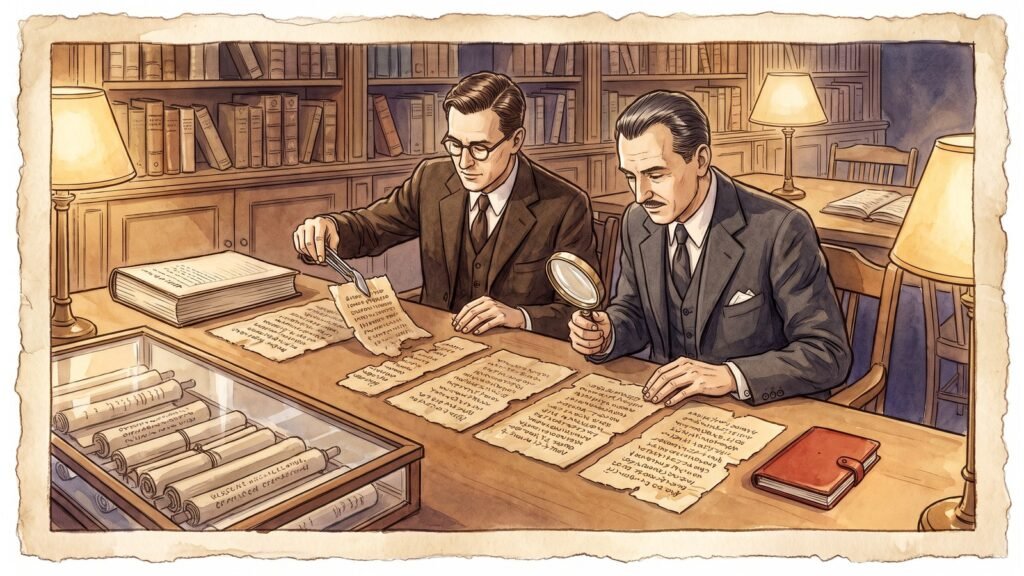
In November 1931 the readers of The Times learned that a collection of Greek biblical manuscripts on papyrus, older than any complete Bible then known, had been acquired by the American-born collector Alfred Chester Beatty. The announcement was made by Sir Frederic Kenyon, recently retired as Director of the British Museum, who described a group of codices containing parts of the Greek Old Testament, the Gospels and Acts, the letters of Paul and the Book of Revelation. Most of them were assigned to the second, third and fourth centuries. Together they formed what is still the most important single group of early Christian biblical books, and the manuscripts known collectively as the Chester Beatty Biblical Papyri changed the study of both the Greek Old Testament and the New Testament.12 This article describes the collection as a whole: the collector, the discovery, the individual codices and what they revealed. The Pauline codex, Papyrus 46, is treated separately in Papyrus 46 and the Chester Beatty Pauline Collection, and is mentioned here only in its place within the collection.3
At a glance
- 2nd–4th centuries: A group of Greek biblical codices is copied in Egypt; the oldest, of Numbers and Deuteronomy, is probably of the second century.
- Late 1920s: The codices are found, apparently together, and pass to dealers in Egypt.
- 1930–1931: Alfred Chester Beatty buys the greater part; the University of Michigan and others buy leaves.
- November 1931: Frederic Kenyon announces the discovery in The Times.
- 1933–1958: Kenyon publishes the texts in eight fascicles with plates.
- 1937–1940: Campbell Bonner edits the Greek Enoch and Melito’s homily on the Passion.
- 1950: Beatty moves to Dublin; his library opens there in 1954.
- 2000: The Chester Beatty Library reopens in the grounds of Dublin Castle.
The Collector
Alfred Chester Beatty
Alfred Chester Beatty was born in New York in 1875 and trained as a mining engineer at the Columbia School of Mines. He made his fortune in the American West, first in Colorado and later as a consultant to large mining companies, and in 1913 he moved to London. There he founded Selection Trust, through which he financed copper mining in Northern Rhodesia, and other ventures in Africa and elsewhere. He became a British subject in 1933 and was knighted in 1954.45
Beatty was a collector from youth. He began with minerals and Chinese snuff bottles, and from the early twentieth century he collected manuscripts on a large scale: Islamic manuscripts and miniatures, Western illuminated books, Japanese and Chinese prints and scrolls, Armenian and Ethiopian manuscripts, and early books from Egypt. He worked with scholars and dealers who could advise him and he paid particular attention to condition and quality. The biblical papyri were thus acquired by a collector already accustomed to buying at the highest level and to employing specialists to publish what he bought.67
Dublin and the Library
In 1950 Beatty left London and settled in Dublin, partly in response to the post-war Labour government’s tax and currency controls. He built a library for his collections on Shrewsbury Road, which opened to the public in 1954, and in 1957 he was made the first honorary citizen of Ireland. On his death in 1968 he left the library and its collections in trust for the public. In 2000 the Chester Beatty Library moved to a restored eighteenth-century building, the Clock Tower Building, in the gardens of Dublin Castle, where the biblical papyri are now kept and where several leaves are regularly displayed.8910
The Discovery and Acquisition
The Lack of a Recorded Find
Unlike the Dead Sea Scrolls or the Nag Hammadi codices, the Chester Beatty papyri were not recovered by archaeologists, and the place and circumstances of their discovery are not documented. They reached the antiquities market in Egypt in the late 1920s and were sold through dealers in Cairo. Kenyon reported in his introduction that the manuscripts were said to have been found in a pottery jar in a Coptic cemetery, and he mentioned reports that the find had been made near the Fayum or at Aphroditopolis, the modern Atfih, on the east bank of the Nile south of Cairo. The German scholar Carl Schmidt, who investigated the matter in Egypt, later reported information pointing to the region of Atfih. None of these accounts can be verified.1112
The likeliest explanation, accepted by most scholars, is that the codices belonged to a single Christian community or church, perhaps a monastery, and were buried or stored together at some point in late antiquity. The uniformity of the find supports this. The books are of similar format, the earliest and latest are separated by about two centuries, and they appear to have been kept together long after the oldest was copied. Brent Nongbri, in his study of the archaeology of the earliest Christian manuscripts, has emphasised how little is actually known and how often reports of jars and cemeteries accompanied finds that reached dealers through clandestine digging.13
Division among Purchasers
The papyri did not pass to a single buyer. Beatty acquired the largest share in 1930 and 1931, and further leaves in later years. Other leaves were bought by the University of Michigan, which acquired thirty leaves of the Pauline codex. Leaves of the Ezekiel, Daniel and Esther codex were acquired by John H. Scheide of Titusville, Pennsylvania, whose collection is now at Princeton University; others went to the University of Cologne and to the Fundación San Lucas Evangelista in Madrid. A single leaf of the codex of the Gospels and Acts was later identified in the Austrian National Library in Vienna. The dispersal reflects the way in which papyri were divided by dealers to increase their value.141516
Kenyon's Announcement and Edition
Kenyon, who had already written widely on the text of the Greek Bible and on the papyri of the British Museum, was invited by Beatty to edit the biblical texts. After the announcement in The Times he published the manuscripts in a series of fascicles printed by Emery Walker in London between 1933 and 1958. The first fascicle gave a general introduction; subsequent fascicles printed the Gospels and Acts, Revelation, Genesis, Numbers and Deuteronomy, Isaiah, Jeremiah and Ecclesiasticus, and Ezekiel, Daniel and Esther, with separate volumes of photographic plates.17181920212223
Kenyon’s edition was notable for its speed and its plates. Within a few years of the acquisition the scholarly world had full transcriptions and photographs of almost all the biblical texts, which allowed independent study at once. The non-biblical texts in the collection, including the Greek text of the last chapters of the Book of Enoch and the homily on the Passion by Melito of Sardis, were edited by Campbell Bonner of the University of Michigan in 1937 and 1940.2425
The Old Testament Codices
The Genesis Codices
The collection includes two codices of Genesis. The first, known in Septuagint studies as Rahlfs 961, is a fourth-century codex containing large parts of Genesis 9 to 44, written in two columns. The second, Rahlfs 962, is dated to the late third century and contains smaller parts of Genesis 8 to 46 in a single column. Because the great uncial codices of the fourth century are badly damaged in Genesis, these two papyri were for many years among the oldest substantial witnesses to the Greek text of the book. Their readings were studied by Albert Pietersma in a new edition published in 1977.262728
Numbers and Deuteronomy
The oldest manuscript in the collection is the codex of Numbers and Deuteronomy, Rahlfs 963. Kenyon dated it to the first half of the second century, and many later scholars have placed it in the second century, which would make it one of the earliest Christian codices of any text. It contains parts of Numbers 5 to 36 and Deuteronomy 1 to 34, written in two columns in a fine, rounded hand. Its age gives it considerable weight as a witness to the Septuagint of these books.2930
The codex is also important for the history of Christian scribal practice. It is generally regarded as a Christian manuscript because it is a codex, but it has been noted that it does not preserve the contracted form of the divine name used in most Christian books, since the relevant words are not preserved in its surviving portions. The question of whether early Christian copies of the Greek Old Testament used the contracted forms of kyrios and theos, as did later copies, has therefore been discussed with reference to this papyrus as well as to others.3132
Isaiah, Jeremiah and Ecclesiasticus
A third-century codex of Isaiah, Rahlfs 965, preserves parts of chapters 8 to 60 and is notable for marginal notes in Coptic, written in an early form of the Coptic script. These glosses are among the earliest examples of Coptic writing in a Christian book and indicate that the codex was used by readers whose first language was Egyptian. A small fragment of Jeremiah, Rahlfs 966, of the late second or third century, contains part of chapter 4 and chapter 5. A fourth-century codex of Ecclesiasticus, Rahlfs 964, preserves parts of chapters 36 to 46.3334
Ezekiel, Daniel and Esther
The codex containing Ezekiel, Daniel and Esther, Rahlfs 967, is the most widely dispersed of the collection and in some respects the most important of the Old Testament manuscripts. Its leaves are divided between Dublin, Princeton, Cologne and Madrid, and the combined text was assembled over several decades. The Princeton portion was published in 1938 and the Cologne portion from 1968 onwards.353637
In Daniel the codex is of exceptional value. The Greek text of Daniel used in the churches from the third century onwards was that attributed to Theodotion, and the earlier Old Greek translation had survived in only one medieval manuscript, the Chigi codex, and in a Syriac version. Papyrus 967 provides an independent and much older witness to the Old Greek of Daniel, and it shows that the Old Greek was still in use in Egypt in the late second or early third century. It also places chapters 7 and 8 before chapters 5 and 6, an order that some scholars regard as reflecting an earlier stage of the book, and it contains the stories of Bel and the Dragon and of Susanna, with Susanna after Bel and the Dragon at the end of the book.383940
In Ezekiel the codex has also attracted attention. It lacks Ezekiel 36:23b–38, and it places chapter 37 after chapters 38 and 39. Johan Lust argued in 1981 that these features reflected an older Hebrew text in which the passage was absent and the chapters were in a different order, and that the familiar text represents a later expansion. Other scholars explain the absence as an accidental omission. The question remains open and is among the clearest cases in which an early Greek papyrus has been used to argue for an earlier form of a Hebrew book.41
The New Testament Codices
Papyrus 45: The Gospels and Acts
The codex of the Gospels and Acts, numbered P45, was written in the third century, probably in its first half. Thirty leaves survive, most of them in fragments: two leaves of Matthew, six of Mark, seven of Luke, two of John and thirteen of Acts. The codex originally contained all four Gospels and Acts, an estimated 220 leaves, in a single volume. It is the oldest known manuscript to have contained the four Gospels together, and in that sense the earliest material evidence for the four-Gospel collection as a physical book.424344
The order of the books cannot be determined directly from the surviving leaves, but T. C. Skeat argued from the construction of the codex that the Gospels stood in the order Matthew, John, Luke, Mark, the order found also in the fifth-century Codex Bezae and in some Latin manuscripts and often called the Western order.4546 The leaves were made from single sheets folded in half and stacked in gatherings of two leaves each, a method of construction unusual among early codices.47
The text of P45 does not belong clearly to any of the groups that textual critics have identified in later manuscripts. In Mark its readings were for a time associated with the so-called Caesarean text; elsewhere they stand between the Alexandrian and Western forms. Studies of its scribe have shown that he frequently shortened his text, omitting words that he considered superfluous and rephrasing for clarity, while keeping the sense. E. C. Colwell, Peter Head and James Royse have all analysed these habits, and their work has made P45 an important case in the study of how early scribes treated their exemplars.484950
Papyrus 46: The Pauline Letters
The Pauline codex, P46, of which Beatty owned fifty-six leaves and the University of Michigan thirty, is usually dated to around 200. It preserves most of the letters of Paul, including Hebrews, which stands after Romans. Its history, text and dating are discussed in a separate article on this site, and it is enough here to note that it is part of the same find and the earliest substantial manuscript of the Pauline corpus.51
Papyrus 47: Revelation
The codex of Revelation, P47, of the second half of the third century, preserves ten leaves containing Revelation 9:10 to 17:2. It was for many years the oldest substantial witness to the book, and its text agrees most often with Codex Sinaiticus. Together with Codex Alexandrinus and Codex Ephraemi Rescriptus, it forms one of the main groups of witnesses that textual critics distinguish in Revelation. The book was copied less often than the Gospels and Paul in the early centuries, and the survival of a third-century manuscript of it in Egypt is a valuable witness to its use there.525354
The Non-Biblical Texts
Enoch and Melito
One codex in the collection, of the fourth century, contained two works not included in the biblical canon of most churches. The first was the last chapters of the Book of Enoch, chapters 97 to 107, in Greek; the second was the homily on the Passion by Melito, bishop of Sardis in the second century. Part of the codex is in Dublin and part at the University of Michigan. Campbell Bonner published the Enoch text in 1937 and the Melito homily in 1940.5556
The Enoch text was important because the Greek of these chapters was otherwise unknown, and the book had survived complete only in Ethiopic. The Melito homily was a still more remarkable recovery. It had been known by title from ancient writers but was thought to be lost, and Bonner’s identification restored to scholarship a substantial work of a second-century bishop, which has since been studied for its liturgical, theological and rhetorical character and for its treatment of the Passover.5758
Other Collections in the Library
The Chester Beatty Library also holds non-biblical papyri and early codices acquired in the same period, including a group of Manichaean codices in Coptic from Medinet Madi in the Fayum, bought in 1930 and divided between Dublin and Berlin, and later acquisitions of Coptic and Greek biblical texts. Some of these later items are associated with the find that produced the Bodmer papyri in Upper Egypt, and the relationship of the two collections is discussed by James M. Robinson in his history of the Bodmer find.5960 The Bodmer collection itself is described in The Bodmer Papyri and the Earliest New Testament Codices.61
The Collection as a Group
Books of a Community
Taken together, the Chester Beatty biblical papyri give an impression of the library of a Christian community over two centuries. The oldest books, of Numbers and Deuteronomy and perhaps of Jeremiah, were copied in the second century; the codices of the Gospels and Acts, Paul, Isaiah, Revelation and Ezekiel–Daniel–Esther in the third; and the Genesis codex, Ecclesiasticus and the Enoch–Melito codex in the fourth. All are codices, all are written on papyrus, and all but a few are in Greek. The community that owned them kept books from different periods together, read the Old and New Testaments side by side, and included texts such as Enoch and Melito that later fell outside the boundaries of the canon.6263
Historians of early Christianity have often used the collection as evidence of how Christian scriptures were gathered and read before the councils and canon lists of the fourth century. The presence of the four Gospels and Acts in one codex and of the Pauline letters in another shows that these groups of writings were already treated as collections. The inclusion of Enoch indicates that the boundaries of the Old Testament were not everywhere fixed in the same way. Kenyon himself drew attention to the significance of the codex form, which these manuscripts showed to have been the normal form for Christian scriptures by the third century.6465
Effects on Textual Criticism
Before the discovery of the Chester Beatty papyri, the text of the New Testament was reconstructed mainly from the parchment codices of the fourth and fifth centuries, especially Codex Vaticanus and Codex Sinaiticus. The papyri provided witnesses up to a century and a half older. They showed that the text of the Gospels in the third century was already varied, that the groupings of later manuscripts could not simply be projected back into the earliest period, and that the text of Vaticanus, in Paul especially, had very old antecedents. Their influence can be seen in the critical editions of the New Testament from the 1930s onwards and in all subsequent textual handbooks.6667
For the Septuagint the effects were equally significant. The papyri provided some of the oldest witnesses for several books and, in Daniel, an independent witness to the Old Greek. They also helped to show that the Greek translations of the Old Testament had already undergone revision in the second and third centuries and that Christian copies did not represent a single uniform text.6869
Format and Scribal Practice
Sizes and Layouts
The Chester Beatty codices vary considerably in size and layout, and this variety is itself instructive. The codex of Numbers and Deuteronomy was a tall book written in two narrow columns to the page, a layout that recalls the columns of a roll and that is found in several of the earliest Christian codices. The first Genesis codex was also written in two columns, while the second Genesis codex, the codex of the Gospels and Acts and the Pauline codex were written in a single column. Page sizes range from relatively small books that could be held in one hand to larger volumes of more than twenty-five centimetres in height. Kenyon recorded the dimensions of each manuscript and reconstructed the original number of leaves wherever the evidence allowed.7071
The construction of the codices also varies. Some were made as a single large quire, in which a stack of sheets was folded once down the middle to form a book; the Pauline codex is the best-known example, with more than fifty sheets in one gathering. Others were made of several smaller quires. The codex of the Gospels and Acts, as Skeat showed, was made of gatherings of a single folded sheet, a method that allowed a large book to be assembled from many small units. These differences suggest that no single method of making Christian books had yet become standard in the third century, and that scribes and bookmakers experimented with the new format.7273
Hands and Scribes
The handwriting of the codices ranges from careful book hands to more informal scripts. The codex of Numbers and Deuteronomy is written in a fine, regular hand that Kenyon compared with the best literary papyri of its period. The Ezekiel, Daniel and Esther codex was written by more than one scribe. The codex of the Gospels and Acts is in a competent but less formal hand, with a fairly consistent letter size and few corrections. Kenyon thought that most of the manuscripts were produced by trained scribes rather than by private individuals, and later scholars have generally agreed, though they have pointed out that trained scribes in Roman Egypt wrote documents as well as books, and that the boundary between the two kinds of work was not sharp.747576
Contractions and Reading Aids
All the New Testament codices in the collection use the nomina sacra, the contracted forms of sacred names such as God, Lord, Jesus, Christ and Spirit, marked by a horizontal line above the letters. The Old Testament codices of the third and fourth centuries use them as well. The consistency of the practice across manuscripts copied in different decades and by different scribes is one of the clearest indications that it was an established Christian convention by the third century, and the collection has been central to the study of its origins.77
The codices also contain aids to reading. Some mark the beginnings of sections by spaces or by letters projecting into the margin; some use the high point as punctuation; several distinguish the end of one book from the beginning of the next by a title or a blank space. Corrections are found in most of the manuscripts, some by the original scribe and some by later readers. In the Isaiah codex the marginal glosses in Coptic show a reader working from the Greek and noting its meaning in his own language. These features show that the books were not only copied but also read and used over a long period.787980
The Papyri and the History of the Bible
Before the Fourth-Century Bibles
The great parchment Bibles of the fourth and fifth centuries, Codex Vaticanus, Codex Sinaiticus and Codex Alexandrinus, contain the Old and New Testaments in single volumes. The Chester Beatty papyri show an earlier stage, in which the scriptures were copied as smaller groups of books in separate codices: the Pentateuch in parts, the Prophets in single or paired volumes, the Gospels with Acts, the letters of Paul together, Revelation alone. The transition from such collections to the one-volume Bible was made possible by the use of parchment and by the patronage of churches and emperors in the fourth century. The papyri thus give material form to the stage of Christian scripture that preceded the complete Bible.8182
Christian Reading in Egypt
The collection is also evidence for the place of reading in the Christian communities of Egypt. Its owners possessed costly books, some of them already a century old, and they continued to use them as Christianity spread in the Egyptian countryside and as Coptic began to be written. The marginal notes in Coptic in the Isaiah codex, the inclusion of Melito’s homily, which was used in connection with the celebration of Easter, and the presence of texts from both Testaments suggest a community in which scripture was read in worship and studied privately. The papyri cannot by themselves show how such a community was organised, but they show the range of books it valued.838485
Relation to Other Finds
Since the 1930s other collections have added to the evidence that the Chester Beatty papyri first made available. The Bodmer papyri, acquired in Geneva from the 1950s, include early codices of John and Luke and of the letters of Peter and Jude. The Oxyrhynchus papyri, published continuously since 1898, have yielded many smaller fragments of biblical books from the second to the fourth centuries. Taken together, these finds have made it possible to compare scribal habits, page layouts and texts across a much wider sample of early Christian books. In that larger body of evidence, the Chester Beatty codices remain distinctive for the number of books they represent and for the fact that they appear to have been owned together.8687
Later Study and Digitisation
The Chester Beatty papyri have been studied continuously since Kenyon’s edition. New editions of individual codices have been made, among them Pietersma’s edition of the Genesis papyri, and the dispersed leaves of Papyrus 967 have been brought together in the editions of the Cologne and Madrid portions. A conference on P45 held in 2000 resulted in a volume edited by Charles Horton, published in 2004, that brought together studies of its codicology, scribal habits and place in the history of the Gospels.888990
In the twenty-first century the Chester Beatty Library collaborated with the Center for the Study of New Testament Manuscripts in producing high-resolution digital images of the biblical papyri, and the images were made freely available. The papyri remain fragile, and only a few leaves are displayed at a time in the galleries in Dublin Castle. The digital images allow scholars to examine details of the papyri that were invisible on Kenyon’s plates.9192
Frederic Kenyon
Frederic George Kenyon, who edited the collection, was born in 1863 and spent his career at the British Museum, where he was Director and Principal Librarian from 1909 to 1931. He had edited the papyrus of Aristotle’s Constitution of the Athenians in 1891 and catalogued the Greek papyri of the museum. He wrote several widely read books on the text of the Greek Bible and on the history of manuscripts, and served as President of the British Academy. His edition of the Chester Beatty papyri, begun just after his retirement, was the major scholarly project of his later years. He died in 1952.93
Conclusion
The Chester Beatty biblical papyri form a group of Greek codices from Egypt copied between the second and fourth centuries, acquired by Alfred Chester Beatty and others in the early 1930s and published by Frederic Kenyon within a few years. They include the oldest manuscript of the four Gospels and Acts in one book, the earliest substantial copy of the Pauline letters, an early copy of Revelation, important early witnesses to Genesis, Numbers and Deuteronomy, Isaiah and Ezekiel, the Old Greek of Daniel, and the lost homily of Melito of Sardis. Their discovery widened the range of evidence for the text of the Christian Bible by more than a century and made it possible to study the books of an early Christian community as a group. The collection remains in Dublin, where it continues to be studied and, through digital images, to be read by scholars far beyond the city in which Beatty chose to place it.949596
Notes
- Frederic G. Kenyon, announcement of the Chester Beatty papyri, The Times (London), November 1931. ↩
- Frederic G. Kenyon, The Chester Beatty Biblical Papyri: Descriptions and Texts of Twelve Manuscripts on Papyrus of the Greek Bible, Fasciculus I: General Introduction (London: Emery Walker, 1933). ↩
- Grokipedia, “Chester Beatty Papyri”. ↩
- Grokipedia, “Alfred Chester Beatty”. ↩
- Arthur J. Wilson, The Life and Times of Sir Alfred Chester Beatty (London: Cadogan, 1985). ↩
- Arthur J. Wilson, The Life and Times of Sir Alfred Chester Beatty (London: Cadogan, 1985). ↩
- Grokipedia, “Chester Beatty Library”. ↩
- Grokipedia, “Chester Beatty Library”. ↩
- Grokipedia, “Dublin Castle”. ↩
- Arthur J. Wilson, The Life and Times of Sir Alfred Chester Beatty (London: Cadogan, 1985). ↩
- Frederic G. Kenyon, The Chester Beatty Biblical Papyri: Descriptions and Texts of Twelve Manuscripts on Papyrus of the Greek Bible, Fasciculus I: General Introduction (London: Emery Walker, 1933). ↩
- Brent Nongbri, God’s Library: The Archaeology of the Earliest Christian Manuscripts (New Haven: Yale University Press, 2018). ↩
- Brent Nongbri, God’s Library: The Archaeology of the Earliest Christian Manuscripts (New Haven: Yale University Press, 2018). ↩
- Frederic G. Kenyon, The Chester Beatty Biblical Papyri: Descriptions and Texts of Twelve Manuscripts on Papyrus of the Greek Bible, Fasciculus I: General Introduction (London: Emery Walker, 1933). ↩
- Allan Chester Johnson, Henry Snyder Gehman and Edmund Harris Kase, eds, The John H. Scheide Biblical Papyri: Ezekiel (Princeton: Princeton University Press, 1938). ↩
- Angelo Geissen, Der Septuaginta-Text des Buches Daniel Kap. 5–12, zusammen mit Susanna, Bel et Draco, sowie Esther Kap. 1,1a–2,15 nach dem Kölner Teil des Papyrus 967 (Bonn: Habelt, 1968). ↩
- Frederic G. Kenyon, The Chester Beatty Biblical Papyri: Descriptions and Texts of Twelve Manuscripts on Papyrus of the Greek Bible, Fasciculus I: General Introduction (London: Emery Walker, 1933). ↩
- Frederic G. Kenyon, The Chester Beatty Biblical Papyri, Fasciculus II: The Gospels and Acts (London: Emery Walker, 1933). ↩
- Frederic G. Kenyon, The Chester Beatty Biblical Papyri, Fasciculus III: Revelation (London: Emery Walker, 1934). ↩
- Frederic G. Kenyon, The Chester Beatty Biblical Papyri, Fasciculus IV: Genesis (London: Emery Walker, 1934–1936). ↩
- Frederic G. Kenyon, The Chester Beatty Biblical Papyri, Fasciculus V: Numbers and Deuteronomy (London: Emery Walker, 1935). ↩
- Frederic G. Kenyon, The Chester Beatty Biblical Papyri, Fasciculus VI: Isaiah, Jeremiah, Ecclesiasticus (London: Emery Walker, 1937). ↩
- Frederic G. Kenyon, The Chester Beatty Biblical Papyri, Fasciculus VII: Ezekiel, Daniel, Esther (London: Emery Walker, 1937–1938). ↩
- Campbell Bonner, The Last Chapters of Enoch in Greek, Studies and Documents 8 (London: Christophers, 1937). ↩
- Campbell Bonner, The Homily on the Passion by Melito, Bishop of Sardis, Studies and Documents 12 (London: Christophers; Philadelphia: University of Pennsylvania Press, 1940). ↩
- Frederic G. Kenyon, The Chester Beatty Biblical Papyri, Fasciculus IV: Genesis (London: Emery Walker, 1934–1936). ↩
- Albert Pietersma, Chester Beatty Biblical Papyri IV and V: A New Edition with Text-Critical Analysis, American Studies in Papyrology 16 (Toronto: Hakkert, 1977). ↩
- Grokipedia, “Septuagint”. ↩
- Frederic G. Kenyon, The Chester Beatty Biblical Papyri, Fasciculus V: Numbers and Deuteronomy (London: Emery Walker, 1935). ↩
- Albert Pietersma, Chester Beatty Biblical Papyri IV and V: A New Edition with Text-Critical Analysis, American Studies in Papyrology 16 (Toronto: Hakkert, 1977). ↩
- Larry W. Hurtado, The Earliest Christian Artifacts: Manuscripts and Christian Origins (Grand Rapids: Eerdmans, 2006). ↩
- Natalio Fernández Marcos, The Septuagint in Context: Introduction to the Greek Versions of the Bible, trans. Wilfred G. E. Watson (Leiden: Brill, 2000). ↩
- Frederic G. Kenyon, The Chester Beatty Biblical Papyri, Fasciculus VI: Isaiah, Jeremiah, Ecclesiasticus (London: Emery Walker, 1937). ↩
- Natalio Fernández Marcos, The Septuagint in Context: Introduction to the Greek Versions of the Bible, trans. Wilfred G. E. Watson (Leiden: Brill, 2000). ↩
- Frederic G. Kenyon, The Chester Beatty Biblical Papyri, Fasciculus VII: Ezekiel, Daniel, Esther (London: Emery Walker, 1937–1938). ↩
- Allan Chester Johnson, Henry Snyder Gehman and Edmund Harris Kase, eds, The John H. Scheide Biblical Papyri: Ezekiel (Princeton: Princeton University Press, 1938). ↩
- Angelo Geissen, Der Septuaginta-Text des Buches Daniel Kap. 5–12, zusammen mit Susanna, Bel et Draco, sowie Esther Kap. 1,1a–2,15 nach dem Kölner Teil des Papyrus 967 (Bonn: Habelt, 1968). ↩
- Grokipedia, “Book of Daniel”. ↩
- Grokipedia, “Theodotion”. ↩
- Sharon Pace Jeansonne, The Old Greek Translation of Daniel 7–12, Catholic Biblical Quarterly Monograph Series 19 (Washington: Catholic Biblical Association, 1988). ↩
- Johan Lust, “Ezekiel 36–40 in the Oldest Greek Manuscript”, Catholic Biblical Quarterly 43 (1981), 517–533. ↩
- Frederic G. Kenyon, The Chester Beatty Biblical Papyri, Fasciculus II: The Gospels and Acts (London: Emery Walker, 1933). ↩
- Grokipedia, “Papyrus 45”. ↩
- Charles Horton, ed., The Earliest Gospels: The Origins and Transmission of the Earliest Christian Gospels. The Contribution of the Chester Beatty Gospel Codex P45 (London: T&T Clark, 2004). ↩
- T. C. Skeat, “A Codicological Analysis of the Chester Beatty Papyrus Codex of Gospels and Acts (P45)”, Hermathena 155 (1993), 27–43. ↩
- Grokipedia, “Western text-type”. ↩
- T. C. Skeat, “A Codicological Analysis of the Chester Beatty Papyrus Codex of Gospels and Acts (P45)”, Hermathena 155 (1993), 27–43. ↩
- Peter M. Head, “Some Observations on Early Papyri of the Synoptic Gospels, Especially concerning the Scribal Habits”, Biblica 71 (1990), 240–247. ↩
- James R. Royse, Scribal Habits in Early Greek New Testament Papyri, New Testament Tools, Studies and Documents 36 (Leiden: Brill, 2008). ↩
- Bruce M. Metzger and Bart D. Ehrman, The Text of the New Testament: Its Transmission, Corruption, and Restoration, 4th edn (New York: Oxford University Press, 2005). ↩
- Kurt Aland and Barbara Aland, The Text of the New Testament, trans. Erroll F. Rhodes, 2nd edn (Grand Rapids: Eerdmans; Leiden: Brill, 1989). ↩
- Frederic G. Kenyon, The Chester Beatty Biblical Papyri, Fasciculus III: Revelation (London: Emery Walker, 1934). ↩
- Grokipedia, “Papyrus 47”. ↩
- Grokipedia, “Book of Revelation”. ↩
- Campbell Bonner, The Last Chapters of Enoch in Greek, Studies and Documents 8 (London: Christophers, 1937). ↩
- Campbell Bonner, The Homily on the Passion by Melito, Bishop of Sardis, Studies and Documents 12 (London: Christophers; Philadelphia: University of Pennsylvania Press, 1940). ↩
- Grokipedia, “Book of Enoch”. ↩
- Grokipedia, “Melito of Sardis”. ↩
- Grokipedia, “Manichaeism”. ↩
- James M. Robinson, The Story of the Bodmer Papyri: From the First Monastery’s Library in Upper Egypt to Geneva and Dublin (Eugene: Cascade, 2011). ↩
- James M. Robinson, The Story of the Bodmer Papyri: From the First Monastery’s Library in Upper Egypt to Geneva and Dublin (Eugene: Cascade, 2011). ↩
- Frederic G. Kenyon, The Chester Beatty Biblical Papyri: Descriptions and Texts of Twelve Manuscripts on Papyrus of the Greek Bible, Fasciculus I: General Introduction (London: Emery Walker, 1933). ↩
- Larry W. Hurtado, The Earliest Christian Artifacts: Manuscripts and Christian Origins (Grand Rapids: Eerdmans, 2006). ↩
- Bruce M. Metzger and Bart D. Ehrman, The Text of the New Testament: Its Transmission, Corruption, and Restoration, 4th edn (New York: Oxford University Press, 2005). ↩
- Kurt Aland and Barbara Aland, The Text of the New Testament, trans. Erroll F. Rhodes, 2nd edn (Grand Rapids: Eerdmans; Leiden: Brill, 1989). ↩
- Natalio Fernández Marcos, The Septuagint in Context: Introduction to the Greek Versions of the Bible, trans. Wilfred G. E. Watson (Leiden: Brill, 2000). ↩
- Grokipedia, “Septuagint”. ↩
- Frederic G. Kenyon, The Chester Beatty Biblical Papyri: Descriptions and Texts of Twelve Manuscripts on Papyrus of the Greek Bible, Fasciculus I: General Introduction (London: Emery Walker, 1933). ↩
- Larry W. Hurtado, The Earliest Christian Artifacts: Manuscripts and Christian Origins (Grand Rapids: Eerdmans, 2006). ↩
- T. C. Skeat, “A Codicological Analysis of the Chester Beatty Papyrus Codex of Gospels and Acts (P45)”, Hermathena 155 (1993), 27–43. ↩
- Larry W. Hurtado, The Earliest Christian Artifacts: Manuscripts and Christian Origins (Grand Rapids: Eerdmans, 2006). ↩
- Frederic G. Kenyon, The Chester Beatty Biblical Papyri: Descriptions and Texts of Twelve Manuscripts on Papyrus of the Greek Bible, Fasciculus I: General Introduction (London: Emery Walker, 1933). ↩
- Larry W. Hurtado, The Earliest Christian Artifacts: Manuscripts and Christian Origins (Grand Rapids: Eerdmans, 2006). ↩
- James R. Royse, Scribal Habits in Early Greek New Testament Papyri, New Testament Tools, Studies and Documents 36 (Leiden: Brill, 2008). ↩
- Larry W. Hurtado, The Earliest Christian Artifacts: Manuscripts and Christian Origins (Grand Rapids: Eerdmans, 2006). ↩
- Frederic G. Kenyon, The Chester Beatty Biblical Papyri, Fasciculus VI: Isaiah, Jeremiah, Ecclesiasticus (London: Emery Walker, 1937). ↩
- James R. Royse, Scribal Habits in Early Greek New Testament Papyri, New Testament Tools, Studies and Documents 36 (Leiden: Brill, 2008). ↩
- Larry W. Hurtado, The Earliest Christian Artifacts: Manuscripts and Christian Origins (Grand Rapids: Eerdmans, 2006). ↩
- Larry W. Hurtado, The Earliest Christian Artifacts: Manuscripts and Christian Origins (Grand Rapids: Eerdmans, 2006). ↩
- Bruce M. Metzger and Bart D. Ehrman, The Text of the New Testament: Its Transmission, Corruption, and Restoration, 4th edn (New York: Oxford University Press, 2005). ↩
- Campbell Bonner, The Homily on the Passion by Melito, Bishop of Sardis, Studies and Documents 12 (London: Christophers; Philadelphia: University of Pennsylvania Press, 1940). ↩
- Frederic G. Kenyon, The Chester Beatty Biblical Papyri, Fasciculus VI: Isaiah, Jeremiah, Ecclesiasticus (London: Emery Walker, 1937). ↩
- Brent Nongbri, God’s Library: The Archaeology of the Earliest Christian Manuscripts (New Haven: Yale University Press, 2018). ↩
- James M. Robinson, The Story of the Bodmer Papyri: From the First Monastery’s Library in Upper Egypt to Geneva and Dublin (Eugene: Cascade, 2011). ↩
- Larry W. Hurtado, The Earliest Christian Artifacts: Manuscripts and Christian Origins (Grand Rapids: Eerdmans, 2006). ↩
- Albert Pietersma, Chester Beatty Biblical Papyri IV and V: A New Edition with Text-Critical Analysis, American Studies in Papyrology 16 (Toronto: Hakkert, 1977). ↩
- Angelo Geissen, Der Septuaginta-Text des Buches Daniel Kap. 5–12, zusammen mit Susanna, Bel et Draco, sowie Esther Kap. 1,1a–2,15 nach dem Kölner Teil des Papyrus 967 (Bonn: Habelt, 1968). ↩
- Charles Horton, ed., The Earliest Gospels: The Origins and Transmission of the Earliest Christian Gospels. The Contribution of the Chester Beatty Gospel Codex P45 (London: T&T Clark, 2004). ↩
- Grokipedia, “Chester Beatty Library”. ↩
- Grokipedia, “Chester Beatty Papyri”. ↩
- Frederic G. Kenyon, The Chester Beatty Biblical Papyri: Descriptions and Texts of Twelve Manuscripts on Papyrus of the Greek Bible, Fasciculus I: General Introduction (London: Emery Walker, 1933). ↩
- Frederic G. Kenyon, The Chester Beatty Biblical Papyri: Descriptions and Texts of Twelve Manuscripts on Papyrus of the Greek Bible, Fasciculus I: General Introduction (London: Emery Walker, 1933). ↩
- Grokipedia, “Chester Beatty Papyri”. ↩
- Grokipedia, “Chester Beatty Library”. ↩