

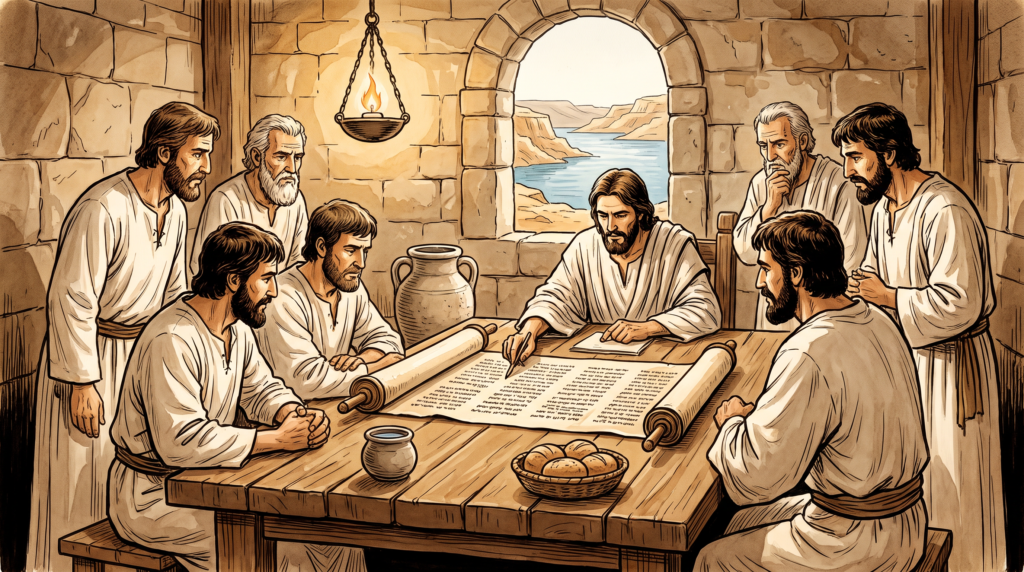
Among the seven original Dead Sea Scrolls that came into the hands of the antiquities market in 1947 and were acquired by the Syrian Orthodox Metropolitan Athanasius Yeshue Samuel and by the Hebrew University and the Jordanian Department of Antiquities, one parchment scroll in particular has come to function as the charter of the community that owned and copied the rest of the library. The scroll is the Serekh HaYahad, the Rule of the Community, designated by the conventional siglum 1QS, a single parchment column of about twenty-five lines running across roughly two and a half metres of writing and preserving, in eleven columns, the foundational document of a Jewish sectarian movement that lived at the edge of the Judaean desert in the two centuries before the Roman destruction of the Temple in 70 CE. The scroll is, in the words of the Israel Museum’s online Digital Dead Sea Scrolls edition, the major section of one of the first seven scrolls discovered in Cave 1 at Qumran and is “a sectarian work, crucial for understanding the Community’s way of life.” It deals with the admission of new members, with conduct at communal meals, and with the most distinctive theological doctrine of the sect, the doctrine of the two spirits who divide humanity between the sons of light and the sons of darkness. The picture that emerges from the scroll is one of a communal, ascetic life governed by rigorous rules, which transformed the members of the community into “priests in spirit,” who lived sacred lives in a “spiritual temple” in opposition to the defiled physical Temple in Jerusalem. The Community Rule is at once the most studied, most translated, and most theologically distinctive of the Dead Sea Scrolls, and the scroll is the document that anyone who wants to understand the yahad of the Dead Sea has to read first.
The discovery in Cave 1 and the long path to publication
The seven original Dead Sea Scrolls that were acquired in 1947 and 1948 were discovered, on the most reliable reconstruction of the events, by a party of three Bedouin of the Ta’amireh tribe who were looking for a stray goat in the cliffs above the north-western shore of the Dead Sea in the early spring of 1947. The Bedouin entered one of the caves in the marl terrace above Wadi Qumran, a little over a kilometre north of the ruined settlement at Hirbet Qumran, and found a number of cylindrical jars, some broken and some intact, lying in the dust of the cave floor. Some of the jars contained leather and parchment scrolls in a remarkable state of preservation. The Bedouin took a number of the scrolls to a cobbler in Bethlehem named Khalil Eskander Shahin, who is generally known as Kando, and Kando in turn brought the scrolls to the Syrian Orthodox Metropolitan of Jerusalem, Athanasius Yeshue Samuel. The Metropolitan acquired four of the scrolls, the others were acquired by the Hebrew University of Jerusalem through the antiquities dealer and biblical scholar Eleazar Sukenik, and a fifth scroll, the Copper Scroll, was acquired separately in 1952. Among the four scrolls acquired by the Metropolitan were three that are now in the Shrine of the Book at the Israel Museum in Jerusalem, namely the great Isaiah Scroll (1QIsaiaha), the Habakkuk Commentary or Pesher (1QpHab), and the Community Rule (1QS), and the fourth, the War Scroll (1QM), was acquired by Sukenik and is also in the Shrine of the Book. The Community Rule was one of the three scrolls that the Metropolitan first sent to the American School of Oriental Research in Jerusalem for examination in the spring of 1948, and the scroll was, in the inaugural series of studies published in the late 1940s and early 1950s, the document that gave the scholarly world its first extended look at the theology and the way of life of the community that had produced the rest of the library.
The Community Rule was first published in 1951, in a preliminary edition by Millar Burrows of the American Schools of Oriental Research, with the assistance of John Trevor and Walter Brownlee, and the scroll was given the title “Manual of Discipline” because of a perceived resemblance, in the structure of the admission and penitential sections, to the disciplinary manuals of the Methodist tradition. The title stuck for almost a generation, and it was only in the late twentieth century that the title “Community Rule” came into general use, on the basis of the recognition that the Hebrew word serekh, which means “rule” or “order,” and the Hebrew word yahad, which means “community” or “association” and which is the self-designation of the sect, are the technical terms that the document itself uses for the group and for the document. The improved reading of the scroll was made possible by the use of infrared photography and by the careful editing of the scroll by a succession of scholars, including John Marco Allegro, who produced the first editio minor in 1960, John Strugnell and Joseph Baumgarten, who worked on the Cave 4 copies of the Rule, and Florentino Garcia Martinez and Eibert Tigchelaar, who produced the standard two-volume edition of the scrolls in English translation. The scroll is, in the present state of the text, one of the best-edited of the Dead Sea Scrolls, and the text is in a stable enough state that the major scholarly commentaries, including those of Jacob Licht, Menahem Mansoor, and Duane Christensen, can work from essentially the same text. The scroll has been the object of a continuous stream of monographs and articles since 1951, and the literature on the scroll is now so large that the major synthetic treatments of the yahad devote substantial space to the Rule before turning to the other Dead Sea Scrolls that the community produced.
The manuscript itself
The Community Rule (1QS) is, on the physical evidence, a single parchment scroll about two and a half metres long and about twenty-four centimetres high, with eleven columns of writing, twenty-five lines to the column, copied in a Jewish square hand of the late Hasmonean or early Herodian period, that is to say roughly between the years 100 and 75 BCE according to the paleographical analysis of Frank Moore Cross. The parchment is of excellent quality, well prepared, well ruled, and well preserved, and the writing is in a clean, careful hand with very few corrections and a number of characteristic Hasmonean letter forms, including the curved he and the long samekh. The scroll is written in Hebrew, with occasional Aramaic loan words, and the Hebrew is of a relatively late and standardised type that is consistent with the literary Hebrew of the late Second Temple period. The text is, on the evidence of the orthography and of the corrections, a careful copy of an older text, and the text is in general well preserved, with the major lacunae in columns six and seven having been filled in from the parallel Cave 4 copies, in particular from 4Q256 (4QSb) and 4Q257 (4QSc), which are the next best preserved of the dozen or so manuscript copies of the Rule that were found in the Qumran caves.
The number of manuscript copies of the Rule that have been identified at Qumran is, on the present state of publication, no fewer than twelve, including the principal Cave 1 copy, 1QS, and eleven Cave 4 copies (4Q255 through 4Q264), together with two small fragments from Cave 5 (5Q11 and 5Q13). The number is striking, because it is the largest number of copies of any single sectarian composition from Qumran, and the number is one of the pieces of evidence that the Community Rule was the foundational document of the community that owned the rest of the library. The Cave 4 copies include both earlier and later recensions of the text, and the comparison of the different recensions has been one of the most fruitful areas of Dead Sea Scrolls research since John Strugnell and Joseph Baumgarten began the publication of the Cave 4 fragments in the 1990s. The Cave 4 copies in particular preserve a shorter form of the text than 1QS, and the shorter form is generally considered to represent an earlier stage in the development of the document, with 1QS representing a late and somewhat expanded version in which the older material has been supplemented by later additions. The standard view, which has emerged from the work of Baumgarten, Schiffman, Hempel, and others, is that the Rule went through a number of editorial stages in the two centuries before the destruction of the site in 68 CE, and the Rule is a document that grew over time in the hands of the community that used it.
The scroll contains, in addition to the Community Rule proper, two short appendices that are found on the same parchment and that are conventionally designated 1QSa and 1QSb. The first appendix, 1QSa, is called the Rule of the Congregation, and it contains a brief set of regulations for the messianic community, that is, for the yahad as it will be when the messiahs of Aaron and Israel have arrived. The second appendix, 1QSb, is called the Rule of the Blessing, and it contains a series of priestly blessings for the eschatological high priest and for the princes of the congregation. Both appendices were originally considered to be integral parts of the Community Rule, but the more recent scholarship, in particular the work of Schiffman and Hempel, has argued that the two appendices are separate compositions that were copied on the same parchment for convenience and that they are not part of the original Rule. The standard practice in modern scholarship is to treat 1QSa and 1QSb as independent works, but the conventional siglum 1QS, with the appendices, is still used to refer to the entire physical scroll, and the appendices are edited and studied together with the Rule in the major editions.
The structure of the document
The Community Rule is, in the form in which 1QS preserves it, a composite document that can be divided into a number of distinct literary units. The major units, in the order in which they appear in the scroll, are a general statement of the purpose of the community (1.1 to 1.15), the covenant ceremony (1.16 to 3.12), the Treatise on the Two Spirits (3.13 to 4.26), the rule for the members of the community (5.1 to 6.23), the penal code (6.24 to 7.25), the rule for the maśkîl or instructor (9.12 to 9.26), and a concluding hymn. The seven units, which have been distinguished by the form-critical analysis of Leaney, Licht, and most recently by Hempel in her commentary on the Rule, are not all of the same literary type. The first unit, the general statement of purpose, is in the form of a hortatory introduction. The second unit, the covenant ceremony, is a liturgical text in which the priests, the Levites, and the people recite a series of blessings and curses. The third unit, the Treatise on the Two Spirits, is a theological instruction, possibly composed originally outside the community, that was incorporated into the Rule at some point in the development of the document. The fourth, fifth, and sixth units are legal texts, in the form of regulations for admission, for the conduct of the communal meals, and for the discipline of the members. The seventh and final unit is a hymn, in the style of the Thanksgiving Scroll, that closes the document with a doxology. The seven units, taken together, form a document that is at once a founding charter, a liturgical text, a theological treatise, a legal code, and a hymn, and the document is one of the most internally varied compositions in the whole of the Dead Sea library.
The covenant ceremony, which occupies the second unit of the document, is one of the most striking passages in the scroll. The ceremony, as it is described in columns 1.18 to 3.12, is a ritual in which the priests, the Levites, and the people of the yahad recite a series of blessings and curses, and in which the entire community is brought into a renewed relationship with God by means of an oath. The ceremony is modelled, as several scholars including Jonas Greenfield and Moshe Weinfeld have argued, on the covenant ceremony that is described in the book of Deuteronomy, in particular on the ceremony at Mount Gerizim and Mount Ebal that is described in Deuteronomy 27, in which the tribes of Israel, divided into two groups, recite the blessings and the curses of the covenant. The Qumran covenant ceremony adapts the Deuteronomic model to the context of the yahad, with the priests, the Levites, and the people of the community playing the roles that the tribes of Israel play in the Deuteronomic ceremony. The ceremony, in the form in which the scroll preserves it, is a renewal of the Mosaic covenant, but the covenant is now understood in a strongly dualistic sense, with the curses of the covenant aimed not at the enemies of Israel but at the “men of Belial” within Israel, and the blessings of the covenant aimed at the sons of light who have joined the yahad. The ceremony is the most distinctive ritual of the community, and the ceremony is the ritual in which the members of the yahad are, in the strongest sense, constituted as a community.
The Treatise on the Two Spirits
The most distinctive theological section of the Community Rule is the Treatise on the Two Spirits, which occupies 1QS 3.13 to 4.26 and which is, in the words of the standard edition by Garcia Martinez and Tigchelaar, “arguably the most distinctive part of the Rule.” Unlike the other sections of the document, the Treatise on the Two Spirits does not speak of the covenant or of the Mosaic Law, or even of the yahad, and for this reason, as the form-critical study of Hempel has argued, the Treatise is likely to have been composed originally outside the community and to have been incorporated into the Rule at some point in the development of the document. The Treatise begins, in 1QS 3.13 to 4.1, with the statement that God has created two spirits for humanity to walk in, the spirit of truth and the spirit of deceit, and the Treatise goes on to catalogue the virtues of the spirit of truth, which include modesty, humility, kindness, insight, and the fear of God, and the vices of the spirit of deceit, which include greed, falsehood, pride, haughtiness, lying, cruelty, and so on. The Treatise, in its catalogue of virtues and vices, is a remarkable document in the history of Jewish ethics, and the Treatise has been compared by several scholars, including Albert M. Habermann and David Flusser, to the ethical lists in the Pauline epistles and in the Testaments of the Twelve Patriarchs. The Treatise is, in particular, one of the most important witnesses for the development of the cardinal-vice tradition in late Second Temple Judaism.
The Treatise goes on, in 1QS 4.1 to 4.14, to describe the cosmic dualism that is the framework of the entire document. The Treatise attributes the rule of the spirit of truth to the Prince of Light, and the rule of the spirit of deceit to the Angel of Darkness, and the Treatise represents the present age as a period in which the two spirits struggle for control of the human heart. The struggle will, the Treatise teaches, continue until the time of the visitation, when God will destroy the spirit of deceit and will establish the eternal rule of the spirit of truth. The Treatise is, in this respect, one of the most important witnesses for the development of the cosmic-dualistic tradition in late Second Temple Judaism, and the Treatise has been compared by various scholars to the dualism of the Iranian tradition of Zoroastrianism, to the dualism of certain Greek philosophical traditions, and to the dualism of the Wisdom of Solomon and the Ethiopic text of 1 Enoch. The most influential recent treatment, by Hempel in her 1993 study of the Qumran dualism, has argued that the Treatise represents a development within the Jewish wisdom tradition rather than a borrowing from an external source, and the Treatise is, in this reading, a genuinely Jewish document that draws on the older traditions of wisdom, of cosmic struggle, and of the two ways that are present in the Hebrew Bible and that develops these traditions in a distinctive and original way.
The Treatise closes, in 1QS 4.20 to 4.26, with a paragraph that has been much discussed in the scholarly literature. The paragraph, which is the most controversial passage in the entire Treatise, teaches that God has set the two spirits in equal parts in the human heart until the time of the visitation, and the paragraph appears to attribute to the human being a share in both of the two spirits. The paragraph has been read, by some scholars, as a mitigation of the cosmic dualism of the Treatise, on the grounds that the human being, with a share in both spirits, has a measure of freedom to choose between the two ways. The paragraph has been read, by other scholars, as an intensification of the cosmic dualism, on the grounds that the share in both spirits is itself the work of God and that the human being, even in the share of the spirit of truth, is still under the rule of the spirit of deceit. The two readings are not necessarily mutually exclusive, and the most careful recent treatments, including those of Hempel and of John Strugnell in his posthumously published lectures on the Qumran dualism, have argued that the paragraph is best read as a synthesis in which the cosmic dualism is held together with the older Jewish tradition of the two ways and the human capacity for moral choice. The Treatise is, in this reading, a sophisticated theological document that resists any simple reduction to either the deterministic or the libertarian pole, and the Treatise is one of the most intellectually impressive products of the late Second Temple Jewish tradition.
The rule of life
The fourth, fifth, and sixth units of the Community Rule, which run from 1QS 5.1 to 9.26, are the legal sections of the document, and the legal sections are the most practical parts of the Rule and the parts that have the most direct evidence for the daily life of the yahad. The fourth unit, which runs from 1QS 5.1 to 6.23, is the “rule for the members of the community,” and the unit contains the regulations for the admission of new members, for the conduct of the communal meals, and for the hierarchy of ranks within the yahad. The fifth unit, which runs from 1QS 6.24 to 7.25, is the penal code, and the unit contains a list of offences and the corresponding penalties, with the penalties ranging from a reduction in the food ration to expulsion from the community for a period of years or permanently. The sixth unit, which runs from 1QS 9.12 to 9.26, is the rule for the maśkîl, the instructor, and the unit contains the regulations for the head of the community, the man who is responsible for the spiritual and the practical welfare of the members.
The admission procedure, as it is described in 1QS 6.13 to 6.23, is one of the most distinctive features of the rule of life. The candidate, before being admitted to the yahad, is examined by the maśkîl, the head of the community, and is required to take an oath, in the presence of the members, to return to the Torah of Moses, to keep the commandments of God, to obey the leaders of the community, and to observe the rules of the community in all of their particulars. The candidate is also required to accept the discipline of the community, to submit to the penal code, and to take his share in the communal meals and in the communal prayers. The candidate is, after the oath is taken, admitted to the community on a probationary basis, and the candidate is not permitted to take his full share in the communal life until the maśkîl is satisfied that the candidate has been sufficiently tested. The procedure, in its emphasis on the candidate’s submission to the leaders of the community, is one of the most hierarchical of the admission procedures in the late Second Temple Jewish tradition, and the procedure is one of the pieces of evidence that the yahad was a tightly organized community with a clear chain of command. The procedure is also one of the pieces of evidence that the yahad was, in the sociological sense, a “sect” in the sense that the term has been used by Max Weber and by the sociologists of religion who have followed him.
The communal meals, as they are described in 1QS 6.4 to 6.13, are another distinctive feature of the rule of life. The meals, in the form in which the scroll describes them, are conducted in silence, with the blessing of the bread and the wine recited by a priest, and with the members of the community seated in order of rank, with the priests first, the Levites second, and the people third. The meals are accompanied by prayers, and the meals are an anticipation of the messianic banquet, the banquet of the eschatological age, in which the community will be re-established in the presence of the messiahs of Aaron and Israel. The meals, in this respect, are not merely practical occasions for the nourishment of the members of the community but are liturgical occasions in which the community anticipates the eschatological fulfilment of its own existence. The meals are, in this sense, the central ritual of the yahad, and the meals are the ritual in which the community most fully expresses its identity as the priestly community of the end of days.
The penal code, as it is described in 1QS 6.24 to 7.25, is one of the most extensive in the late Second Temple Jewish tradition, and the penal code is one of the most important witnesses for the internal discipline of the yahad. The code contains a list of offences and the corresponding penalties, with the offences ranging from the most minor infraction of the rules of the community to the most serious offence of betraying the community to the outside. The penalties range from a reduction in the food ration for a period of days or weeks to expulsion from the community for a period of years or permanently. The code, in its detail, is one of the most valuable sources for the social organization of the yahad, and the code has been used by sociologists of religion, including Bryan Wilson and Roy Wallis, as one of the test cases for the sociology of sectarian discipline. The code is also one of the pieces of evidence that the yahad was a community in which the boundary between the inside and the outside was drawn with great care, and the boundary was policed by a system of penalties that were designed to ensure that no member of the community could, by his or her behaviour, compromise the identity of the community as a whole.
The yahad and the site at Qumran
The yahad, the community described in the Community Rule, is, on the most widely held view in modern scholarship, the same as the community that lived at the site of Hirbet Qumran, the ruined settlement on the north-western shore of the Dead Sea that was excavated by Roland de Vaux and Gerald Lankester Harding in the 1950s and that has been the subject of a continuous programme of excavation and survey since 1951. The site, which consists of a main building, a cemetery, and a number of outlying structures, is generally dated to the late Hellenistic and early Roman periods, that is to say the two centuries before the destruction of the site by the Romans in 68 CE, and the site has produced a remarkable range of archaeological evidence for the community that lived there. The main building, which is the largest structure at the site, includes a number of rooms that have been identified, on the basis of their plan and their fittings, as a communal dining room, a scriptorium, a pottery workshop, and a number of ritual baths, and the cemetery, which contains more than a thousand graves arranged in a regular pattern, is one of the most distinctive features of the site. The site is one of the best documented of the late Second Temple Jewish settlement sites, and the site has been the subject of a series of important recent studies by Yitzhak Magen, Hanan Eshel, and the recent Hungarian and Italian excavations that have continued the work of de Vaux and Lankester Harding.
The identification of the yahad with the inhabitants of Hirbet Qumran is, on the basis of the archaeological and the literary evidence, one of the most firmly established identifications in the field of Dead Sea Scrolls research, but the identification is not without its critics. A number of scholars, including the Israeli archaeologist Yizhar Hirschfeld and the American archaeologist Robert Donceel, have argued that the site is more plausibly identified as a Hasmonean or Herodian villa rustica, a country estate of the type that was common in the late Second Temple period, and the critics have pointed to the lack of clear evidence for the production of the Dead Sea Scrolls at the site, to the absence of any clear evidence for the storage of the scrolls in the main building, and to the absence of any clear evidence for the ritual meals that are described in the Community Rule. The majority view, which has been defended most recently by Jodi Magness in her comprehensive study of the archaeology of Qumran, holds that the site is best understood as a sectarian settlement that was occupied by the community described in the Community Rule, and the majority view has been supported by the discovery of the ritual baths, by the discovery of the communal dining room, and by the discovery of the cemetery, all of which correspond closely to the practices described in the scroll.
The yahad, in the form in which the Community Rule describes it, is, on the basis of the literary and the archaeological evidence, a community of about two hundred members at its peak, including women and children, with a hierarchy of ranks and a detailed system of discipline. The community lived a life of asceticism, with the members sharing their property in common, taking their meals in the communal dining room, and supporting themselves by a combination of agriculture and craft production. The community is generally identified, on the basis of the descriptions of the community in the writings of Pliny the Elder, Josephus, and Philo of Alexandria, with the Essenes, the Jewish sectarian movement that is described in these three sources, and the identification has been supported by the work of Schiffman, Baumgarten, and Eshel. The yahad, in this reading, is the Essene community of the late Second Temple period, and the Community Rule is the document that gives the most detailed insight into the way of life of the community that lived at Qumran and that produced the rest of the library that has been recovered from the caves in the marl terrace above the site.
The messianic expectations
One of the most distinctive features of the Community Rule, and one of the features that has been most studied in the recent scholarship, is the messianic expectation that the document expresses. The Rule, in 1QS 9.10 to 9.11, refers to the coming of the prophet and of the messiahs of Aaron and Israel, and the Rule represents the messianic age as the age in which the yahad will be re-established in the presence of the two messiahs. The expectation of two messiahs, one priestly and one lay, is one of the most distinctive features of the Qumran messianic tradition, and the expectation is attested in a number of other Dead Sea Scrolls, including the Rule of the Congregation (1QSa), the War Scroll (1QM), and the Florilegium (4Q174). The expectation of two messiahs is one of the features that distinguish the Qumran messianic tradition from the messianic tradition of the Pharisees and from the messianic tradition of the early Christian movement, both of which expect a single messiah. The expectation of two messiahs is also one of the features that make the Qumran messianic tradition one of the most distinctive products of the late Second Temple Jewish tradition.
The messianic expectation of the Community Rule is, in the form in which the document expresses it, a future expectation. The Rule, like the other Dead Sea Scrolls, does not identify the messiahs by name, and the Rule does not claim that the messiahs are already present. The messiahs are, in the Rule, figures of the eschatological age, the age in which the sons of light will be vindicated and the sons of darkness will be destroyed. The Rule is, in this respect, a document of anticipation, and the Rule looks forward to the time when the present age of the rule of the spirit of deceit will be brought to an end and the new age of the rule of the spirit of truth will be established. The Rule is, in this sense, one of the most important witnesses for the eschatological expectation of the late Second Temple Jewish tradition, and the Rule has been used, together with the other Dead Sea Scrolls, by scholars including George Brooke, John Collins, and Michael Wise in their reconstructions of the Jewish matrix out of which the early Christian expectation of the messiah emerged. The Rule, in this reading, is one of the most important documents for the history of Jewish messianism in the period immediately before the emergence of Christianity.
The afterlife of the scroll
The Community Rule has had a remarkable afterlife in the modern world. The scroll, in the years since 1947, has been the object of a vast body of scholarly literature, and the scroll has been the subject of monographs and articles in all of the major modern languages. The scroll has also been the object of a series of translations, and the scroll is now available in English, German, French, Italian, Spanish, Dutch, Hebrew, Japanese, and a number of other languages, and the translations are the basis of a substantial body of reception history. The scroll has also been the object of a series of popularizations, and the scroll has been the basis of a number of works of fiction and non-fiction that have brought the story of the yahad to a wide audience. The scroll, in this respect, is one of the most widely read of the Dead Sea Scrolls, and the scroll has been the most important single document for the popular understanding of the Qumran community.
The Community Rule has also had a remarkable afterlife in the study of the history of religion. The scroll, in the years since 1947, has been used by historians of religion, including Mircea Eliade, Jonathan Smith, and the scholars of the Chicago group, as one of the most important witnesses for the history of Jewish sectarianism in the late Second Temple period. The scroll has also been used by historians of the Christian tradition, including the scholars of the Jesus Seminar, as one of the most important witnesses for the Jewish context of the early Christian movement. The scroll, in this respect, has been one of the most important documents for the modern study of the history of religion, and the scroll has been one of the most important single texts for the modern understanding of the Jewish roots of the Christian tradition. The scroll, in this sense, has had an afterlife that has extended well beyond the narrow world of the Qumran community and the Dead Sea Scrolls, and the scroll has become one of the most important documents for the modern study of religion in general.
The Community Rule, finally, has been the basis of a number of important recent editorial and digital projects, including the Israel Museum’s Digital Dead Sea Scrolls edition, the Brill Dead Sea Scrolls edition, the Oxford Dead Sea Scrolls edition, and the recent edition of the Cave 4 copies by Tigchelaar. The scroll is, in the present state of publication, one of the best edited of the Dead Sea Scrolls, and the text is in a stable enough state that the major scholarly commentaries, including those of Licht, Mansoor, Metso, Schiffman, and Hempel, can work from essentially the same text. The scroll is, in this respect, a model of the kind of documentary edition that the Dead Sea Scrolls have produced, and the scroll is one of the most accessible of the Dead Sea Scrolls to the non-specialist reader. The Community Rule, in sum, is one of the most important documents of the late Second Temple Jewish tradition, and the document is one of the most important witnesses for the way of life of the yahad of the Dead Sea, for the theology of the late Second Temple Jewish tradition, and for the eschatological expectation of the period immediately before the emergence of Christianity. The scroll is, in this sense, one of the most important single documents of the Jewish tradition, and the scroll is one of the most important single documents for the modern understanding of the Jewish roots of the Christian tradition.
References
- The Community Rule (1QS) — Israel Museum, Digital Dead Sea Scrolls at the Israel Museum, Jerusalem.
- Community Rule — Grokipedia, the free encyclopedia (last accessed 14 October 2026).
- The Dead Sea Scrolls — John J. Collins, in The Anchor Bible Dictionary, ed. David Noel Freedman, Doubleday, New York, 1992, vol. 2, pp. 85-101.
- The Rule of the Community and Memory — Archives: The Journal of the McGill University Department of History, no. 30 (2010).
- 1QS 3:13-4:26. The Instruction on the Two Spirits — Encyclopaedia of the Dead Sea Scrolls (entry).
- From the Dead Sea Scrolls (1QS) — Hugh W. Nibley, in Studies in the Book of Mormon, Brigham Young University, 1992.
- Essenes — Grokipedia, the free encyclopedia (last accessed 14 October 2026).
- Qumran — Grokipedia, the free encyclopedia (last accessed 14 October 2026).
- Hempel, Charlotte. The Qumran Rule Texts in Context — Studies in the Dead Sea Scrolls and Related Literature, T&T Clark / Brill, 2013.
- Schiffman, Lawrence H. The Halakhah at Qumran — Studies in Judaism in Late Antiquity, Brill / Oxford University Press, 1975.
- Magness, Jodi. The Archaeology of Qumran and the Dead Sea Scrolls — Eerdmans / Princeton University Press, 2002.
- Collins, John J. Apocalypticism in the Dead Sea Scrolls — Literature in Context, Routledge / Yale University Press, 1997.
- Brooke, George J. Exegesis at Qumran: 4QFlorilegium in Its Jewish Context — Journal of the Study of the Old Testament Supplement Series, 29, Sheffield Academic Press, 1985.
- Wise, Michael O., Martin G. Abegg Jr., and Edward M. Cook. The Dead Sea Scrolls: A New Translation — HarperSanFrancisco, 1996 (now Open Library, WorldCat).