

A scroll unlike any other
Of the roughly nine hundred manuscripts recovered from the eleven caves of Qumran between 1947 and 1956, only one was never written on parchment or papyrus. It was etched, line by careful line, into the surface of a sheet of metal that, when cleaned and unfolded, measured a little over two and a half metres long. When its first column was opened in the laboratory of the Jordanian Department of Antiquities in the spring of 1956, conservators and epigraphers alike realised they were looking at something the world of Hebrew Bible scholarship had never seen: a Dead Sea scroll that was not a scroll at all in the usual sense, but a pair of copper plates, riveted at intervals, hammered flat and rolled into a tight cylinder, and inscribed with a list of treasure deposits in Hebrew that read more like a clandestine inventory than a religious text.
The Copper Scroll, designated 3Q15 in the standard Qumran catalogue, has occupied a peculiar position in biblical studies ever since. It is the longest of the Hebrew inscriptions from the Qumran corpus, containing around three thousand words, and it is the only one written in a square Jewish script that uses a Mishnaic Hebrew vocabulary distinct from the more archaic biblical Hebrew of the canonical scrolls. It is also the only Qumran text whose subject is, on its face, an inventory of gold, silver, and sacred objects buried in dozens of locations across the land of Israel. The deposits it lists are vast by any ancient reckoning: tens of thousands of talents of silver, more than a thousand talents of gold, jars of manna, vessels of purification water, and items belonging, the text insists, to the Temple that was in Jerusalem.
The interpretation of the scroll has divided scholars for nearly seven decades. Some, following the original excavators, have read it as a literal record of the treasures of the Second Temple, hidden in the years of the First Jewish Revolt against Rome (66-73 CE) and never recovered. Others, drawing on linguistic and literary arguments, have read it as a literary composition whose numerical figures are not to be taken at face value, but as encoded references to theological realities. A third position treats the scroll as a genuine treasure list, but one produced by a community whose understanding of wealth, sacred space, and eschatological restoration was so thoroughly imbued with symbol that the line between literal and figurative is impossible to draw. The Copper Scroll is, in a way no other Qumran manuscript is, a document about money and a document about meaning at the same time.
What makes the Copper Scroll especially striking when set beside the other eight hundred or so Dead Sea Scrolls is the contrast between its subject and theirs. The great biblical manuscripts from Cave 1 – the Isaiah Scroll, the Habakkuk Commentary, the Rule of the Community – are texts whose concern is religious and whose transmission history belongs to the history of the biblical canon and of late Second Temple piety. The Copper Scroll is none of these things. Its vocabulary is administrative, its grammar Mishnaic, its contents monetary. Read alongside the Isaiah Scroll, it is as if one found, in the same archaeological context, a law report and a treasure map. The juxtaposition was always going to be controversial, and it has been.
There is also the matter of the metal itself. Copper in the late Second Temple period was not an everyday writing surface. Parchment, prepared from the skins of clean animals, and papyrus, imported from Egypt, were the standard media for written documents of any length. Sheets of lead were used for short inscriptions of a particular kind – curse tablets, amulets, and certain kinds of ritual inscriptions known from the Mediterranean world. Copper sheets large enough to receive thousands of words were something else again. To produce them, a workshop would have needed the technical capacity to mine or to acquire refined copper, to hammer it into sheets thin enough to be rolled without cracking, to anneal the metal so that it could be inscribed without splitting, and to inscribe it cleanly with a chisel or a hard metal stylus. The very existence of the Copper Scroll is therefore evidence of a kind of craft knowledge that is otherwise unrecorded in the archaeological record of late Second Temple Judea.
The location of the find also gives the Copper Scroll a special status in the broader Qumran corpus. The Dead Sea Scrolls as a group were recovered from eleven caves along the north-western shore of the Dead Sea, between the wadi Qumran in the north and the wadi Murabba’at in the south, with the bulk coming from caves one, four, and eleven. Cave 3, in which the Copper Scroll was found, lies only a short distance east of the ruins of Khirbet Qumran, the settlement that the original excavators identified as the mother community of the scrolls, and it is the smallest of the major Qumran caves. The finds from Cave 3 include the Copper Scroll, a parchment duplicate of part of the same text, and a small number of Hebrew and Aramaic fragments of biblical and parabiblical texts. The cave was clearly used for the deposit of documents, and the Copper Scroll was, by the assessment of the excavators, deliberately placed in a niche at the rear of the cave behind a stone, suggesting that whoever put it there did not expect to retrieve it soon.
Discovery in Cave 3
The Copper Scroll was not found by the original Ta’amireh bedouin who in 1947 entered Cave 1 and recovered the first seven scrolls that would change biblical scholarship. It was found almost exactly five years later, on 14 March 1952, by a French Dominican archaeologist, the Reverend Roland de Vaux, and his team from the Ecole Biblique in Jerusalem, working in coordination with the Jordanian Department of Antiquities and with Gerald Lankester Harding, the British director of that department. The find is dated to the very end of the major Qumran excavation campaigns, and Cave 3 was the only cave in which a substantial copper manuscript was ever found. It was discovered, by all accounts, accidentally, when two of the bedouin who had been working with de Vaux’s crew happened upon a narrow opening in the cliff face at the foot of the marl terrace on which the settlement of Khirbet Qumran stands.
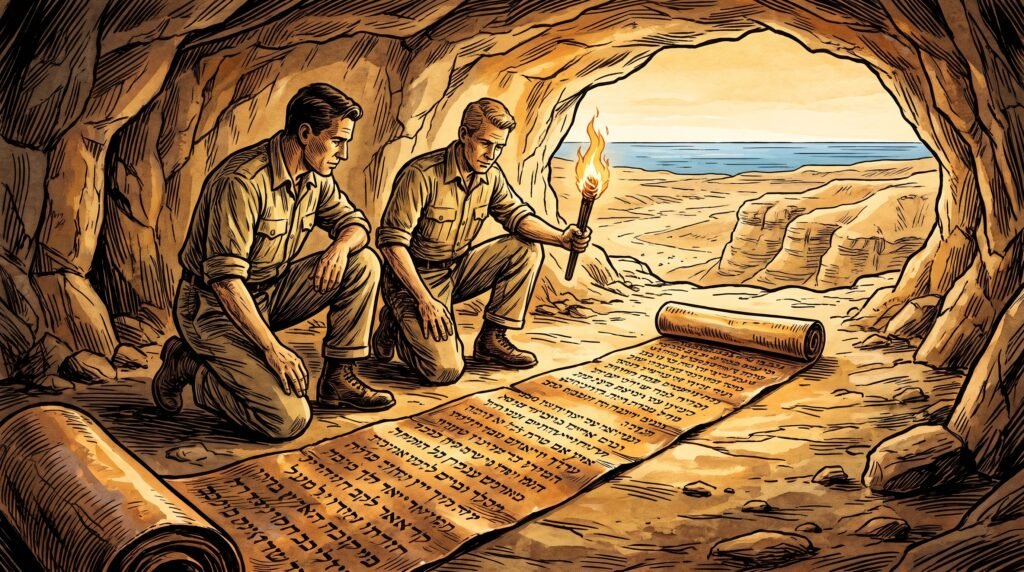
The cave itself was small, with a low entrance that gave onto a chamber barely large enough for a man to stand upright. The copper object, when the bedouin first set eyes on it, sat in a niche behind a fallen stone. It was covered in a thick patina of green copper carbonate, and its surface was so corroded that the lines of writing were invisible to the unaided eye. The excavators had the object carried out of the cave wrapped in cloth and brought to the museum at the Rockefeller Building in East Jerusalem. There, conservators attempted the first cleaning with chemicals and brushes, only to discover that the patina was protecting, not destroying, the letters beneath. The scroll was photographed, examined, and measured. It was clearly rolled. It was clearly inscribed. And it was clearly too brittle and too tightly coiled to be unrolled by any method then available without destroying it.
The problem of how to read a copper scroll occupied the scholars and conservators for nearly three years. Two early proposals, attempting to prise the metal apart from the outside, failed; one attempt at the British Museum in London in 1953 nearly destroyed the artefact. The solution eventually adopted was to saw the scroll, from top to bottom, into horizontal strips about a centimetre wide, so that each strip could be flattened and read individually and the text reassembled like a long paper frieze. The sawing was done by a Manchester toolmaker working under the supervision of the British Museum’s keeper of conservation, H. J. Plenderleith. The scroll arrived in Manchester in late 1955, was sawn into strips in early 1956, and was unrolled successfully enough to be read by the autumn of that year.
The reading itself was entrusted to a small team of epigraphers led by John Trever of the American Schools of Oriental Research, with contributions from Patrick Skehan of the Catholic University of America and John Marco Allegro of Oxford. The first reliable transcription, with photographs, was published by John Marco Allegro in 1960 in a small monograph titled The Treasure of the Copper Scroll. The text was republished in the standard editio princeps of the Qumran Cave 3 materials in 1962, in the series Discoveries in the Judaean Desert volume iii, by Skehan, Allegro, and Andrew G. Woodward.
What the text says
The Copper Scroll is written in Hebrew, in the square Aramaic-derived Jewish script of the late Second Temple period, and its language is best classified as Mishnaic Hebrew of the Second Temple and early rabbinic horizon. The text is divided into two principal sections, one on the first copper sheet and one on the second, separated by a brief colophon-like passage. The sheets were originally joined by rivets along the edge, so that when unrolled the whole document would read continuously. The first sheet carries the larger part of the list, in three columns of text running across the width of the metal; the second sheet carries a shorter continuation. Within each numbered entry, the text typically opens with a formulaic verb of concealment: “in the place which is called X, in the hill of Y, hidden in a cave at the base of the cistern, a tomb dug into the cliff from the north, buried at a depth of three cubits, lies Z talents of silver.” A typical entry names a place, sometimes with a direction to a specific geographical feature, gives the depth at which the deposit is buried, the kind of container it is stored in, and the contents.
The contents themselves fall into several categories. The most numerous are hoards of silver and gold, denominated in talents; a single entry at the close of the second sheet claims that a total of more than four hundred and forty talents of silver and over a hundred and five talents of gold are buried in a single place. Other entries list sacred objects: a container of the “manna” that, according to the Priestly tradition in Exodus, sustained the wilderness generation; vessels of the waters of purification used in the Temple cult; a quantity of “the inscribed of the Seed of the House,” an obscure phrase that has been read variously as “the inscribed tablets of the high-priestly line,” “the inscribed plates of the genealogical record,” and, more recently, as a term for the inscribed stone tablets of some sacred apparatus. There is a quantity of “Tarshish” perhaps: darics of gold or vessels of the kind associated with Phoenician trade, whose exact meaning in this context remains contested.
The vocabulary is technical, often unusual, and frequently suggestive of a written source. The verbs for “hidden,” “buried,” “dug,” and “sealed” cluster in patterns that are consistent across the document. There are also a number of place names that have resisted identification. The first column opens with a reference to “the place that swallows” (or “that is swallowed”), a name that may preserve a toponym known from elsewhere in the corpus or may be a textual corruption. The second sheet opens with a passage that begins, “the remainder of the things hidden in Galilee,” and proceeds to name specific deposits in the north of the land. The fourth column describes “the things hidden in Jerusalem of the priest Hilqiah,” and a fifth column mentions “the things hidden in the ford of the Jordan.” The geography that emerges is recognisable: the limestone hills of Judah, the rift valley, the Galilee, the coastal plain, and the desert to the south. The list, taken as a whole, suggests that the document was compiled by someone with intimate knowledge of the land.
One striking feature of the language is the use of a numerical shorthand for the totals. The sums given are not round. They are presented in figures that, when reconstructed, sometimes yield amounts that have no obvious symbolic resonance and sometimes yield figures that do. Several entries give totals that are exact multiples of nine, a number whose symbolic resonance in late Second Temple Jewish numerology has been much discussed. Other entries give totals that are presented in unusual denominations, including the “ch” for a sum that has been read as a variant of the Persian daric, a gold coin of the Hellenistic and early Roman period that circulated widely in the eastern Mediterranean and was minted in Tyre and Sidon.
The interpretations
Three principal interpretations of the Copper Scroll have been advanced in the scholarly literature, and each has its advocates and its problems. The first, the literalist or treasure-trove reading, treats the scroll as an authentic inventory of the treasures of the Jerusalem Temple, hidden by priests before the destruction of the Temple in 70 CE and never recovered. The most forceful statement of this view in the early literature was Allegro’s own, who for a time entertained the possibility that the deposits might still be findable and that their discovery would confirm the historical character of the text. The literalist reading has always faced the difficulty that the totals given in the scroll, if taken in the standard ancient sense of the talent as roughly thirty kilograms of silver, amount to quantities of bullion that would have been unprecedented for the Temple treasury on any reconstruction of the Second Temple economy.
The second reading, the literary or allegorical reading, sees the numerical figures as encoded theological statements, perhaps referring to the spiritual treasures of the Qumran community, perhaps to the eschatological wealth of the new Temple expected at the end of days. The most coherent statement of this view was developed by the Hungarian-born scholar József T. Milik in his 1959 study of the Qumran copper inscriptions and was elaborated by a number of subsequent studies that emphasised the affinity of the Copper Scroll’s vocabulary with the Hebrew of the Mishnah and the Talmud and with the literary conventions of late Second Temple pseudepigraphic texts. The literary reading has faced its own difficulties, principally the awkwardness of treating a document whose vocabulary, syntax, and pattern of concealment formulas are entirely consistent with administrative texts known from the Hellenistic and Roman East as a literary fiction.
A third reading, articulated in different forms by several scholars including Frank Moore Cross and Magen Broshi, treats the scroll as a treasure list produced by a community or a faction in the years immediately before the First Jewish Revolt, whose members were charged with the responsibility of safeguarding the Temple’s wealth in the face of what they took to be the imminent catastrophe of Roman intervention. On this reading, the document is not a Temple record in the strict sense, but a community list, and the deposits it names are not all real caches but include some elements that are symbolic of the Temple’s spiritual treasures. This third position has the advantage of accommodating the philological evidence that the language of the document is consistent with administrative practice, while also accounting for the unusual magnitudes of the sums listed.
Whatever the merits of these readings, certain details of the scroll point away from any simple allegorical reading. The level of geographical specificity is unusual for a literary composition: specific hills, specific cisterns, specific tombs, specific directions of approach. The presence of a number of deposits hidden in caves of the kind associated with Qumran and the surrounding area, including what appears to be a reference to one of the other Qumran caves themselves, suggests a community with local knowledge. And the fact that two copies of the scroll exist – a partial duplicate on parchment, designated 3Q14, was recovered from the same cave – suggests that this was a document with operational importance, not a literary curiosity. The deposit of the treasure, in other words, was not a metaphor. The treasure was hidden.
Why it matters
For the study of the Hebrew Bible and the Masoretic text, the Copper Scroll matters for several reasons that are not at first obvious. First, it is the latest independent witness to a strand of late Second Temple Hebrew vocabulary that is otherwise preserved chiefly in the Mishnah and the Talmuds and that has, in recent decades, become central to the reconstruction of the Hebrew of the period between the closure of the biblical canon and the redaction of the rabbinic literature. The Copper Scroll’s contribution to this strand of vocabulary is unique because it is a text from the late Second Temple period that uses this vocabulary in a context that is not literary-religious but administrative. It is, in the language of the documentary papyri, a piece of evidence for the real use of Mishnaic Hebrew in everyday and bureaucratic life in the period.
Second, the Copper Scroll is the only Qumran document that is dated by its script, by its orthography, and by its content to the period immediately preceding the First Jewish Revolt. The other Qumran scrolls, with the exception of the Copper Scroll, are generally dated to the second and first centuries BCE, with a few extending into the early first century CE. The Copper Scroll’s place in the manuscript tradition is, on the basis of linguistic and paleographic arguments, just before 70 CE. In the broader history of the Hebrew manuscript tradition, the Copper Scroll is thus one of the very latest documents that is not a product of the rabbinic world. It belongs, by every test that scholars of the period apply, to the world of the Second Temple, of the priestly scribes who served it, and of the community or faction that hoped to outlive its destruction.
Third, the Copper Scroll is the most conspicuous object in the entire Qumran corpus that is made of metal. Its survival is therefore a matter of considerable material interest. The very fact that two sheets of copper could be hammered into a flat surface thin enough to be rolled, inscribed with thousands of letters, riveted together, and buried in a cave for nearly two thousand years, raises questions about the metal-working capabilities of late Second Temple Judea that have not been fully addressed in the scholarly literature. The Copper Scroll is, in this respect, a relic of a kind of artisanal practice that is otherwise unattested in the region in this period.
Finally, the Copper Scroll matters for the history of scholarship itself. The reception of the Copper Scroll, from Allegro’s 1960 monograph to the long-running debate that followed, has been the most public of any of the Qumran debates, and the story of how the scroll was sawed open and read is one of the most dramatic episodes in the modern history of manuscript discovery. The Copper Scroll is the Qumran manuscript that everyone has heard of, even when they have not heard of the others. It is, in the public imagination, the document that proves that real treasure was hidden in the hills of Judea, and that someone, somewhere, may yet find it.
References
- Discoveries in the Judaean Desert of Jordan, Volume III: Les Petites Grottes de Qumran – Maurice Baillet, Józef T. Milik, and Roland de Harlez, Oxford: Clarendon Press, 1962
- The Treasure of the Copper Scroll – John Marco Allegro, Garden City: Doubleday, 1960
- The Copper Scroll and the Treasure of the Temple – Frank Moore Cross, in: Revue de Qumran, vol. 9, no. 1, 1977
- The Copper Scroll Revisited – Józef T. Milik, in: Revue Biblique, vol. 66, 1959
- The Dead Sea Scrolls: Hebrew, Aramaic, and Greek Texts with English Translations – Florentino Garcia Martinez and Eibert J. C. Tigchelaar, Leiden: Brill, 1997
- The Copper Scroll and the Archaeology of Qumran – Robert Donceel and Pauline Donceel-Voûte, in: Revue de Qumran, vol. 17, no. 4, 1996
- The Bible and the Dead Sea Scrolls – James H. Charlesworth, ed., Waco: Baylor University Press, 2006
- The Copper Scroll of Qumran: A New Reading and Assessment – Emile Puech, in: Revue de Qumran, vol. 22, no. 2, 2005