

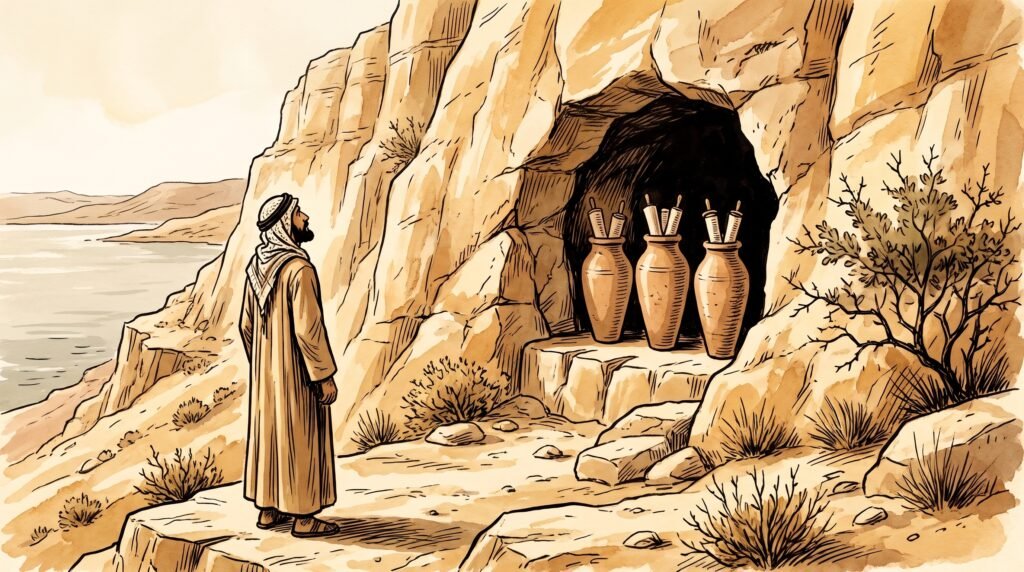
The seven scrolls that came out of the caves in the winter of 1947 were the beginning, not the whole story. What followed was fifteen years of Bedouin and archaeological finds, a custody dispute that ran for a generation, a slow publication programme that outlasted the careers of its first editors, and a philological labour that rewrote what the field knew about the transmission of the Hebrew Bible.
The Dead Sea Scrolls are now treated as a single body of evidence, but they were found in fragments over a decade, by people who had no agreed framework for what they had, and they have been interpreted in sharply different ways. The Masoretes are a small part of that story, but a consequential one. The scrolls are the oldest surviving manuscripts of the Hebrew Bible by a thousand years, and they have settled a debate that the medieval Masoretes, working centuries after the events, could only infer. The text that the Tiberias scribes codified in the eighth and ninth centuries was the text that was being copied at Qumran in the late Second Temple period. The chain is now continuous from the Hasmoneans to the Aleppo.
The discovery of 1947
The traditional account of the first discovery begins with a Bedouin shepherd named Muhammed edh-Dhib, of the Ta’amireh tribe. In the winter of 1947, he was looking for a stray goat along the cliffs above the northwestern shore of the Dead Sea, near a place the Bedouin called Khirbet Qumran. He threw a stone into a cave opening and heard pottery break. He went in, and found seven tall clay jars, some sealed, and inside them a number of scrolls wrapped in linen.
Three of the seven scrolls found their way to a cobbler and antiquities dealer in Bethlehem named Khalil Eskander Shahin, nicknamed Kando. Kando showed them to a Syrian Orthodox merchant, who offered a small sum, and then to the Metropolitan of the Syrian Orthodox Church in Jerusalem, Athanasius Yeshue Samuel, who bought four of the scrolls in 1948. The other three went through different hands and were eventually acquired by the Hebrew University and the Israel Museum. The whole process took more than a year. The first scroll was not unrolled and read by a scholar until February 1948, when the American scholar William F. Albright was shown the great Isaiah Scroll and confirmed that it was genuinely ancient.
The first seven scrolls were the complete Isaiah Scroll (1QIsa-a), the Community Rule (1QS), a pesher on Habakkuk (1QpHab), two scrolls of the War Rule (1QM and 1QSa), the Genesis Apocryphon (1QapGen), and a phylactery case. The Isaiah Scroll alone was nearly eight metres long when unrolled. The find was, in scale and preservation, the most significant manuscript discovery of the twentieth century, and the first to push the textual record of the Hebrew Bible back before the medieval codices.
What followed was a scramble. The British Mandate was about to end; the State of Israel was about to be declared; the West Bank, which included the Qumran area, was about to fall to Jordan. A joint expedition of the École Biblique, the British School of Archaeology, and the Hebrew University worked the site in 1949 under the Dominican priest Roland de Vaux, but the war interrupted and most of the site was left for the Jordanian Department of Antiquities. The site would not be fully excavated until the 1990s. Between 1952 and 1956, the Bedouin found another ten caves, and a few of the major scrolls emerged in surprising places. The Temple Scroll, the largest of the scrolls, was acquired by a Bethlehem dealer in 1967 and only identified as such in 1991. The Copper Scroll, the only scroll written on metal, was found in 1952, cut into two pieces, and is now in the Jordan Museum in Amman.
The Qumran community
The scrolls were found in caves near a site called Khirbet Qumran, a small ruin on the dry plateau above the Dead Sea, about a kilometre from the shore. The site had been inhabited in the late Second Temple period and destroyed in the Jewish revolt of 66 to 73 CE. The community that lived there is generally identified with the Essenes, a Jewish sect described by Pliny the Elder, by the Roman geographer Strabo, and by the Jewish-Roman historian Josephus as a community of ascetics living near the Dead Sea. The identification is not uncontested: a small minority of scholars have argued that the site was a fortress, or a villa, or a Hasmonean winter palace, and that the scrolls came from the Jerusalem Temple library rather than from a sectarian community on the site. The majority view since the 1990s is that the Qumran community was Essene, that the site was a sectarian centre, and that the scrolls were the community’s library, hidden in the caves when the community was destroyed.
What we know of the community’s practices comes mostly from the scrolls themselves, particularly the Community Rule (1QS), the Damascus Document (CD, also found in the Cairo Genizah), and the War Scroll (1QM). The community practised a strict daily lustration in water, a communal meal eaten in silence, an initiation procedure that took two years, and a hierarchical organisation led by a Mebaqqer, an inspector, and a council of fifteen. The community followed a solar calendar of 364 days, which put it at odds with the lunar calendar of the Jerusalem Temple; this is one of the reasons the community is thought to have been sectarian. The community expected an imminent war between the Sons of Light and the Sons of Darkness, in which the Sons of Light would be led by a figure called the Teacher of Righteousness against a figure called the Wicked Priest, who is plausibly identified with one of the late Hasmonean high priests. The community did not survive the revolt. The site was destroyed by fire in 68 CE, and the scrolls were hidden in the caves, perhaps by survivors, perhaps by parties travelling from the site as the Roman army advanced.
The community was small, on the order of a few hundred members at any one time. The library, at roughly nine hundred manuscripts in fragments, is consistent with a community of that size: a working library of biblical texts, apocryphal and pseudepigraphic works, and the community’s own liturgical and legal documents. The scrolls are not a national archive; they are a community’s library, abandoned in haste and recovered by accident. The contingent circumstances of their survival are part of why they have mattered so much.
The eleven caves
The scrolls were found in eleven caves in the cliffs above the site, between 1947 and 1956. Cave 1, discovered by edh-Dhib, contained the seven initial scrolls. Cave 2, found in 1952, contained fragments of the Book of Jubilees and a phylactery. Cave 3, the “Copper Scroll cave”, contained the Copper Scroll and a few fragments of biblical text. Cave 4, the most productive, was found in 1952 and yielded the bulk of the manuscript fragments: about 15,000 fragments from some 500 manuscripts, including hundreds of biblical fragments, the pesharim, the Temple Scroll, and the larger part of the Community Rule tradition. Caves 5 and 6 yielded smaller finds. Cave 7, also found in 1952, contained a small set of Greek manuscripts, including copies of the Twelve Minor Prophets and the Book of Enoch. Caves 8, 9, and 10, found in 1955, contained miscellaneous fragments, including the famous copper phylactery tefillin from Cave 8 and the war of the sons of light against the sons of darkness fragments in Cave 9. Cave 11 was discovered in 1956 and contained a complete psalms scroll, an apocryphal psalms scroll, and the Temple Scroll fragments that would be joined into the full document later.
The dating of the manuscripts, from the second century BCE to the first century CE, makes them the oldest surviving Hebrew manuscripts of the biblical books by a margin of about a thousand years. The Great Isaiah Scroll (1QIsa-a) is dated paleographically to the late second century BCE, with the standard caveats. Other biblical manuscripts are dated to the late first century BCE. The manuscripts were copied by scribes whose hands have been compared, in a major study by Frank Moore Cross, with the hands of the scribes who copied the Ben Asher and Ben Naphtali codices in Tiberias, and the result is suggestive: the same scribal practices, the same orthographic conventions, and the same attention to textual accuracy run through the Qumran scrolls and the medieval Masoretic codices.
What was in them
The scrolls fall into three groups, with significant overlap. The first is the biblical texts. Every book of the Hebrew Bible is represented among the Qumran scrolls except Esther, with copies ranging in date from the second century BCE to the first century CE. The Great Isaiah Scroll is the most famous of these, and the most complete. The Isaiah Scroll is 7.34 metres long, written on seventeen sheets of parchment sewn end to end, and contains the entire fifty-eight chapters of Isaiah, in a form substantially identical to the Masoretic Isaiah. There are minor differences, mostly orthographic and a small number of variant readings, but the text is recognisably the same book, copied more than a thousand years before the medieval codices.
The second group is apocryphal and “rewritten Bible” literature. The Genesis Apocryphon (1QapGen) is a retelling of the Genesis narratives in Aramaic, with expansions and elaborations that put it in the same literary family as Jubilees and the Testaments of the Twelve Patriarchs. The Temple Scroll (11QT) is the longest of the Qumran scrolls, about 8.7 metres, and presents itself as a second Torah given by God to Moses: a comprehensive restatement of the laws of the Temple, the festivals, the king, the army, and the land, woven through with biblical language. The Jubilees fragments (4QJub) and the Enoch fragments (4QEn) connect the Qumran library to the apocryphal literature that was known in late antiquity but had not previously been found in Hebrew or Aramaic originals.
The third group is the sectarian literature: the documents of the community itself. The Community Rule (1QS) describes the community’s initiation, organisation, and discipline. The Damascus Document (CD), found in both the Qumran caves and the Cairo Genizah, is a parallel document that locates the community in a wider Israel and treats the migration to the desert as the central act of the community’s history. The War Scroll (1QM) describes an eschatological war in which the Sons of Light, led by the archangel Michael, defeat the Sons of Darkness, led by Belial, in a final cosmic battle. The Habakkuk Pesher (1QpHab) is a running commentary on the first two chapters of Habakkuk, in which the prophet’s text is reinterpreted as referring to events in the community’s own history: the Wicked Priest, the Man of the Lie, the Teacher of Righteousness. The Copper Scroll (3Q15) is different in kind: a list of buried treasure, written in a distinctive post-exilic Hebrew on thin copper sheets, with a content that no one has been able to match to any known site, and that has provoked a small industry of treasure-hunting speculation. The Copper Scroll has never been decoded in a satisfying way.
The publication and custodianship
The publication of the scrolls was one of the great scientific scandals of the twentieth century. After the initial finds in 1947, an international team was convened to publish them, under the general editorship of Roland de Vaux. The team was small, and it had other scholarly commitments, and the work proceeded slowly. By 1991, only a fraction of the Qumran corpus was in print. The unpublished texts were held by a small group of editors who had exclusive access, and the delays were widely suspected to be deliberate: the unpublished texts included material that would have unsettled Catholic doctrine, the editorship of the biblical texts included Catholic scholars, and the suspicion was that publication was being delayed for confessional reasons. The accusation was probably unfair to the individual editors, but the delays were real, and the academic consequences were significant: an entire generation of biblical scholars could not use the Qumran corpus in their work, and a parallel industry of unauthorised reconstructions and rumours grew up in the absence of the published texts.
The crisis came to a head in 1991. The Huntington Library in California announced that it had acquired the photographs of the unpublished Qumran scrolls, taken in the 1950s and 1960s under the original publication contract, and that it would allow open access. The photographs had been taken precisely because the contract required photographs to be available to scholars, and they were now, by the terms of the original agreement, public. The publication crisis was resolved in months: the team scrambled to publish what they had been sitting on, and a flood of editions appeared between 1991 and 2010. The discovery accelerated the development of the digital edition: the Leon Levy Dead Sea Scrolls Digital Library, hosted by the Israel Antiquities Authority, now provides high-resolution images of all the Qumran fragments, and the official publication series Discoveries in the Judaean Desert continues to appear.
The scrolls themselves are now in two museums. The vast majority, including the Great Isaiah Scroll, are in the Shrine of the Book at the Israel Museum in Jerusalem. The Copper Scroll is in the Jordan Museum in Amman, along with a few other fragments. The split reflects the political geography of 1967: the West Bank sites were excavated under Jordanian authority, and the Jordanian Department of Antiquities retained the finds. The arrangement is stable, and it would be diplomatically expensive to change. For scholarly purposes, the digital library is now the working copy of the corpus, and the physical location of the manuscripts is less important than it was.
What the scrolls changed
The most consequential finding for the transmission of the Hebrew Bible is that the text was largely stable. Before 1947, the oldest complete Hebrew Bible manuscript was the Leningrad Codex, dated 1008 CE. The Qumran scrolls pushed the textual tradition back over a thousand years, and the differences between, say, the Great Isaiah Scroll and the Masoretic Isaiah are minor. The scribes of the Second Temple period were transmitting a text whose lineage runs into the Ben Asher family at Tiberias a millennium later. The text that the Masoretes codified was, in the most literal sense, the text that the Hasmoneans and the Herods had been reading.
The scrolls also showed that the text was not yet uniform. The same biblical book could circulate in different recensions. Some Qumran manuscripts align with the Septuagint’s Hebrew Vorlage rather than with the proto-Masoretic text. The Septuagint, the Greek translation of the Hebrew Bible made in Alexandria in the third and second centuries BCE, was based on a Hebrew text that is sometimes older than the Masoretic and sometimes different from it. The Qumran scrolls, read alongside the Septuagint and the Masoretic, give us a picture of the Hebrew text in the late Second Temple period as a fluid tradition with multiple local recensions, and the Masoretes as one of several efforts to fix the text in a single authoritative form.
The scrolls also confirmed the antiquity of the book order. The Great Isaiah Scroll, the Twelve Minor Prophets fragments, the Psalms Scrolls from Cave 11, all show the books in an order consistent with the Tiberian order of the Tiberian codices, with some variation. The book order of the Hebrew Bible, which had been thought to be a medieval rabbinic decision, now appears to be considerably older. The same is true of the paragraph divisions, the chapter-like sections, the cantillation marks: the Qumran scribes, while they did not use the full Tiberian vocalisation and accent system, used a similar set of structural divisions. The Masoretes’ work was less innovation and more codification of an existing tradition than had been thought.
Why they matter for the Masoretes
What the scrolls give the student of the Masoretic text is a baseline. The Masoretes were not inventing the vowel points, accents, and orthographic conventions out of nothing. They were codifying, in the seventh to tenth centuries CE, a written tradition whose roots reach into the late Second Temple period and which the Qumran community already handled with care. Without the scrolls, the chain runs from Tiberias backward into mist. With the scrolls, the chain runs backward into the hands of scribes who were contemporaries of the Hasmoneans and the Herods.
The scrolls also sharpen the Masoretes’ achievement. The Tiberias scribes in the eighth and ninth centuries worked in a period when the Jewish community was reconstituting itself after the destruction of the Second Temple, when the text of the Hebrew Bible was a live political and religious question, and when the competing Greek and Aramaic versions were circulating. The Masoretes’ choice to fix the consonantal text and add a complete vocalisation and accentuation was a deliberate act of preservation. Without the Masoretes, the consonantal text of the Hebrew Bible would have been lost in the same kind of small variations that overtook the Greek and Aramaic versions. With the Masoretes, the text is what the Ben Asher family copied in Tiberias in 1008 CE. The Qumran scrolls now show that this was, within the limits of copyist variation, what the community at Qumran was reading in the first century.
The scrolls also vindicate the Masoretes’ care in a way that the medieval sources could not. The Karaites, who rejected the oral Torah and the Masoretic tradition, had argued that the consonantal text of the Hebrew Bible was a rabbinic invention. The scrolls show that the consonantal text is older than the rabbinic tradition by a thousand years. The Masoretes’ care is older than the Masoretes.
The caves are quiet now. The Bedouin who found the first scrolls are dead. The community that hid them is gone. The manuscripts are in two museums, scanned, edited, and slowly settling into the apparatus of biblical scholarship, where they belong. The next great edition is the digital one, and it is now in progress: the Qumran library, fully imaged, fully catalogued, and accessible to any scholar with an internet connection. The work of the next generation is to read the corpus carefully, and to see what the dead scribes can still tell us about how a text becomes scripture.
The trading journey that brought the scrolls to market ran through the same networks that had moved antiquities in the Levant for a century. The scrolls were not, in the first days, recognised for what they were. Kando and his rivals in the Bethlehem antiquities trade were looking for customers, and the scrolls were valuable first as objects and only second as texts. The first academic to see the great Isaiah Scroll was a Syrian Orthodox archbishop, not a Hebrew Bible scholar, and the first academic to recognise its antiquity was a visiting American, not a British Mandate archaeologist. The British Mandate Department of Antiquities was not informed. The scrolls entered the antiquities market the way most antiquities in the region entered the market: through tribal networks, through dealers, and through the willingness of foreign collectors to buy manuscripts whose export the Mandate was supposed to forbid. The political stakes were higher than the antiquities trade alone. The British Mandate was ending; the United Nations partition vote was less than a year away; the State of Israel was about to be declared; the West Bank was about to be taken by Jordan. The four scrolls acquired by the Syrian Orthodox Metropolitan Mar Samuel were eventually sold to Israel, after a long and legally complicated transaction. The first seven scrolls of 1947 are now in two museums, and the trail that brought them there is part of the political history of the late Mandate.
The community’s calendar was a particular point of conflict with the Jerusalem Temple. The solar calendar of 364 days, attested in the Community Rule and other sectarian texts, divided the year into four equal quarters of 91 days each, with the major festivals falling on fixed days of the week. The Temple in Jerusalem, in contrast, ran on a lunar calendar of 354 days, with the festivals determined by observation of the new moon. The two calendars would drift apart by eleven days every year, and the Qumran community treated the Temple’s calendar as evidence of the corruption of the priestly establishment. The Qumran calendar was a sectarian marker, but it was not a fringe invention. The solar calendar is attested in the Book of Jubilees, in the Book of Enoch, and in later rabbinic traditions about the pre-exilic Temple calendar, which suggests that the Qumran calendar was once a respectable priestly tradition that the Jerusalem establishment had abandoned.
The War Scroll (1QM) is the most striking of the sectarian texts. The scroll describes a seven-stage war, with the Sons of Light fighting the Sons of Darkness in a final cosmic battle that will end with the destruction of the Sons of Darkness and the establishment of an eternal Temple. The war is described in liturgical and tactical detail: the trumpets, the banners, the formation of the army, the prayers the priests will recite, the order of the battle. The Sons of Light are led by the archangel Michael; the Sons of Darkness are led by Belial. The war is not metaphorical in the scroll. It is a literal description of a real event that the scroll expects to happen. The Temple Scroll (11QT) is the longest of the Qumran scrolls, about 8.7 metres, and presents itself as a second Torah given by God to Moses at Sinai: a comprehensive restatement of the laws of the Temple, the festivals, the king, the army, and the land. The scroll is a rewritten Bible in the form that scholars call the Moses pseudepigraphon: a text that takes the biblical narrative and rewrites it with new laws and new narrative material. The community that produced it was making a claim about revelation itself.
The textual variants in the Qumran scrolls are most visible in the Books of Samuel and the Books of Kings, where the Masoretic text and the Septuagint’s Hebrew Vorlage diverge in dozens of places. The Dead Sea Scrolls include a Samuel manuscript (4QSam-a) that supports the Septuagint against the Masoretic in several of these places, and a Jeremiah manuscript (4QJer-a and 4QJer-b) that is shorter than the Masoretic Jeremiah by about one seventh. The variants are not large in absolute terms: the textual tradition is unusually stable. The variants are large in interpretive terms. They show that the Hebrew text was not yet fixed in the late Second Temple period, that the Septuagint’s translators were working from a Hebrew text that is now attested in the Qumran corpus, and that the Masoretic text is one of several recensions that were in circulation. The variants are also important for the interpretation of the New Testament. The Gospel of Matthew, the Epistle to the Hebrews, and the Revelation of John all quote the Hebrew Bible, and many of the quotations diverge from the Masoretic text in ways that are now, with the Qumran evidence, easier to explain. The New Testament writers were not, in most cases, quoting a defective Greek Septuagint. They were quoting a Hebrew text that was in some cases closer to the Septuagint’s Vorlage than to the Masoretic text.
The Qumran scrolls also vindicate the Masoretes against the Karaites. The Karaites, a Jewish sect that arose in the eighth century in Baghdad, rejected the oral Torah and the authority of the rabbis, and they argued that the consonantal text of the Hebrew Bible was a rabbinic invention that the rabbis had imposed on the biblical tradition. The Masoretes were, in this reading, the agents of a rabbinic distortion. The Qumran scrolls refute the Karaite reading completely. The consonantal text of the Hebrew Bible is older than the rabbinic tradition by a thousand years. The Qumran community, in the late Second Temple period, was reading a consonantal text that is recognisably the same as the Masoretic consonantal text. The Karaites, in their polemic against the Masoretes, were not aware of the depth of the textual tradition they were rejecting. The Masoretes’ work, in retrospect, was not innovation: it was the preservation of a tradition that was already a thousand years old in their time. The Qumran scrolls add another thousand years to the preservation, and the tradition is now visible as a continuous stream from the Hasmoneans to the Ben Asher family in Tiberias in 1008 CE.