

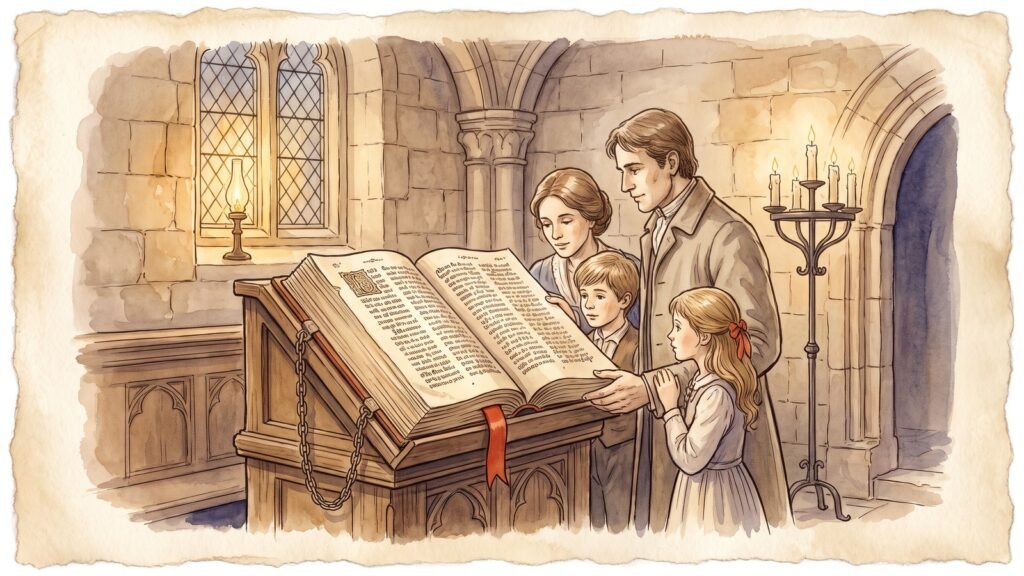
In the seventy-five years between the death of William Tyndale in 1536 and the publication of the King James Version in 1611, the English Bible passed from a forbidden book, printed abroad and smuggled into the realm, to an authorised text read in every parish church. During these years at least six distinct English versions were printed: the Coverdale Bible of 1535, the Matthew Bible of 1537, the Great Bible of 1539, the Geneva Bible of 1560, the Bishops’ Bible of 1568 and the Catholic New Testament of Rheims of 1582. Each was shaped by the religious politics of its time, and each built upon the work of its predecessors, so that the translation of 1611 was in large part a revision of a tradition that had been formed in the course of the sixteenth century.1
At a glance
- 1526: William Tyndale’s English New Testament, translated from the Greek, is printed at Worms.
- 1535: Miles Coverdale’s Bible, the first complete printed English Bible, is issued on the Continent.
- 1536: Tyndale is executed near Brussels.
- 1537: The Matthew Bible, edited by John Rogers, is published with the king’s licence.
- 1538: Royal injunctions require an English Bible to be set up in every parish church.
- 1539: The Great Bible, Coverdale’s revision of Matthew’s Bible, is published under Thomas Cromwell’s direction.
- 1543: The Act for the Advancement of True Religion restricts private Bible reading by social rank.
- 1557–1560: English exiles in Geneva publish a New Testament and then the Geneva Bible.
- 1568: The Bishops’ Bible is published under Archbishop Matthew Parker.
- 1582: The Catholic Rheims New Testament is printed; the Old Testament follows at Douai in 1609–1610.
- 1604–1611: The Hampton Court Conference leads to the King James Version of 1611.
This article describes the English Bibles printed between the work of Tyndale and the King James Version, the circumstances in which they were produced and the features that distinguished them. The life and work of Tyndale himself are treated in the article on William Tyndale and his influence on later translation in Tyndale’s legacy, while the making of the 1611 version is described in the article on the Hampton Court Conference and the Authorised Version.
Tyndale's foundation
The English Bibles of the sixteenth century rested on the work of William Tyndale. Since the Constitutions of Oxford of 1409 the making and reading of English translations of the Bible without episcopal approval had been forbidden in England, a measure directed against the followers of John Wyclif and their manuscript translations. Tyndale, an Oxford-educated priest, sought in 1523 the support of the bishop of London for a new translation from the Greek and, failing to obtain it, left England for Germany.2 His New Testament, translated from Erasmus’s Greek text with reference to the Vulgate and to Luther’s German, was printed at Worms in 1526, and copies were smuggled into England, where they were sought out and burned by the authorities.
Tyndale went on to translate the Pentateuch from the Hebrew, printed at Antwerp in 1530, and the Book of Jonah, and he revised his New Testament in 1534. He also translated the historical books from Joshua to Chronicles, but these were not printed during his lifetime. In 1535 he was betrayed and arrested at Antwerp, and in October 1536 he was strangled and burned at Vilvoorde near Brussels. His translations, which combined close attention to the Hebrew and Greek with a plain and vigorous English, provided the foundation of every English Bible printed in the following century.3
The Coverdale Bible, 1535
The first complete Bible printed in English was the work of Miles Coverdale, a former Augustinian friar from Yorkshire who had worked with Tyndale on the Continent. It was printed in 1535, probably at Cologne or Antwerp, and was dedicated to King Henry VIII. Unlike Tyndale, Coverdale did not claim to translate from the original languages. The title page described the Bible as translated out of Douche and Latyn, that is, out of German and Latin, and he drew on the Zurich Bible, Luther’s German, the Vulgate and the Latin version of Pagnini, while incorporating Tyndale’s New Testament and Pentateuch with revisions.4
The Coverdale Bible was a substantial folio with a woodcut title page, whose iconography of the king handing the Scriptures to the clergy has been studied by Mark Rankin and Guido Latré as an expression of the royal supremacy over the Church that Henry had recently asserted.5 It was the first English Bible to separate the books of the Apocrypha from the rest of the Old Testament and place them in a section of their own, following the example of the Zurich Bible. In 1537 two further editions were printed at Southwark by James Nycolson, and these carried the statement that they had been set forth with the king’s most gracious licence.6 Coverdale’s English was smooth and melodious, and many of his renderings, especially in the Psalms, were to have a long life.
The Matthew Bible, 1537
In 1537 there appeared another complete English Bible, which was ascribed on its title page to Thomas Matthew. The name was a pseudonym, and the work was edited by John Rogers, a friend of Tyndale who had been chaplain to the English merchants at Antwerp. Rogers combined Tyndale’s published New Testament and Pentateuch with Tyndale’s unpublished translation of the historical books from Joshua to Chronicles, which had evidently come into his hands after Tyndale’s arrest, and he supplied the remaining books from Coverdale’s translation. He added prefaces, a large number of marginal notes, and a table of principal matters.7
The Matthew Bible was printed on the Continent, probably at Antwerp, and imported into England by the London printers Richard Grafton and Edward Whitchurch. Through the efforts of Archbishop Thomas Cranmer and Thomas Cromwell, the king’s chief minister, it received a royal licence, so that a Bible containing the bulk of Tyndale’s translation, which had been condemned a decade earlier, was now permitted for sale in England.8 Rogers himself was later the first of the Protestant martyrs burned under Mary I, in February 1555. The Matthew Bible was revised in 1539 by the lawyer Richard Taverner, whose version, known as Taverner’s Bible, introduced some changes in vocabulary but had little lasting influence.9
The Great Bible, 1539
An official Bible for the parishes
The Matthew Bible, with its notes and prefaces, was regarded by many as too partisan to be appointed for use in churches, and Cromwell commissioned Coverdale to prepare a revision without the controversial notes. In September 1538 Cromwell issued injunctions requiring every parish to provide one book of the whole Bible of the largest volume in English, to be set up in the church where parishioners might conveniently read it.10 The revision was intended to meet this requirement.
Because the Paris presses were thought to offer better workmanship, the printing of the new Bible was begun in Paris by the printer François Regnault, under the supervision of Coverdale and Grafton. In 1538 the French authorities intervened and seized a part of the sheets. The presses, types and workmen were then moved to London, where the printing was completed by Grafton and Whitchurch, and the Bible was published in April 1539.11 From its large size it became known as the Great Bible.
Text and frontispiece
The Great Bible was a revision of the Matthew Bible, in which Coverdale corrected the Old Testament books in part against the Latin version of Sebastian Münster, which followed the Hebrew closely, and revised the New Testament with reference to the Latin of Erasmus. The marginal notes of the Matthew Bible were omitted, and in their place Coverdale used small marks in the text, which referred to annotations that were never printed.12
The frontispiece, a woodcut attributed to the circle of Hans Holbein, showed King Henry VIII seated at the top, handing the Word of God, the Verbum Dei, to Cranmer on one side and Cromwell on the other, who in turn passed it to the clergy and laity, while the people below cried Vivat Rex and God save the King. The image presented the English Bible as a gift of the king and an instrument of royal government.13 The second edition of April 1540 contained a preface by Cranmer, and the Great Bible is therefore sometimes called Cranmer’s Bible. When Cromwell was executed in July 1540, his coat of arms was removed from the frontispiece in subsequent editions.14
Restriction and reaction
Seven editions of the Great Bible were printed between 1539 and 1541, and the version remained the official Bible of the Church of England for nearly thirty years. Its Psalter, which was largely Coverdale’s work, was incorporated into the Book of Common Prayer and continued to be used in the Prayer Book long after the Bible itself had been superseded.15 The king’s enthusiasm for the open Bible, however, did not last. In 1543 the Act for the Advancement of True Religion forbade the reading of the Bible by women, artificers, apprentices, journeymen, husbandmen and labourers, while permitting noblemen and gentlemen to read it in their households and noblewomen and gentlewomen to read it privately. The measure reflected concern that the reading of the Bible by unlearned people was leading to dispute and disorder.16
Under Edward VI, from 1547 to 1553, the restrictions were relaxed, and editions of the Great Bible and of other versions were reprinted in large numbers. The accession of Mary I in 1553 brought the restoration of Catholic worship, and English Bibles ceased to be printed in England for the remainder of her reign.
The Edwardian years were also marked by editions that combined text and commentary in new ways. Editions of the Matthew Bible and of Taverner’s revision were reprinted with additional notes, and the Great Bible was issued in smaller formats suitable for household use. The printers of London, among them Grafton, Whitchurch, John Day and William Seres, issued English New Testaments in octavo and smaller sizes, sometimes with Erasmus’s Latin in parallel, and the paraphrases of Erasmus on the Gospels, translated into English, were ordered by royal injunction to be set up in churches beside the Bible.17
The Geneva Bible, 1560
The exiles at Geneva
During Mary’s reign several hundred English Protestants went into exile on the Continent, and a group of them settled at Geneva, where John Calvin and Theodore Beza directed the Reformed church and where there was a flourishing Protestant press. Among them were William Whittingham, a fellow of All Souls, Oxford, who was related by marriage to Calvin, Anthony Gilby, Thomas Sampson and others. In 1557 Whittingham published an English New Testament, a revision of Tyndale’s version with reference to Beza’s Latin, and the exiles then undertook a revision of the whole Bible.18
The Geneva Bible was published in 1560, printed at Geneva by Rowland Hall and dedicated to Queen Elizabeth I, who had come to the throne in 1558. The translators revised the Great Bible in the Old Testament against the Hebrew, making use of the Latin versions of Pagnini, Münster and Leo Jud and of the French Bible of the Genevan church, and in the New Testament they revised Whittingham’s version of 1557. Bruce Metzger observed that the Geneva Old Testament was the first English version of the prophetic and poetic books translated in their entirety from the Hebrew, since Tyndale had not reached them.19
A Bible for study
The Geneva Bible differed from its predecessors in several ways that made it a book for private reading and study. It was printed in a quarto format, much smaller and cheaper than the folio Great Bible, and in a roman type rather than the black letter of the earlier English Bibles. It was the first English Bible in which the whole text was divided into numbered verses, following the system introduced by Robert Estienne. It contained maps, woodcut illustrations, tables, summaries at the head of each book and chapter and, above all, an extensive body of marginal notes explaining the meaning of difficult words and passages and applying them to doctrine and conduct.20
The notes reflected the Reformed theology of Geneva, and some of them, especially those on the books of Daniel and Revelation, contained interpretations unfavourable to the papacy and observations on the limits of royal authority that later attracted the disapproval of King James VI and I. Vivienne Westbrook has examined how the annotations were revised in later editions, notably in Laurence Tomson’s revision of the New Testament in 1576, which was based on Beza’s Latin and notes, and in the replacement of the notes on Revelation in 1599 by those of Franciscus Junius.21
Popularity
The Geneva Bible became the most widely read English Bible of the later sixteenth and early seventeenth centuries. It was first printed in England in 1575 and 1576 by Christopher Barker, who later obtained the office of royal printer, and more than a hundred editions of the whole Bible or the New Testament were printed before 1644. It was the Bible used by William Shakespeare in most of his biblical allusions, by John Bunyan and by many of the settlers of New England.22 It was known popularly as the Breeches Bible from its rendering of Genesis 3:7, which said that Adam and Eve sewed fig leaves together and made themselves breeches, although the same word had appeared in the earlier Wycliffite translation.
Its popularity was not welcome to all. The bishops of the Church of England were uneasy about its notes, and Queen Elizabeth, though she accepted its dedication, did not authorise it for use in churches. The Great Bible remained the official version in the parishes, and the Church soon sought to provide a version of its own.23
The Bishops' Bible, 1568
In the 1560s Matthew Parker, archbishop of Canterbury, organised a revision of the Great Bible to be carried out by a group of bishops and other scholars, each assigned a portion of the text. The work was intended to provide an official Bible for the churches that would match the scholarship of the Geneva version without its controversial notes. It was published in 1568 by Richard Jugge, the queen’s printer, in a large folio with engraved portraits of the queen, the earl of Leicester and Lord Burghley, and it became known as the Bishops’ Bible.24
The revisers were instructed to follow the Great Bible except where it departed from the Hebrew or the Greek, to avoid bitter notes, and to mark passages less edifying for public reading so that they might be omitted. The quality of the work was uneven, since the various revisers worked largely independently and some portions were revised more thoroughly than others. A revised edition appeared in 1572, in which the Psalter of the Great Bible was restored alongside the new translation because the new version of the Psalms had not proved acceptable for singing and recitation.25 Harry Spillane has related the Bishops’ Bible to Parker’s antiquarian interests and his efforts to present the English Church as the heir of an ancient Christian tradition in England.26
The Convocation of Canterbury in 1571 ordered that a copy of the Bishops’ Bible should be placed in every cathedral and, as far as possible, in every church. It never displaced the Geneva Bible in private use, however, and it was printed in far fewer editions. Its principal importance lay in its later role as the base text for the King James Version.27
The Rheims New Testament, 1582
The Catholic exiles from Elizabethan England produced a translation of their own. At the English College founded by William Allen at Douai, which moved to Rheims in 1578, the scholar Gregory Martin translated the Bible from the Latin Vulgate, assisted by Allen, Richard Bristow and others. The New Testament was published at Rheims in 1582 with an extensive commentary, and the Old Testament was published at Douai in 1609 and 1610, after the college had returned there. The version is known as the Douay-Rheims Bible.28
The Rheims translators followed the Vulgate as the text declared authentic by the Council of Trent, and they deliberately retained many Latin terms, such as azymes, parasceve and pasch, which they believed could not be rendered into English without loss of meaning. Their preface defended the translation as a means of protecting Catholics from the errors of the Protestant versions, while arguing that the Scriptures should not be read indiscriminately by all.29 Brett Foster has examined the Latinate vocabulary of Martin’s translation and its rhetorical character.30 The Rheims New Testament was attacked by Protestant writers, notably William Fulke, who in 1589 printed it in parallel with the Bishops’ Bible in order to refute its notes, thereby making it widely known. Its vocabulary influenced the translators of 1611, who adopted a number of its Latin-derived words.31
Words and controversy
The differences between the versions were not only a matter of scholarship. Certain words carried theological weight, and their translation became the subject of open controversy. Tyndale had rendered the Greek ekklesia as congregation rather than church, presbyteros as senior or elder rather than priest, agape as love rather than charity, and metanoia as repent rather than do penance. Thomas More attacked these choices as an attempt to undermine the institutions and sacraments of the Catholic Church, and Tyndale defended them as faithful renderings of the Greek.32
The later versions took different positions on these words. The Great Bible restored church in many places, and the Bishops’ Bible generally followed it, while the Geneva Bible retained much of Tyndale’s vocabulary and supported it in its notes. The Rheims translators deliberately preferred the terms of Catholic tradition, such as priest, penance and charity, and their preface argued that the Protestant translators had altered the sense of Scripture by their choice of words. In the rules of 1604 the translators of the King James Version were instructed to keep the old ecclesiastical words, such as church rather than congregation, so that the debate begun by Tyndale and More shaped the vocabulary of the 1611 Bible.33
The English Bible in Scotland
The Geneva Bible also became the Bible of the Reformed Church of Scotland, which was established in 1560 under the leadership of John Knox, who had himself spent part of his exile at Geneva. The first Bible printed in Scotland was an edition of the Geneva text produced at Edinburgh by Thomas Bassandyne and Alexander Arbuthnot, begun in 1576 and completed in 1579 and dedicated to the young King James VI. In 1579 the Scottish Parliament required householders above a certain level of wealth to possess a Bible and a psalm book in the vernacular, on pain of a fine.34 The Geneva Bible thus became the Bible of the household in Scotland as in much of England, and it remained so until it was gradually replaced by the King James Version in the course of the seventeenth century.
Towards 1611
By the end of the sixteenth century the English Bible existed in two principal Protestant forms, the Geneva Bible, preferred by many clergy and laity for private use, and the Bishops’ Bible, appointed for reading in churches, as well as in the Catholic version of Rheims and Douai. The coexistence of these versions was a source of controversy, and at the conference held at Hampton Court in January 1604 between King James I and representatives of the bishops and the Puritan clergy, the Puritan spokesman John Rainolds proposed a new translation. The king accepted the proposal, and some fifty scholars were organised in six companies at Westminster, Oxford and Cambridge to undertake the work.35
The rules drawn up for the translators by Richard Bancroft, bishop of London, directed that the Bishops’ Bible should be followed and as little altered as the truth of the original would permit, and that the translations of Tyndale, Matthew, Coverdale, Whitchurch, that is the Great Bible, and Geneva should be used where they agreed better with the text. Marginal notes were to be limited to the explanation of Hebrew and Greek words.36 The King James Version of 1611 was thus the culmination of the sixteenth-century tradition, and a large proportion of its New Testament wording can be traced back, through the intervening versions, to the work of Tyndale.37
The period in perspective
The English Bibles of the period between Tyndale and 1611 show a continuous tradition of revision. Each version took over most of the text of its predecessor and corrected it in the light of new scholarship, of the original languages and of the changing needs of the Church. The Coverdale Bible completed what Tyndale had begun; the Matthew Bible preserved Tyndale’s unpublished work; the Great Bible established an official version for the parishes; the Geneva Bible brought the scholarship of the Reformed churches and an apparatus for private study; the Bishops’ Bible provided a revised version for the established Church; and the Rheims New Testament presented a Catholic alternative from the Vulgate.38
The period also saw the English Bible become a printed commodity on a large scale. The earliest versions were printed abroad in small numbers, but by the end of the century English printers were producing Bibles in many formats and at a range of prices, from great folios for church lecterns to small octavos for private reading. The changes in format, type, apparatus and price, as much as the changes in wording, shaped the way in which the Bible was read in England.39
The history of these versions illustrates the close relation between the transmission of the biblical text and the politics of religion. The translation and printing of the English Bible were successively forbidden, licensed, commanded, restricted and promoted by the state, and the choice of a version, its notes and its format expressed the theological commitments of those who produced it. The King James Version of 1611 inherited the scholarship and the language of this tradition, and it was through that version that the work of Tyndale, Coverdale and the Geneva translators reached the readers of the following centuries.40
Notes
- Tyndale’s Legacy: The English Bible Line, masoretes.online; David Daniell, “The Great Bible, 1539”, in The Bible in English: Its History and Influence (New Haven: Yale University Press, 2003), 198–220. ↩
- William Tyndale: Greek, Hebrew, and the English Bible, masoretes.online. ↩
- William Tyndale: Greek, Hebrew, and the English Bible, masoretes.online; Tyndale’s Legacy: The English Bible Line, masoretes.online. ↩
- Coverdale Bible, Grokipedia; H. F. Moule, “The Coverdale Bible of 1535”, The Library, 3rd ser., 2 (1911): 273–276. ↩
- Mark Rankin and Guido Latré, “The Materiality and Iconography of the Coverdale Bible (1535) Title Page in Context”, in The Edinburgh Companion to the Bible and the Arts (Edinburgh: Edinburgh University Press, 2014), 272–291. ↩
- Coverdale Bible, Grokipedia. ↩
- Matthew Bible, Grokipedia; Vivienne Westbrook, “John Rogers and the Matthew Bible”, in Long Travail and Great Paynes: A Politics of Reformation Revision (Dordrecht: Springer, 2001), 36–77. ↩
- Vivienne Westbrook, “John Rogers and the Matthew Bible”, in Long Travail and Great Paynes: A Politics of Reformation Revision (Dordrecht: Springer, 2001), 36–77. ↩
- Vivienne Westbrook, “John Rogers and the Matthew Bible”, in Long Travail and Great Paynes: A Politics of Reformation Revision (Dordrecht: Springer, 2001), 36–77. ↩
- Great Bible, Grokipedia; David Daniell, “The Great Bible, 1539”, in The Bible in English: Its History and Influence (New Haven: Yale University Press, 2003), 198–220. ↩
- David Daniell, “The Great Bible, 1539”, in The Bible in English: Its History and Influence (New Haven: Yale University Press, 2003), 198–220. ↩
- David Daniell, “The Great Bible, 1539”, in The Bible in English: Its History and Influence (New Haven: Yale University Press, 2003), 198–220. ↩
- Great Bible, Grokipedia. ↩
- David Daniell, “The Great Bible, 1539”, in The Bible in English: Its History and Influence (New Haven: Yale University Press, 2003), 198–220. ↩
- David Daniell, “The Great Bible, 1539”, in The Bible in English: Its History and Influence (New Haven: Yale University Press, 2003), 198–220. ↩
- David Daniell, “The Great Bible, 1539”, in The Bible in English: Its History and Influence (New Haven: Yale University Press, 2003), 198–220. ↩
- David Daniell, “The Great Bible, 1539”, in The Bible in English: Its History and Influence (New Haven: Yale University Press, 2003), 198–220. ↩
- Geneva Bible, Grokipedia; David Daniell, “The Geneva Bible, 1560”, in The Bible in English: Its History and Influence (New Haven: Yale University Press, 2003), 291–319. ↩
- Bruce M. Metzger, “The Geneva Bible of 1560”, Theology Today 17 (1960): 339–352; “The Preface to the Geneva Bible, 1560”, in Gerald Bray (ed.), Documents of the English Reformation (Cambridge: James Clarke, 2019), 319–326. ↩
- Bruce M. Metzger, “The Geneva Bible of 1560”, Theology Today 17 (1960): 339–352; “The Preface to the Geneva Bible, 1560”, in Gerald Bray (ed.), Documents of the English Reformation (Cambridge: James Clarke, 2019), 319–326. ↩
- Vivienne Westbrook, “The Geneva Bible Annotations”, ibid., 143–173. ↩
- David Daniell, “The Geneva Bible, 1560”, in The Bible in English: Its History and Influence (New Haven: Yale University Press, 2003), 291–319; Bruce M. Metzger, “The Geneva Bible of 1560”, Theology Today 17 (1960): 339–352. ↩
- Elizabeth I, Grokipedia; David Daniell, “The Geneva Bible, 1560”, in The Bible in English: Its History and Influence (New Haven: Yale University Press, 2003), 291–319. ↩
- Bishops’ Bible, Grokipedia; David Daniell, “The Bishops’ Bible, 1568”, in The Bible in English: Its History and Influence (New Haven: Yale University Press, 2003), 338–347. ↩
- Bishops’ Bible, Grokipedia; David Daniell, “The Bishops’ Bible, 1568”, in The Bible in English: Its History and Influence (New Haven: Yale University Press, 2003), 338–347. ↩
- Harry Spillane, “‘A Matter Newly Seene’: The Bishops’ Bible, Matthew Parker, and Elizabethan Antiquarianism”, Reformation 27 (2022): 107–124. ↩
- Bishops’ Bible, Grokipedia; David Daniell, “The Bishops’ Bible, 1568”, in The Bible in English: Its History and Influence (New Haven: Yale University Press, 2003), 338–347. ↩
- Douay–Rheims Bible, Grokipedia; David Daniell, “The Rheims New Testament, 1582”, in The Bible in English: Its History and Influence (New Haven: Yale University Press, 2003), 358–368. ↩
- “The Preface to the Rheims New Testament, 1582”, ibid., 327–356; Brett Foster, “Gregory Martin’s ‘Holy Latinate Jerusalem’”, Prose Studies 28 (2006): 130–149. ↩
- “The Preface to the Rheims New Testament, 1582”, ibid., 327–356; Brett Foster, “Gregory Martin’s ‘Holy Latinate Jerusalem’”, Prose Studies 28 (2006): 130–149. ↩
- “The Preface to the Rheims New Testament, 1582”, ibid., 327–356; Brett Foster, “Gregory Martin’s ‘Holy Latinate Jerusalem’”, Prose Studies 28 (2006): 130–149. ↩
- William Tyndale: Greek, Hebrew, and the English Bible, masoretes.online. ↩
- Hampton Court Conference and the 1611 Authorised Version, masoretes.online; David Daniell, “The Bishops’ Bible, 1568”, in The Bible in English: Its History and Influence (New Haven: Yale University Press, 2003), 338–347. ↩
- David Daniell, “The Geneva Bible, 1560”, in The Bible in English: Its History and Influence (New Haven: Yale University Press, 2003), 291–319; Bruce M. Metzger, “The Geneva Bible of 1560”, Theology Today 17 (1960): 339–352. ↩
- Hampton Court Conference and the 1611 Authorised Version, masoretes.online. ↩
- Hampton Court Conference and the 1611 Authorised Version, masoretes.online; David Daniell, “The Bishops’ Bible, 1568”, in The Bible in English: Its History and Influence (New Haven: Yale University Press, 2003), 338–347. ↩
- William Tyndale: Greek, Hebrew, and the English Bible, masoretes.online; Tyndale’s Legacy: The English Bible Line, masoretes.online. ↩
- Tyndale’s Legacy: The English Bible Line, masoretes.online; David Daniell, “The Great Bible, 1539”, in The Bible in English: Its History and Influence (New Haven: Yale University Press, 2003), 198–220. ↩
- David Daniell, “The Geneva Bible, 1560”, in The Bible in English: Its History and Influence (New Haven: Yale University Press, 2003), 291–319; Bruce M. Metzger, “The Geneva Bible of 1560”, Theology Today 17 (1960): 339–352. ↩
- Hampton Court Conference and the 1611 Authorised Version, masoretes.online; David Daniell, “The Bishops’ Bible, 1568”, in The Bible in English: Its History and Influence (New Haven: Yale University Press, 2003), 338–347. ↩