

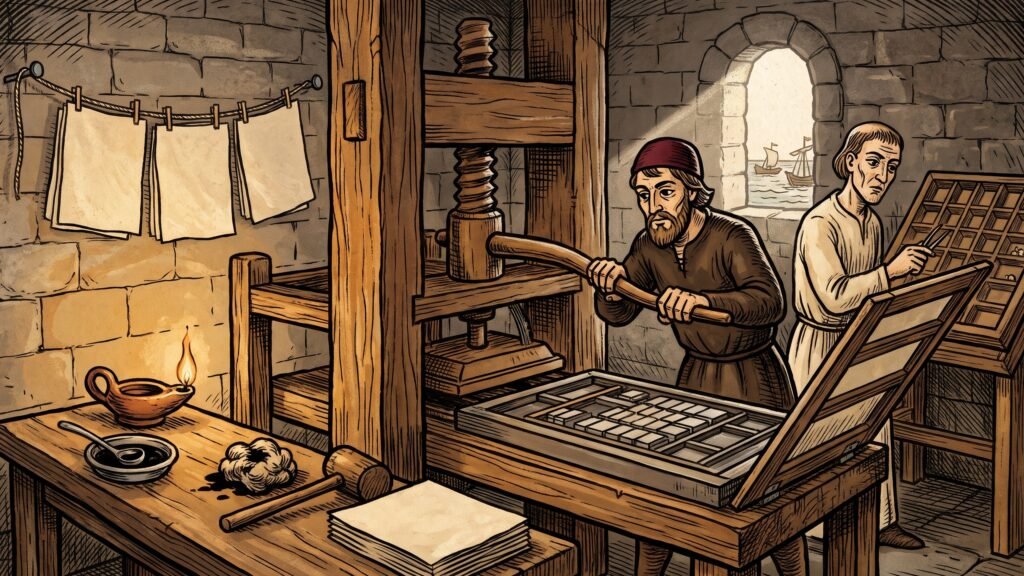
On the last day of June 1487, in a rented room in the Jewish quarter of Faro on the southern coast of Portugal, a printer named Don Samuel Gacon finished the first book ever printed in his country. It was a Torah. It was set in two columns of Hebrew, vocalized but unaccented, printed on vellum in a type that appears to have been cut for the job in the town itself, and it ran to a hundred and ten leaves. It carried no commentary. It carried, for its first five leaves, a masorah that was cut off before the book had been bound. And when it was done, exactly one copy of it was ever made, that copy was the only one that ever needed to be made, and it is still in London, shelfmarked C.49.c.1 in the British Library. Everything else about the book had to be reconstructed: the type from the shapes of the letters, the workshop from the colophon, the community from the parish records, and the journey from the ownership notes in the margins and on the flyleaf.
It is worth being precise at the outset about what this book is not. It is not a manuscript. The Faro Pentateuch is a printed book, and it is the only incunable in the world whose claim to fame is that it is the first book printed in a particular country. It is also not the first Hebrew book printed in Europe, that honour belongs to the Jews of Reggio Calabria in 1475 and to the Soncino brothers in the north Italian plain, and it is not the first printed Hebrew Bible, since a Pentateuch with vowels and accents had already appeared in Bologna in January 1482. Nor is it the oldest or the grandest Hebrew book in existence. Its illumination amounts to a single decorated letter at the opening of Genesis. Its scholarship is thin. Its name never appears in the colophons of the famous Rabbinic Bibles, and it was never a source for them.
And yet it is worth a long look, for the simple reason that it is a hinge. Before 1487 Portugal had no printing press of any kind; after 1487 the country printed about thirty incunabula in ten years, and half of them were Hebrew. The Faro Pentateuch is the first term of that sequence, and it is also the least documented member of it. This essay follows the object from the shop in which it was made, through its type and its text and the masorah that was trimmed away in the binding, then follows the single copy across Italy to Padua and across the Channel to London, and finally looks at the extraordinary legend – a naval raid, a bishop’s library, a book stolen in 1596 and never returned – that grew up around it and turned out to be false.
A Country That Printed Nothing
It is difficult to overstate how unusual the Faro Pentateuch is in the history of printing, and the easiest way to see it is to begin with what Portugal had before it. There was nothing. The movable-type press had been invented in Mainz around 1450, and by the time the Faro book appeared the technology was forty years old and had spread across France, Germany, the Low Countries, Italy, Spain and England. Portugal had bought the habits of print without the means to use them. No dated book printed in Portugal is known to precede 30 June 1487. The country had a university at Coimbra, a flourishing legal culture, a liturgy in Latin, a vernacular literature already two centuries old, and a maritime empire that was about a decade away from the Cape of Good Hope, and it possessed no press at all.
The sequence that follows is therefore startlingly compressed. The Faro Pentateuch of 1487 was followed two years later by the first book printed in the Portuguese language, a treatise on confession printed at Chaves in 1489, though the claim to be first rests on a paper record rather than a printed one and has been contested on the ground that a Castilian ritual printed in the 1480s and long held in Rio de Janeiro may have preceded it. Latin printing came later still, with the missal printed at Leiria in 1494 or 1495. Of the roughly thirty Portuguese incunabula, a dozen or so are Hebrew. The first book printed in Portugal was a Bible. The first book printed in Portuguese was a religious manual. The first large-scale enterprise of Portuguese printing was a Jewish enterprise, and it died with the expulsion.
That is the background against which the Faro book should be read, and it explains why Faro is worth more attention than a town of its size would normally attract from a history of the book. The Jewish press in Faro was short-lived. Between 1487 and about 1491 it produced three Hebrew books: the Pentateuch, and two further works of which only fragments survive. Lisbon, between 1489 and 1492, hosted a far more sophisticated press, run by a rabbi whom the sources call only Eliezer, which produced a suite of Hebrew books in a remarkably short time including the famous Lisbon Pentateuch of 1491. Leiria, from 1492 to 1496, added four Hebrew titles and one vernacular. Then came the decree.
The printers themselves were not Portuguese-born. The technology had crossed the border from Spain two or three years earlier, along with the type and the skills to use it. A Hebrew press had been running at Híjar in Aragon since about 1485, and its proprietor, Rabbi Eliezer Alantansi, had cut type in three sizes of square letters and in a distinctive cursive script, had employed the Christian engraver Alfonso Fernández of Córdoba, and had used a lavish rectangular border of animal and floral motifs that reappears in a Latin prayer book and then in the first Lisbon imprints of 1489. The Híjar operation was wound down around 1487 or 1488. Whatever the precise sequence of movements, the equipment and the personnel of Iberian Hebrew printing were being redistributed across the Iberian Peninsula in exactly these years, and Faro was one of the destinations. The Faro Pentateuch is the first product of that movement, and its typographic character shows it: the letters are square, slightly rounded rather than gothic, and the workshop that cut them was working from a different craft tradition from the Italian printers who had been setting Hebrew for a decade.
The House of Don Samuel Gacon
The printer’s name is Samuel Gacon, also known as Samuel Porteiro, and the “Don” in front of it is not decoration but an assertion of status. In the Portuguese Jewish world the honorific was used of men of substance, and Gacon was plainly a man of substance: he owned the type, he financed the book, and the 1901 Jewish Encyclopedia reports, on the authority of Steinschneider, that the expenses of the edition were paid by Don Samuel Gacon himself. He was therefore proprietor and patron at once, which was the usual arrangement in a small Jewish press and has a modern parallel in the way a printer-publisher in a small town operates a shop that is also his front room.
The shop stood in the Judiaria, the walled Jewish quarter of Faro, in a building that later became known as the house of Gacon. Faro itself was a small city of perhaps ten thousand people on the flat coastal plain of the Algarve, a working port with a tuna fishery, a salt trade, and a steady traffic of Atlantic shipping. Its Jewish community was old, documented from the Middle Ages, and was among the more established Sephardic communities of the south, though small enough that a single press could plausibly serve it. The community would be reduced to almost nothing within a decade of this book appearing.
What we know of the workshop comes from three directions: the physical book itself, the colophon, and the scholarly reconstruction of Shlomo Pereira, whose study of the Faro copy’s ownership is the fullest account we have of how it travelled. The press itself was a wooden screw press of the ordinary European kind, standing in a room lit by a lamp and a narrow window, with a compartmented type case on a slanting stand, a shallow dish of ink with a small ladle, a bundle of ink-stained wool for dabbing the type, a wooden mallet, and a cord strung between two nails on which the damp sheets were hung to dry. A pressman pulled the bar; a compositor stood at the case and picked up the sorts one at a time with a small pair of tweezers. The whole operation was done by a handful of men in a single room, and the man who owned the type was also the man whose name went on the book.
Gacon’s staff, according to the reconstructions, included Samuel Porteira and his son David, the younger serving as proofreader, and David is later associated with the Soncino family of printers. That connection, if the identification holds, is a small but genuine bridge between Faro and the great Italian Hebrew presses, and it is one of several hints that the Faro operation was not isolated. The Iberian press network of the 1480s was small, mobile, and intimate: the same names turn up in Faro, Lisbon, Híjar and later Salonica, carrying type and habits of work across borders that were about to become impassable. There is also a documented tradition of Jewish printers working with Christian partners who supplied the press, the type-cutter, and the financial backing, while the Jewish community supplied the editor, the proofreader, the corrector and the market. The Faro Pentateuch is a Jewish book in every respect that matters to a reader: the text, the orthography, the punctuation of the liturgy, the spelling of the colophon. But the machine that printed it was a European machine, and the workshop that housed it was in a building in a town.
The Arithmetic of a Date
The colophon at the end of the book is short, and it is where the whole object becomes datable to the day. It reads, in essence: here is concluded the Pentateuch, printed in the city of Faro on the ninth of the month of Tammuz in the year of “praise the righteous, for he is good”, by order of the noble and elevated Don Samuel Gacon, may God protect him.
The date is encoded in the manner typical of Hebrew books of the fifteenth century, which did not use Arabic numerals. A phrase is quoted from a verse, and the reader takes the numerical value of its first word. “Praise the righteous, for he is good” is the opening of Isaiah 3:10 in the Jewish liturgy. The Hebrew word imru, praise, has the numerical value two hundred and forty-seven. Add the standard thousand for the era – the conventional offset between the Creation and the present – and you have five thousand two hundred and forty-seven, which is the Jewish year corresponding to 1487 in the Christian reckoning. The ninth of Tammuz, in that year, is the thirtieth of June in 1487 in the Julian calendar, which was the calendar Portugal then kept, and the thirtieth of June was a Saturday.
And here the colophon presents a problem that anyone who has read a fifteenth-century Hebrew colophon will recognise immediately, because it runs through the whole literature of Hebrew printing. The book was finished on the Sabbath. Which is not permitted, either for a Jew who observes the day of rest or for a Christian who would not want the desecration of a book of the law on the day of rest. Two explanations account for it, and they need not be exclusive. The first is that the printing was finished on Friday and the colophon dated to the Sabbath, the way a Jewish legal document is often dated to the day that follows the act, and to give the day an extra measure of honour. The second is that the work genuinely was completed on the Sabbath, often on Friday evening, by non-Jewish printers working under contract who wanted the job closed as quickly as possible. The second explanation carries an unpleasant corollary, and it is the reason the practice is treated with such caution: a book finished that way did not leave the Jewish editors time to proofread the sheets before the full run was made. Either way, the arithmetic was done, the number is right, and the day of the week was a difficulty somebody had to solve before the book could be finished.
Two other details of the colophon are worth a moment. The printer’s name is written with a gimel carrying a geresh, which is the standard way of indicating a soft g, so that the name reads Gacon and not Gacon with a hard g. And the blessing – may God protect him – is addressed to the man who paid for the book, in the formula that Jews used for benefactors and for kings. Gacon was both. The colophon does not describe him as the printer. It describes him as the man whose orders the book was printed by, which is a form of words that reveals the shape of the enterprise: the press was his, the type was probably his, and the person standing at the case was his employee.
What the Book Is Made Of
Physically, the Faro Pentateuch is a modest object with expensive materials. It is a hundred and ten leaves of vellum, the leaves measuring roughly twenty-seven by twenty and a half centimetres, printed in two columns of thirty-two lines, with the first five leaves set two lines short. The text is the full Pentateuch – Genesis, Exodus, Leviticus, Numbers and Deuteronomy – and nothing else. There is no commentary, no Targum, no index, no pagination, no signatures, no register marks and no catchwords. Nothing in the book’s physical construction assists a reader in navigating it, because the book was made on the assumption that a reader who needed the Torah would know the Torah.
The vellum is the most surprising material choice of all. Skin is expensive, hard to prepare, and wasteful; a Jewish printer with a limited market would normally have used paper, and the Faro press did use paper for its later books. To open a new venture with the most expensive substrate available, in the most expensive possible format, was a deliberate statement. It announced that this book was to be the authoritative copy of the Torah for the community that made it – the equivalent, in a poor and small town, of printing on the best paper you can buy for the first edition of the standard text. And indeed, in a sense, it was. In the Iberia of 1487 the Masoretic text of the Hebrew Bible had no fixed printed form at all; it existed in manuscript, in a scatter of regional readings, and the printed editions that would settle it were still two generations away.
Two sizes of type were used. The larger, with squared and slightly rounded letters, carried the biblical text; a broader type was kept for the rubrics, the headings and the few display words that mark the structure of the book. At the very opening, at the start of Genesis, the first letter of the book – the bet of bereshit, in the beginning – is printed in a large white letter against a decorated black ground, a small ornamental panel of white foliage and scrollwork on the dark field. It is the only decoration of consequence in the volume, and it is an elegant, restrained, entirely appropriate thing: a single illuminated letter marking the beginning of the beginning. The other four books of the Torah do not receive the same treatment. Their openings are marked, but with nothing of this kind.
It is also worth remembering that the book has no commentary, and that this was not an oversight but a decision with a market in mind. A Jewish press in Iberia could print for the local community, for export to the Sephardic communities of North Africa and the Ottoman world, or for Christian scholars who wanted the bare sacred text without the rabbinic apparatus around it. A Pentateuch with Rashi’s commentary and the Targum Onkelos, as the Lisbon press would print in 1491, is a book for Jewish readers, and it is a big book. A bare vocalized Pentateuch is smaller, cheaper to print, and usable by anyone who can read Hebrew – a Jew studying alone, a Christian Hebraist, a schoolmaster with a class of boys. The Faro book is a reading and teaching tool, and the fact that it is also the first thing the Portuguese press ever made suggests that the man behind it knew exactly which audience he was aiming at.
That single decorated letter is worth holding in mind against the manuscript tradition. A fifteenth-century Sephardic Pentateuch written on vellum would have carried a programme of illumination: an architectural frame around each of the five openings, panels of narrative painting, a decorated word panel at the opening of each book, and often a full-page miniature. The Faro book has none of that. Its one ornament is the printed equivalent of a modest word panel, done in type rather than in paint. The Faro Pentateuch is therefore an object that has been deliberately stripped of the manuscript’s apparatus and given only what the press could do well. That decision is itself a kind of document, and it points the same way as everything else about the book: toward a reading and study Bible for a community with limited means, rather than a liturgical or presentational volume.
A Type Cut for One Book
The letters themselves carry a message. The type used for the Faro Pentateuch was, on the balance of the evidence, cut locally, in Faro, for this book; its peculiarities do not correspond to the sorts of any other known press, and the metal itself carries the marks of a workshop that was cutting Hebrew type for the first time and doing it under deadline. The differences from a mature Hebrew type are instructive, because each of them is a solution to a problem that a first-time type-cutter and a first-time compositor had to solve simultaneously.
The most consequential is the complete absence of the dagesh, the dot placed inside a letter to mark a doubled consonant. Its absence is not a cosmetic matter. The dot inside a letter is a real distinction in the vocalised text; a word read with a doubled consonant and the same word read without it are not always the same word, and in some places the doubling is the difference between a noun and a verb or between two verbs of different meanings. A type without the dagesh is a type that cannot print the text correctly. The explanation is mechanical rather than conceptual: a dot inside a letter requires either a special sort or a hand operation on the printed sheet, and a press that had never printed Hebrew before did not have either. The same is true of the maqaf, the short horizontal stroke that marks a compound word, which is likewise absent. A Hebrew reader in 1487 looking at this book would have seen a text that was recognisably the Torah and yet imperfectly vocalised in exactly the two places where the pointing carries grammatical weight.
There are other quirks, each of them a small mechanical compromise. The aleph and the lamed are run together, a ligature that saves space at the cost of elegance. The resh, the shin and the tav are stretched, that is, cut wider than their natural proportion, so that the compositor could make up a full measure at the end of a line without having to abbreviate or space out the line more than the eye tolerates. This is the kind of adjustment a printer makes when the case is short of sorts and does not want to buy more: the letters are made to fit. The shin dot, the little mark that distinguishes sin from shin, appears only sometimes, because the sort for it was evidently in short supply. Every one of these decisions is legible evidence of a workshop that got the job done with the materials to hand, and that then stopped.
Set against this, the type is handsome. Contemporary observers of Iberian Hebrew printing noted that its letters were somewhat rounder than the gothic forms of the Italian presses, a difference that would have struck any reader who had handled a Soncino or a Naples book. It is a characteristic of a different workshop tradition, and it tells us that the Faro press was working within the Spanish orbit rather than the Italian one, even though the idea of a Hebrew press had reached Portugal from Italy and the technology itself was Italian in origin. Gacon’s letters are the first Portuguese letters, in the sense that matters for the history of typography, and after the expulsion there would not be another.
Vowels Without Accents
The most consequential single feature of the Faro Pentateuch is not a feature it has but a feature it lacks. The book is vocalized: the vowel points, the small dots and dashes that hang under and inside the consonants, are present throughout, and their presence was a genuine novelty. The technology of printing with vowel points had only just been invented. It was introduced in Italy in 1482, in a printed text produced in Naples by the sons of Abraham ben Yashar, and the Faro book of 1487 is the earliest example of it in the Iberian Peninsula and, of course, the first book printed in Portugal whatever its script.
What vowel points do is simple to state and easy to underestimate. Unpointed Hebrew is a consonantal skeleton. A reader who has been brought up in a synagogue tradition, or who has been trained, or who has simply had years of exposure, reads the skeleton fluently and hears the vowels without seeing them. Everybody else has to learn the language of the text before they can read the text. The vowel points put the pronunciation on the page. For a community that wanted its members – and this was the argument that was made in the Jewish world at the time, against the strong resistance of the traditionalists – to be able to read scripture and pray from a printed book rather than from memory and from a teacher, the vowel points were the whole point. They are a reading technology, and their arrival in Portugal in a printed Torah was a small but real democratisation of the text.
And then the book has no accents. The te’amim, the system of cantillation marks, are missing from every page. These are the marks that tell a reader how to chant: which syllable takes the melody, where the phrases of the song begin and end, how the accents combine with one another into the elaborate grammar of the Torah’s musical grammar. In manuscript Bibles the accents are not decorative. They are the notation of a tradition of oral performance several centuries old, and they are indispensable to it. Without the accents, the Faro Pentateuch could be read. It could not be sung.
That is a strange and moving thing for a book to be. A Torah in 1487 that could be read aloud in Faro but not chanted, that could be studied in the house but not used in the synagogue, that was the property of a community rather than an instrument of its ritual. It was a book for teaching, and for private devotion, and for the acquisition of knowledge – and the evidence suggests that this was exactly what the Faro community needed. The synagogue at Faro, the Isaac Bitton, had been built in the fourteenth century and enlarged in the eighteenth; a community with a substantial house of study and a working synagogue would have had the liturgical books it needed already, and the deficit in Faro was not chanting but comprehension.
The technical reason for the omission is not mysterious. Every accent is a separate piece of type, and the accent system is combinatorial: there are prepositive accents that sit under a word and postpositive accents that sit above it, and they combine into a large number of shapes, each of which needs its own sort. To print the accents is to print an entire second alphabet of combinable marks in a correct and consistent position on the line. A press that was cutting its first Hebrew type, in a town with one job, in a month, did not attempt it. The Hebrew printers of Bologna, five years earlier, had attempted it, on the evidence of their 1482 Pentateuch, which was printed by Joseph ben Abraham Caravita, with Joseph Hayyim ben Aaron Strassburg as corrector, and which carries both vowels and accents with the Targum in the margin and Rashi’s commentary above and below. The Soncino Bible of 1483 to 1485 did the same in a two-column setting and made the point that a vocalized and accented Hebrew Bible could be set in type. Gacon had the Faro press, the Faro type, and about a month. He had the vowels, which were a single added sort per letter and could be bought in with the type. He did not have the accents, which were an alphabet of their own. Five years later the Lisbon press managed the whole apparatus. That difference is the whole distance between Faro and Lisbon, and between 1487 and 1492.
The Masorah on the Knife Edge
The most haunting detail in the book concerns the masorah, and it is the detail that makes the Faro Pentateuch a genuine object of masoretic scholarship rather than a curiosity of print history. The first five leaves of the book are set two lines short of the measure used everywhere else in the volume. Two lines of space, given up deliberately at the head and foot of the page, is precisely the space that a manuscript Bible reserves for the masorah magna, the great masorah, which in a codex is written in the upper and lower margins in a fine hand and which records, word by word and letter by letter, every place in the text where a given word occurs, in every form in which it occurs, so that a copyist can check their work against it. The small masorah, the masorah parva, occupies the outer margin beside the text.
So the Faro printers were planning, from the first leaf, to print the masorah. Their type was laid out to accommodate it. They had the idea, and they had made room for it. And then they changed their minds, or ran out of time, or found the work too large, and the remaining hundred and five leaves were printed without any marginal apparatus whatsoever. There is no masorah parva in the outer margin anywhere in the volume. There is no masorah magna above or below the text anywhere in the volume. A small handful of masoretic notes survive, at the end of Genesis, where a body of them was gathered – but the body of them is the smallest part of what was planned.
And then the binder intervened. When the book was bound, the top and bottom margins of those first five leaves were cut away, in the ordinary way, to give a clean, even edge to the block of pages – and with them went the masorah that had been printed there. The stubs that remain, the cut edges of the trimmed margins, still carry the vestigial traces of the letters that were in them. This is the cruellest accident in the history of the book: the only evidence that the earliest Iberian printed Torah ever carried a masorah was destroyed by the ordinary professional competence of a bookbinder in Faro who was simply doing the job as it was done. He had no idea that he was cutting away the physical proof of a first. Every modern description of the volume that mentions the masorah at all is describing an absence recovered from a stub.
It is worth pausing on what the masorah is, because it is the oldest systematic textual criticism in the world and it is easy to underestimate. The masorah is a vast concordance of the Torah’s vocabulary, compiled and kept over centuries and transmitted with the text itself, recording not merely which words occur but the orthographic and phonological forms in which they occur: how a word is spelled with or without a full spelling out, how its vowels are given, how it is inflected. It was copied by hand for more than a thousand years before the press arrived, and it was in the first instance an instrument of control rather than of scholarship – a device by which the correctness of a copy could be checked by counting, by a scribe who did not need to understand the text in order to know whether his copy was right. It is also, as scholars of the Hebrew Bible have long recognised, the closest thing the tradition has to a critical apparatus embedded in the text.
That the Faro printers attempted it, and dropped it, is a fact about the difficulty of print. In manuscript the masorah was flexible: the scribe could write the notes in the space available, abbreviate, and run the glosses up and down the margin. In type the space was fixed, and the glosses had to be set in a type, at a size, in a measure, and a masorah in the margin of a two-column page competes for the room that the text needs. The decision to abandon it was probably made in the middle of setting the book, when the compositors understood what the remaining hundred and five leaves would cost in time and in type. It was a rational decision. It was also the decision that left the fifth book of Moses without its apparatus in the first printed Torah of Portugal, and it is the reason that when Jacob ben Hayyim ibn Adonijah printed the masorah in Venice in 1524 and 1525, he was doing something that no Iberian press had yet managed to do.
The Text and the Errors
Set against that failure, the text itself is remarkably good. The Faro Pentateuch follows the Masoretic text closely – closely enough that the divergences can be listed, which is to say that for the great majority of its words and letters it reproduces the received consonantal and vocalic tradition with real care. That is a striking thing for 1487. The alternative was available and was widely taken: printing from an unpointed, unstandardised manuscript, setting whatever the exemplar happened to say, and letting the tradition sort itself out over the following decades. Gacon’s book does not do that. It was set from a good exemplar, and the small number of departures from the Masoretic text reads like the residue of a careful job rather than the product of carelessness.
The departures, as catalogued in the modern scholarship, are these. Genesis contains a small number of abbreviated words. Exodus contains a spelling error and four words that are missing. Leviticus is missing one word. Numbers has a word misplaced. Set out like that it sounds damning, and it would be damning if the standard of comparison were a modern critical edition. But the comparison here is the received Masoretic text as transmitted, and a fifteenth-century printed book that reproduces the received text with four omissions and a handful of contractions is doing better than the overwhelming majority of its contemporaries. Printers setting from manuscripts routinely introduced far worse. What is remarkable is not that the Faro book has errors but that it has so few, and that the ones it has are of a kind – a miscopied letter, a dropped line, a word transposed – that belong to the workshop rather than to the tradition.
The parashah divisions tell a similar story of partial competence. A printed Torah for liturgical use has to mark the boundaries of the weekly portions, the parashot, so that a reader can find the reading for a given week without a manuscript to consult. The Faro book does not mark the twenty-three portions of Genesis and Exodus at all, but it does mark the thirty-one portions of the remaining three books, with a couple of exceptions. This asymmetry is itself revealing. It suggests a production process in which the first two books were set from an exemplar that carried no parashah divisions, and the last three from one that did, or a plan that changed as the job progressed. It also means the book is a partial liturgical instrument: for the first two portions of the year a reader needed another copy.
And then, at the end of Exodus and again at the end of Numbers, the book does something unexpected. At the close of the second book it prints, in the ordinary size of the text but without vowel points, the words chizuk v’imzu – be strong, and let us go up – which are the last words of Deuteronomy. At the close of the fourth book it prints chazak v’nitchazak – be strong, and let us be strengthened – which is a line from the second book of Samuel. These are not part of the Masoretic text of Exodus or Numbers. They are the printer’s own words, placed where a reader’s eye lands when the book ends. A first printer, closing his first book, put an exhortation into it: the strength to go up, and the strength to be strengthened. It is the most human sentence in the volume, and it appears twice, in the same position, in the two books where the Masoretic text itself ends on a military or promissory note.
From Faro to Mantua
The book then did what books do, and it travelled. Its earliest known owner was anonymous, and lived in northern Italy, probably in the Po valley, somewhere between 1487 and 1500. He left marginal notes in the book in an early Italian-Ashkenazic hand, and his notes are the first of the kind that would accumulate on the object over the next four centuries: a reader who owned a Hebrew Bible and wrote in its margins about something that struck him.
The second owner is better defined. An inscription links a Rabbi Nissim of Mantua with the book and with the city of Mantua, and a subsequent note on the front paste-down records that an anonymous buyer acquired the volume from the revered R. Nissim of Mantua for twenty-two francs. The most likely identification of this R. Nissim is Nissim Yitzchak ben Yehudah Sforno, the rabbi of Mantua in the early sixteenth century, a scholar of some standing who wrote a well-known epistle on the Kuzari and whose responsa survive in manuscript collections, and who belonged to the same family circle as Obadiah Sforno, the biblical commentator whose influence on Christian Hebraists was enormous. Whether or not this identification holds, the evidence puts the book in Mantua, in Jewish hands, in the first decades of the sixteenth century – and it puts it there with a price attached.
Twenty-two francs is not a small sum. It is the sort of price that belongs with a substantial, well-made, well-used book, not a cheap working copy, and the fact that the price was recorded suggests a transaction of some formality between people who knew what they were doing. The note is also the only document in the object’s history that describes a physical act: a handover, a payment, a change of hands, recorded by a man who wanted the transaction remembered. Everything else in the provenance of the Faro Pentateuch is inference from a stamp, a catalogue or a name, but this is a receipt, written by a witness, at the moment when a Hebrew Pentateuch passed from a rabbi in Mantua to a buyer whose identity was never recorded.
The chronology of those early owners overlaps, of course, with the catastrophe. The expulsion decree was signed on 5 December 1496 and took effect at the end of October 1497. Every Hebrew book in Portugal had to leave the country within that window, or be hidden, or be destroyed. A book printed in Faro in 1487 was ten years old when the decree came, and it was in Jewish hands in Mantua shortly afterwards. That is the ordinary shape of the story: a book made in a place, carried out of it by people who had to leave, and then carried on through the ordinary traffic of the Jewish book world of Italy for three hundred years. It was not looted, in the end. It was saved, and then it was sold.
The Rarest Thing in Padua
The next chapter belongs to Giuseppe Almanzi, born in Padua in 1801 and dead there in 1860, a poet and a bibliophile of enormous energy and learning, who built the greatest private collection of Hebrew books of his century in the former capital of the Venetian Republic. The core of the collection came to him from his father, Baruch Chaim Almanzi, who died in 1837 and who had himself acquired the library of Chaim Yosef David Azulai – the great Italian rabbi and bibliographer, the author of the Shem ha-Gedolim – from Azulai’s son in Ancona.
The Faro Pentateuch appears in the printed catalogue of the Almanzi collection, Yad Yosef, published in Padua in 1864 by Samuel David Luzzatto, and it appears there as entry 318, described plainly as the only copy known. The interesting question is how it got in. Azulai’s catalogue of his own books, the Ma’alot Tov, does not mention it, and the collection Azulai sold was overwhelmingly Kabbalistic and Italian-rabbinic in character; a printed Pentateuch from Faro is not what one expects to find at the centre of it. On the balance of the evidence, the Faro book was acquired by Giuseppe Almanzi himself, between 1838 and 1852, as one of the acquisitions he made on his own account. It is the kind of thing that a collector with a passion for the first or the rarest would have gone after: an incunable, on vellum, the first book printed in a country, a single known copy, and a type nobody else has.
By 1852 the book was being talked about in the scholarly world. Steinschneider’s catalogue of Hebrew books in the Bodleian Library, published in Oxford in that year, names the Almanzi collection explicitly among its sources, and lists the Faro Pentateuch among the Almanzi treasures – and it is from this catalogue that the book gets the number 1072 by which it is still cited. Three years later the British Museum bought a group of fourteen Hebrew vellum incunabula from the Almanzi printed collection through the firm of Asher and Company, and took formal possession in 1868. The Faro Pentateuch was the most important of the fourteen. The remainder of the Almanzi printed collection was sold in 1872 to Temple Emanuel in New York through the Amsterdam bookseller Frederik Müller, and was presented to Columbia University in 1892.
It is worth sitting with how strange this is. A Torah printed in a room in Faro in 1487, by a man whose name is preserved in its own colophon, passed through Jewish hands in Mantua in the sixteenth century, through the collection of Azulai’s family in Ancona, through the library of a Paduan poet, through the trade of Asher and Company in London, and into the British Museum – and then, three generations later, through that same Paduan collection again into Temple Emanuel in New York and then into Columbia. The route from Padua to London and then back to Padua and out to New York is not a route of persecution. It is the ordinary, world-wide, entirely respectable traffic of the Jewish book trade, which moved books across Europe with the same ease that it moved people, and which was still working, buying and selling and cataloguing and treasuring Hebrew books, long after the presses that made them had closed.
The Raid That Never Happened
And yet the Faro Pentateuch acquired a legend, and the legend is worth examining because it tells us something about how modern Portugal and modern England have each chosen to remember the book, and because it is one of the more durable myths in the history of incunabula.
The legend begins in July 1596. The Earl of Essex led a combined Anglo-Dutch naval expedition against Cadiz, one of the great amphibious enterprises of the age. Cadiz was not taken, and the fleet sailed down the Portuguese coast to the Algarve. It disembarked near Faro on 23 July; the city, which had been largely evacuated, was sacked and burned over four days; the fleet re-embarked on 27 July. Among the spoil was the library of the Bishop of Faro, Fernando Martins Mascarenhas, who had been bishop from 1594 or 1595, who was later to become Inquisitor General in Spain and who died in 1628. He was not in Faro at the time; he had gone with his troops towards Lagos, and the famous account of what was taken was written eight years later, on the basis of other people’s reports. Essex brought the looted books back to England and kept them at one of his residences. In 1600 he gave a large part of them to Thomas Bodley for the new library he was building at Oxford. The Bodleian received 176 titles in 215 volumes. Sixty-five titles in 91 volumes bear, on their boards, the gold armorial stamp of Bishop Mascarenhas. Every one of them is a Latin theological or legal text. The catalogue of the donation records no Hebrew book at all.
The legend says that the British Library’s Faro Pentateuch was among the spoils of Faro in 1596, that it was taken to England and never returned, and that Portugal has been asking for it back ever since. The story has been repeated in Portuguese local press – in 2017, for instance, in coverage of a relaunch in Faro marking five hundred and thirty years since the printing – and it has given rise to a repatriation campaign led by the Associacao Faro 1540. It is very nearly certainly false, and it is worth setting out the four reasons why, because the refutation is a small masterpiece of how historical evidence actually works.
First, the inscriptions. The notes of the earliest owner, of R. Nissim of Mantua, and of the anonymous buyer who paid twenty-two francs, place the book in northern Italy, in Jewish hands, at exactly the period when the legend requires it to have been sitting in a Portuguese bishop’s library in Faro. A book cannot be in Mantua and in a bishop’s bookroom in the same decade without a story to explain it, and no such story exists.
Second, the location. The book is in London, not Oxford. The Bodleian’s records of the Essex donation are detailed and itemised, and the Hebrew material is conspicuously absent from them. Sixty-five stamped volumes survive from that library and every one is Latin. The Faro Pentateuch carries no stamp of Mascarenhas on its binding.
Third, the documented trail. The Faro Pentateuch is named as part of the Almanzi collection in an 1852 Bodleian catalogue, one hundred and fifty-six years after the alleged raid, and its own inscription documents a sale from Mantua long before it. A book that can be traced by name in an Oxford printed catalogue in 1852 and by an inscription in the sixteenth century was not lying unrecorded in an English episcopal collection for three hundred years.
Fourth, and decisively, the fourth reason is contextual, and it is the one that turns the whole story inside out. In Portugal, a Hebrew book was not a neutral object. It was evidence. Rabbi Abraham Sabba, known as the Tzror ha-Mor, was imprisoned for six months for trying to recover manuscripts he had buried. Elijah Capsali records that King Manuel appointed agents to seize every Hebrew book in the country. The Inquisition, established in Portugal in 1536, treated the discovery of hidden Hebrew books as damning evidence of judaizing, and the trials in Lisbon, Evora and Coimbra are full of it. For a Portuguese bishop to have collected Hebrew manuscripts and kept them on his shelves through the regime of an Inquisition that would have prosecuted him for it, and through the lifetime of an Inquisitor General, is not a thing that is likely to have happened. No Portuguese bishop of the period is recorded as a Hebraist. The premise of the legend – that the Bishop of Faro owned a fine Hebrew Pentateuch and lost it to English sailors – requires a man who did not exist in a world that did not exist.
What actually happened to the book is better than the myth, and it is also, in its way, harder to commemorate. It was sold, by a rabbi, to a buyer, for twenty-two francs, in the ordinary market of the Jewish book world of the Italian Renaissance. It was collected, catalogued and cherished by a poet in Padua. It was bought by a museum through a bookseller in London, in a transaction with a price and an invoice. It came to England because it was bought, not because it was taken.
What Was Left in Faro
The community that made the book was destroyed within a decade of its printing, and the remains are what we have. Faro’s Jewish quarter was closed; its synagogues closed, the last of them in the 1960s; the old Jewish cemetery, a walled enclosure on the edge of the town with a hundred and seven graves, was abandoned and its ground became a field. That cemetery is now the Faro Jewish Heritage Centre, restored and dedicated in 1993, with the Isaac Bitton synagogue museum opened inside it on 3 June 2007 and given a facsimile of the Pentateuch to display. The last synagogue in Faro had closed sixty years before, so the museum is a reconstruction assembled from what was saved: a tahara house, a bar mitzvah scene, a wedding, and the tomb of a rabbi buried there in 1838. The whole ensemble is listed as a place of public interest in the Portuguese register of national monuments, and eighteen trees stand at the gate in memory of Aristides Sousa Mendes, the rabbi who saved hundreds of Jewish children from the death camps and who was born in this town.
The press itself did not long survive. The Faro shop produced its second and third books around 1491, both of them legal works, of which only fragments remain; the fragments were found in a bookbinding in Leiden, in 1908, which is one of the stranger recoveries in the history of Hebrew printing, because the binding had carried the pieces out of Portugal and then out of the Sephardic world entirely. The last books printed in a Hebrew press in Portugal were two vernacular editions of Zacuto’s Almanach Perpetuum, printed in 1496, the first known case of a book in a vernacular language being produced in a Hebrew printing house – versions in Spanish and in Latin of the astronomical tables that Portuguese pilots were carrying around the Cape of Good Hope, printed by Jews for a Christian market, in the same year in which that market was about to be closed to them by law.
In 1991 the Civil Governor of Faro obtained the British Library’s authorisation to reissue the Pentateuch in facsimile, and two Portuguese scholars, Manuel Cadafaz de Matos of the Catholic University and Manuel Augusto Rodrigues of Coimbra, were given the job of enriching the edition with seventy pages of new research. The result was exhibited at the Government’s civil building in Faro in May 1993, in the presence of representatives of Jewish communities from Portugal and abroad – and of the Bishop of Faro himself, described at the time as a connoisseur of the Hebrew language. The commemorative museum, the Núcleo Histórico da Imprensa de Gutenberg e do Pentateuco de Faro, was opened in November 2018 in the former chapel of the Bishop’s Palace on Rua do Município, and reopened to the public in 2025; the visitor can see a facsimile of the Pentateuch, a replica of a press of the kind Gacon would have used, and a reconstructed medieval scriptorium. The most substantial modern study of the print is Shlomo Pereira and Eli Rosenfeld’s Monuments of Paper and Parchment: Hebrew Printing in Portugal in the Late Fifteenth Century, published in 2025, which studies the sixteen Portuguese Jewish incunabula with the kind of attention that used to be reserved for the Italian presses, and which includes the fullest account yet published of the Faro Pentateuch and its single copy.
And the repatriation campaign continues. The Associacao Faro 1540 has argued for the return of the Faro Pentateuch to Portugal, and the argument has been made in print by Peter Booker in the Annual Report of the British Historical Society of Portugal. The claim rests on the 1596 legend, which is why the myth matters so much to the present: if the book was stolen in 1596 it should come home, and if it was bought in 1880 it is London’s, and the difference between those two sentences is the difference between a restitution case and a museum’s pride. The scholarship published in the last decade makes the answer clear. The book was not stolen. It was sold, and it was sold by Jews to Jews, and the man who sold it was a rabbi in Mantua and the man who bought it was paying twenty-two francs in a shop that is still recorded in the book’s own flyleaf. There is no grievance to redress, only a story to correct.
The Line That Runs From Faro to Venice
Set the Faro Pentateuch in its sequence and it stops being an oddity and becomes a first term. The Faro press of 1487 was followed by the Lisbon press of Eliezer, which between 1489 and 1492 produced a remarkable run of Hebrew books, among them a Pentateuch with the Targum Onkelos and Rashi’s commentary, printed between 8 July and 6 August 1491, which has long been described as the most celebrated and the most beautiful of the fifteenth-century Hebrew books, and which is the subject of a separate account of the Lisbon press and the Portuguese school of Hebrew illumination. Its type was handsome enough that Daniel Bomberg later acquired it for his Venetian press. The Lisbon shop also produced in 1489 Nahmanides on the Torah, which was Portugal’s second Hebrew book, and in 1492 Isaiah and Jeremiah with the commentary of David Kimhi, and Proverbs. The earlier Spanish presses, at Guadalajara in 1482 and at Híjar in the middle of the decade, had already shown that a Hebrew press could work in Iberia.
What none of that sequence records is what happened to the equipment and the men, and here the Faro book offers one of the clearest pieces of evidence we have. In 1497 the presses of Portugal closed, and the people who had run them did not disappear; they left, carrying their type and their habits of work with them, and they set up again wherever the Sephardic diaspora had settled. Judah Gedaliah, who had worked in the Lisbon shop, took the Lisbon material to Salonica and founded the first Hebrew press there. There is a tradition that the Lisbon types themselves were carried east to Constantinople. The Faro type, so far as is known, simply ceased – cut for one book, used for three, and then, as far as anyone can establish, unmade or scattered. But the men who had learned to handle it went on, and one of Gacon’s proofreaders is associated with the Soncino family of printers in northern Italy. The metal was the fragile thing. The trade in expertise was the durable export, and it is the reason that a Torah printed in a single room in Faro in 1487 is connected, however distantly, to Hebrew printing in Venice in 1525.
The Venetian line begins where these lines converge. Daniel Bomberg, a Christian printer of Protestant background who had turned Hebrew printing into an industry in Venice, issued the first Rabbinic Bible in 1516 and 1517, edited by Felix Pratensis: the Hebrew text surrounded by the Aramaic Targums and a set of rabbinic commentaries, a new kind of book and a direct descendant of the manuscript Mikra’ot Gedolot. Its masoretic apparatus was thin, and the edition did not satisfy the Jewish readers for whom it was in part intended. Bomberg’s response was to commission a second edition, published in 1524 and 1525 and edited by Jacob ben Hayyim ibn Adonijah, a scholar from Tunis who had settled in Venice. That edition printed the masorah parva in the margins, the masorah magna above and below the text, and a masorah finalis at the end, gathered from the manuscripts that Ben Hayyim was able to collect, and it presented a heavily revised text along with the notes. It was the first printed edition to carry the masorah as a real apparatus, and in the phrase of a later scholar it rescued the massorah from perdition. It became the standard for the printed Hebrew Bible for four hundred years, and was the basis for editions running from Plantin to Hutter to Buxtorf to Kennicott and beyond.
Between the Faro book of 1487 and the Venetian book of 1525 lies a generation and a half of the most consequential developments in the history of the Hebrew text, and the Faro Pentateuch stands at the beginning of it with its fingers on the switch that was not thrown. Its compositor had laid out five leaves with room for a masorah. Its type had been cut for a masoretic edition. Its printer knew, or had been told, that the Torah needed its apparatus, and then the apparatus was dropped and the book was printed without it, and the evidence was trimmed off by a binder. Twenty-seven years after the Faro Pentateuch was finished, Jacob ben Hayyim printed the masorah properly, in the same layout that the Faro compositor had attempted, and the difference between the two books is the difference between an idea that was tried and a technique that was mastered. Everything in between – Lisbon 1491, the Bomberg editions, the reprints, the Leipzig and Oxford Bibles, the collation of manuscripts in the twentieth century – is downstream of the moment in 1487 when someone in Faro tried to fit the masorah into a printed page and nearly succeeded.
Why One Copy Changes the Story
It remains to say what the single surviving copy makes possible and what it prevents. Every other Portuguese Hebrew incunabulum of the period is known from several copies, in several institutions, and can therefore be collated, compared and studied as a transmission: the type can be measured against other impressions of the same sorts, the text can be compared with other witnesses, the printing can be dated from the state of individual sheets. The Faro Pentateuch has none of that. Its type exists in exactly one state. Its text has exactly one witness. Its decoration has exactly one example. There is no second copy to tell us which of the four missing words in Exodus were missing in the exemplar and which were dropped on the press, no second copy to tell us whether the first leaf of Genesis was decorated in the same way in every impression, and no evidence at all for how many copies the shop actually pulled.
That last question – how many copies there were – is the great unanswerable one. Samuel David Luzzatto’s Yad Yosef described the book in 1864 as the only copy known, and the word “known” is doing quiet work. For five hundred years, that is, nobody has ever come forward with a second Faro Pentateuch. Either the press pulled a very small number, or the rest were destroyed, or they are still where they have always been, in the private hands and the institutional collections of the Sephardic world, unexamined. The absence is itself an argument: the Faro type was probably not a success commercially, or the books did not travel. Gacon’s press made three books in about four years and then the ground shifted under it. What we have is the one that made it out.
There are other open questions, and they are the sort that a single copy keeps open. The gap between the printing in 1487 and the earliest known ownership in northern Italy in the same decade is unbridged: we do not know who bought the book off the press, or how it travelled the several hundred kilometres from Faro to the Po valley, or whether it went through Iberia, where a Hebrew book was by then a thing to be hidden rather than a thing to be sold. The identity of R. Nissim of Mantua is probable rather than certain, and with it the whole early ownership chapter rests on an inference. And there is a live suggestion, put forward in the recent scholarship, that Faro might have been the place of origin of an early printed Targum Onkelos, two leaves of which survive in the National Library of Israel – in which case the Faro press’s first book would have been printed before the Pentateuch itself, and the object that is called the first book printed in Portugal would not be the first book printed in Portugal. It is a hypothesis, not a finding, and it is exactly the kind of question that a second copy could resolve and a single copy cannot.
The bibliographic citations are short. The copy is British Library, C.49.c.1. It is Steinschneider number 1072 in the 1852 Bodleian catalogue. It is described in the standard modern compilation of Hebrew incunabula, Offenberg’s Biblia Hebraica of 2004, and it is treated at length, with a reproduction of every feature we have discussed, in Pereira and Rosenfeld’s Monuments of Paper and Parchment of 2025. For a book with one copy, the apparatus of description is thin by necessity, and each of those references carries a piece of the object that the others do not.
A Monument Made of Paper and Parchment
There is a museum in the former chapel of the Bishop’s Palace in Faro, and a cemetery that has become a heritage centre with a facsimile of the Pentateuch in it, and a plaque unveiled in the town in memory of Samuel Gacon at a ceremony closed by the singing of the Hatikva, and a facsimile edition authorised by the British Library in 1991, and a campaign for the return of a book that was never stolen. This is what a country does with its first printed book when the country is small and the book is enormous in its significance and gone. It builds a room for it. And there is something in that, something slightly awkward, which the Faro Pentateuch sharpens by the very fact of its absence. The museum in the bishop’s palace is a room with no book in it, a building that has nothing to do with the object except that a legend claimed it once did. The heritage centre at the old cemetery commemorates a community that was destroyed, and holds a reproduction of a book that left. Pereira and Rosenfeld have a phrase for what the book itself is, and it is the right one: a monument, they write, not of stone but of paper and parchment.
Meanwhile the book itself is in London, in a room in which it can be consulted, in a library that has held it for a hundred and fifty years, and it is in good condition, and it has been photographed, described, and cited more often in the last decade than in the previous four centuries. It has had, in a sense, two careers. The first was the one that mattered to the people who made it: the first Torah of a community that would be scattered within a decade, printed with vowel points so that the young could read it, set in a type cut in the town, with a masorah that was planned and dropped and then trimmed away, and with a printer’s own exhortation printed twice in the margins of the biblical text – be strong, and let us go up; be strong, and let us be strengthened. The second has been the one in London: a curiosity with a shelfmark, the first book of a country, the object at the centre of a myth about an English raid.
It is worth ending with the arithmetic, because the colophon is the last thing the printer had to say and it is a strange, exact, beautiful way to close a job. Here is the year of “praise the righteous, for he is good” – two hundred and forty-seven, plus a thousand, plus five more – on the ninth of Tammuz, in the city of Faro, by the order of the noble and elevated Don Samuel Gacon, may God protect him. Somebody sat down with a sheet of paper and worked out that a phrase from Isaiah could stand for a year, and then found the day that the phrase pointed to, and discovered that the day was a Saturday, and solved the problem of the Sabbath with a piece of arithmetic or a piece of luck or a piece of both. The book was bound by a man who cut away the only page on which the masorah had been printed. The book was sold in Mantua for twenty-two francs. The book was carried to Padua, and to London, and to New York, and back, and it is still there, in a condition that no one involved in any of that would have believed possible, still sharp in its impressions, still with its trimmed first five leaves and its two small exhortations and its single decorated letter at the beginning of the beginning.
It was printed on a Saturday, in June, in 1487, in a town that could not have guessed what the next ten years would do to it. It went to Mantua, because somebody bought it. It went to Padua, because a poet collected it. It went to London, because a museum bought it. And through all of that it remained, in the specific and technical sense that matters to the history of the printed word, the first book printed in Portugal – a Torah that could be read aloud but not sung, printed with the vowels and without the music, in a type cut for one job, in a book whose masorah was cut off before anyone knew it was there.
References
- From Faro to Mantua to London: The Odyssey of Portugal’s First Printed Book – The Faro Pentateuch of 1487 — Shlomo Pereira, Sephardic Horizons, vol. 16, accessed 1 November 2026
- Faro Pentateuch, Faro 1487 — Incunabula Short Title Catalogue, CERL, catalogue record for the British Library copy, C.49.c.1
- Incunabula — Western Sephardic Diaspora Roadmap, DHLAB, British Library Hebrew incunabula, accessed 1 November 2026
- Bible Editions — Jewish Encyclopedia, accessed 1 November 2026
- Incunabula — Jewish Encyclopedia, accessed 1 November 2026
- Toledano — Jewish Encyclopedia, accessed 1 November 2026
- Inventory of Hebrew Incunabula — Bodleian Libraries, accessed 1 November 2026
- Jacob ben Chayyim and the Second Rabbinic Bible: Foundations of Masoretic Standardization — UASVBible, accessed 1 November 2026
- Faro Pentateuch — Wikipedia, accessed 1 November 2026
- The Lisbon Bible and the Portuguese School of Hebrew Illumination — masoretes.online, related essay
In 1991 Faro gave the world a facsimile of the Faro Pentateuch, and that is a better commemoration than a claim of ownership would have been. A facsimile reproduces the appearance of a book; the object itself continues to do the work it was made to do, which is to sit on a table and be read. There is no irony in the book being in London. The whole of its later history is a story of a book being bought, which is the normal condition of books and the reason any of them survive at all. It left Portugal because somebody carried it out; it left Italy because somebody sold it; it left Padua because a museum valued it more than a private library could hold it. It travelled the way the printing itself travelled in those years – through ports, through shops, through the hands of people for whom a book on vellum was worth crossing a continent for, and who treated it accordingly for five hundred years. The first book printed in Portugal is in London because it was loved, and because love is a poor guide to where a thing ought to be kept.