

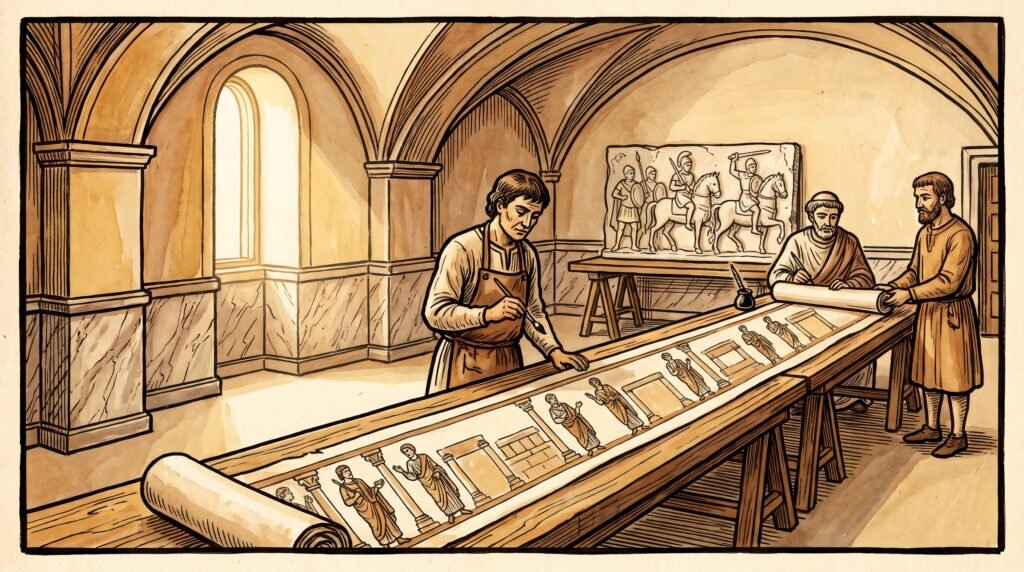
There is a sheet of parchment in the Vatican Library that is about thirty centimetres tall and rather more than a metre wide, and it is covered along its entire height with a band of small painted figures in classical dress. It is not a page. It is one of fifteen pieces cut from a single roll ten and a half metres long, and when those fifteen pieces are laid end to end they make the longest surviving illuminated manuscript of the Greek Bible: a horizontal band of pictures running without a break for the length of a great hall, with the Greek text of the Book of Joshua written in curves around and above it. The roll was painted in grisaille, in shades of grey and black on vellum, and the colour was added afterwards, possibly long afterwards, by a second campaign of artists who found the pictures already there. It was made in Constantinople in the middle of the tenth century, at the court of the emperor, by a monk and calligrapher named Basileios. It is the only surviving example of its kind: every other illustrated roll of the early Christian world is a vertical document with a picture at the top, and this one is painted across its whole breadth from end to end. It is also, and this is the part that has occupied scholars for half a century, a copy of something that has been lost.
The manuscript is Vatican, Biblioteca Apostolica Vaticana, Pal. gr. 431, and it is generally known as the Joshua Roll. It was cut apart in 1902 and its fifteen sheets are now kept separately, under Plexiglas, in the Vatican’s manuscript stores; the single continuous object that the Middle Ages knew existed only as a memory of how the sheets were supposed to go together. Its earlier history runs from Constantinople to Italy by about 1500. The Bibliotheca Palatina at Heidelberg, where the roll spent three centuries, was itself the creation of a collecting impulse that has a direct line to the Vatican today. Electors Palatine gathered manuscripts with a seriousness that modern libraries would envy, and when the Palatinate was devastated in the Thirty Years’ War the collection was moved repeatedly, from Heidelberg to Mannheim, from Mannheim to Düsseldorf, and finally to Rome when the Elector accepted the title of Elector of Bavaria and the Holy Roman Empire in exchange for a loan of money from the papacy. The manuscripts came with him. A city-scale transfer of a library, carried out over years by wagon and by barge, is the sort of event that usually destroys collections and sometimes preserves them; the Palatine survived the journey in a state that allowed the Joshua Roll to reach the Vatican intact in 1902, and to be detached there into the sheets that are now individually numbered and individually photographed. Everything that has happened to this manuscript since the fifteenth century has happened inside a single library’s history, and the single most remarkable thing about that history is that the roll came through it intact. It passed, through the collection of the humanist Niccolo Leonico Tomeo and then of the Habsburg banker Ulrich Fugger, into the Bibliotheca Palatina at Heidelberg, and from there to Rome in 1622 as part of the Palatine collection of the newly elevated papal library, where it has remained ever since. Almost every fact about it is contested, and almost every fact about it is interesting.
The Only One of Its Kind
Begin with the format, because it determines everything else. A roll in the ancient and early medieval world was a working format. It was cheap, it was continuous, it could be rolled up and carried, and it could be read a section at a time by unrolling it and rolling it again. It was also, usually, a format for one dimension. The great illuminated manuscripts of the early Christian era that survive on parchment – the Rossano Gospels, the Sinope Gospels, the Vienna Genesis – are codices, which is to say they are books: gatherings of folded leaves sewn or glued at the spine. Of the rolls themselves, the famous examples are vertical, narrow and tall, with the text running down the roll and an image or a set of images at the head. The Joshua Roll is horizontal, and it is painted all the way along.
The practical consequence of that is visible on every sheet. The pictures run as a single continuous frieze, and the text does not sit in a tidy block beside or beneath them; it curves, and it is compressed, and it gives way to the images where the images demand it. The writing follows the shape of the painting, wrapping around a figure or bending over a building, because the painter had first claim on the surface and the scribe had to fit the text into what was left. This is the opposite of the normal relationship between text and image in a manuscript, where the scribe lays out the page and the painter is given a space. Here the picture is the page.
The effect on the reader is a change of pace that no codex can reproduce. A person unrolling the roll does not encounter a sequence of framed images, each with its margin and its border and its own internal stillness. They encounter a band that keeps moving, in which a city on the horizon continues into the next column and a line of soldiers is still marching when the next scene begins. The eye is carried along the scroll by the continuous horizontal, which is why the standard description of the work has always borrowed the language of the frieze and, more recently, of the triumphal column. The manuscript is sometimes compared to the great carved columns of the Roman and early Byzantine world, the Column of Trajan or the Column of Theodosius or the Bernward Column at Hildesheim, and the comparison is apt for more than the shape. A frieze that wraps a cylinder is a thing designed to be seen by someone walking past it.
The object itself is startlingly simple for something so large. The parchment was joined in a way that tells you something about the workshop that made it. Fifteen sheets of roughly equal width, each one the height of a man’s forearm and the width of two, joined edge to edge along their long sides, with the seams left visible and unpainted or lightly scored so that a painter working along the roll would know where one sheet ended and the next began. The joins run vertically, straight across the band of pictures, and in a few places a figure or a building is interrupted by one, which means that the seams were laid out first and the painting was composed to fit them rather than the other way round. The sheets are not uniform. Some are short and some are long, and the two ends of the roll are missing entirely, so that what survives begins somewhere in the middle of the narrative and stops before the end. When the sheets were separated in 1902 each was given its own number, and they have been photographed, measured and compared ever since. The reconstruction is therefore not a hypothesis but an arithmetic: the sheets can be laid out in order because the join lines, the width of the photographed strips and the continuity of the painted band all agree. Fifteen sheets of joined parchment, each something over thirty centimetres tall and between forty-three and ninety centimetres wide, the whole thing running to 10,460 millimetres according to the Göttingen catalogue of the Septuagint and to rather more according to some other measurements. The sheets were detached from each other in 1902, which was done for perfectly respectable reasons of conservation: a ten-metre roll cannot be handled, cannot be consulted in a reading room and cannot be stored on a shelf. The act that saved the roll also ended it. What the Vatican has today is an archive of fifteen sheets; what the Middle Ages had was a book.
The Copy and the Lost Original
The dating of the Joshua Roll has been argued for seventy years and is not settled. The history of the argument is itself instructive. The first important study was published in 1926 by the great German scholar Martin Lietzmann, who asked in effect how old the pictures were, and the question of the copy’s date was raised before the second world war. Kurt Weitzmann’s monograph of 1948 made the tenth-century case, and made it in terms that have shaped everything since: if the roll is a Macedonian Renaissance work, then the Byzantine revival of the tenth century is not merely a revival of old models but a new and confident art in its own right, and the Joshua Roll becomes one of its key documents. Schapiro’s reply of 1949 and Tselos’s article of 1950 sharpened the alternative, and Katzenellenbogen’s review of 1951 summarised a field that has not moved very far since. Kresten’s work of 2010 and Wander’s of 2012 are the current state of the question. What has changed most in seventy years is not the conclusion but the method: the debate was once conducted over photographs in journals, and is now conducted over the sheets themselves, digitised in Rome and in Heidelberg, with the joins, the fibre, the pigment and the letterforms all available for re-examination by anyone who cares to look. It is a good example of the way the subject has been improved by imaging rather than by theory. The German art historian Kurt Weitzmann, who published the decisive monograph on it in 1948, gave it the title that became the standard: The Joshua Roll: A Work of the Macedonian Renaissance. The Macedonian Renaissance is the period of the Byzantine tenth century when the empire, enriched by its conquests and confident again, looked deliberately backwards to the art of the fifth and sixth centuries and copied it. Weitzmann’s position, and the one that has dominated since, is that the Joshua Roll is a tenth-century creation in a deliberately archaistic manner: the pictures imitate late antique models because the court wanted late antique pictures.
Meyer Schapiro, who had a better eye for a manuscript than almost anyone of his generation, accepted the tenth-century date but rejected the conclusion. In a famous article of 1949, “The Place of the Joshua Roll in Byzantine History”, he pointed out that the assumption the whole argument rested on – that illustrated horizontal rolls did not exist in late antiquity – was an assumption and not a fact, and that the roll’s pictures look like the work of competent copyists rather than of a tenth-century artist inventing a form. In 1950 D. Tselos published the question directly: “The Joshua Roll. Original or Copy?”
The most recent and most consequential contribution is Herbert Kresten’s, in the monumental study he published in 2010 for the Vatican, and it turns on a single technical observation. The script of the roll is a majuscule, and the word for the Greek text of Joshua in the manuscript’s own heading refers to Joshua son of Nun. But the letterforms are not ordinary Byzantine book hands. They imitate, almost slavishly, a style that Kresten calls the late antique biblical majuscule, a specific canonical form of majuscule lettering used in the early centuries for the Scriptures. The scribe was not writing the way people wrote in his own day. He was writing the way he had been taught to write in an earlier tradition, and the imitation is so close that it has been mistaken for the thing itself. This is precisely why the roll has been called sixth-century for most of a century, and why the error persisted: the manuscript imitates a sixth-century appearance with such fidelity that it has fooled some of the best eyes in the field.
Kresten’s argument runs from that observation to a reconstruction. The scribe and the painter were working from an exemplar, a Vorlage, and they were trying to reproduce it faithfully. That exemplar was itself a roll, and it was probably dated to around 500. It was rediscovered, Kresten suggests, around 950, but by then it was badly damaged by its great age: the parchment had perished in places, the paintings had flaked, the text was broken. What the tenth-century workshop produced, between about 955 and 975, was in effect a facsimile – a careful and expensive copy of a damaged original, with the damage itself copied, so that the modern reader sees the state of the model as it was in 950 rather than the state of the model as it was in 500. Steven Wander’s monograph of 2012 pushed the copyist’s date further, to 961, and proposed a specific patron: Basil the Parakoimomenos, the illegitimate son of the emperor Romanos I, who died in 961 and who was a patron of the arts and a commander in the eastern campaigns. On this reading the roll may have been a study for a small triumphal column.
The question underneath all of this is a question about what a copy is. If the Joshua Roll is a tenth-century copy of a late antique original, then the most important thing about it is not itself but the lost thing it preserves: a witness to a late antique illuminated Joshua scroll that no longer exists, of which we have this second-hand image, made by people who were consciously reviving the form. And if Weitzmann is right, then the Joshua Roll is one of the most important surviving documents of the Macedonian Renaissance, a manifesto of classicism at the moment when the empire was asserting itself. Both readings can be true of the same object, and the scholarly disagreement, far from being a pedantic squabble over a date, is a disagreement about whether the tenth century can create something new or can only remember. It is still, as Katzenellenbogen wrote in his review in 1951, one of the most important and difficult problems in Byzantine art.
The Pictures
The pictures were painted first, in grisaille, by several artists working in what may have been a single coordinated campaign; the colour was applied later, and the two stages may even be separated by a considerable interval in practice, however close they are in the imagination of the object. Grisaille is a technique of painting in greys, and it is associated in Byzantine art with stone and with silver, with the appearance of a statue rather than the surface of a living thing. Its use here means that the roll’s figures read, at first, as though they were carved. The palette, where the later colour survives, is restrained: ochres, earths, a certain amount of red, and the whole effect is of a world built out of stone and earth rather than out of the jewelled colour of, say, the Paris Psalter. The comparison with the Paris Psalter is unavoidable and constant, since the two works share a habit of translating classical prototypes into a Byzantine idiom, with elongated figures, large heads, drapery that falls in heavy parallel folds, and a persistent interest in what the Greek tradition called ponderatio, the weight of the body.
What is unusual is the way the pictures run. The technical vocabulary is worth unpacking because it explains why the roll looks the way it does. A frieze is a band of continuous narrative, without frame or border, in which the figures and the architecture of one scene run into the next. It is the format of the sculpted frieze, of the silverware of the period and of the illuminated margin of a Psalter, and it demands from its painter something very particular: the ability to compose at a scale that is continuous and at the same time varied, so that the eye is held by the movement of the band without being bored by it. The Joshua Roll does this with an economy of means. The figures are small, the architecture is schematic, the trees are little clusters of conventional foliage, and yet the band moves. The conquest of a city, a battle, the crossing of a river, a council of enthroned figures – the subject changes and the band does not break, because the painter’s real subject is the band itself. In a codex, the picture is a pause in the reading. On a roll, the picture is the reading. They are not framed and not set in registers. They form one horizontal band, and, as the scholars have noted, the band appears to slope: the whole procession of figures descends gently along the length of the roll, which is a device associated with the great imperial columns and with the illusion of a relief seen in the round. The cities are the other signature element. In one of the best-known compositions, on the sheet usually numbered twelve, a woman sits enthroned beside Joshua; she is the personification of Jericho, and she wears on her head a structure that looks like a small fortified city. The convention is ancient and Near Eastern: a city is a woman, and her crown is her walls. When the figures approach a walled town in this roll, the town is sitting there waiting for them, and the picture is as much about the personification as about the siege.
That sheet is also where the most striking single image in the roll appears. The angel who appears to Joshua is dressed not in the flowing garments of the usual heavenly figure but in the uniform of a commander, with a cloak and a belt and the accoutrements of a soldier. The implication is not subtle. Joshua’s success is depicted as a military campaign, and the angel who directs it appears in the dress of an imperial officer. The scene that closes the cycle shows the conquered kings paying homage to Joshua, which is the visual form of the roll’s argument: the Book of Joshua is a story of victory, and victory is depicted with the conventions of victory in the imperial present.
How many pictures there are depends on whom you ask. The German literature count twenty-seven, the complete facsimile edition published in 1984 counts thirty-six, and the English summaries generally decline to commit. The discrepancy is instructive rather than embarrassing: the boundary between one scene and the next in a continuous frieze with no frames is a matter of judgement, and a painter’s running composition does not come with dividers. The text gives a slightly firmer edge, because it covers roughly Joshua 2 to Joshua 10 according to one reconstruction and to the first twelve chapters according to another, and because Meyer Schapiro observed that the manuscript may never have been intended to be longer than it is. It may be that this was the whole of the book as its makers understood it, or that the roll was made for a purpose that did not require the remainder.
The script itself deserves a last look. The Greek text is an abridgement of the Septuagint of Joshua, and it is an abridgement in the service of the pictures: the narrative is cut, paraphrased and compressed so that it can be fitted to the band, and the result is a text that is a commentary on the pictures as much as a text in its own right. It is not the Hexaplar, and there is no undertext: the roll is not a palimpsest, and there is no Latin or Hebrew layer beneath the Greek, and no place where the name of God appears in Hebrew characters. Whatever the roll is, it is not the sort of object that scholars had in mind in the years when they thought they were looking at a sixth-century manuscript full of lost scriptural layers.
How a Book Gets to the Vatican
The roll’s journey is as interesting as its pictures and considerably better documented than most. It was almost certainly made in Constantinople. From there it came to Italy, by about 1500, in the circle of the Venetian humanist Niccolo Leonico Tomeo, whose Greek manuscripts were among the most important ever assembled in the West. It passed afterwards to the Habsburg banking house of Fugger, and from the Fuggers to the Bibliotheca Palatina at Heidelberg, the great princely library of the Palatinate, where it was a centrepiece of a collection that was among the most extraordinary in Europe. Then, in 1622, the Elector Palatine moved the library to Rome as the price of his new imperial title, and it entered the Vatican as the Palatine collection, where it has been ever since.
Compare that with the fate of the other great purple codices of the early Byzantine period, because it shows how much more stable this object was. The Codex Petropolitanus Purpureus, one of the most splendid of them, was long ago cut up and distributed: a hundred and eighty-two leaves remain in St Petersburg, thirty-three on the island of Patmos, six in the Vatican, four in the British Library among the Cotton manuscripts, two in Vienna, single leaves in Athens, in Thessalonica, in a private collection at Lerma in Spain and in the Pierpont Morgan Library in New York. The Rossano Gospels were found in the sacristy of the cathedral at Rossano in Calabria in 1879 and are still there; the Sinope Gospels, bought in 1899 from an old woman on the Black Sea coast and published by Henri Omont in 1901, are in Paris. A decade later the Stowe Missal was cut apart and its pieces are in Dublin, with further fragments in the Chester Beatty, the Morgan and the Getty. The normal fate of a great manuscript in the early modern period was dispersal, and the Joshua Roll’s journey to Heidelberg and then to Rome, intact, is unusual.
What happened to it in 1902 was different in kind. The roll was detached into its constituent sheets, presumably because of the practical impossibility of handling a ten-metre object. The sheets were photographed, measured and collated, and the reconstruction became possible. The picture is slightly absurd: a library in Rome spent decades and considerable effort cutting a manuscript into pieces and then a century and more spent piecing it back together in the imagination and on paper, and the join is now marked by the fact that the sheets are stored separately and can be laid out in sequence by anyone who asks. It is the normal fate of a roll, and it happens to every one that survives; the difference is that for the Joshua Roll the cutting is documented, which means that the shape of the original is known rather than inferred.
None of which quite explains why the object should be so rare. The uniqueness of a fully illuminated horizontal roll is now a fact of survival rather than of intention: for the Joshua Roll’s makers the format was presumably unremarkable, and there may once have been a dozen such scrolls in imperial libraries. What we have is one. The other was lost in the centuries when Constantinople’s libraries were stripped, and the loss was so total that by the nineteenth century the form itself had become unimaginable, and a scholar looking at the Joshua Roll could assume it was an experiment rather than the last example of a category.
A Bible as a Picture
Set the roll beside the other ways in which the Bible was made visual, and its oddness becomes clear. In the synagogue at Dura-Europos, in Mesopotamia, dated to 244, the walls carried a painted cycle of biblical scenes – the Torah, the Exodus, Samuel anoints David, the sacrifices of the Temple – executed in flat registers on wet plaster, and they are the earliest surviving monumental cycle of Jewish narrative art. The synagogue at Hammat Tiberias, in Galilee, has a fourth-century mosaic floor with panels of the binding of Isaac, the meeting at the well, the sacrifice of Isaac. In Christian Egypt, the walls of the catacombs carry the Good Shepherd, the orans, Jonah under the gourd vine, the earliest narrative imagery of Christ. These are the pictures of a book being read out of doors, in rooms, above graves: images that borrow a familiar repertoire of Greco-Roman motifs and bend them to a new purpose.
The Joshua Roll belongs to that tradition and departs from it at once. It is the Bible made into a single continuous decorated object on a scale that is closer to public monument than to private reading. It is a book you cannot hold and cannot sit down with. It is a book whose pictures are a triumphal procession, and whose text has been reduced and bent to make room for them. And it was made, as the Wander hypothesis has it, in the palace of an emperor, in a decade when the empire had reconquered the east and the court was celebrating military success.
That last point should be held with care. It is a hypothesis, not a fact, and it sits at the speculative end of a long argument. But it does explain several things that otherwise resist explanation: why the picture of a conquered city is a crowned woman waiting to be taken; why the angel of the Lord wears a commander’s uniform; why the cycle ends with kings paying homage. Joshua in Byzantine Christian exegesis was read as a type of Christ, as a figure of the conqueror who enters the promised land and distributes it, and that typology sat inside a court culture for which the vocabulary of conquest was the ordinary vocabulary of power. The roll’s pictures and the tenth century’s politics are not separable without damage, and the fact that the roll may be a copy of a fifth-century original makes the point sharper rather than blunter: what the tenth century wanted to reproduce was not only the pictures but the memory of an age when the pictures had been made.
It is tempting to close on the mystery of the lost original, and the mystery is real: somewhere in the ninth or tenth century there was a late antique roll of Joshua, painted across its whole breadth, which was found, found damaged, and copied. That original is gone, and the only reason we know it existed is that a copyist and a painter in Constantinople thought it worth the labour of a year. But the more interesting thing about the Joshua Roll is not the ghost behind it. It is the physical fact of the thing itself: fifteen sheets of parchment, ten and a half metres of painted band, a text bent into curves around the figures because the figures were there first, and a picture of conquest in a scroll that was cut apart to be preserved and has been put back together, on paper, by scholarship. It is one of the great objects of the history of the Bible, and it has only just become legible.
References
- Joshua Roll (Rahlfs 661) — Gottinger Septuaginta, Gottingen Academy of Sciences, catalogue record
- Cod. Vat. Pal. gr. 431 — Biblioteca Apostolica Vaticana, DigiVatLib digital facsimile
- Bav. Pal. gr. 431 — Universitatsbibliothek Heidelberg, Bibliotheca Palatina, digitised facsimile
- Verzeichnis der griechischen Handschriften des Alten Testaments — Alfred Rahlfs, Weidmann, Berlin, 1914
- Joshua Roll — Wikipedia, Wikipedia, accessed 31 October 2026
- Josua-Rolle — Wikipedia, accessed 31 October 2026
- The Joshua Roll — Emil Kren and Daniel Marx, Web Gallery of Art, accessed 31 October 2026
- The Joshua Roll — Amalia Spiliakou, Teacher Curator, 3 January 2020
- Joshua Roll Facsimile Edition, after Otto Mazal, Graz 1984 — Facsimile Finder, accessed 31 October 2026
- Review of The Joshua Roll by Steven H. Wander — The Medieval Review, 2013
- The Joshua Roll: A Work of the Macedonian Renaissance, review article — Adolf Katzenellenbogen, Speculum 26(2), April 1951
- The Glory of Byzantium: Art and Culture of the Middle Byzantine Era, catalogue entry 162 — Metropolitan Museum of Art, 1997
- Joshua Roll facsimile exhibit — Carleton College Library, accessed 31 October 2026
- Codex Petropolitanus Purpureus — Wikipedia, Wikipedia, accessed 31 October 2026
- Sinope Gospels — Wikipedia, Wikipedia, accessed 31 October 2026
- Rossano Gospels — Wikipedia, Wikipedia, accessed 31 October 2026
- Stowe Missal — Wikipedia, Wikipedia, accessed 31 October 2026
- Codex Purpureus Rossanensis — Emil Kren and Daniel Marx, Web Gallery of Art, accessed 31 October 2026