

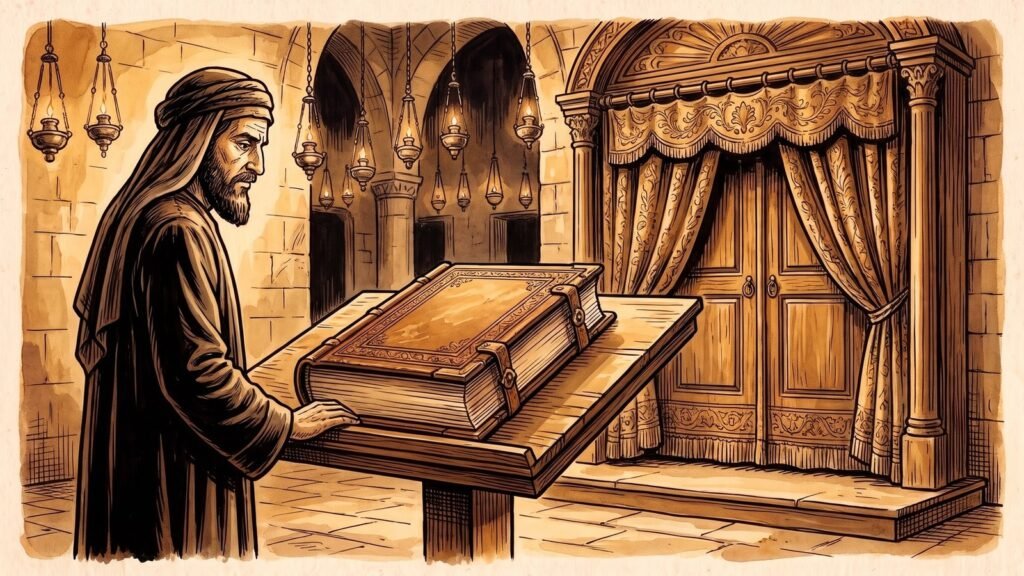
Two objects kept in the Great Synagogue of Aleppo bore the same name, and neither of them resembled the other. One was a worked mass of silver, made to be fitted over the upper ends of the rollers of a closed scroll. The other was a bound parchment manuscript whose honorific, Keter Aram Soba, transferred the language of sovereignty to a book. The manuscript name has travelled widely. The silver fittings survive, for the most part, at one remove, described in other people’s catalogues and kept in other countries’ museums.
A Silver Band and a Parchment Codex
The distinction is not a pedantic one. Within a single tradition, and often within a single room, the word crown covers a metal object that was weighed, hallmarked, donated, lent, insured, stored, and in at least one recorded instance sold, and a name applied to a manuscript to say that the manuscript outranked every other of its kind. The first was an ornament fitted to the Torah scroll; the second was a claim about the Torah scroll’s authority. An archive that folds them together will misdescribe both.
There is a further complication. The accessible public record for Aleppo’s Torah silver is thin. The Centre for Jewish Art’s survey of Syrian, Egyptian and Karaite synagogues turned up a group of silver dedicatory plaques characteristic of Syrian communities which had originally been attached to Torah ark curtains, and similar plaques on Torah cases, among them a collection of cases brought secretly from Syria to Israel in the years before the survey was completed. Specific Aleppo Torah crowns, as distinct from the plaques, the finials and the cases that accompanied them, are thinly represented in the published record.
Three bodies of documentation frame the subject. The first is the history of the synagogue, now set out and interpreted through a project at CUNY Academic Commons, drawing on the Sephardic Heritage Museum’s photographs and on earlier published work. The second is the corpus of the Jewish Encyclopedia, which describes the crown of the Law in the vocabulary of ritual law and the appurtenances of a scroll in the vocabulary of the workshop. The third is a name: Keter Aram Soba, the Crown of Aleppo.
How the Crown Works
The mechanics are set out with unusual clarity in the Jewish Encyclopedia’s article on the Scroll of the Law. The scroll is girded with a strip of silk and robed in a mantle. The two rollers are of hard wood, with flat, round tops and bottoms, to support and protect the edges of the parchment when it is rolled, and their projecting handles, especially the upper ones, are usually of ivory. The gold and silver ornaments belonging to the scroll are known as kele qodesh, sacred vessels, and are said to resemble the ornaments of the high priest. The principal ornament among them is the crown of the Law, made to fit over the upper ends of the rollers when the scroll is closed. Some scrolls have two crowns, one for each upper end.
The crown is therefore a collar of metal with a job to do, and it is neither a plaque nor a finial. A finial is a terminal, fitted to the end of a roller; a crown is a band that grips the pair of upper roller ends together. The Jewish Encyclopedia’s article on the crown of the Law is terse about the object and fuller about its law. A coronet, usually made of gilded silver, with bells, bearing a Hebrew inscription, it is placed upon the upper ends of the handles of the scroll. Sometimes the crown is a double one. A similar emblem, often borne between two lions, decorates the mantle of the scroll and the curtain of the Ark, and signifies the majestic sovereignty of the Law.
That last sentence carries more weight than it first appears to. The emblem that crowns the scroll is the same emblem that hangs on the ark curtain, and the article says so explicitly. The curtain of the Ark was a textile surface hung in front of the most sacred furniture of the Tabernacle; the mantle of the scroll is its domestic equivalent. The crown’s meaning, in other words, was carried by cloth as well as by metal, and the two media were interchangeable in the imagination of the sources.
The rest of the apparatus is described with equal precision. Suspended by a chain from the top of the rollers is the breastplate, to which, as in the case of the crowns, little bells are attached. Lions, eagles, flags and the Magen David, either chased or embossed, or painted, are the principal decorations of the breastplate, whose borders and the pillars of Boaz and Jachin are in open-work, and in whose centre there is often a miniature ark, the doors being formed as the two tablets of the Law. Over the breastplate, again by a chain from the head of the rollers, hangs the pointer, the yad.
The law treats the fittings with the same seriousness. When not in use, these ornaments were hung up on the pillars inside the synagogue, on the authority of a responsum of David ibn Abi Zimra published at Leghorn in 1651; in modern times they are placed in a drawer or safe under the ark. The people used to donate, or loan, the silver ornaments used for the scroll on holy days. And the crown itself was never simply decoration: in geonic times, he who read the last chapter of the Pentateuch on Simhat Torah had a crown of silver or gold, or a garland of myrtle, placed upon his head, similar to the one placed upon the head of a bridegroom, whence probably the name Bridegroom of the Law.
From this arose the custom of having a crown placed permanently upon the scroll of the Law, the making of crowns or garlands on festival days being thereafter a transgression of the Law. The code that records the prohibition also records the saying of Hillel that one who makes use of the crown perishes, glossed as a warning against making the crown of learning into an ornament, and the Mishnah’s enumeration of three crowns, of Torah, priesthood and royalty, with the crown of a good name above them all. On Sefaria the same enumeration appears as Pirkei Avot 4:13, where Rabbi Shimon says that there are three crowns and that the crown of a good name supersedes them all.
One further layer of the vocabulary belongs to the parchment rather than the metal. Menahot 29b reports that when Moses ascended on high he found the Holy One, blessed be He, sitting and tying crowns on the letters of the Torah, and that Rava holds that seven letters require three crowns. The crown here is a graphic device, an addition to the written text, and the Talmud gives it a permanent place in the scriptural line itself. The same word that names the silver band on the roller names the mark on the letter.
The crown of the Law was also understood to have a legal and commercial dimension. The Jewish Encyclopedia records the question, referred to Isaac Lampronti in his Pahad Yizhak, whether the Keter Torah in use may be sold for the purpose of settling a dowry for a daughter. The question treats the crown as an item of property with an attached prohibition, attached to a scroll, attached to a congregation, and therefore capable of generating litigation. A manuscript called a crown cannot be sold. A metal crown can, under conditions, be sold to settle a dowry.
The Ark, the Curtain and the Silver Plaque
Set against that apparatus, the Great Synagogue of Aleppo offers an unusually large setting. The building stands in the old Jewish ghetto in the Bahsita quarter of the city. It was destroyed by the invading Mongols in 1400, and reconstruction began in 1405 and was completed in 1418. Seven hechalot, arks, were built along the southern wall, facing toward Jerusalem, and the entire building was renovated in 1855. Its architecture was influenced by the designs of Muslim mosques, and the ark of the synagogue is very similar to the mosque’s mihrab. Earlier in the century, in 1327, the building had been turned into a mosque with the approval of the sultan of Cairo and had acquired the name of the Al-Hayyat, or Snake, mosque; an inscription on the ancient section of the great synagogue, built in the form of a basilica with three stoae during the Byzantine period, dates from 834.
No single date emerges from the sources consulted. The Encyclopaedia Judaica records a Jewish tradition, given by Rabbi Abraham Dayyan, that the community began in the era of Joab ben Zeruiah, conqueror of the city in the time of King David, who also built the great synagogue; it puts Jewish settlement there continuously since Roman times, and lists the most ancient synagogue of the city, Kanisat Mutakal, as a building of the fourth century. The CUNY account does not discuss the age of the structure at all. A synagogue whose ancient section carries an inscription of 834, whose own tradition assigns its foundation to the age of David, and whose architecture has been read as Byzantine, holds at least three incompatible claims upon its own antiquity, and the question bears directly on the silver, since a ninth-century building and a building of the age of David would have carried entirely different sets of fittings.
The interior was arranged in three parts: a western wing, an open courtyard with pillars on all four sides where the community worshipped outdoors in good weather, and an eastern wing. The eastern wing was added later to accommodate the Spanish exiles who came to Aleppo after the expulsion from Spain in 1492, and the date is not settled: the CUNY account says it is speculated that the wing was constructed during the sixteenth century although it may have been later, while the Encyclopaedia Judaica places the addition in the second half of the fifteenth century, when the great synagogue, known to them as the Yellow, could no longer accommodate the whole congregation. The community’s division into a Musta’arab or native congregation and a Sephardic one is also recorded, with communal leadership in the hands of the Dayyan family for several centuries.
The arrangement of the arks was a matter of doctrine as well as of capacity. Chief Rabbi Laniado wrote that the Great Synagogue was constructed in accordance with kabbalistic teaching, and that this is why it contained seven arks for storing Torah scrolls and seventy-two pillars. The seven arks were distributed across the three sections, each with two doors large enough for a person to enter so that the scrolls within could be removed; because of the holiness of the arks, anyone entering them would remove their shoes. The Heichel Tekiah, the largest of the arks, stood in the middle open section, its platform reached by climbing nine stairs, and on that platform circumcisions were performed and the shofar was blown on the Jewish New Year. Another ark, the Heichal Eliyahu, stood in the cave of the Prophet Elijah in the eastern section, because, in the CUNY account, a safe in the cave contained four codices, among them the Keter Aram Soba.
This is the point at which the two senses of crown enter the same room and refuse to be separated. In the Syrian communities the ornament for such curtains was silver, in the form of dedicatory plaques sewn to the cloth, and the Centre for Jewish Art’s survey found a group of them which had originally been attached to Torah ark curtains. The Jewish Encyclopedia’s observation that the emblem of the crown, borne between two lions, decorated the curtain of the Ark as well as the mantle of the scroll, is thus less a comparison than a description of Syrian practice. The ark curtain was a silver-bearing surface, and the plaque carried an inscription, a donor’s name, a date, the formula of consecration. The Syrian ark curtain was a memorial wall made of cloth and metal, and the metal was the writing.
The plaques matter because they are what survives in number. A crown is a single object and a plaque is a surface; a synagogue that owns seven arks owns seven sets of fittings, and a congregation that donates to an ark records the donation. The Centre for Jewish Art’s survey found similar plaques on Torah cases as well, including the cases brought secretly from Syria to Israel, which the newsletter describes as an important additional source of information about the community’s artefacts in their native Syria. The phrasing is the key: the objects are evidence about artefacts, that is, they stand in place of the record rather than forming part of it. The metal arrived. The paper about the metal did not.
The Thinning of the Aleppo Record
The documentary situation of the Aleppo silver follows from what happened to the building and to the community that used it. In December 1947 the Great Synagogue was set ablaze; the structure remained standing but its roof caved in, and after the riots the eastern section was restored and the community prayed there, with the remainder of the building restored from the late 1980s. Silver is recoverable in one of two ways, by survival in place or by removal with the people who owned it. The Aleppo fittings mostly went the second way, and they went in the years when the community was leaving, which is the worst possible condition for an object whose significance lay in its association with a specific ark, a specific scroll and a specific set of other fittings.
The consequences for the written record are more severe than the consequences for the metal. A plaque that survives carries its inscription. A crown that survives carries nothing except its own workmanship, and what it meant depends entirely on documents that have not survived: the dedicatory inscription that may once have been attached to it, the inventory of the ark, the community’s ledger, the responsa that record who was permitted to borrow the ornaments. Where the inscription is gone, the object survives as an unattributed silver band. Where the paper is gone, the object survives as a shape.
This is the general condition of synagogue silver, and it explains the shape of the published literature. The Centre for Jewish Art’s survey found what it found by visiting Aleppan, Syrian, Egyptian and Karaite synagogues in Israel and by documenting the objects that had come out of Syria, rather than by working in Aleppo itself. The cases brought secretly from Syria to Israel over the past few years were still being documented when the newsletter was written. The metal is recoverable because it was portable. The paper was not, and it went out with the people or into the fire.
Crowns Misclassified, Crowns Untraced
Two problems complicate the work. The first is misidentification, and it is systematic rather than random. In the course of its work on Italian ritual metalwork, the Centre for Jewish Art found that the Piemontese communities use two types of Torah finial, tower-shaped finials, or pinnacoli, and coronet-like finials, or corone. The coronet-like type is often mistaken for a Torah crown, the newsletter records, though it is smaller in size and always comes in pairs. The test is therefore simple and reliable: a finial is terminal and comes in pairs, and a crown grips the pair of upper roller ends and comes in one or two. The confusion is predictable, because a coronet and a crown are similar in silhouette and different in function, and because a cataloguer working from a photograph has no rollers to measure against.
The second problem is tracing individual objects, and it is where the literature becomes most uneven. The Jewish Museum of Vienna displays several crowns of different sizes and designs in its permanent exhibition, and Carolin Kayali’s account of the attempt to reconstruct the history of one Galician Torah crown from that collection proceeds on the explicit assumption that only scant reliable information is available for most of the objects. The article describes an attempt to trace the story of a Torah crown from the museum using just a few clues, and the catalogue image of the object is captioned as a Torah crown of between 1772 and 1799. That is a window rather than a point, and it is offered as a frame for the object rather than a fact about it.
Contrast the Prague holdings, where the museum’s collection overview carries enough detail to serve as a corrective. The Jewish Museum in Prague lists a Torah crown, inventory number JMP 037.746, of silver, made in Prague in 1723 by Filip Oberholzer, hammered, chased and partly gilt, and describes it as the oldest preserved Torah crown from Bohemia, acquired by the museum before the war. The same overview lists a Torah shield, inventory number JMP 046.075, of silver, made in Prague in 1784 by Richard Fleischmann, hammered, chased and cast, partly gilt and set with emeralds and rubies. That shield forms part of a group of Torah adornments commissioned for the Pinkas Synagogue by its warden Wolf Zappert in 1783 and 1784, and it hangs in the Winter Prayer Hall of the Spanish Synagogue.
The Prague pair is instructive because the two objects carry two different kinds of name. The crown is named for its maker and its year, which is what a maker’s mark allows. The shield is named for its commissioner and its synagogue, which is what a dedication and a building allow. Neither name is a donor’s name in the personal sense, and neither is the name of the person who used the object week by week. It is a general feature of synagogue silver that the people who paid for it are recorded less often than the people who made it, and that the people who used it are recorded least of all, though they are the reason the object exists.
The same asymmetry appears in New York, where two Torah crowns are catalogued with unusual fullness. The first, accession number M 260, is by Ze’ev Raban and the Bezalel School of Arts and Crafts, Jerusalem, 1912 to 1917, of silver worked in repousse, filigree and piercing, with semiprecious stones and carved bone, measuring nine and a quarter by nine inches. It carries silver medallions of the zodiac against filigree, and at the bottom silver medallions set with semiprecious stones alternate with bone plaques depicting Holy Land sites, among them David’s Tower, the Dome of the Rock, Absalom’s Tomb, Rachel’s Tomb and Zachariah’s Tomb. It was carried to Russia in the early 1920s, as its import marks attest, and later became part of the collection of Rose and Benjamin Mintz of Warsaw. The couple took the collection to New York to exhibit at the 1939 World’s Fair, though it was ultimately not shown, and in 1947 Rose Mintz, then a widow, sold it with the rest of the collection to the museum.
The second, accession number 1986-68a, is by Moshe Zabari, Jerusalem, 1958, of silver and leather, measuring eight and a quarter by eight and three-eighths inches, and is recorded as the gift of Sassi and Fred Lonner in 1986. Set side by side, the two records show the whole of the nineteenth- and twentieth-century metal in miniature, from the learned maker’s name to the named patron’s gift, and from the zodiac and the Holy Land sites to the plain surface of a later workshop’s silver and leather. What they do not show is a congregation. A crown’s history is a community’s history, and a catalogue can hold the object without the community.
Two Senses of Keter
The name of the manuscript is the pivot of this essay, and it needs to be set out carefully. The Encyclopaedia Judaica records that Aleppo is called by the Jews Aram Zoba, or Aram Zova. The CUNY history of the Great Synagogue names the codex as the Keter Aram Soba, the Aleppo Codex, and observes that the codex was hidden for centuries in the Great Synagogue, where it became known as the Crown of Aleppo. The two sources agree on the substance and differ only in transliteration, a difference that recurs throughout the literature and is worth noting because it affects searching. The crown in the name is the ordinary Hebrew word for a crown, and the second element is the city’s own Jewish name, so the honorific says, in effect, the crown of the place whose name is itself a Jewish toponym.
The word has a history of its own. In the Jewish Encyclopedia’s article on the crown, the English rendering stands for five distinct Hebrew words in the Bible, among them the circlet worn by a Hebrew monarch as a symbol of his royal power and the circlet worn by the high priest; for the phrase crown royal in Esther the word is keter, which seems to be a Persian loan-word. The article also observes that keter, with the related ataret and its derivatives, carries the applied meaning of ornament, dignity and distinction. The noun is therefore already unstable before it reaches Aleppo. It can mean an object of metal, an emblem of status, and a mode of speech for describing what is superior.
Applied to a manuscript, the crown becomes an honorific, which is to say a claim rather than a fitting. Applied to a scroll’s rollers, it becomes a fixture, which is to say a thing. The two operations are inverses of one another. The silver crown lends a fragment of sovereignty to the object it grips; the manuscript’s name lends a fragment of sovereignty to the name of the city that held it. Neither moves. Both assert. What makes the pairing interesting is that Aleppo housed both at once, in a building whose arks were distributed according to a kabbalistic scheme and whose occupant was a codex that the community itself had crowned.
At least four things in this tradition answer to the word. There is the metal crown of the Law, with its bells and its inscription and its chain of legal restrictions. There is the crown of Torah, priesthood and royalty in the Mishnah’s enumeration, which the Jewish Encyclopedia reads as evidence that the crown of the Law was a material crown and not a figurative expression. There is the crown of the good name, which is superior to the other three. And there is the crown on the letters of the Torah, tied by God himself according to Menahot 29b, which makes the word part of the scriptural line rather than part of the furniture. A community that used all four senses in one building was living inside the word’s ambiguity.
A Crown That Names Its Land
It is worth pausing on the bone plaques of the New York crown, because they perform a claim rather than a decoration. A Jerusalem crown of 1912 to 1917, made by a workshop founded in 1906, carries in carved bone the Tower of David, the Dome of the Rock, Absalom’s Tomb, Rachel’s Tomb and Zachariah’s Tomb. The workmanship is modern and the geography is ancient, and the two are combined without embarrassment: the sign of the zodiac is set against filigree in the body of the crown, and the Holy Land is set in bone along its foot. This is what a crown does at the level of iconography. It converts a set of metal fittings into a claim about legitimacy, and the claim is carried on the object itself, where it travels with the object and cannot be separated from it by any later owner.
That is the essential difference between the silver crown and the manuscript called a crown, and it is the reason the comparison is worth making. The manuscript’s crown travels by reputation; the metal crown travels by attachment. When the Aleppo codex was called Keter Aram Soba, the name asserted the community’s standing in the world of learning, and it did so in a way that any reader of the book could verify, since the book was in the room. The metal crown asserts its community’s standing through a metal that anyone present could see, touch and, on occasions, lift. The name and the fitting make the same claim on the same audience, with different materials and different durability.
The silver is also the part that records. The New York crown’s bone plaques and zodiac medallions fix a place and a cosmos; the Syrian plaques that the Centre for Jewish Art found on ark curtains and Torah cases fixed a donor and a date; the Prague shield fixed a warden and a synagogue; the Aleppo plaques, had they remained in Aleppo, would have fixed the names of Aleppo’s own subscribers to the seven arks. Silver is expensive, and expensiveness is what makes a record durable. A name inscribed in silver outlasts a name inscribed in ink, and outlasts a name inscribed in neither.
But the same expensive material that makes the record durable makes its loss catastrophic. This is the paradox that runs through the Syrian material. The congregation that could afford to dedicate silver plaques to its ark curtains was a congregation with means, and the community that had means in Aleppo in the nineteenth and early twentieth centuries left, and took with it what it could and left behind what it could not. The metal that did remain in Aleppo did so in a building that was still standing and was no longer being furnished. The paper that remained, the community’s accounts and protocols and responsa, went out with the people or went into the fire. Neither material can compensate for the loss of the other.
The Rigid Case and the Soft Mantle
A comparison with the other major fitting of the Torah scroll, the case, clarifies what the Aleppo silver was doing. The Jewish Museum in New York catalogues a Samaritan Torah case, or tik, made in Damascus in 1568 by Matar Ishmael ha-Ramhi, of copper inlaid with silver. In antiquity, cloth mantles or bags, also called tikim, protected the scroll; by the eleventh century, rigid cases, also called tikim, were made from wood, copper and silver, according to an inventory of 1059 from the Jerusalemite Synagogue found in the Cairo Genizah. When enclosed in a tik the Torah is set in a vertical position and rolled by means of its staves, the opposite of a Torah protected by a mantle, which is laid flat for reading during the service.
The case is a container for the scroll. The crown is an attachment to it. The distinction governs the handling of the object, the space it occupies, and the way it is carried and stored. A scroll in a mantle is laid flat to be read and is gathered up again to be put away. A scroll in a rigid case stands upright in the ark and is carried, by its staves, from place to place. The crown belongs to the second arrangement. It cannot be fitted to a scroll laid out on a reading platform, because the rollers are not there in the same way; it is an object for the closed scroll, as it travels and as it is stored.
The Damascus case also shows what a Syrian fitting could carry in the way of writing. It is copper inlaid with silver, the silver inlays forming circular fields with pointed terminals, arabesques filling the fields and repeated in the corners of the surrounding rectangular frames, and the same system of decoration used on Mameluke and Ottoman book covers of the sixteenth century. The case belongs to the earliest group of Torah cases to have survived; all five were made for the Samaritan community in the Near East during the sixteenth century, three of them remain in use, and the fourth is at the University of Michigan. The style is Mameluke in form and Ottoman in date.
The case is also the object that travels. The large-scale emigration of Jews from Arab lands after the founding of the State of Israel in 1948 brought many tikim to the West, leading to their adoption by traditional Ashkenazic communities. Cases went out of Syria in quantity, in the luggage of families who were leaving, and were adopted in synagogues that had no tradition of the rigid case and had to learn a new vocabulary for it. The Centre for Jewish Art’s account of the cases brought secretly from Syria to Israel over the past few years is a smaller and more recent instance of the same movement, and it shows that the object has a documented afterlife, carrying with it the plaques that had been sewn to it as it went.
The comparison with the Aleppo ark curtain is instructive here too. The curtain stayed in Aleppo, or was consumed in the fire; the case left, with its silver inlay and its dedication intact, and so did the manuscript called the Crown of Aleppo. What did not leave, or left only as a photograph, was the crown of the Law. That asymmetry between the objects that travel and the objects that stay is the shape of the Aleppo record, and it is why the surviving knowledge of Syrian synagogue silver sits largely in the collections of Jerusalem, of Prague, of Vienna and of New York rather than in Aleppo.
A Crown Is a Paper Object
The argument of this essay can be put briefly. Aleppo kept two crowns. One was metal, fitted to a scroll, and the other was a name given to a codex, and the community’s use of the word for both was not a confusion but a precision. The metal crown made the scroll sovereign in the room; the manuscript’s name made the codex sovereign beyond the room. The Crown of Aleppo has been read for a century as a metaphor, because it survives as a metaphor, in a manuscript. The silver crown survives as a shape, or as a photograph, or as a line in a catalogue, or not at all, because it never carried its own account of itself.
What would reconstruct the record, if anything can, is on the documentary side. A synagogue inventory naming the fittings of each ark. A dedication or a ledger entry naming the donor. A responsum on the kind that David ibn Abi Zimra’s consulted when he asked where the ornaments should be kept when not in use, or that Isaac Lampronti consulted when a family asked whether a crown could be sold to settle a dowry. A photograph of an open ark. The museum catalogues that carry a maker’s mark and a date are the residue of such papers even when the papers themselves are lost, and they are worth exactly as much as the record behind them.
Two methodological cautions follow. The first is the one the Centre for Jewish Art inscribed on its own survey: a coronet-like finial is often mistaken for a crown, being smaller and always coming in pairs. The second is the one Aleppo itself supplies. When the name Keter Aram Soba is translated as the Crown of Aleppo, the translation is not wrong, but it is incomplete, because it converts a name into a category and leaves behind the community that conferred it and the silver that would have made the claim visible to everyone present. The same is true of the metal crown. It is not a metaphor. It was an object, made by hand, to fit a specific pair of rollers, at a cost that somebody bore, for a scroll read aloud in a particular room on particular days.
Both crowns, in other words, are still worth studying, but neither can be studied from the other alone. The manuscript crown is invisible without the building; the metal crown is mute without the paper. The codex that was crowned in Aleppo is in a vault in Jerusalem, and the metal that crowned the scrolls was in a case, or in a photograph, or in a catalogue entry with a lot number. The honest position, for a subject of this kind, is to hold both halves of the record in view at once and to mark clearly where the evidence stops. A crown that has lost its papers is still an object, and it is still evidence, but it is evidence of a question rather than of an answer.
References
- History of the Great Synagogue — Carol Silvera, The Great Synagogue of Aleppo, CUNY Academic Commons, 2016
- Aleppo — Encyclopaedia Judaica, The Gale Group, 2007, via the Jewish Virtual Library
- Newsletter 16, Winter 2004 — Center for Jewish Art, Hebrew University of Jerusalem, 2004
- Crown — Emil G. Hirsch, Frank Knight Sanders and Kaufmann Kohler, The Jewish Encyclopedia, Funk and Wagnalls, 1901-1906, via JewishEncyclopedia.com
- Crown of the Law — Kaufmann Kohler and Judah David Eisenstein, The Jewish Encyclopedia, Funk and Wagnalls, 1901-1906, via JewishEncyclopedia.com
- Scroll of the Law — Joseph Jacobs, Judah David Eisenstein, Ludwig Blau and the Executive Committee of the Editorial Board, The Jewish Encyclopedia, Funk and Wagnalls, 1901-1906, via JewishEncyclopedia.com
- Pirkei Avot 4:13 — Sefaria, Mishnah, Mishnah Yomit translation, n.d.
- Menahot 29b — Sefaria, William Davidson Edition of the Babylonian Talmud, Koren Publishers, n.d.
- Torah Crown, accession number M 260 — The Jewish Museum, New York, collection record, object dated 1912-17
- Torah Crown, accession number 1986-68a — The Jewish Museum, New York, collection record, object dated 1958
- Samaritan Torah Case (Tik), accession number S 21 — The Jewish Museum, New York, collection record, object dated 1568
- Metals and 3D Objects — Jewish Museum in Prague, collection overview, n.d.
- In Search of History at the Jewish Museum of Vienna: The history of a Galician Torah crown — Carolin Kayali, Copernico, 7 December 2023, doi 10.25355/evzy-6h54