

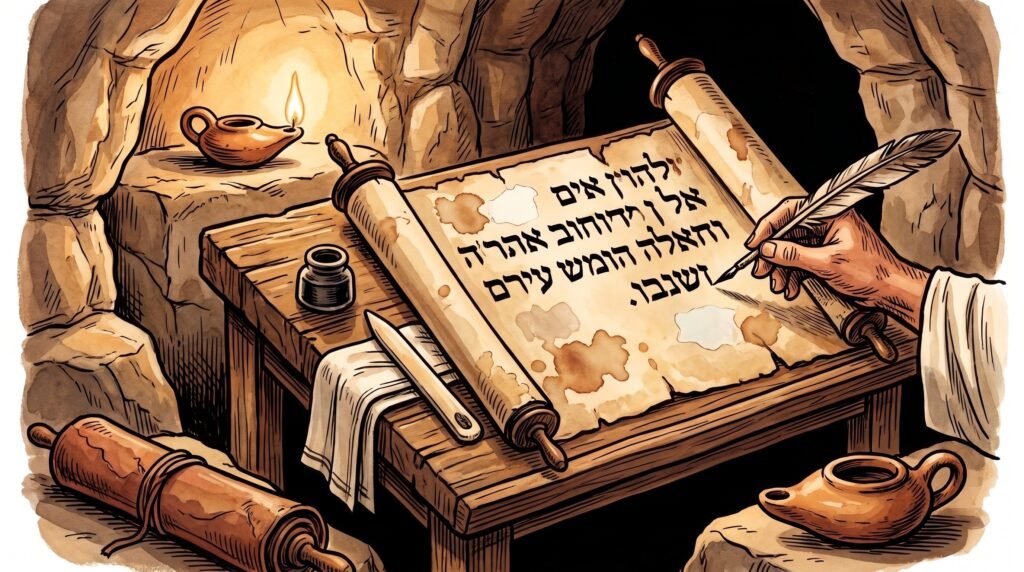
A wooden reading lectern is set inside a limestone cave. An oil lamp flickers on a low stone ledge, throwing a circle of warm light across an open parchment. Above the lectern, a hand holds a quill, paused mid-letter, the ink still wet at the nib. This is the world of the Qumran scribes — people who copied and re-copied the books now in our Hebrew Bibles, often in a different shape from the one we read today. Among the manuscript discoveries from the caves above the northwestern shore of the Dead Sea, one scroll stands apart because the text it carries is not the text we have inherited. The Psalms Scroll from Cave 11, designated 11QPsa in the standard reference system and sometimes labelled 11Q5 in the older convention, assembles forty-one psalms that appear in the Masoretic Psalter, but in a sequence not found in any medieval Hebrew manuscript, and adds seven non-canonical compositions that do not appear in any Masoretic Psalter at all. For half a century the scroll has been treated as the single most important witness to the question of how the Psalter was put together, and the most important early evidence that the book of Psalms was still in motion when the Christian era began.
The story of 11QPsa, like that of most of the Dead Sea Scrolls, is a story of an unwritten marketplace. Cave 11 was discovered in January 1956 by Ta’amireh bedouin working the cliffs of the Wadi Qumran plateau, in the same broad wave of discoveries that took in Caves 1 through 10 in the period from 1947 to the early 1950s. The Cave 11 lot was bought in stages by different middlemen operating out of Bethlehem and Jerusalem. The single most famous scroll from Cave 11 — the Temple Scroll — ended up with Yigael Yadin after a clandestine transaction conducted through the East Jerusalem antiquities dealer Kando in the years around the 1967 Arab-Israeli war. The Psalms Scroll had a quieter journey: it passed to the Palestine Archaeological Museum (the Rockefeller Museum) by way of Mar Samuel, the Syrian Orthodox Archbishop of Jerusalem, who in the late 1950s and early 1960s was one of the principal conduits for several of the Cave 11 lots. The scroll was at the museum by 1961, when the Discoveries in the Judaean Desert editorial team began to assign individual scrolls for first publication. The Psalms Scroll was assigned to the American biblical scholar James A. Sanders, at the time on the faculty of the Pittsburgh Theological Seminary in Pittsburgh, Pennsylvania, who would publish the editio princeps in 1965 as “The Psalms Scroll of Qumrân Cave 11 (11QPsa)” in volume 4 of the Discoveries in the Judaean Desert series, with the publisher Clarendon Press (Oxford University Press).
What the Sanders edition revealed has been engaging the question ever since. The scroll is dated, on paleographic grounds, to the early Herodian period of the first century CE, placing it roughly contemporary with the latest phases of activity at the Qumran community site. The parchment is a single piece, badly damaged at the joints, with what survives coming in irregular column lengths. The legible sections of the scroll fall into two collections of compositions and a long prose insert between them. The first collection consists of forty-one canonical psalms in a reordered sequence. The classical opening “Praise the Lord, all peoples” of Psalm 117 is followed by a series through Psalm 109, before the scroll pivots toward smaller groupings: Psalms 135 and 136, the Songs of Ascents 120 through 132, the Davidic psalms 138 through 145, the Hallelujah psalms 146 through 150, the Hallel psalms 105 and 96 and 147, the Songs of Moses 91, and the Psalms of David 86 and 48 and 28. The second collection consists of eight further compositions: a prose “Plea for Deliverance” of a persecuted righteous man, plus seven compositions that include non-canonical works under superscriptions such as “Songs of the Sabbath Sacrifice” “Apostrophe to Zion”, and “Hymn to the Creator” — a poetic piece now identified with the canticle that appears as Sirach 51:12-30 in the Greek and Latin Bibles. The running headings of the scroll attribute the various subgroups of psalms to David and to the traditionally-named Levitical poets Asaph and Joshua (in addition to the unidentified “Songs of David”).
The third element of the scroll is the long prose insert: a prayer of a persecuted righteous man whose text borrows heavily from the language of the Hebrew Psalter and the deuteronomic corpus. James Sanders titled this composition “Plea for Deliverance” in his edition; the composition has been the principal evidence for the strong claim that the Psalms Scroll was the liturgical Psalter of a specific Jewish community — almost certainly the yahad, the community whose other writings fill the Qumran caves. The supplicating voice is not the historical voice of David but a corporate voice of the righteous remnant in exile, which fits the function ascribed to the Psalter in the sectarian literature: the book of the prayers of the men of the covenant, the book of the community that waits.
What the scroll tells us about the history of the Masoretic Psalter is the question that has driven most of the scholarship it has provoked. The Masoretic Psalter of 150 psalms, divided into five books, with the standard medieval sequence, was solid by the time the Ben Asher codices were copied in the late first millennium CE. The Scroll shows that a century or so before the destruction of the Jerusalem Temple, that sequence was still being discussed. Sanders’s central claim, in the introduction to the 1965 volume and in the follow-up articles that ran through the 1970s, was that the Psalter had not yet settled: that the shape of the book — its divisions, its sequence, its boundaries — was decided over a long stretch of the second temple period, with active variants still circulating in the first century CE. The Scroll is one of the pieces of evidence for that claim; the Septuagint version of the Psalter, which includes a Psalm 151 (drawn from the canonical Psalm 151 of the Greek tradition and not of the Masoretic), and the divergent order of the Septuagint Psalter in general, are the others. Each represents a different moment in a process that had not, even at the Christian era, fully closed.
Comparing the text of 11QPsa against the Masoretic Psalter has been a technically demanding exercise because the consonantal skeleton of any Hebrew psalter is very close, but the close collation has yielded variants. The most consequential are in the orthography: the scroll is in a more archaic spelling system than the Masoretic codices, retaining old plural terminations and pre-exilic orthographic habits that had largely been smoothed out by the medieval period. There are also substantive variants, including the appearance of a paragraph division where the Masoretic Psalter runs straight, the presence of a line that appears in no other witness, and small differences in the order of clauses within a single verse. None of these changes is large enough to alter the meaning of any verse, but the aggregate effect is to confirm that the scroll lies behind the same family of Hebrew traditions that produced the Masoretic Psalter, with the same consonantal text, but with the editorial hand still free to shape the book.
The non-canonical compositions on the scroll have had a more complicated afterlife. The “Hymn to the Creator” was promptly identified with the canticle of Sirach 51:12-30, which in some Septuagint manuscripts appears at the end of Psalms (not as part of Sirach itself). This identification is the basis for the claim that the Psalm 151 of the Septuagint is in part a re-purposing of canonical and extra-canonical material for liturgy. The “Apostrophe to Zion” has a parallel in a Septuagint appendix to the Psalms known as “the second of the two non-Masoretic psalms.” Its recovery into the historical record from 11QPsa is one of the major textual finds of twentieth-century Hebrew Bible scholarship. The other compositions — the prose “Plea for Deliverance,” the “Songs of David,” the “Songs of Joshua,” the composition associated with the Sabbath, and the prose section sometimes called the “Catena” — are present in 11QPsa but do not survive in any other clear early witness. The post-exilic dating of these compositions is open, and the identification of any of them with non-canonical works known from other sources (such as the Psalms of Solomon, the Hodayot, or the Sirach wisdom literature) remains conjectural in most cases.
The disposition of the scroll itself has also told a smaller story. The Palestine Archaeological Museum, where Sanders first read the scroll, was renamed the Rockefeller Museum in 1966, and the bulk of the Cave 11 collection stayed in Jordanian custody in Jerusalem after the 1967 war even as the bulk of the Cave 1-10 materials ended up in the Shrine of the Book in Israel. The Psalms Scroll was scanned, photographed, and published, but for a long time the only widely available edition was Sanders’s editio princeps, with later work being progressively added by Florentino Garcia Martinez, Peter W. Flint, and the more recent generation of digital epigraphers. The Israel Antiquities Authority has now placed high-resolution photographs of the scroll online through the Leon Levy Dead Sea Scrolls Digital Library, and the publication of the Cave 11 Psalms Scroll in a fully revised critical edition is among the slow but ongoing projects of the post-2010 public-access programme of the IAA. The general reader who wants to read 11QPsa in full can do so by working through the digital library, but the experience of reading the scroll is constrained by the simple fact that a substantial fraction of the parchment no longer survives. The visible text is patchy, discontinuous, and at moments ambiguous.
The scribal practice that produced 11QPsa is the next layer of the analysis. The scroll is written in an early Herodian formal bookhand — the script of the trained scribes who were producing Torah scrolls and other copies for the temple in the period just before the destruction. The text was copied with a high degree of accuracy: the place-names, the divine names, the marginal peticordah lines all follow the conventions of the period. The exceptions are also informative. The divine name appears in paleo-Hebrew script inside the otherwise square consonantal text in several columns of the scroll. This is a feature shared with several of the non-biblical scrolls from Qumran, but it is unusual in biblical scrolls. It is sometimes taken as a sectarian marker, indicating that the scroll originated in a community that regarded the older Hebrew alphabet as the sacred medium of the name. Whether this is a defining marker of the yahad or simply a piece of scribal conservatism that survived in some scribal schools and not in others is still open. The fact that 11QPsa is one of the biblical scrolls from the Qumran caves that contains this feature is enough to put it inside the orbit of the community for most scholarly purposes.
The dating of the scroll is a problem of the same kind that affects every other scroll from the Qumran corpus. The early Herodian script points to the first half of the first century CE. The paleographic method by which Frank Moore Cross dated the Dead Sea Scrolls places this scroll firmly within that range, with internal agreement between the script and the language that suggests the scribe was a native reader of late Second Temple Hebrew, not a later copyist producing an antiquarian reproduction. Theologians and historians of religion sometimes attribute the scroll to the Essenes, on the (not uncontested) general attribution of the Qumran scrolls to that group; paleographers prefer to leave the question at “a Jewish scribe of the first century”. That is the safe framing of the present scholarly consensus: the scroll is a Jewish document from a Second Temple scribal context, with no decisive proof of which group of Jews.
Radiocarbon dating of the scroll has now been completed by the joint Arizona-Zurich radiocarbon programme for the Dead Sea Scrolls. The parchment samples from the second half of the scroll were measured and gave a calendar date of approximately 30-50 CE with a 2-sigma range of approximately 5-65 CE. The paleographic and radiocarbon dates agree within their margins of error. The scroll is a Herodian-period document and a probable witness to the temple-period text tradition in the period just before the Roman suppression of the Jewish revolt in 70 CE.
The implications for the formation of the Psalter are the reason 11QPsa has been so widely read and reread. The book of Psalms in our Bible is one of the most stable of the ancient Israelite collections. The 150 psalms, divided into five books, with their running headings attributing authorship to David and the korahites, with their superscriptions sending the reader from one psalm to the next in an order that the Masoretes formalised in the seventh to ninth centuries — this is what we have inherited. 11QPsa shows that the collection had been gathered, attributed, and partly ordered long before the Christian era, but that the order, the number, and the boundaries were all still being negotiated when the scroll was copied. The Septuagint tradition, which inserts Psalm 151 and reorders the canonical sequence in several places, is the later Greek voice of the same debate. The Peshitta tradition reflects yet another moment in the same conversation. 11QPsa is the evidence that this conversation was still open in the first century CE.
For practical students of the Masoretic text, the lesson is more limited but still useful. The scroll confirms that the consonantal text of the Hebrew psalter has been stable at the level of individual verses for at least two thousand years. The variants between 11QPsa and the Masoretic Psalms at the level of single letters are minor and consistent with what Cross’s local-text theory of the late Second Temple period would lead us to expect: the Qumran witnesses tend to reflect a more conservative orthography than the medieval recensions. The Qumran scribes were not free to invent readings, but they were also not under the same pressure of the Masoretic schools to regularise spelling. Their text is at once older and more archaic than the medieval codices, even when it is at its most formal.
The interest of 11QPsa for the history of the canon does not, then, lie in the text as such. The interest lies in the architecture of the book. The 150-psalm Psalter with its five-book division is the Masoretic shape; the 151-psalm Psalter with its rearranged order is the Septuagint shape; the reordered 41-psalm sequence with seven extra compositions is the Qumran shape. Each one represents a stage in a process of collection, attribution, and ordering that ran for several centuries before the Christian era and probably for several centuries after it. The Masoretic shape won out, eventually, because of the dominance of the Babylonian academies and their scribal conventions. The Qumran shape is a snapshot of a moment when the Masoretic shape had not yet been settled. The recovery of that snapshot is one of the most consequential of the twentieth-century finds in Hebrew Bible studies.
The Cave 11 find also fits into the broader archaeological story of the Qumran corpus. Cave 11 was one of the larger of the manuscript caves, and contained fragments of roughly twenty documents of varying lengths, including the Temple Scroll — the longest of the Dead Sea Scrolls, running over eight metres — and the Psalms Scroll, which is roughly a metre in length. The Cave 11 assemblage shows the hallmarks of a carefully curated scribal library: many of the texts are in early Herodian formal bookhands, the parchments are unusually well made, and the texts themselves are biblical and para-biblical in roughly the same proportions. Caves 7 through 10 in the same period contained more fragmentary material that has been only partly edited. The slow pace at which the Cave 11 materials were first published reflects the difficulty of working on damaged parchment with a small scholarly community in the period just after the establishment of the State of Israel, and the continuing debate about dating and attribution reflects how much is at stake in the assignation.
The Psalms Scroll is, in the end, a window into a moment when a Jewish scribal community was still choosing which of its prayers to keep in the book of prayers. The choice the Masoretes finally made — the choice we have inherited — was a strong choice, made deliberately, and not one that the Qumran community would necessarily have agreed to. The decisions about which psalms to include, which to omit, in what order to place them, which to credit to David and which to Korah or Asaph, which to treat as cultic and which as personal — all of those decisions are visible in the Qumran tradition. We can see, in the Psalms Scroll, the moment before the canon closed.
The Digital Edition and the Continuing Discussion
The Psalms Scroll has been re-edited, re-imaged, and re-studied several times since Sanders’s 1965 publication. The Israel Antiquities Authority opened the great majority of its Dead Sea Scrolls plate collection to the world’s researchers in 1991 and to the public in a series of stages through the 2000s; the high-resolution images of 11QPsa that the IAA now serves through the Leon Levy Dead Sea Scrolls Digital Library are an order of magnitude clearer than the photographs Sanders and his successors worked from. Peter W. Flint’s “The Dead Sea Psalms Scrolls and the Book of Psalms” (Brill, Leiden, 1997; volume 17 in the series Studies on the Texts of the Desert of Judah) is the principal monograph on 11QPsa and the other Psalms scrolls from the Qumran corpus. The author had been a student of James Sanders at the Pittsburgh Theological Seminary in the 1980s, and the Flint study continues Sanders’s reading of the scroll while updating the philological and redaction-historical analysis. The Flint monograph is the second-generation edition of the scroll and remains the standard reference work for the scholarly study of 11QPsa. A third major edited volume on the Psalms scrolls and the Book of Psalms was published in 2001 in the context of the Princeton Dead Sea Scrolls Project at the Princeton Theological Seminary, and is associated with Peter Flint as one of the general editors of the project. The three principal studies of the scroll — the Sanders editio princeps of 1965, the Flint monograph of 1997, and the Princeton project’s edited volumes of the 2000s — together constitute the principal scholarly tradition on which further work on the scroll has built.
A second wave of revision came with the digital editions published by the Martin B. Center of the University of Münster and the Hebrew University’s Orion Center for the Study of the Dead Sea Scrolls and Related Literature, working in parallel through the 2010s. The images produced by the Multispectral Imaging Project led by Gregory Bearman and the subsequent re-imaging of the photographic plates by the Israel Antiquities Authority have, between them, made it possible for the first time to read sections of the scroll that Sanders had treated as illegible. The “Catena” composition, in particular, was substantially re-read by the Münster team in 2014, who proposed a different segmentation of the units and a tighter literary reading of the whole. The most important single result is that two of the lines that Sanders had marked as lacunae have now been read as continuous text, with the consequence that the composition is shorter than originally thought.
There is one part of the discussion that has not been settled. The argument that the Psalms Scroll is a specifically Qumranic document, composed in or for the community that produced the other Cave 11 scrolls, has been the working assumption of most scholarship from the mid-1970s onwards, but it has been progressively weakened. The paleo-Hebrew divine name in the scroll is a characteristic of some but not all of the Cave 11 documents, and is shared with a small number of scrolls from other caves including the Temple Scroll and the Community Rule. The orthography of 11QPsa is consistent with the Hebrew of the late Second Temple period, but does not by itself pick out a Qumran community. The Hymn to the Creator, the Apostrophe to Zion, the Plea for Deliverance, and the Catena have, between them, the air of compositions by community scribes, but no single one is decisive. The argument has thus moved toward a more modest position: the Psalms Scroll was probably copied in a scribal centre that was broadly aligned with the yahad but cannot be fixed as definitely Qumranic. The Israel Antiquities Authority’s official position, in its online editions, leaves the question explicitly open.
The reception of the scroll within rabbinic Judaism and within later Jewish practice is, finally, an interesting piece of the larger picture. The rabbis of the Mishnaic and Talmudic period did not, on the whole, treat any of the seven non-Masoretic compositions of the Psalms Scroll as canonical. The “Apostrophe to Zion” is quoted in the Babylonian Talmud (Berakhot 7b) but in a form that differs from the Qumranic text, suggesting that the rabbis knew a Hebrew tradition independent of the Dead Sea Scrolls version. The “Hymn to the Creator” was treated by the medieval commentators as a canticle of Sirach and not as a psalm at all, which is consistent with the older Hebrew tradition. The other non-canonical compositions of the scroll appear to have had little to no influence on the post-rabbinic liturgical tradition, and they died out in the rabbinic stream of the Second Temple period’s literary inheritance even as the Psalms themselves were retained in the Masoretic canon. The traditions were preserved in the Qumranic library long enough for the parchment to survive; they did not survive in the rabbinic tradition.
That is the larger interest of the scroll. The 150-psalm Psalter of the Masoretes is not a self-evident book. It is the product of an editorial project that selected, ordered, attributed, and freely edited its material over a long period of time. The Psalms Scroll shows one of the moments when the editorial project was still open, when the choices that we now take for granted had not yet been made, and when a Jewish scribal community was deciding, on the basis of its own criterion, what to keep. The choices we have inherited from the Masoretes are wise choices and durable ones; the choices the Qumran scribes made are also wise ones, but they did not survive in the rabbinic tradition. The continuity of Jewish prayer is wider than the continuity of Jewish scriptural canon; both are visible in the Qumran scrolls, and both can be studied through the prose and the verse of the Psalms Scroll from Cave 11.
References
- The Psalms Scroll of Qumrân Cave 11 (11QPsa) — James A. Sanders, Discoveries in the Judaean Desert IV, Clarendon Press / Oxford University Press, 1965.
- Peter W. Flint, The Dead Sea Psalms Scrolls and the Book of Psalms — Studies on the Texts of the Desert of Judah 17, Brill, Leiden, 1997.
- 11QPsa digital edition — Israel Antiquities Authority, Dead Sea Scrolls Digital Library (Leon Levy), accessed 2026.
- Understanding the Dead Sea Scrolls — Hershel Shanks (ed.) — Biblical Archaeology Society, Random House, 1992.
- Qumran — The Pottery Factory (and the Dead Sea Scrolls) — Hershel Shanks, Biblical Archaeology Review.
- Pride of Place: Another Fragment (E) of the Psalms Scroll from Qumran Cave 11 (11QPsa) — Yigael Yadin, Textus 5 (1966): 1-10.
- Apocryphal Psalms in the Psalms Scrolls — Peter W. Flint, Oxford University Press edited volume.
- Qumran Studies: The Psalms Scroll — Jozef T. Milik, Revue Biblique.
- The Cave 11 Scrolls and the Hebrew Bible — John J. Collins, Yale University Press.
- Qumran Psalms Scroll (11Q5 / 11QPs-a) — Three Things; curated short reference on 11QPsa.
- Tianmu Library: Text of the Psalms Scroll — Tianmu Judean / Dead Sea Scrolls collection.
- The Text of the Old Testament — Ernst Würthwein — William B. Eerdmans, on Masoretic and Qumran texts.