

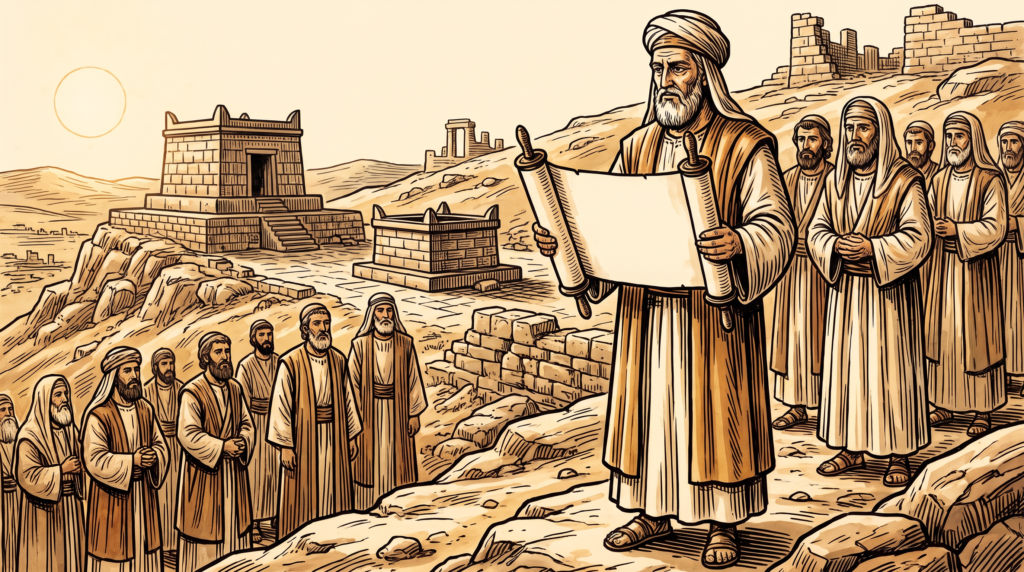
Of all the manuscript witnesses to the Pentateuch that have survived from antiquity, none is more puzzling, more singular, and more stubbornly useful to the textual scholar than the Samaritan Pentateuch. The Samaritan Pentateuch is the version of the five books of Moses that has been preserved, copied, read aloud, and venerated for some two and a half millennia by the Samaritan community, the small but unbroken Israelite population that has remained on Mount Gerizim above the city of Nablus since at least the fifth century BCE and that has preserved, in its own distinctive Hebrew script and in its own distinctive textual tradition, a copy of the Torah that is recognisably the same book as the Masoretic Text venerated by Rabbinic Judaism yet is at the same time, in hundreds of small particulars, markedly different from it. The Samaritan Pentateuch is, in the most precise scholarly sense, a fourth textual witness alongside the Masoretic Text, the Septuagint, and the Dead Sea Scrolls fragments, and it is a witness that cannot be derived from any of the other three and that no critical edition can ignore without leaving noticeable gaps in the textual history. The Samaritan Pentateuch is also a remarkable artefact of community survival. It has come down to us in manuscripts that range from the earliest fragmentary copies of the late Second Temple period, through the great medieval scrolls that form the backbone of the surviving manuscript tradition, to the liturgical codices of the present-day Samaritan community in Holon and on Mount Gerizim. The Samaritan Pentateuch is, in other words, both a textual problem and a living tradition, and the present essay attempts to bring the two sides together.
The Samaritans and Their Text
The Samaritans are the descendants of the Israelite population that remained in the land of Israel after the Assyrian deportation of the northern tribes in 722 BCE. The community traced its descent from the priestly line of Aaron through Eleazar and Phinehas and through the line that had served at the sanctuary at Dan, in the northern kingdom of Israel, until the fall of Samaria. After the Assyrian conquest, the Samaritans continued to occupy the land around Shechem and Mount Gerizim, and they continued to worship the God of Israel at the temple that they had built on Mount Gerizim in the fifth century BCE, in the period when the Jewish exiles were returning to Jerusalem from Babylon to build the Second Temple. The Samaritan temple on Mount Gerizim was destroyed, probably by the Hasmonean high priest John Hyrcanus, around 110 BCE, and the Samaritan community was thereafter deprived of its central sanctuary, but the community continued to exist as a distinct religious group, separated from the Jewish community by a combination of theological disagreement about the central sanctuary, by ethnic and genealogical self-understanding, and by the geographical fact that the Samaritans remained on Mount Gerizim while the Jewish community was centred on Mount Zion in Jerusalem. The Samaritan community has persisted, in reduced numbers, to the present day, with a population of approximately eight hundred people, divided between the holy city of Nablus on Mount Gerizim and a diaspora community in Holon, near Tel Aviv.
The Samaritan Pentateuch is, in the most straightforward sense, the version of the Pentateuch that the Samaritan community has venerated from antiquity. The Samaritan Pentateuch preserves the same five books of the Torah that are preserved in the Masoretic Text, the Septuagint, and the Samaritan Torah scrolls: Genesis, Exodus, Leviticus, Numbers, and Deuteronomy. The Samaritan Pentateuch is, however, written in a distinctive Hebrew script that is recognisably the old Israelite or Paleo-Hebrew script that was used in the land of Israel before the Babylonian exile, rather than the Aramaic square script that became standard for the writing of Hebrew after the exile and that is used in the Masoretic Text and in the standard Jewish Torah scrolls. The Samaritan script is not, strictly speaking, identical to the Paleo-Hebrew script of the First Temple period, but it is descended from it, and the Samaritans have preserved the script, with only minor modifications, in continuous use from antiquity to the present. The Samaritan script is, in a real sense, the most direct living connection between the script of the First Temple period and the script of the present day, and the Samaritan Pentateuch is the most extensive text written in that script.
The Samaritan Pentateuch is, in addition to its distinctive script, a distinctive textual tradition. The text preserved in the Samaritan Pentateuch is at many points identical with the text preserved in the Masoretic Text, but at a substantial number of points it differs from the Masoretic Text, and at some points it differs from the Masoretic Text in readings that agree with the Septuagint against the Masoretic Text, and at other points it differs from both the Masoretic Text and the Septuagint in readings that are unique to the Samaritan tradition. The most famous of the unique readings is the tenth commandment of the Samaritan Pentateuch, which is not, as in the Masoretic Text, the prohibition of coveting the neighbour’s house, wife, slaves, or cattle, but is instead a commandment about building an altar on Mount Gerizim and offering sacrifices there, with a long passage that is unique to the Samaritan Pentateuch and that is inserted into the Decalogue after the ninth commandment. The insertion is not, strictly speaking, a tenth commandment in the theological sense, because the Samaritans, like the Jews, count the prohibition of coveting as one commandment and the commandment about Mount Gerizim as the introduction to the material that follows, but the insertion is, in the most tangible sense, theologically motivated, and it is the single most distinctive feature of the Samaritan Pentateuch as a text.
The Samaritan Pentateuch also preserves a number of readings in which it agrees with the Septuagint against the Masoretic Text. The most famous of these is the age of Methuselah in Genesis 5:21, where the Samaritan Pentateuch, agreeing with the Septuagint, gives the age of Enoch at the birth of Methuselah as 165 years, while the Masoretic Text gives 65 years; the corresponding figure in the Septuagint, in the Samaritan Pentateuch, and in the Masoretic Text are different, and the chronologies of the antediluvian patriarchs that can be constructed from the three texts are consequently different. The Samaritan Pentateuch also preserves a number of readings in which it agrees with the Masoretic Text against the Septuagint, and a substantial number of readings in which it agrees with neither and preserves readings that are unique to itself. The textual character of the Samaritan Pentateuch has been the subject of extensive scholarly study, and the consensus of the modern scholarship is that the Samaritan Pentateuch is, in the most precise textual sense, an independent textual tradition that cannot be derived from the Masoretic Text or from the Septuagint and that has preserved readings that go back to a very early stage in the transmission of the Pentateuch.
The Manuscript Tradition
The manuscript tradition of the Samaritan Pentateuch is, in many ways, as singular as the text itself. The earliest surviving manuscript of the Samaritan Pentateuch is a fragment that was found in the excavations at Qumran and that bears the inventory number 4QpaleoExod^m, a fragment of Exodus in the old Hebrew script that has been dated by the paleographers to the second half of the second century BCE. The Qumran fragment is significant for two reasons: first, it is the earliest manuscript evidence of any part of the Samaritan Pentateuch, and second, it shows that the old Hebrew script was still being used to copy biblical books at Qumran even though the Aramaic square script had become standard in the wider Jewish community. The Qumran fragment is not, strictly speaking, identical with the text of the Samaritan Pentateuch as we now have it, but it is sufficiently close to the Samaritan tradition to be of great interest to the textual scholar, and it has been taken by some scholars as evidence that the Samaritan text was circulating, in some form, in the late Second Temple period, even before the schism between the Samaritans and the Jews was complete.
The earliest manuscript of the Samaritan Pentateuch that is unambiguously Samaritan in its liturgical and community use is the famous Abisha Scroll, which is preserved in the Samaritan community in Nablus and which bears, in the colophon that has been attached to it from an early date, the claim that it was written by Abisha, the great-grandson of Aaron, in the thirteenth year of the Israelites’ settlement in the land of Israel. The colophon is, in the scholarly sense, not historical, and the paleographers have dated the manuscript itself to the late medieval period, probably to the thirteenth or fourteenth century CE. The Abisha Scroll is, however, the most venerated scroll in the Samaritan tradition, and it is the scroll that is used for the most solemn liturgical occasions in the Samaritan community. The Abisha Scroll is written in the Samaritan script, on parchment, in a single long scroll that is divided into the appropriate liturgical readings, and it is the manuscript that every other Samaritan scroll is judged against in the determination of textual variants.
The Abisha Scroll and the other great Samaritan scrolls of the medieval period are preserved in a number of collections, including the collection in the Samaritan community in Nablus, the collection in the Samaritan community in Holon, and a number of scrolls that have been acquired by Western libraries over the course of the past century. The British Library, the Cambridge University Library, the Bodleian Library at Oxford, the Bibliothèque nationale de France, the Vatican Library, and a number of American libraries including the Library of Congress, the Jewish Theological Seminary, and the Schøyen Collection all possess scrolls or fragments of the Samaritan Pentateuch, and the study of the Samaritan Pentateuch has been advanced by the publication of critical texts based on these collections. The most important modern critical edition of the Samaritan Pentateuch is the edition published by Abraham Tal, in cooperation with the Samaritan community, in the 1990s, and based on a comparison of the major medieval scrolls and the early printed editions.
The medieval Samaritan scrolls are, in addition to being important witnesses to the text of the Samaritan Pentateuch, important witnesses to the history of the Samaritan community. The colophons of the medieval scrolls preserve the names of the scribes who copied them, the names of the donors who paid for the copying, the dates on which the scrolls were completed, and the names of the prominent members of the Samaritan community at the time of the copying. The colophons are, in a real sense, a continuous documentary record of the Samaritan community from the late antique period to the present day, and the colophons have been studied by scholars of Samaritan history, including Jean-Pierre Rothschild, Benyamim Tsedaka, and Abraham Katsch, who have used the colophons to reconstruct the genealogies of the prominent Samaritan families, the history of the Samaritan priesthood, and the history of the Samaritan community’s relations with its Muslim, Christian, and Jewish neighbours.
The Textual Character of the Samaritan Pentateuch
The textual character of the Samaritan Pentateuch has been the subject of extensive scholarly study, and the modern consensus is that the Samaritan Pentateuch is, in the most precise textual sense, an independent textual tradition that has preserved readings that go back to a very early stage in the transmission of the Pentateuch. The basis of the consensus is the comparison of the Samaritan Pentateuch with the Masoretic Text, the Septuagint, and the Dead Sea Scrolls fragments, and the observation that the Samaritan Pentateuch agrees with each of the other three witnesses in some readings, disagrees with each of them in other readings, and preserves readings that are unique to itself in still other readings. The textual character of the Samaritan Pentateuch is most easily illustrated by reference to the tenth commandment, the only passage in the Pentateuch in which the Samaritan text is, at the level of substantial content, distinct from the Masoretic Text and the Septuagint.
The Samaritan tenth commandment, in the form in which it is preserved in the standard manuscripts, runs as follows: And it shall come to pass, when the Lord thy God hath brought thee into the land whither thou goest to possess it, that thou shalt put the blessing upon Mount Gerizim and the curse upon Mount Ebal. Are they not beyond the Jordan, behind the way of the going down of the sun, in the land of the Canaanites that dwell in the Arabah, over against Gilgal, beside the oaks of Moreh, toward the south? For the Lord your God is bringing you into the land to possess it, and the Lord your God will cut off the nations from before thee, the Hivites, the Amorites, the Perizzites, the Canaanites, the Jebusites, and the Girgashites, and the Lord your God shall deliver them up before you, and ye shall smite them and utterly destroy them; thou shalt make no covenant with them, nor show mercy unto them; neither shall ye make marriages with them; ye shall not give your daughters unto their sons, nor take their daughters unto your sons. For they will turn away thy sons from following me, that they may serve other gods; then will the anger of the Lord be kindled against you, and he will destroy thee suddenly. But thus shall ye deal with them: ye shall break down their altars, and dash in pieces their pillars, and hew down their Asherim, and burn their graven images with fire. For thou art a holy people unto the Lord thy God; the Lord thy God hath chosen thee to be a people for his own possession, above all peoples that are upon the face of the earth. The Lord thy God will set thee on high above all nations of the earth; and thou shalt be a holy people unto the Lord thy God, as he hath spoken unto thee. And it shall come to pass, when the Lord thy God hath brought thee into the land, that thou shalt set the blessing upon Mount Gerizim and the curse upon Mount Ebal, as it is written in the book of the Law of Moses, and ye shall obey all the commandments and the statutes and the judgments which I command thee this day. And it shall be, if thou shalt hearken diligently unto the voice of the Lord thy God, to observe and to do all his commandments which I command thee this day, that the Lord thy God will set thee on high above all the nations of the earth; and all these blessings shall come on thee and overtake thee, if thou shalt hearken unto the voice of the Lord thy God. Blessed shalt thou be in the city, and blessed shalt thou be in the field. Blessed shall be the fruit of thy body, and the fruit of thy ground, and the fruit of thy cattle, the increase of thy kine, and the young of thy flock. Blessed shall be thy basket and thy kneading-trough. Blessed shalt thou be when thou comest in, and blessed shalt thou be when thou goest out. And the Lord shall cause thine enemies that rise up against thee to be smitten before thee; they shall come out against thee one way, and shall flee before thee seven ways. And the Lord shall command the blessing upon thee in thy barns, and in all that thou puttest thine hand unto; and he will bless thee in the land which the Lord thy God giveth thee. And the Lord shall make thee the head, and not the tail; and thou shalt be above only, and thou shalt not be beneath; if thou shalt hearken unto the commandments of the Lord thy God, which I command thee this day, to observe and to do them, and shalt not turn aside from the way which I command thee this day, to the right hand or to the left, to go after other gods to serve them.
The insertion of this passage into the Samaritan Pentateuch after the tenth commandment of the Masoretic Text is, in the most tangible sense, theologically motivated, and it is the single most distinctive feature of the Samaritan Pentateuch as a text. The insertion is, in the Samaritan understanding, a part of the Decalogue that was given to Moses at Mount Sinai, and it is, in the Samaritan understanding, the commandment about the central sanctuary that was, in the Samaritan tradition, the temple on Mount Gerizim. The insertion is, however, not theologically motivated in the sense that the Samaritans added the passage to the Pentateuch in order to make the text support their claim to Mount Gerizim. The passage is, rather, a passage that was already present in the Samaritan tradition at a very early stage of its transmission, and the most plausible scholarly explanation is that the passage was added to the Samaritan text in the period after the schism between the Samaritans and the Jews, when the Samaritan community was asserting its claim to Mount Gerizim as the legitimate central sanctuary of Israel. The passage is, in a real sense, the Samaritan answer to the centralisation of the cult at Jerusalem in the Masoretic Text, and the passage is, in the most tangible sense, the most distinctive feature of the Samaritan Pentateuch as a text.
The textual character of the Samaritan Pentateuch is also illustrated by the smaller variants that distinguish it from the Masoretic Text and the Septuagint. The variants are too numerous to enumerate in detail here, but they include a number of readings in which the Samaritan Pentateuch agrees with the Septuagint against the Masoretic Text, a number of readings in which the Samaritan Pentateuch agrees with the Masoretic Text against the Septuagint, and a substantial number of readings in which the Samaritan Pentateuch preserves readings that are unique to itself. The variants have been catalogued by a number of scholars, including John William Wevers, who produced a comprehensive apparatus of the variants of the Samaritan Pentateuch against the Masoretic Text in his work on the textual history of the Septuagint, and Emanuel Tov, who included the Samaritan Pentateuch in his comprehensive catalogue of the variants of the Hebrew Bible against the Masoretic Text. The variants have also been studied by the editors of the critical editions of the Samaritan Pentateuch, including Abraham Tal, who has noted that a number of the unique readings of the Samaritan Pentateuch can be explained as expansions, harmonisations, and theological adjustments, and that the underlying text of the Samaritan Pentateuch is, in the most precise textual sense, very close to the text that underlies the Masoretic Text and the Septuagint.
The Place of the Samaritan Pentateuch in the Textual History of the Hebrew Bible
The place of the Samaritan Pentateuch in the textual history of the Hebrew Bible is, in the modern scholarly consensus, an important and somewhat singular place. The Samaritan Pentateuch is, in the most precise textual sense, a witness to a stage in the transmission of the Pentateuch that is not represented by the Masoretic Text or by the Septuagint alone, and it is a witness that has preserved readings that go back to a very early stage in the transmission of the Pentateuch. The consensus is based on the comparison of the Samaritan Pentateuch with the Masoretic Text, the Septuagint, and the Dead Sea Scrolls fragments, and on the observation that the Samaritan Pentateuch agrees with each of the other witnesses in some readings, disagrees with each of them in other readings, and preserves readings that are unique to itself in still other readings. The consensus is also based on the observation that the Samaritan Pentateuch is, in the most precise paleographic sense, written in a script that is closer to the script of the First Temple period than the script used in the Masoretic Text, and on the observation that the Samaritan Pentateuch is, in the most precise linguistic sense, written in a form of Hebrew that is closer to the Hebrew of the First Temple period than the Hebrew of the Masoretic Text.
The place of the Samaritan Pentateuch in the textual history of the Hebrew Bible has been the subject of extensive scholarly debate. The earlier scholarship, in the nineteenth and early twentieth centuries, tended to treat the Samaritan Pentateuch as a late and corrupt recension of the Masoretic Text, on the grounds that the Samaritan text contained a number of obvious expansions and harmonisations that were absent from the Masoretic Text, and on the grounds that the Samaritan text was, in the most precise textual sense, derived from a Hebrew text that was later than the text that underlies the Masoretic Text. The later scholarship, in the twentieth and twenty-first centuries, has revised this view in important ways. The most important revisions are based on the Dead Sea Scrolls, which include a number of fragments that agree with the Samaritan Pentateuch against the Masoretic Text, and on the observation that the Samaritan Pentateuch is, in the most precise textual sense, a witness to a stage in the transmission of the Pentateuch that is not represented by the Masoretic Text or by the Septuagint alone. The revisions have led to the consensus that the Samaritan Pentateuch is, in the most precise textual sense, an independent textual tradition, and that the Samaritan Pentateuch is, in the most tangible sense, a witness to a stage in the transmission of the Pentateuch that has important implications for the reconstruction of the original text of the Pentateuch.
The place of the Samaritan Pentateuch in the textual history of the Hebrew Bible is also illustrated by the history of its reception in the Christian and Jewish traditions. The Samaritan Pentateuch was used by Origen in the third century CE, who included the Samaritan readings in his Hexapla alongside the Hebrew text, the Septuagint, and the other Greek versions. The Samaritan Pentateuch was used by Jerome in the fourth century CE, who referred to the Samaritan text in his preface to the Vulgate and who used the Samaritan readings in his commentary on the Pentateuch. The Samaritan Pentateuch was known to the Masoretes, who referred to the Samaritan text in some of their Masoretic notes, although the Masoretes did not use the Samaritan text as a source for the readings that they fixed in the Masoretic Text. The Samaritan Pentateuch was rediscovered by Western scholars in the seventeenth century, when a number of Samaritan scrolls were acquired by Western libraries, and the study of the Samaritan Pentateuch has been a part of the study of the Hebrew Bible ever since.
The place of the Samaritan Pentateuch in the textual history of the Hebrew Bible is, in sum, an important and somewhat singular place. The Samaritan Pentateuch is a witness to a stage in the transmission of the Pentateuch that is not represented by the Masoretic Text or by the Septuagint alone, and it is a witness that has preserved readings that go back to a very early stage in the transmission of the Pentateuch. The Samaritan Pentateuch is, in the most tangible sense, a living tradition, and the Samaritan Pentateuch is, in the most precise textual sense, a witness that no critical edition of the Hebrew Bible can ignore without leaving noticeable gaps in the textual history. The Samaritan Pentateuch is, in the most comprehensive sense, a part of the textual history of the Hebrew Bible, and the Samaritan Pentateuch is, in the most definitive sense, a witness to the remarkable tenacity of the One that has kept the Samaritans in the land of Israel, on Mount Gerizim, in unbroken community from antiquity to the present day.
The Samaritan Liturgical Calendar and the Use of the Scroll
The Samaritan Pentateuch is, in addition to being a textual witness, a liturgical document that is used in the daily and annual life of the Samaritan community. The Samaritan liturgical calendar is based on the Samaritan Pentateuch, and the Samaritan calendar is in some respects different from the Jewish calendar that is based on the Masoretic Text. The most striking difference is in the calculation of the date of the Passover, which is, in the Samaritan tradition, fixed by the Samaritan community on a specific day of the year, and which is, in the Masoretic tradition, fixed by the Jewish community on a different day. The Samaritan Passover is celebrated on the fourteenth day of the first month of the Samaritan year, and the Samaritan Passover is the central event of the Samaritan liturgical year, and the Samaritan Passover is the occasion on which the Samaritans gather on Mount Gerizim to offer the Paschal sacrifice, in the manner prescribed by the Samaritan Pentateuch, on the altar that has been reconstructed on the summit of Mount Gerizim in recent decades. The Passover sacrifice on Mount Gerizim is the most visible expression of the continuity of the Samaritan tradition, and the Passover sacrifice is, in a real sense, the most important ritual act of the Samaritan community in the present day.
The Samaritan Pentateuch is also used in the daily and weekly liturgy of the Samaritan community. The Samaritan liturgy is centred on the reading of the Torah, and the Samaritan liturgy includes a number of liturgical readings that are not in the Masoretic Text, including the Decalogue, which is read aloud in the Samaritan liturgy at every Sabbath service, and the priestly blessing, which is recited by the Samaritan high priest at every festival service. The Samaritan liturgy also includes a number of prayers and hymns that are based on the Samaritan Pentateuch, including the prayers that accompany the reading of the Decalogue and the priestly blessing. The Samaritan liturgy is, in a real sense, the most complete liturgical tradition that is based on a single biblical text, and the Samaritan liturgy is, in the most tangible sense, a living witness to the role of the Samaritan Pentateuch in the religious life of the Samaritan community.
The Samaritan Pentateuch is also used in the Samaritan calendar in a way that is not paralleled in the Jewish or Christian traditions. The Samaritan calendar is based on a solar year that is calculated from the spring equinox, and the Samaritan calendar is, in the most precise astronomical sense, a calendar that is based on the observation of the actual sun. The Samaritan calendar is adjusted by the Samaritan high priest on the basis of the observation of the ripening of the barley crop in the spring, and the Samaritan calendar is, in a real sense, an agricultural calendar that is based on the actual progress of the agricultural year in the land of Israel. The Samaritan calendar is, in addition, a calendar that is preserved in a continuous tradition from antiquity to the present day, and the Samaritan calendar is, in the most tangible sense, a witness to the continuity of the Samaritan community in the land of Israel.
The Samaritan Pentateuch is, in sum, a textual witness, a liturgical document, a calendar source, and a living tradition. The Samaritan Pentateuch is, in the most precise textual sense, an independent textual tradition that has preserved readings that go back to a very early stage in the transmission of the Pentateuch. The Samaritan Pentateuch is, in the most tangible sense, a living tradition that is venerated, read aloud, copied, and used in the daily and annual liturgy of the Samaritan community on Mount Gerizim and in Holon. The Samaritan Pentateuch is, in the most comprehensive sense, a part of the textual history of the Hebrew Bible, and the Samaritan Pentateuch is, in the most definitive sense, a witness to the remarkable tenacity of the Samaritan community in the land of Israel from antiquity to the present day.
The Samaritan Pentateuch also occupies a singular place in the discussion of the formation of the Pentateuch as a literary work. The Samaritan text has been studied by scholars of the Documentary Hypothesis, of the Supplementary Hypothesis, of the Fragmentary Hypothesis, and of the Neo-Fragmentary Hypothesis, and the readings of the Samaritan text have been used by each of these schools of thought as evidence for the literary history of the Pentateuch. The most distinctive feature of the Samaritan text from this perspective is the expansion of the Decalogue with the passage about Mount Gerizim, which has been used by some scholars as evidence that the Samaritan text was edited in the post-exilic period, after the Samaritan temple on Mount Gerizim had been built, and that the passage about Mount Gerizim was added to the Samaritan text in order to support the Samaritan claim to Mount Gerizim as the central sanctuary. The expansion is, however, not the only distinctive feature of the Samaritan text from this perspective, and the Samaritan text also preserves a number of other readings that have been used by scholars as evidence for the literary history of the Pentateuch, including the variant of the letters in the blessings of Jacob, the variant of the letters in the songs of Balaam, and the variant of the letters in the blessings of Moses. The variants are, in the most precise literary sense, an important source for the study of the formation of the Pentateuch, and the variants are, in the most tangible sense, an important part of the evidence for the literary history of the Pentateuch as a whole.
References
- The Israelite Samaritan Information Institute — the principal living archive of the Samaritan community on Mount Gerizim, with editions of the Samaritan Pentateuch and liturgical texts.
- Samaritan Pentateuch — Grokipedia overview with bibliography and manuscript list.
- The Leon Levy Dead Sea Scrolls Digital Library — Israel Antiquities Authority, with high-resolution images and transcriptions of 4QpaleoExod^m and related fragments.
- Abraham Tal, The Samaritan Pentateuch (Tel Aviv, 1994) — the principal modern critical edition with apparatus of variants against the Masoretic Text.
- Bibliography on the history of the Samaritan Pentateuch — WorldCat search for monographs on the manuscript and textual tradition.
- British Library Samaritan Collections — catalogue of Samaritan scrolls held in the British Library, London.
- Bodleian Library Samaritan Manuscripts — catalogue of Samaritan scrolls and fragments in the Bodleian Library, Oxford.
- Library of Congress, African and Middle Eastern Division — catalogue of Samaritan manuscripts held in the Library of Congress, Washington DC.
- The Schoyen Collection — private collection including Samaritan biblical manuscripts; see the online catalogue for holdings.
- Benyamim Tsedaka, The Textus Receptus of the Samaritan Pentateuch — Samaritan-community edition of the received text, useful for consulting the liturgical form.
- Alan D. Crown (ed.), The Samaritans (Mohr Siebeck) — the standard scholarly anthology on Samaritan history, religion, and the place of the Pentateuch in the Samaritan tradition.
- Jean-Pierre Rothschild, Samaritan Chronicles (Brill) — edition and study of the Samaritan community chronicles and colophons.