

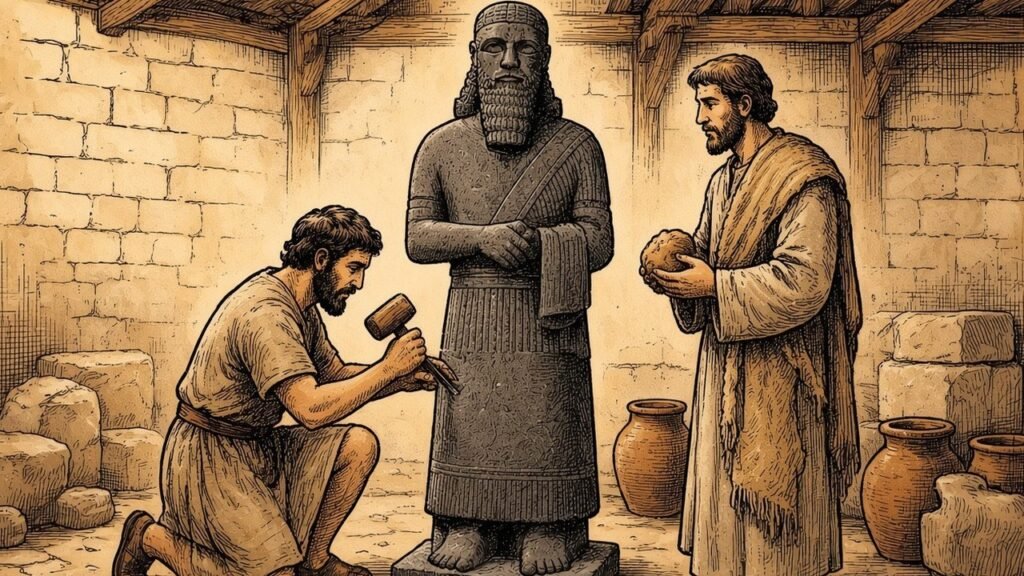
The Tell Fakhariyeh statue is a basalt figure of a standing ruler, about two metres high with its base, which was found in 1979 at the foot of an ancient mound near the source of the Khabur River in north-eastern Syria. Its long skirt carries two inscriptions recording the same dedication to the storm god Hadad: a text in Akkadian written in cuneiform on the front, and a text in Aramaic written in the alphabet on the back. The Aramaic text is the longest and most complete early royal inscription in that language yet known, and by most reckonings one of the oldest. It names its author as Hadad-yith‘i, son of Shamash-nuri, the ruler of Gozan, and it is usually placed in the middle of the ninth century BC. The statue is unusual in two respects. It is the only substantial bilingual in Akkadian and Aramaic from so early a date, so that it shows how a ruler on the edge of the Assyrian world presented himself in two languages and two scripts at once. And its Aramaic letters have a markedly archaic appearance, older than the historical date of the text would lead one to expect, which has obliged epigraphers to reconsider how the alphabet developed in the Aramaean lands. This article describes the discovery of the statue, its appearance, the two inscriptions and their relationship, the people and places they name, the script and language of the Aramaic text, the questions of date that it raises, and its significance for the history of Aramaic and for the study of the Hebrew Bible.123
At a glance
- Object: Basalt standing statue of a bearded ruler, about two metres high with its base, bearing inscriptions in Akkadian and Aramaic.
- Find: Found by a farmer early in 1979 at the foot of Tell Fakhariyeh, near the source of the Khabur River in north-eastern Syria.
- Dedicant: Hadad-yith‘i, son of Shamash-nuri, called king of Gozan in the Aramaic and governor in the Akkadian.
- Deity: Hadad of Sikan, the storm god, called “canal inspector of heaven and earth”.
- Date: Usually placed in the middle of the ninth century BC, although the Aramaic letter forms look older.
- Texts: A longer Akkadian text in cuneiform on the front of the skirt and an Aramaic text in alphabetic script on the back.
- First edition: Ali Abou-Assaf, Pierre Bordreuil and Alan R. Millard, Paris, 1982.
- Location: National Museum of Damascus.
Discovery and Publication
The Find of 1979
Tell Fakhariyeh, also written Tell Fekheriye or Tell Fekherye, is a mound on the edge of the modern town of Ras al-Ayn, close to the border between Syria and Turkey. It lies beside the copious springs that form the head of the Khabur, the largest tributary of the Euphrates within Syria, and it stands a short distance from Tell Halaf, the site of ancient Gozan. The mound had been the subject of a brief American excavation in 1940, directed by Calvin McEwan for the Oriental Institute of the University of Chicago, and it was known to have been occupied in the Bronze and Iron Ages, but no monument of importance had been recovered there. Early in 1979 a farmer working the land at the foot of the mound struck a large stone while digging. The object proved to be a statue lying on its back, broken at the feet but otherwise in remarkably good condition, with its inscriptions almost wholly legible. It was reported to the antiquities authorities and removed to the National Museum in Damascus, where it remains.456
The circumstances of the find explain both its good fortune and its limitations. The statue appears to have been buried, whether deliberately or by the collapse of the building in which it stood, and was therefore protected from the weathering and deliberate damage that have reduced many monuments of the region to fragments. On the other hand, it was not found in a controlled excavation, so that nothing is known for certain of the structure in which it had been set up or of the objects associated with it. The inscriptions themselves say that the statue was placed before Hadad in his temple at Sikan, and the mound of Tell Fakhariyeh has accordingly been identified with Sikan, but the temple has not been located. Later excavations at the mound, conducted by a German and Syrian team in the first decade of the twenty-first century, uncovered Middle Assyrian and Iron Age levels and added to the understanding of the site, without, however, recovering the shrine of the god.78
The First Edition
The statue was published with notable speed. Ali Abou-Assaf, then director of excavations in the Syrian antiquities service, undertook the archaeological and art-historical description; Pierre Bordreuil of the Centre National de la Recherche Scientifique took responsibility for the Aramaic text; and Alan Millard of the University of Liverpool edited the Akkadian. Their joint volume, La statue de Tell Fekherye et son inscription bilingue assyro-araméenne, appeared in Paris in 1982 in the series Études assyriologiques. In the same year Millard and Bordreuil presented the discovery to an English-speaking readership in a short article in the Biblical Archaeologist, with photographs and a translation of the two texts. The edition set out the readings on which all subsequent discussion has been based, and it raised at once the problems of date and script that have occupied later scholarship.910
The publication was followed by an unusually concentrated burst of commentary. In 1982 Stephen Kaufman published a long study of the bilingual in the journal Maarav, examining the relation between the two versions, the grammar and orthography of the Aramaic, and the bearing of the text on the history of the language. In 1983 the journal Iraq devoted part of a volume to the statue, with contributions by Millard on the relations between Assyrians and Aramaeans, and by Jonas Greenfield and Aaron Shaffer on difficult words and phrases in the two versions. Within a few years almost every scholar working on Old Aramaic had contributed a note or an article, and the statue had taken a central place in the handbooks of West Semitic epigraphy. This rapid reception reflects the rarity of the object: there are few Old Aramaic inscriptions of any length, and none before had come accompanied by a parallel text in a well understood language.111213
The Statue
Form and Dress
The figure is carved from a single block of dark basalt, the stone used for most of the monumental sculpture of northern Syria in the Iron Age. It represents a bearded man standing upright with his feet together and his hands clasped before his chest, the right hand held in the left, in the attitude of prayer or reverent attendance that is common in Mesopotamian votive statues. His hair is gathered behind the head, and his beard is long and rectangular, arranged in rows of tight curls in the Assyrian manner. He wears a long garment reaching to the ankles, with a fringed hem, and a shawl or sash passing diagonally over the left shoulder. The garment is decorated with incised bands and fringes, and its lower part forms a broad, smooth field on which the inscriptions are cut. The feet, which were broken from the figure when it was found, rest on a low rectangular plinth.1415
The style of the statue is essentially Assyrian. The proportions, the treatment of the beard and hair, the costume and the posture all resemble those of Assyrian royal and official statues of the ninth century, such as the statue of Ashurnasirpal II from Nimrud now in the British Museum, although the Fakhariyeh figure is more simply worked and somewhat heavier in its forms. Several scholars have noted provincial features in the carving, such as the large head and the summary treatment of the hands, and have suggested that it was the work of a local sculptor trained in the Assyrian manner rather than of a craftsman from the capital. The figure therefore presents its subject in the visual language of the empire, as a pious ruler standing before his god, while the Aramaic inscription on its back speaks in the language of his own people.161718
The Placement of the Inscriptions
The two inscriptions are disposed on the skirt of the figure, below the waist. The Akkadian text, in thirty-eight lines of cuneiform, occupies the front of the skirt, where it would be seen by anyone standing before the statue. The Aramaic text, in twenty-three lines of alphabetic script, is cut on the back, running horizontally across the lower part of the garment. The placing reflects the relative prestige of the two languages: Akkadian, the language of Assyrian kingship and of the ancient scribal tradition of Mesopotamia, received the place of honour, while the Aramaic was set where it would be read by those who walked round the statue. It does not follow that the Aramaic was considered unimportant. It was carefully cut and laid out, and it was evidently intended to be read by the people of Gozan and Sikan, few of whom can have been able to read cuneiform.192021
Both texts are cut with care in lines that follow the curve of the figure. The cuneiform signs are those of the Neo-Assyrian script, with some forms that are somewhat older in character, and the text is written in a form of Akkadian that shows Assyrian and Babylonian features together. The alphabetic text is set out in lines of regular length, with words separated by small dots or strokes, a practice common to the early alphabetic inscriptions of the Levant. The letters are cut deeply and evenly, and the surface of the stone has preserved them so well that only a few readings are uncertain. In this respect the statue contrasts with many other early Aramaic monuments, which survive only as broken fragments whose texts must be reconstructed by conjecture.2223
The Two Inscriptions
The Content of the Dedication
Both texts record the dedication of the statue by Hadad-yith‘i to the god Hadad of Sikan. They open with an extended invocation of the god, describing him in a series of epithets as the provider of the rains and the giver of abundance. In the Aramaic he is called the “canal inspector of heaven and earth”, who rains down abundance and gives pasture and watering to all lands, who gives rest and food to the gods his brothers, and who makes the rivers flow. The epithets reflect the importance of the storm god in a region where agriculture depended on rainfall and on the springs and channels of the Khabur. The god is called “great lord” and “merciful god”, to whom it is good to pray, and his residence is placed in Sikan.242526
The text then introduces the dedicant. In the Aramaic version he is “Hadad-yith‘i, king of Gozan, son of Shamash-nuri, king of Gozan”, and he describes himself as having set up and given the statue to the god for the life of his soul, the length of his days, the increase of his years, the well-being of his house, his descendants and his people, and to remove illness from him, and that his prayer might be heard and his words accepted. The purpose of the statue was therefore to stand permanently before the god as the image of its donor, interceding on his behalf. The text closes with a warning to anyone who might remove the donor’s name from the furnishings of the temple, and with a series of curses on such a person.2728
The order of these elements, invocation, identification of the donor, statement of purpose and curses, is common to the votive and building inscriptions of the ancient Near East. It is shared in broad terms by royal inscriptions in Akkadian, Phoenician, Moabite and Aramaic, and it places the Fakhariyeh statue in a recognisable tradition of royal piety. What makes the statue distinctive is that the same dedication was made twice, in two languages and in two scripts, and that the two versions, though closely related, are not identical.2930
The Relationship of the Versions
The Akkadian and Aramaic texts run in parallel for most of their length, and it is clear that one was composed with reference to the other. Their relationship, however, is not that of a word-for-word translation. The Aramaic version is in places shorter, in places fuller, and it uses its own idioms and formulae. The first editors and most later commentators have concluded that the Akkadian text was the primary composition and that the Aramaic was based on it, since the structure and much of the phrasing of the invocation follow Mesopotamian models closely. Kaufman, in his study of 1982, drew attention to passages in which the Aramaic seems to render the Akkadian closely, with calques of Akkadian expressions, and others in which it departs freely from its model. Others have argued that the two texts were composed together by bilingual scribes who were at home in both traditions, and that neither should be regarded simply as a translation of the other.3132
The divergences become more pronounced in the second half of the texts. The Aramaic version falls into two sections of roughly equal length, the second of which opens with a fresh reference to the image of Hadad-yith‘i and repeats, in a different form, the statement of the donor’s identity and purpose before proceeding to the curses. Some scholars have described the Aramaic text as composed of two originally separate dedications set one after the other, while others regard the repetition as a deliberate literary structure. The Akkadian text follows a corresponding but not identical arrangement, with differences in the order of the clauses and in the wording of the curses. Whatever its explanation, the structure shows that the bilingual was not produced mechanically, and it gives an insight into the way in which Aramaean scribes adapted the conventions of Mesopotamian royal inscriptions to their own language.3334
Titles and Status
One of the most revealing differences between the versions concerns the title of the dedicant. In the Akkadian text Hadad-yith‘i and his father Shamash-nuri are called šakin māti, “governor of the land”, a title used in Assyrian administration for provincial governors, and the land is named as Gozan. In the Aramaic text both are called mlk, “king”, of Gozan. The difference has been widely interpreted as evidence of the dual status of local rulers on the margins of the Assyrian empire in the ninth century. To the Assyrian king and his officials, to whom the Akkadian text was addressed, Hadad-yith‘i was a governor holding his land at the pleasure of the empire. To his own subjects, who read the Aramaic, he was a king in the tradition of the Aramaean dynasts who had ruled the Khabur region before the Assyrian advance.353637
The difference of title illustrates a broader point. In the course of the ninth century the Assyrian kings brought the Aramaean states of the Khabur and the middle Euphrates under their control, sometimes by conquest, sometimes by the submission of local rulers who were left in office as vassals or governors. The statue shows such a ruler presenting himself in the forms of Assyrian piety and administration, while retaining in his own language the royal title and the local religious tradition of his family. It is one of the clearest documents of the process by which the Aramaean world was absorbed into the Assyrian empire, and by which, in the long run, Aramaic became a language of the empire itself.383940
People and Places
Gozan and the Khabur
The kingdom named in the inscription, Gozan, lay in the upper basin of the Khabur. Its capital, ancient Guzana, is the mound of Tell Halaf, which stands a few kilometres from Tell Fakhariyeh and was excavated by Max von Oppenheim between 1911 and 1913 and again in 1929. Oppenheim uncovered there a palace of the tenth or early ninth century built by a ruler named Kapara, decorated with orthostats and colossal statues in a vigorous local style, which became famous when the finds were displayed in Berlin. Gozan was known in Assyrian sources as the centre of the land of Bit-Bahiani, an Aramaean state named, as was usual among the Aramaeans, after the ancestor of its ruling house. In the Hebrew Bible, Gozan appears among the places to which the Israelites of Samaria were deported by the Assyrians after the fall of their kingdom, in the phrase “Halah, and Habor the river of Gozan” in the books of Kings.414243
The Khabur region came under Assyrian control in the course of the ninth century. The annals of Adad-nirari II record tribute received from Bit-Bahiani at the end of the tenth century, and Ashurnasirpal II, in the early ninth century, again received the submission of its ruler. The region appears thereafter as an Assyrian province, administered by governors whose names occur in the lists of eponyms, the officials after whom the years were named in the Assyrian calendar. The Fakhariyeh statue belongs to this period of transition, when the local dynasty still ruled, but did so as part of the Assyrian administrative order.444546
Hadad-yith‘i and Shamash-nuri
Neither Hadad-yith‘i nor his father is mentioned in Assyrian royal inscriptions. A man named Shamash-nuri, however, appears in the Assyrian eponym lists as the official of the year 866 BC, under Ashurnasirpal II. Many scholars identify him with the father of Hadad-yith‘i, which would place the son’s activity in the middle decades of the ninth century and offer a fixed point for the date of the statue. The identification is attractive but not certain, since the name was not uncommon, and some scholars have preferred to leave the date of the statue more open. If it is accepted, the statue would have been set up within a generation or so of 866, perhaps around 850 BC or a little later.474849
The names of the two rulers are themselves informative. Shamash-nuri, “Shamash is my light”, is an Akkadian name invoking the Mesopotamian sun god, while Hadad-yith‘i, “Hadad is my salvation” or “Hadad is my help”, is Aramaic and invokes the storm god of the Aramaeans. In the Akkadian version the son’s name is given in an Akkadian form, Adad-it‘i. The combination of Akkadian and Aramaic names within one family is typical of the mixed culture of the Khabur region, where Aramaean dynasties had long lived in contact with Assyrian officials and Mesopotamian scribal traditions.5051
Hadad of Sikan
The god to whom the statue is dedicated, Hadad of Sikan, was one local form of the great storm god of Syria and Mesopotamia, called Hadad in West Semitic and Adad in Akkadian. Hadad was the chief god of many Aramaean states, including Damascus, whose kings in the Bible bear the name Ben-Hadad, “son of Hadad”. At Sikan he was evidently venerated as the lord of the springs of the Khabur as well as of the rains, and his title of canal inspector, rendering an Akkadian term for an official responsible for irrigation, expresses his role as the guarantor of the water on which the fields depended. The sanctuary of Sikan is mentioned in other Assyrian texts, and it appears to have been a religious centre of some importance in the region.525354
Script and Language
The Letter Forms
The most debated feature of the Aramaic inscription is its script. The letters belong to the linear alphabet used in the Levant from the end of the second millennium BC, which in its earliest monumental form is usually called Phoenician, and from which the Hebrew, Moabite and Aramaic scripts derived. In most Aramaic inscriptions of the ninth and eighth centuries, such as the inscription of Zakkur king of Hamath and the treaties from Sefire, the letters have developed distinctive forms, and the Aramaic script can be distinguished from the contemporary Phoenician and Hebrew scripts. The letters of the Fakhariyeh inscription, by contrast, resemble those of Phoenician inscriptions of the eleventh and tenth centuries, such as the inscription on the sarcophagus of Ahiram of Byblos. Several letters, including the forms of he, mem and qof, are of an archaic type, and some are written in orientations that had been abandoned elsewhere by the ninth century.55565758
Had the inscription been found without its Akkadian counterpart and without any other indication of date, it would probably have been assigned on the evidence of its letters to the eleventh or tenth century. Some scholars, indeed, argued in the first years after its publication that the statue should be dated considerably earlier than the ninth century, and that the identification of Shamash-nuri with the eponym of 866 was mistaken. The weight of opinion, however, has remained with the ninth-century date, which is supported by the style of the sculpture, the form of the cuneiform signs and the historical setting. The script therefore presents a problem: how could a ninth-century scribe in Gozan have written letters that look two centuries older?596061
Explanations of the Archaic Script
Several explanations have been proposed. Joseph Naveh, who had argued before the discovery that the Aramaeans adopted the alphabet from the Phoenicians at an early date and then developed it independently, saw in the Fakhariyeh script evidence of a local tradition that had preserved older forms. On this view the alphabet reached the Khabur region in the eleventh century, and the scribes of Gozan, remote from the centres where the script was evolving, continued to use the letter forms they had received. Others have suggested that the scribe deliberately imitated an older style for a monumental and religious inscription, as later scribes sometimes used archaic forms for solemn purposes. A third view, which combines elements of the first two, holds that the inscription reflects a regional variety of the alphabet in north-eastern Syria, developed in contact with Assyrian scribal practice and distinct from the script of western Syria.6263
The discussion has a wider significance. Palaeographic dating, the practice of assigning an undated inscription to a period on the evidence of its letter forms, rests on the assumption that the script developed at a roughly uniform pace across a region. The Fakhariyeh inscription shows that this assumption is not always safe, and that conservative or regional traditions could preserve older forms long after they had been abandoned elsewhere. It has therefore served as a caution in the dating of other inscriptions, and it has encouraged epigraphers to pay closer attention to local variation in the early history of the alphabet.6465
Spelling and Vowel Letters
The orthography of the Aramaic text is no less remarkable. Early Phoenician writing represented only consonants, and the use of certain letters to indicate vowels, the so-called matres lectionis, developed gradually in Aramaic, Moabite and Hebrew. In most Old Aramaic and Hebrew inscriptions of the ninth century vowel letters are used at the ends of words, but rarely within them. The Fakhariyeh inscription, however, uses the letters waw and yod within words to indicate long vowels more frequently than other inscriptions of comparable date. This feature contrasted with the archaic appearance of the script and added to the difficulty of dating the text, since the extended use of internal vowel letters had been thought to be a later development.6667
The combination of archaic letters with relatively advanced spelling has been explained in various ways. Some scholars have seen the influence of cuneiform, in which vowels are always written, on scribes accustomed to the fuller notation of Akkadian. Others have argued that the use of internal vowel letters in Aramaic began earlier than had been supposed, and that the Fakhariyeh inscription simply provides the earliest extensive evidence for it. Whatever the explanation, the text has become an important witness in the study of the development of vowel notation in the West Semitic alphabets, a process that culminated in the system of vowel letters used in the consonantal text of the Hebrew Bible.6869
Grammar and Dialect
The language of the inscription is Old Aramaic, but it differs in several respects from the language of the contemporary inscriptions of western Syria. Scholars have noted forms of the verb, pronouns and vocabulary that set it apart, and some have spoken of a distinct eastern dialect of Old Aramaic, spoken in the Khabur region and influenced by long contact with Akkadian. Among the features discussed is the use of a prefix with the letter lamed in verbs expressing a wish or command, which recalls both the Akkadian precative and the verbal forms of later Eastern Aramaic dialects. The vocabulary includes a number of loanwords and calques from Akkadian, especially in the religious and administrative terms of the invocation and the titles.707172
The existence of dialectal variation at so early a date has implications for the history of Aramaic as a whole. It shows that the language was not uniform in the ninth century, and that the later division between Western and Eastern Aramaic may have roots in the earliest period of the language. It also illustrates the role of the Khabur and the Mesopotamian borderlands in the formation of the Aramaic that later became the administrative language of the Assyrian, Babylonian and Persian empires, the form known as Imperial or Official Aramaic.737475
The Curses
The Protection of the Name
The final part of each inscription is devoted to the protection of the statue and of the donor’s name. Anyone who in future should remove the name of Hadad-yith‘i from the vessels of the house of Hadad, and set his own name upon them, is cursed by the god. The concern reflects a common practice in the ancient Near East, where later rulers sometimes appropriated the monuments of their predecessors by erasing the original names and inscribing their own. Assyrian royal inscriptions regularly end with curses on any future king who might damage the inscription or remove the name of its author, and with blessings on one who would restore it. The Fakhariyeh curses follow this tradition, but in the Aramaic version they take a particularly vivid form.7677
The Futility Curses
The Aramaic text calls on Hadad to bring frustration upon the offender in every part of his life. He shall sow, but not reap; he shall sow a thousand measures of barley, and take only a small part of it. A hundred ewes shall suckle a lamb, and it shall not be satisfied; a hundred cows shall suckle a calf, and it shall not be satisfied; a hundred women shall suckle a child, and it shall not be satisfied; a hundred bakers shall bake in an oven, and they shall not fill it. His people shall glean barley from the rubbish heaps to eat. Plague, the scourge of the god Nergal, shall not be cut off from his land. The pattern of these curses, in which an action is performed but fails to achieve its natural result, is known to scholars as the futility curse. It appears in a number of Aramaic and Assyrian treaties and inscriptions, and it was familiar long before the discovery of the statue from the eighth-century Aramaic treaties of Sefire, which contain closely similar formulae.787980
The futility curses are of particular interest because of their close parallels in the Hebrew Bible. In the list of curses in Leviticus 26, the Israelites are warned that if they disobey, “ten women shall bake your bread in one oven”, and “you shall eat, and not be satisfied”. In Hosea it is said of the people, “they shall eat, and not have enough”, and in Micah, “you shall sow, but you shall not reap; you shall tread the olives, but not anoint yourselves with oil”. The book of Haggai describes the people as having sown much and harvested little, eaten and not been satisfied. Delbert Hillers, in his study of treaty curses and the prophets published in 1964, had already traced the connection between such biblical passages and the curses of ancient Near Eastern treaties. The Fakhariyeh inscription supplied a further and earlier example, showing that the futility curse belonged to a common stock of Aramaic and Mesopotamian formulae on which the biblical writers also drew.8182
Image and Likeness
Two Words for the Statue
The Aramaic inscription uses two different words for the statue. The first section refers to it with the word dmwt’, “likeness”, and the second with the word ṣlm, “image”. The Akkadian version uses the cognate of the second word, ṣalmu, the ordinary term for a statue or image in Mesopotamian texts. The two Aramaic words are cognate with the two Hebrew words used in the account of the creation of humankind in Genesis 1:26, where God says, “Let us make man in our image, after our likeness”, using the nouns ṣelem and dəmût. The same pair of words appears again in Genesis 5:3, where Adam fathers a son “in his likeness, after his image”.838485
Before the discovery of the statue, the pairing of the two words in Genesis had been explained in many ways. Some interpreters understood them as distinct, the image referring to a physical form and the likeness to a spiritual resemblance, or the reverse; others regarded them as synonyms used together for emphasis. The Fakhariyeh inscription offered the first extra-biblical example of the two words used of a single object, a royal statue, in a related language. Scholars have drawn different conclusions from it. Some have held that the inscription confirms that the words were essentially synonymous, used interchangeably of the same image. Others have argued that the words carry different nuances in the two sections of the text: the likeness associated with the statue’s role in prayer and petition before the god, and the image with the ruler’s presence and authority. On the latter reading, the inscription supports the interpretation of the image of God in Genesis as a royal concept, in which humanity is appointed to represent the divine ruler on earth, as a statue represented a king in his provinces or before his god.8687
The Statue as Representative
The interpretation of Genesis in the light of royal imagery did not begin with Fakhariyeh. It had been developed in the twentieth century from Mesopotamian and Egyptian texts in which kings are called the image of a god, and from the practice of Assyrian kings who set up statues of themselves in conquered lands as signs of their authority. The Fakhariyeh statue adds a particular case of a ruler who places his image before his god as a permanent intercessor, and who calls it by both of the words used in Genesis. Its contribution to biblical interpretation therefore lies less in deciding the meaning of the Genesis text than in showing the range of associations that the words carried in the Aramaic-speaking world of the early first millennium BC.8889
Place among the Early Inscriptions of the Levant
The Aramaic Royal Inscriptions
The Fakhariyeh statue belongs to a small group of royal inscriptions in Old Aramaic, most of them from the ninth and eighth centuries BC. The best known of the others is the Tel Dan stele, found in fragments in northern Israel in 1993 and 1994, in which an Aramaean king, usually identified as Hazael of Damascus, claims victories over the kings of Israel and of the “House of David”. Others include the inscription of Zakkur, king of Hamath and Lu’ash, which describes the relief of his city from a siege by a coalition led by the king of Damascus; the treaties of Sefire, recording the obligations of a ruler of Arpad to a king named Bar-Ga’yah; and the inscriptions of the kings of Sam’al in south-eastern Anatolia, among them Panamuwa and Bar-Rakib. Compared with these, the Fakhariyeh text is unusual for its completeness, for its bilingual form and for its religious rather than military or political content. It is a dedication rather than a record of victories, and it shows the Aramaean ruler as a worshipper rather than a warrior.909192
Taken together, these inscriptions show Aramaic emerging in the ninth century as a written language of royal display across a wide area, from the Khabur to Damascus and southern Anatolia. The Fakhariyeh statue, placed near the eastern edge of this area and in direct contact with Assyria, is one of the earliest witnesses to this process. It shows that Aramaic was already used for monumental inscriptions at a time when the Aramaean states of the Khabur were becoming part of the Assyrian empire, and it anticipates the later situation in which Aramaic would be written alongside Akkadian throughout the empire and would eventually replace it as the common language of the Near East.939495
Comparison with Other Levantine Inscriptions
The statue may also be compared with inscriptions in other languages of the Levant. The Mesha stele, set up by a king of Moab in the second half of the ninth century, is close to it in date and records the victories and building works of its author in a language closely related to Hebrew. The Ekron royal dedicatory inscription, found at Tel Miqne in 1996, dates from the early seventh century and records the building of a temple by a Philistine ruler for his goddess, in a Phoenician script and a language with Phoenician and Hebrew features. Like the Fakhariyeh statue, the Ekron inscription is a dedication by a ruler who was a vassal of Assyria, and it invokes the blessing of a deity upon its author and his land. Comparison of the three monuments shows how the rulers of the small states of the Levant used the alphabet to proclaim their piety and authority, each in his own language, under the shadow of the Assyrian empire.9697
Within this group the Fakhariyeh statue occupies a special place because of its Akkadian counterpart. No other early alphabetic royal inscription of the Levant is accompanied by a parallel text in cuneiform, and none therefore shows so directly how a ruler of a small state addressed both the empire and his own people. The statue thus provides a model for understanding the bilingual and bicultural situation of the Aramaean and Levantine states in the ninth and eighth centuries, a situation in which the scribes of Israel and Judah also came to work.9899
Significance for Biblical Studies
Language and Literature
The value of the inscription for the study of the Hebrew Bible is threefold. In the first place, it illuminates the history of Aramaic, the language in which parts of the books of Daniel and Ezra are written and in which the Targums and much of rabbinic literature were later composed. It shows the language at an early stage, with dialectal features and spellings that help to explain later developments. In the second place, it adds to the stock of formulae and literary conventions shared by the Hebrew Bible and the inscriptions of its neighbours, among them the futility curses and the vocabulary of image and likeness. In the third place, it illustrates the history of the alphabet and of vowel notation, the system of writing in which the biblical text was transmitted before the addition of the Masoretic vowel points.100101102
History and Geography
The inscription also contributes to the historical geography of the Bible. It confirms the importance of Gozan and the Khabur region in the ninth century, a region that later received deportees from Samaria and that therefore became part of the history of Israel. The Assyrian policy of deportation, which brought Israelites to “Habor, the river of Gozan”, took them to a land where Aramaic was spoken and written, and where the dynasty of Hadad-yith‘i had ruled a century and a half before. In this sense the statue provides a glimpse of the world into which part of the population of the northern kingdom was later transplanted.103104105
Assessment
The Tell Fakhariyeh statue is one of the most informative monuments of the early Aramaean world. Its discovery by chance in 1979, its prompt and careful publication, and the excellent preservation of its inscriptions have made it a fixed point in the study of Old Aramaic, of the alphabet and of the relations between the Aramaean states and Assyria. It shows a ruler of Gozan presenting himself as a governor in Akkadian and as a king in Aramaic, dedicating his image to the storm god of the Khabur springs and calling down on any who would erase his name the curses of frustration later echoed by the prophets of Israel. Its archaic letters and its advanced spelling have obliged scholars to revise their assumptions about the pace and uniformity of the alphabet’s development, and its use of the words for image and likeness has entered the long discussion of the first chapter of Genesis. For a monument of modest size and simple appearance, it carries a remarkable weight of evidence, and it remains the earliest substantial witness to the use of Aramaic as a language of royal inscription.106107108
Notes
- Ali Abou-Assaf, Pierre Bordreuil and Alan R. Millard, La statue de Tell Fekherye et son inscription bilingue assyro-araméenne, Études assyriologiques 7 (Paris: Éditions Recherche sur les Civilisations, 1982). ↩
- Alan R. Millard and Pierre Bordreuil, “A Statue from Syria with Assyrian and Aramaic Inscriptions,” Biblical Archaeologist 45 (1982): 135–141. ↩
- Grokipedia, “Aramaic”. ↩
- Ali Abou-Assaf, Pierre Bordreuil and Alan R. Millard, La statue de Tell Fekherye et son inscription bilingue assyro-araméenne, Études assyriologiques 7 (Paris: Éditions Recherche sur les Civilisations, 1982). ↩
- Grokipedia, “Tell Halaf”. ↩
- Grokipedia, “Khabur (Euphrates)”. ↩
- Ali Abou-Assaf, Pierre Bordreuil and Alan R. Millard, La statue de Tell Fekherye et son inscription bilingue assyro-araméenne, Études assyriologiques 7 (Paris: Éditions Recherche sur les Civilisations, 1982). ↩
- Grokipedia, “Tell Halaf”. ↩
- Ali Abou-Assaf, Pierre Bordreuil and Alan R. Millard, La statue de Tell Fekherye et son inscription bilingue assyro-araméenne, Études assyriologiques 7 (Paris: Éditions Recherche sur les Civilisations, 1982). ↩
- Alan R. Millard and Pierre Bordreuil, “A Statue from Syria with Assyrian and Aramaic Inscriptions,” Biblical Archaeologist 45 (1982): 135–141. ↩
- Jonas C. Greenfield and Aaron Shaffer, “Notes on the Akkadian-Aramaic Bilingual Statue from Tell Fekherye,” Iraq 45 (1983): 109–116. ↩
- Stephen A. Kaufman, “Reflections on the Assyrian-Aramaic Bilingual from Tell Fakhariyeh,” Maarav 3 (1982): 137–175. ↩
- Alan R. Millard, “Assyrians and Arameans,” Iraq 45 (1983): 101–108. ↩
- Ali Abou-Assaf, Pierre Bordreuil and Alan R. Millard, La statue de Tell Fekherye et son inscription bilingue assyro-araméenne, Études assyriologiques 7 (Paris: Éditions Recherche sur les Civilisations, 1982). ↩
- Alan R. Millard and Pierre Bordreuil, “A Statue from Syria with Assyrian and Aramaic Inscriptions,” Biblical Archaeologist 45 (1982): 135–141. ↩
- Ali Abou-Assaf, Pierre Bordreuil and Alan R. Millard, La statue de Tell Fekherye et son inscription bilingue assyro-araméenne, Études assyriologiques 7 (Paris: Éditions Recherche sur les Civilisations, 1982). ↩
- Grokipedia, “Ashurnasirpal II”. ↩
- Grokipedia, “Neo-Assyrian Empire”. ↩
- Ali Abou-Assaf, Pierre Bordreuil and Alan R. Millard, La statue de Tell Fekherye et son inscription bilingue assyro-araméenne, Études assyriologiques 7 (Paris: Éditions Recherche sur les Civilisations, 1982). ↩
- Stephen A. Kaufman, “Reflections on the Assyrian-Aramaic Bilingual from Tell Fakhariyeh,” Maarav 3 (1982): 137–175. ↩
- Grokipedia, “Cuneiform”. ↩
- Ali Abou-Assaf, Pierre Bordreuil and Alan R. Millard, La statue de Tell Fekherye et son inscription bilingue assyro-araméenne, Études assyriologiques 7 (Paris: Éditions Recherche sur les Civilisations, 1982). ↩
- Grokipedia, “Phoenician alphabet”. ↩
- Ali Abou-Assaf, Pierre Bordreuil and Alan R. Millard, La statue de Tell Fekherye et son inscription bilingue assyro-araméenne, Études assyriologiques 7 (Paris: Éditions Recherche sur les Civilisations, 1982). ↩
- Alan R. Millard and Pierre Bordreuil, “A Statue from Syria with Assyrian and Aramaic Inscriptions,” Biblical Archaeologist 45 (1982): 135–141. ↩
- Grokipedia, “Hadad”. ↩
- Ali Abou-Assaf, Pierre Bordreuil and Alan R. Millard, La statue de Tell Fekherye et son inscription bilingue assyro-araméenne, Études assyriologiques 7 (Paris: Éditions Recherche sur les Civilisations, 1982). ↩
- Jonas C. Greenfield and Aaron Shaffer, “Notes on the Akkadian-Aramaic Bilingual Statue from Tell Fekherye,” Iraq 45 (1983): 109–116. ↩
- Stephen A. Kaufman, “Reflections on the Assyrian-Aramaic Bilingual from Tell Fakhariyeh,” Maarav 3 (1982): 137–175. ↩
- Holger Gzella, A Cultural History of Aramaic: From the Beginnings to the Advent of Islam (Leiden: Brill, 2015). ↩
- Ali Abou-Assaf, Pierre Bordreuil and Alan R. Millard, La statue de Tell Fekherye et son inscription bilingue assyro-araméenne, Études assyriologiques 7 (Paris: Éditions Recherche sur les Civilisations, 1982). ↩
- Stephen A. Kaufman, “Reflections on the Assyrian-Aramaic Bilingual from Tell Fakhariyeh,” Maarav 3 (1982): 137–175. ↩
- Jonas C. Greenfield and Aaron Shaffer, “Notes on the Akkadian-Aramaic Bilingual Statue from Tell Fekherye,” Iraq 45 (1983): 109–116. ↩
- Stephen A. Kaufman, “Reflections on the Assyrian-Aramaic Bilingual from Tell Fakhariyeh,” Maarav 3 (1982): 137–175. ↩
- Ali Abou-Assaf, Pierre Bordreuil and Alan R. Millard, La statue de Tell Fekherye et son inscription bilingue assyro-araméenne, Études assyriologiques 7 (Paris: Éditions Recherche sur les Civilisations, 1982). ↩
- Alan R. Millard and Pierre Bordreuil, “A Statue from Syria with Assyrian and Aramaic Inscriptions,” Biblical Archaeologist 45 (1982): 135–141. ↩
- Alan R. Millard, “Assyrians and Arameans,” Iraq 45 (1983): 101–108. ↩
- Alan R. Millard, “Assyrians and Arameans,” Iraq 45 (1983): 101–108. ↩
- Paul-Eugène Dion, Les Araméens à l’âge du fer: histoire politique et structures sociales (Paris: Gabalda, 1997). ↩
- Grokipedia, “Neo-Assyrian Empire”. ↩
- Grokipedia, “Tell Halaf”. ↩
- Grokipedia, “Max von Oppenheim”. ↩
- Grokipedia, “History of the Arameans”. ↩
- K. Lawson Younger Jr., A Political History of the Arameans: From Their Origins to the End of Their Polities (Atlanta: SBL Press, 2016). ↩
- Alan R. Millard, “Assyrians and Arameans,” Iraq 45 (1983): 101–108. ↩
- Grokipedia, “Ashurnasirpal II”. ↩
- Ali Abou-Assaf, Pierre Bordreuil and Alan R. Millard, La statue de Tell Fekherye et son inscription bilingue assyro-araméenne, Études assyriologiques 7 (Paris: Éditions Recherche sur les Civilisations, 1982). ↩
- K. Lawson Younger Jr., A Political History of the Arameans: From Their Origins to the End of Their Polities (Atlanta: SBL Press, 2016). ↩
- Alan R. Millard, “Assyrians and Arameans,” Iraq 45 (1983): 101–108. ↩
- Ali Abou-Assaf, Pierre Bordreuil and Alan R. Millard, La statue de Tell Fekherye et son inscription bilingue assyro-araméenne, Études assyriologiques 7 (Paris: Éditions Recherche sur les Civilisations, 1982). ↩
- Grokipedia, “Akkadian language”. ↩
- Grokipedia, “Hadad”. ↩
- Grokipedia, “Aram-Damascus”. ↩
- Grokipedia, “Damascus”. ↩
- Ali Abou-Assaf, Pierre Bordreuil and Alan R. Millard, La statue de Tell Fekherye et son inscription bilingue assyro-araméenne, Études assyriologiques 7 (Paris: Éditions Recherche sur les Civilisations, 1982). ↩
- Joseph Naveh, Early History of the Alphabet: An Introduction to West Semitic Epigraphy and Palaeography (Jerusalem: Magnes Press, 1982). ↩
- Grokipedia, “Phoenician alphabet”. ↩
- Grokipedia, “Aramaic alphabet”. ↩
- Stephen A. Kaufman, “Reflections on the Assyrian-Aramaic Bilingual from Tell Fakhariyeh,” Maarav 3 (1982): 137–175. ↩
- Joseph Naveh, Early History of the Alphabet: An Introduction to West Semitic Epigraphy and Palaeography (Jerusalem: Magnes Press, 1982). ↩
- Alan R. Millard, “Assyrians and Arameans,” Iraq 45 (1983): 101–108. ↩
- Joseph Naveh, Early History of the Alphabet: An Introduction to West Semitic Epigraphy and Palaeography (Jerusalem: Magnes Press, 1982). ↩
- Holger Gzella, A Cultural History of Aramaic: From the Beginnings to the Advent of Islam (Leiden: Brill, 2015). ↩
- Joseph Naveh, Early History of the Alphabet: An Introduction to West Semitic Epigraphy and Palaeography (Jerusalem: Magnes Press, 1982). ↩
- Grokipedia, “Aramaic alphabet”. ↩
- Stephen A. Kaufman, “Reflections on the Assyrian-Aramaic Bilingual from Tell Fakhariyeh,” Maarav 3 (1982): 137–175. ↩
- Ziony Zevit, Matres Lectionis in Ancient Hebrew Epigraphs (Cambridge, MA: American Schools of Oriental Research, 1980). ↩
- Ziony Zevit, Matres Lectionis in Ancient Hebrew Epigraphs (Cambridge, MA: American Schools of Oriental Research, 1980). ↩
- Grokipedia, “Semitic languages”. ↩
- Stephen A. Kaufman, “Reflections on the Assyrian-Aramaic Bilingual from Tell Fakhariyeh,” Maarav 3 (1982): 137–175. ↩
- Holger Gzella, A Cultural History of Aramaic: From the Beginnings to the Advent of Islam (Leiden: Brill, 2015). ↩
- Grokipedia, “Old Aramaic”. ↩
- Holger Gzella, A Cultural History of Aramaic: From the Beginnings to the Advent of Islam (Leiden: Brill, 2015). ↩
- Grokipedia, “Imperial Aramaic”. ↩
- See also “The Aramaic Tongue” on this site. ↩
- Ali Abou-Assaf, Pierre Bordreuil and Alan R. Millard, La statue de Tell Fekherye et son inscription bilingue assyro-araméenne, Études assyriologiques 7 (Paris: Éditions Recherche sur les Civilisations, 1982). ↩
- Delbert R. Hillers, Treaty-Curses and the Old Testament Prophets (Rome: Pontifical Biblical Institute, 1964). ↩
- Ali Abou-Assaf, Pierre Bordreuil and Alan R. Millard, La statue de Tell Fekherye et son inscription bilingue assyro-araméenne, Études assyriologiques 7 (Paris: Éditions Recherche sur les Civilisations, 1982). ↩
- Joseph A. Fitzmyer, The Aramaic Inscriptions of Sefire, rev. ed. (Rome: Pontifical Biblical Institute, 1995). ↩
- Delbert R. Hillers, Treaty-Curses and the Old Testament Prophets (Rome: Pontifical Biblical Institute, 1964). ↩
- Jonas C. Greenfield and Aaron Shaffer, “Notes on the Akkadian-Aramaic Bilingual Statue from Tell Fekherye,” Iraq 45 (1983): 109–116. ↩
- Delbert R. Hillers, Treaty-Curses and the Old Testament Prophets (Rome: Pontifical Biblical Institute, 1964). ↩
- Ali Abou-Assaf, Pierre Bordreuil and Alan R. Millard, La statue de Tell Fekherye et son inscription bilingue assyro-araméenne, Études assyriologiques 7 (Paris: Éditions Recherche sur les Civilisations, 1982). ↩
- Jonas C. Greenfield and Aaron Shaffer, “Notes on the Akkadian-Aramaic Bilingual Statue from Tell Fekherye,” Iraq 45 (1983): 109–116. ↩
- Grokipedia, “Image of God”. ↩
- Jonas C. Greenfield and Aaron Shaffer, “Notes on the Akkadian-Aramaic Bilingual Statue from Tell Fekherye,” Iraq 45 (1983): 109–116. ↩
- Grokipedia, “Image of God”. ↩
- Holger Gzella, A Cultural History of Aramaic: From the Beginnings to the Advent of Islam (Leiden: Brill, 2015). ↩
- Grokipedia, “Image of God”. ↩
- Joseph A. Fitzmyer, The Aramaic Inscriptions of Sefire, rev. ed. (Rome: Pontifical Biblical Institute, 1995). ↩
- Grokipedia, “Hazael”. ↩
- See also “The Tel Dan Stele” on this site. ↩
- Holger Gzella, A Cultural History of Aramaic: From the Beginnings to the Advent of Islam (Leiden: Brill, 2015). ↩
- Grokipedia, “Old Aramaic”. ↩
- See also “The Aramaic Tongue” on this site. ↩
- See also “The Ekron Royal Dedicatory Inscription” on this site. ↩
- See also “The Mesha Stele and the Moabite Stone” on this site. ↩
- Alan R. Millard and Pierre Bordreuil, “A Statue from Syria with Assyrian and Aramaic Inscriptions,” Biblical Archaeologist 45 (1982): 135–141. ↩
- Alan R. Millard, “Assyrians and Arameans,” Iraq 45 (1983): 101–108. ↩
- Holger Gzella, A Cultural History of Aramaic: From the Beginnings to the Advent of Islam (Leiden: Brill, 2015). ↩
- Grokipedia, “Aramaic”. ↩
- See also “The Aramaic Tongue” on this site. ↩
- K. Lawson Younger Jr., A Political History of the Arameans: From Their Origins to the End of Their Polities (Atlanta: SBL Press, 2016). ↩
- Grokipedia, “Tell Halaf”. ↩
- Grokipedia, “Assyria”. ↩
- Ali Abou-Assaf, Pierre Bordreuil and Alan R. Millard, La statue de Tell Fekherye et son inscription bilingue assyro-araméenne, Études assyriologiques 7 (Paris: Éditions Recherche sur les Civilisations, 1982). ↩
- Stephen A. Kaufman, “Reflections on the Assyrian-Aramaic Bilingual from Tell Fakhariyeh,” Maarav 3 (1982): 137–175. ↩
- Holger Gzella, A Cultural History of Aramaic: From the Beginnings to the Advent of Islam (Leiden: Brill, 2015). ↩