

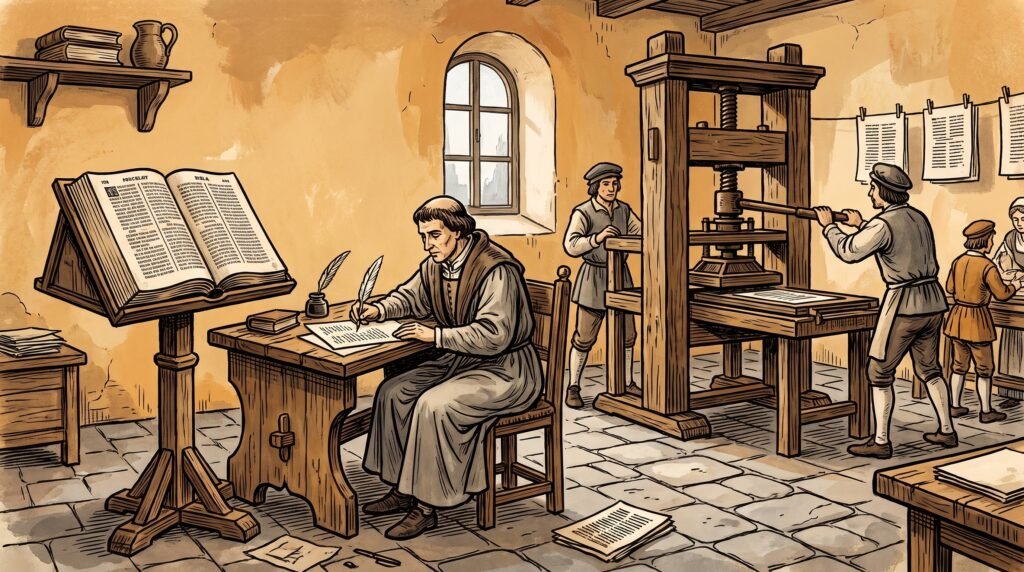
On a January day in 1514 a French-born printer named Arnao Guillén de Brocar finished, in a workshop on the Plaza de San Diego in Alcalá de Henares, the first printed New Testament in Greek. The colophon at the foot of the last page, dated 10 January 1514, named the printer and the place, and named no scholar; the men whose labour the volume recorded would have to wait. By 1517 Brocar had finished the rest: a four-volume Old Testament in Hebrew, Greek, Latin and (for the Pentateuch) Aramaic, the editio princeps of the Septuagint, and a sixth volume of study aids — a Hebrew and Aramaic dictionary, a Hebrew grammar, and a Greek dictionary. The whole polyglot ran to some fifteen hundred pages, in six volumes, six hundred paper copies and six on vellum, of which about a hundred and twenty-three survive. This essay is about the project that produced them: Cardinal Francisco Jiménez de Cisneros, the University of Alcalá, the converso scholars whose names are mostly remembered only by specialists, the printer whose Greek type is still admired, and the long delay between 1517 and 1520-22 that turned the first polyglot of the whole Bible into a quiet monument rather than the publishing event it should have been.
At a glance
- c. 1436: Francisco Jiménez de Cisneros born in Torrelaguna, Castile, the son of a modest hidalgo.
- 1492: Cisneros becomes Archbishop of Toledo and uses the See’s wealth to plan a polyglot Bible and reform the University of Alcalá.
- 1502–08: The team of scholars is assembled at Salamanca, the manuscript hunt begins across Spain, Italy and the Papal library, and Cisneros founds the new Universidad Complutense (1508) with a trilingual college.
- 1510: Arnao Guillén de Brocar, a French-born printer, opens his main press in Alcalá.
- 10 January 1514: Volume V, the Greek New Testament, is finished — the first printed Greek New Testament in history.
- 1514–17: The four Old Testament volumes and the dictionary volume are printed.
- 8 November 1517: Cardinal Cisneros dies at Roa, aged about 81, before the polyglot is published.
- 1520–22: The six volumes are bound, the papal privilege is granted, and copies begin to circulate. Several are lost in a shipwreck in transit to Italy c. 1521; of the 600 + 6 sets printed, about 123 survive.
- 1569–72: Christopher Plantin’s Antwerp Polyglot (the Biblia Regia) begins, drawing heavily on the Complutensian text.
A cardinal and a plan
Francisco Jiménez de Cisneros was not a scholar in the way the men he assembled were scholars. He had been a Franciscan friar, a hermit, a priest, a confessor of Queen Isabella, an Archbishop of Toledo, and from 1507 a Cardinal. He was a man of administration, not of philology. He had read the Bible carefully, in the Vulgate and in the Glossa Ordinaria, and he had come to believe, with Lorenzo Valla and the new biblical humanism, that a sound reading of the Scriptures required a sound text in the original languages.1 The instrument of that belief, for Cisneros, was to be a printed polyglot of the whole Bible in Hebrew, Greek, Latin and (where it existed) Aramaic, set in parallel columns and accompanied by the necessary grammars and dictionaries.
The plan did not begin with the new university. It began with Cisneros’ appointment as Archbishop of Toledo in 1492, and the resources of the primatial See of Spain were what paid for the project. Cisneros had begun the reform of the old University of Alcalá (founded in 1293 but long in decline) as early as 1499, two years before the new university was chartered; the polyglot was already part of that reform.2 It is from this date, 1499, that the project should be reckoned, not from the 1502 or 1503 when the scholars were formally convened.
By 1508 Cisneros had the new Universidad Complutense in operation, with the Colegio Mayor de San Ildefonso at its centre and a trilingual college of Latin, Greek and Hebrew alongside it. The university was not only a school; it was the institutional home of the polyglot project. The manuscripts were to be brought there, the scholars were to work there, the printer’s press was to be installed there, and the volumes were to be set in type in its neighbourhood. For about twenty years, until Cisneros’ death in 1517, Alcalá was the centre of the most ambitious editorial project in early modern Europe.3
The scholars
The men Cisneros assembled were, in their different ways, the right men for the job. Two of them were conversos — Jewish converts to Christianity — whose training in Hebrew and in the rabbinic commentaries was, in sixteenth-century Spain, irreplaceable. A third was a physician. A fourth was a Greek refugee. A fifth was a classical scholar. A sixth was a future adversary of Erasmus. None of them was a professional academic in the modern sense; all of them were working scholars whose labours are now the Complutensian Polyglot.4
The Hebrew and Aramaic columns were the responsibility of three converso scholars. Pablo Coronel (b. Segovia 1480, d. Segovia 1534) was the elder of the three. He had studied theology at Salamanca and was teaching there when Cisneros called him to Alcalá in 1502; Paul Kahle later argued that Coronel, not Zamora, was the principal editor of the Hebrew column.5 Alfonso de Zamora (b. 1474 or 1476, d. after 1544) was Cisneros’ most trusted Hebraist. He had been born a Jew, had studied at Salamanca, had converted, and by 1512 was professor of Hebrew and Aramaic at Alcalá. He was responsible for the Hebrew grammar and the Hebrew and Aramaic dictionary in volume VI, and his name is the only one of the Hebrew scholars that appears in the colophons of the Aramaic volumes.6 Alfonso de Alcalá (also written Alonso de Alcalá) was a physician by training, a Latin and Greek specialist by inclination, and a collaborator of Coronel on the dictionaries. The three of them worked on the same manuscripts and, to a degree that we can no longer reconstruct, on each other’s drafts.
The Greek Old Testament and the Greek New Testament were the responsibility of Demetrius Ducas (also Demetrios Doukas), a Cretan refugee and member of the Cretan school of Greek humanists, who had been called to Spain in the 1500s. Ducas worked from Greek manuscripts that Cisneros had borrowed, with varying success, from the Vatican library of Pope Leo X and from the Greek manuscript collections of Venice.7 Two of the Greek New Testament manuscripts used by the Complutensian — Vaticanus Graecus 330 and Vaticanus Graecus 346 — were formally lent to Cisneros by the Pope in 1515 and returned in 1518, by which time the Greek Testament was already in type. The Greek column for the Psalms used a fourteenth- or fifteenth-century Psalter that had belonged to the library of San Ildefonso.
The Latin Vulgate column was checked against a corrected Vulgate, and the Targum Onkelos for the Pentateuch (with a Latin translation) was added at Cisneros’ direction. Hernán Núñez de Toledo, called “the Pincian” from his chair at the University of Alcalá, and Juan de Vergara, a canon of Toledo and Cisneros’ secretary, were the principal editors on the Latin side. Antonio de Nebrija, the great Spanish humanist and grammarian, was already an old man by 1500 but contributed to the project in its early years and possibly to the Latin preface. Diego López de Zúñiga (Latin Stunica), a younger scholar who would later be one of Erasmus’ most bitter opponents, worked on the New Testament critical apparatus and is the source of the most detailed notes on the Greek manuscripts that survive.8
The converso character of the Hebrew team was politically sensitive. Spain in 1500 was eight years into the morisco problem, four years before the establishment of the Spanish Inquisition was complete in Castile, and the converso scholar at Alcalá was a familiar type who had to navigate the suspicion of the old Christian majority with care. Cisneros’ protection of Coronel, Zamora and Alfonso de Alcalá was firm; the polyglot project was one of the most important cultural investments made by a Castilian churchman in the early sixteenth century, and the conversos who worked on it were, in the labour of editing the Hebrew text, doing the kind of work that no Christian scholar of the period could do as well.
The manuscripts
The Cisneros team worked with manuscripts, and the manuscripts were, by the standards of the early sixteenth century, the best available. Cisneros himself described the Greek manuscripts as castigatissimi, “most correct” or “most carefully corrected,” in his preface. Modern scholarship has had the more sober task of identifying which manuscripts were actually used.9
For the Hebrew Old Testament, the principal manuscript was a Castilian hand of the late thirteenth or early fourteenth century, the codex now in the Complutense University of Madrid as MS M1. A second Castilian hand, the Escorial manuscript G-II-8, was used for the Prophets and the Writings, and a third hand (MS M-10 in Madrid) was used for the cross-checking. Alfonso de Zamora’s personal collection of Hebrew manuscripts — acquired during his years at Salamanca — was the source of several of the Targum and rabbinic readings printed in volume VI, and several pages of the Escorial manuscripts bear his hand in the chapter numbers and the biblical book headings. The basic text of the Complutensian Hebrew Old Testament is a Castilian Sephardic hand, not an Ashkenazi one, and is closer in many of its readings to the text that the Iberian Jews of the late medieval period had carried to the press than to the Tiberias MSS of the Leningrad and Aleppo codices.10
For the Greek Old Testament (the Septuagint), the team worked from a Greek manuscript that had belonged to Cardinal Bessarion, MS 68 in the old catalogue of the Colegio de San Ildefonso, the most thoroughly corrected of the Greek MSS Cisneros had been able to obtain, and possibly the same manuscript that the Vatican had lent in 1515 and recovered in 1518. Delitzsch in the 1870s and Vercellone in the 1860s were the first modern scholars to identify the principal Greek sources, and the secondary literature is now substantial.11
For the Greek New Testament, the Complutensian team worked from at least five manuscripts, of which the most important are the two Vatican manuscripts mentioned above, together with Minuscule 51, Minuscule 234, and the Codex Seidelianus II. None of these is a fourth-century uncial, and the resulting Greek text is, in the New Testament, an eclectic of late medieval Greek witnesses, not a close approximation of the earliest text. The New Testament column is, for that reason, more of a curio than a critical text by modern standards; but for 1514 it was the first printed Greek Testament in history, and the impact on Erasmus’ 1516 Greek New Testament, and on every later printed Greek Testament, is part of the permanent legacy of the project.12
The press and the type
Arnao Guillén de Brocar was born in France, possibly in the Béarn or the Basque country, and worked in Pamplona before settling in Alcalá in 1510. The University of Alcalá, the Colegio de San Ildefonso, and Cisneros’ project were his main clients for the next thirteen years, and the work he did for them is the most accomplished early Spanish type-cutting.13
Brocar’s Greek type has been admired since the sixteenth century as among the most beautiful Greek founts ever cut. It was not the first Greek fount in Spain — the Catalan printer Johann Luschner had cut Greek type in Barcelona in the 1480s — but it was the first to be used at scale, and the characters of the Complutensian were, for half a century, the model that other European printers imitated. The Hebrew type was new too. Cisneros’ team had to provide Brocar with patterns, and the resulting Hebrew fount is a Sephardic square hand of the period, suitable for printing but not at the height of the calligraphic Sephardic hands of the late fifteenth century; later sixteenth-century Hebrew type, especially that of Plantin and Bomberg, was more accomplished. The Latin type was a clean contemporary Roman of the humanist tradition, suitable for the Vulgate column and the prefatory matter.
The printing of the polyglot was done on a single wooden hand press, in a workshop that Cisneros’ biographer wrote of as “the press of the Complutensian University” in the years between 1514 and 1517. The order in which the six volumes came off the press is the order of the colophon dates. Volume V, the Greek New Testament, was finished on 10 January 1514, and the colophon of that volume is the earliest evidence we have of the actual printing of the polyglot. Volume IV (the New Testament apparatus and the dictionary materials) and the four Old Testament volumes followed. The whole print run, of six hundred paper copies and six on vellum, was probably completed by mid-1517, in time for Cisneros to see the project in type, if not yet in distribution, before his death in November of that year.14
The six volumes
The Complutensian Polyglot was, when it appeared, the largest printed book in Europe. The six volumes together ran to some fifteen hundred pages, set in four columns of Hebrew, Greek, Latin and (for the Pentateuch) Aramaic, and were bound separately rather than as a single codex. The order of the volumes, and the contents of each, was fixed by Cisneros’ team in consultation with Cisneros himself; the result is the order in which the volumes were sold, and the order in which they are still catalogued.15
Volume I contained the Pentateuch. The upper three-quarters of each opening were divided into three columns: the Hebrew on the right, the Vulgate Latin in the middle, and the Septuagint Greek on the left. Below, in smaller type, was the Targum Onkelos in Aramaic, with a literal Latin translation beneath it. Volumes II and III contained the rest of the Hebrew, Greek and Latin Old Testament — the historical books, the Prophets, and the Writings. Volume IV contained the Greek and Latin New Testament, set in two columns rather than three, and was the volume that was finished first; the colophon is dated 10 January 1514, the first Greek New Testament ever printed.16 Volume V was the New Testament again, this time with a fuller critical apparatus; and Volume VI was the study aids: Zamora and Coronel’s Hebrew and Aramaic dictionary, Zamora’s Hebrew grammar, and a Greek dictionary. The whole ran to some 1,500 pages, and the six volumes were sold together as a set, in a uniform binding stamped with the arms of the University.
The order of the volumes was not the order in which they had been planned. The Greek New Testament, finished in 1514, was the volume the team had begun with; the Old Testament followed. The 1520 privilege describes the polyglot as a single work in six volumes, but the volume numbering was a publishing convenience, not a chronological record.
The long delay
By 1517 all six volumes were in type. Cisneros died on 8 November 1517 at Roa, aged about eighty-one, before the polyglot had been published. The distribution of the polyglot was the responsibility of the University of Alcalá, and the University had to find a publisher and a printer willing to bind and distribute the run.17
The papal privilege, which was needed for any Spanish book of religious importance in the period, took another two years to obtain. Pope Leo X, who had been one of the lenders of the Greek manuscripts in 1515, granted the privilege in 1520. The University then had to find a way to deliver the six hundred paper copies and the six on vellum; it appears that the costs of binding and distribution were not wholly covered by Cisneros’ estate, and the University had to find additional funding. The first bound copies began to circulate in 1520, and the wider distribution was in 1521 and 1522. Of the six hundred sets printed, only about a hundred and twenty-three are known to survive today.18
The delay mattered. The Erasmus Greek New Testament, which had been prepared independently at Basel between 1514 and 1516, was published in 1516 with the help of the printer Johann Froben, and was distributed widely across Europe. The Complutensian Greek Testament, although it had been printed first, was distributed in 1520 — four years later, and a year after Erasmus’ second edition. The Complutensian was therefore, for the history of the printed Greek New Testament, second in time but first in scholarly weight. Erasmus had the marketing, Cisneros had the better text in some places and the better apparatus in many; the relative standing of the two editions in the sixteenth century is a long argument that is not yet closed.19
The shipwreck is the more dramatic reason for the partial loss of the print run. According to a letter of Philip II of Spain, written in the 1560s, a substantial number of copies were being sent to Italy c. 1521 and were lost when the ship carrying them was wrecked in transit. The letter does not name the ship, the route, or the harbour. Of the six hundred paper sets printed in 1514-17, only about a hundred and twenty-three are known to survive, and the shipwreck is the most plausible explanation for the missing copies.20
The Bomberg parallel
The Complutensian was not the only major Hebrew printing project of the early sixteenth century. In 1516-17, just as Cisneros’ volumes were being printed, the Venetian printer Daniel Bomberg produced the first complete printed Hebrew Bible (the First Rabbinic Bible), with a Massorah and rabbinic commentary, edited by Felix Pratensis. A second Bomberg edition, the Second Rabbinic Bible, edited by Jacob ben Hayyim, appeared in 1524-25 and was to be the more influential of the two. The Complutensian and the Bomberg editions were in some sense competing projects: both printed the Hebrew Old Testament in 1514-17, both used the resources of Iberian converso scholarship (Bomberg’s scholars were Sephardic Jews who had fled Spain after 1492), and both were intended to be the authoritative printed text of the Hebrew Scriptures for the Western church.21
The two editions were not, however, in direct competition. The Complutensian was a polyglot, with the Hebrew as one column of three or four; the Bomberg was a Hebrew Bible with rabbinic apparatus. The Complutensian was, in principle, more useful to the Christian scholar who wanted to read the Hebrew in the company of the Greek and Latin; the Bomberg was more useful to the Jewish or Christian reader who wanted the Massorah and the rabbinic tradition. The Castilian Sephardic text of the Complutensian Hebrew column is, in many places, different from the Tiberias-Masoretic text of the Bomberg; the modern critical editions of the Hebrew Bible have had to weigh both. The Ben Hayyim essay in this journal is a separate account of the Bomberg project.22
The Antwerp Polyglot
The Complutensian’s most direct legacy is the Antwerp Polyglot, the Biblia Regia, printed by Christopher Plantin in Antwerp between 1568 and 1572 under the patronage of Philip II. Plantin and his chief editor, Benito Arias Montano, worked with the Complutensian in front of them, used the same Spanish converso scholarship as a model, and printed in eight volumes rather than six, adding a Syriac column and a fuller apparatus. The Antwerp edition is, in its own right, one of the great polyglot Bibles of the sixteenth century; it was also, in many of its readings and most of its editorial decisions, a refinement of the Complutensian.23
For the Greek New Testament, the Complutensian text survived in some manuscripts of the sixteenth century, and was the source of some of the readings in the early editions of Beza and the Textus Receptus tradition; but the main New Testament tradition of the Reformation and Counter-Reformation periods was Erasmian, not Complutensian. For the Hebrew Old Testament, the Complutensian text was, for the next two centuries, more or less the Castilian Sephardic text; it was not until the work of the Complutensian’s later redactors that the Tiberias-Masoretic text of the Ben Asher tradition displaced the Castilian Sephardic text as the dominant printed tradition. The two streams of the printed Hebrew Bible — the Castilian Sephardic, of which the Complutensian is the major early example, and the Tiberias-Masoretic, of which the Bomberg is the major early example — were the streams that fed into the BHS in 1937 and the BHQ today.24
Strengths and limits
What the Complutensian did for the early sixteenth century is hard to overstate. It was the first printed polyglot of the whole Bible. It was the first printed Greek New Testament. It was the first printed Septuagint. It was the first printed polyglot to include Targum Onkelos. It was, in its apparatus, the first critical edition of any part of the Bible to make use of multiple Hebrew and Greek manuscripts in parallel. The Greek type, by common consent, is among the most beautiful ever cut. The volumes were, when they finally circulated, taken up across Catholic Europe; many of the major Catholic Bibles of the sixteenth century — the Antwerp Polyglot, the Paris Polyglot, the London Polyglot — were conscious continuations of Cisneros’ project.
The limits are also real. The Hebrew column is a Castilian Sephardic hand, and is not the same as the Tiberias-Masoretic text of the Ben Asher tradition. The Greek New Testament is an eclectic of late medieval Greek manuscripts, and is not a close approximation of the earliest text. The Targum Onkelos, the dictionaries and the grammar were indispensable for the work, but they are not in themselves a critical apparatus. The print run was 600 + 6, of which about 123 survive; the long delay between 1517 and 1520-22 meant that the polyglot was, for a generation, less known than it should have been. And the project is, in the modern scholarly sense, incomplete: there is no critical edition of the Complutensian as such, no full reconstruction of the manuscript sources of the Hebrew column, and a long history of unfinished business around the marginalia and the printers’ copy.
None of this is a reason to be cautious about the project. The project is one of the great editorial achievements of the early modern period. It is, in the history of the printed Bible, the place where the apparatus of a modern critical edition was first assembled and first put to press. That Cisneros’ team was working with a small team of converso scholars in a small Castilian university town, that the printer was a Frenchman, that the Greek type had to be cut from scratch, that the volumes were delayed for three years after the death of the patron, and that several hundred copies were lost in a shipwreck — none of this is the substance of the achievement. The substance is that in 1514-17, at Alcalá, a polyglot of the whole Bible was set in type for the first time, and a generation of Christian and Jewish scholars had in their hands an instrument that had never existed before.
The meaning of heavenly wisdom can emerge from any language, and Scripture is the more fruitful the more clearly it is set before the reader in the tongues in which it was first written.
Francisco Jiménez de Cisneros, prefatory letter to the Complutensian Polyglot (1517), trans. C. M. Ajo González de Rapariegos, in Historia de la Universidad de Alcalá (Madrid, 1980), 117.
Related on The Masoretes
- From the resource hub: Cardinal Francisco Jiménez de Cisneros
- From the resource hub: The University of Alcalá de Henares
- From the resource hub: Pablo Coronel, Converso Hebraist
- From the resource hub: Alfonso de Zamora, Converso Hebraist
- From the resource hub: Daniel Bomberg and the Venice Hebrew Press
- From the resource hub: Plantin and the Antwerp Polyglot
- From the journal: Jacob ben Hayyim and the Second Rabbinic Bible (Venice, 1524–25)
- From the journal: The Vowel-Point Controversy: Who Pointed the Hebrew Bible?
Notes
- J. H. Bentley, Humanists and Holy Writ: New Testament Scholarship in the Renaissance (Princeton, 1983), 99-101; and the standard biography of Cisneros, P. F. X. de Régil, El Cardenal Cisneros, fundador de la Universidad de Alcalá (Madrid, 1929). ↩
- C. M. Ajo González de Rapariegos and M. Sáinz de Zúñiga, Historia de la Universidad de Alcalá (Madrid, 1980), 96-104. ↩
- Ajo and Sáinz de Zúñiga, Historia de la Universidad, 110-118; and the contemporary description by A. de Nebrija in Decadencia de las letras (c. 1500, ed. Madrid 1947). ↩
- The standard reconstruction of the scholarly team is in E. Fernández Tejero, “La participación de los conversos en la Políglota,” in Los conversos y la Inquisición (Sefarad, vol. extra, 1980), 47-63. ↩
- P. E. Kahle, “The Hebrew Text of the Complutensian Polyglot,” in Homenaje a Millás-Vallicrosa, vol. I (Barcelona: CSIC, 1954), 741-751, at 745. The claim that Coronel, not Zamora, was the principal editor of the Hebrew column is now widely accepted. ↩
- On Zamora’s life and work, see F. Pérez Castro, ed., El manuscrito apologético de Alfonso de Zamora (Madrid: CSIC, 1950), introduction. ↩
- On the Greek manuscripts, see M. A. del Río, “Greek Sources of the Complutensian Polyglot,” in New Testament Studies 47 (2005), 250-290, at 252-258. The two Vatican manuscripts (Vaticanus Graecus 330 and 346) are now Rahlfs 108 and 248. ↩
- For López de Zúñiga’s role in the New Testament critical apparatus, see L. A. T. West, “Diego López de Zúñiga and the Complutensian Polyglot,” in Sixteenth Century Journal 22 (1991), 435-450. ↩
- Cisneros’ preface is reprinted in the facsimile edition of the Complutensian Polyglot (Madrid: Biblioteca Nacional, 1984), vol. I, fol. iiir. The word castigatissimus appears in the dedication to Leo X. ↩
- M. Ortega, “Spanish Biblical Hebrew Manuscripts and the Complutensian Polyglot,” in Sefarad 65 (2005), 339-372; and F. Pérez Castro, “El ms. hebreo M1 de la Complutense y la Políglota,” in Boletín de la Real Academia de la Historia 175 (1978), 117-148. ↩
- F. Delitzsch, Studies on the Complutensian Polyglott (Leipzig, 1872); and C. Vercellone, Variae lectiones Vulgatae Latinae Bibliorum editionis (Rome, 1860-1870). The identification of MS 68 of San Ildefonso as the principal Septuagint source is Delitzsch’s. ↩
- The Greek New Testament manuscripts are catalogued in the Delitzsch and Vercellone work, and the standard modern survey is in K. Aland, ed., Novum Testamentum Graece (Stuttgart, 27th ed., 1993), introductory matter. ↩
- On Brocar, see C. Griffin, “The ‘Tertia Gravissima’ Indulgentiarum of 1517 and the Printing of the Polyglot,” in Gutenberg Jahrbuch 62 (1987), 109-126; and J. Martín Abad, La imprenta en Alcalá de Henares (Madrid, 1991), 67-92. ↩
- The press and workshop are described in the contemporary record by Brocar’s foreman, reproduced in Martín Abad, La imprenta en Alcalá, 81-86. ↩
- The standard description of the volumes is in the Biblioteca Nacional facsimile edition, Madrid 1984, vol. I introduction. ↩
- The 10 January 1514 colophon is reproduced in the Harvard Divinity School’s online description, hds.harvard.edu, and in the BN facsimile. ↩
- On the death of Cisneros and the disposition of the project, see P. F. X. de Régil, El Cardenal Cisneros (Madrid, 1929), 411-417. ↩
- The 600/6 print run and the 123 surviving sets are documented in the Biblioteca Nacional’s Censo de la Biblia Políglota Complutense (Madrid, 1984). ↩
- On the relationship of the Complutensian and the Erasmus Greek New Testament, see H. J. de Jonge, “Erasmus and the Complutensian Polyglot Bible,” in Erasmus of Rotterdam Society Yearbook 24 (2004), 39-66. ↩
- The shipwreck is described in a letter of Philip II to the Marquis of Tarifa, in the Archivo General de Simancas, Estado leg. 1432, fol. 7. The letter is dated 1564 and the wreck is said to have occurred “hace cerca de cuarenta años” — close to forty years before 1564. ↩
- The Bomberg parallel is treated in detail in Y. H. Yerushalmi, “Cisneros, Bomberg and the Hebrew Bible,” in Studies in the History of the Jewish People (Jerusalem, 1980), 27-44. ↩
- See the Jacob ben Hayyim essay in this journal, on the Second Rabbinic Bible and the Tiberias-Masoretic tradition. ↩
- On the Antwerp Polyglot as continuation of the Complutensian, see B. Rekers, Arias Montano (London, 1972), 56-78. ↩
- On the relationship of the two streams of the printed Hebrew Bible, see E. M. Tov, Textual Criticism of the Hebrew Bible, 3rd ed. (Minneapolis: Fortress, 2012), ch. 4 on the printed editions. ↩
Sources & Further Reading
Primary sources
- Cisneros’ preface, dated 1517, in the facsimile edition of the Complutensian Polyglot (Madrid: Biblioteca Nacional, 1984), vol. I, fol. iiir.
- The colophon of the Greek New Testament, 10 January 1514, reproduced in the Harvard Divinity School’s online description and in the BN facsimile.
- The Latin Vulgate, the Septuagint, the Targum Onkelos, the Hebrew and Aramaic dictionary, the Hebrew grammar and the Greek dictionary, all in the Complutensian Polyglot itself, facsimile ed. (BN, 1984).
- The colophons of the individual volumes, with their printing dates 1514-17, in the BN facsimile.
- Pope Leo X’s lending of Vaticanus Graecus 330 and 346 to Cisneros, 1515, recovered 1518, in the Vatican Secret Archives, Registra Vaticana 1178, fol. 142.
Modern studies
- Biblioteca Nacional, ed., Biblia Políglota Complutense: Edición facsímil (Madrid, 1984), with the introductory volume by J. M. Blecua Perdices and E. Fernández Tejero.
- F. Pérez Castro, ed., El manuscrito apologético de Alfonso de Zamora (Madrid: CSIC, 1950), with the standard introduction to the Hebrew column.
- P. E. Kahle, “The Hebrew Text of the Complutensian Polyglot,” in Homenaje a Millás-Vallicrosa, vol. I (Barcelona: CSIC, 1954), 741-751.
- F. Delitzsch, Studies on the Complutensian Polyglott (Leipzig, 1872).
- C. Griffin, “The ‘Tertia Gravissima’ Indulgentiarum of 1517 and the Printing of the Polyglot,” in Gutenberg Jahrbuch 62 (1987), 109-126.
- J. Martín Abad, La imprenta en Alcalá de Henares (Madrid, 1991).
- E. Fernández Tejero, “La participación de los conversos en la Políglota,” in Los conversos y la Inquisición, Sefarad vol. extra (1980), 47-63.
- B. Rekers, Benito Arias Montano (London: Warburg Institute, 1972).
- M. Ortega, “Spanish Biblical Hebrew Manuscripts and the Complutensian Polyglot,” in Sefarad 65 (2005), 339-372.
- H. J. de Jonge, “Erasmus and the Complutensian Polyglot Bible,” in Erasmus of Rotterdam Society Yearbook 24 (2004), 39-66.
- E. M. Tov, Textual Criticism of the Hebrew Bible, 3rd ed. (Minneapolis: Fortress, 2012), ch. 4 on the printed editions.
- Y. H. Yerushalmi, “Cisneros, Bomberg and the Hebrew Bible,” in Studies in the History of the Jewish People (Jerusalem, 1980), 27-44.
- J. M. Bover, “The Spanish Biblical Hebrew Manuscripts and the Complutensian Polyglot,” in Sefarad 6 (1946), 309-348.
By dan · Reading time: about 24 minutes · Filed in Reformation & Dissent · Tagged: Complutensian Polyglot, Cardinal Cisneros, Brocar, Pablo Coronel, Alfonso de Zamora, Septuagint, Greek New Testament.