

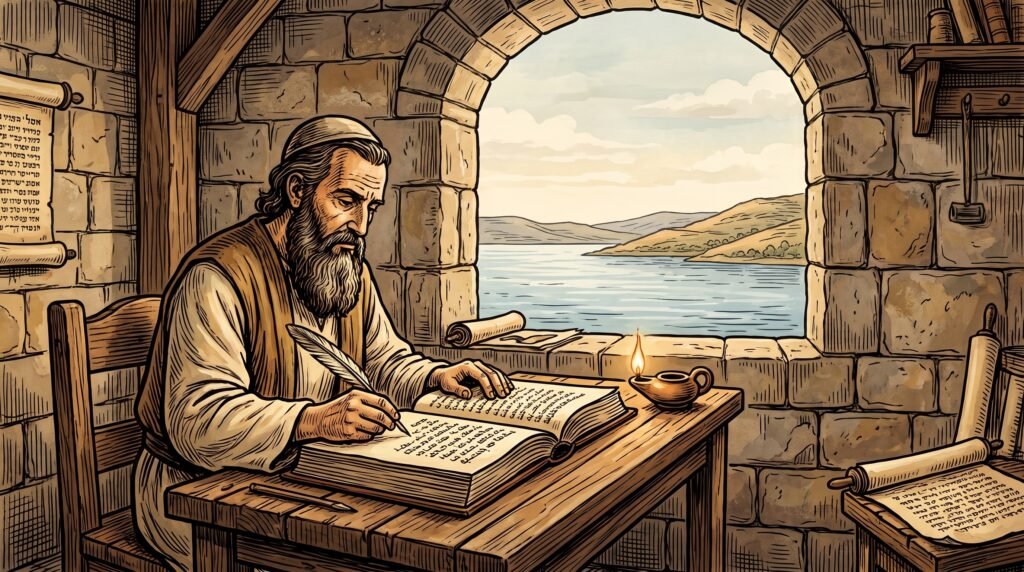
On a low stone shelf above the western shore of the Sea of Galilee, a city once called Tiberias has been, since the second century, the principal Jewish intellectual centre of the Galilee. After the Muslim conquest of 637 the city became, in the Arabic-speaking centuries that followed, a small but persistent home of Jewish learning, sustained by a synagogue, a few courts of law, and the scribal workshops that copied the Torah and the Prophets for the Jewish communities of Syria, Egypt, and the wider Mediterranean. By the eighth century, a tradition of meticulous textual scholarship had taken root in Tiberias that would, in the next two hundred and fifty years, give the Hebrew Bible the form in which almost every reader has read it since. This essay is about that tradition. The two families of scribes who shaped it, the Ben Asher and the Ben Naphtali, the codices they produced, the disagreements between them, the Karaite question that has hung over the Ben Asher line, the reception of their work by Maimonides, and the long rediscovery of the Tiberias school in modern scholarship, are the substance of the story.
At a glance
- c. 750 CE: Asher the Elder, the first of the Ben Asher line, is at work in Tiberias; the earliest external reference to the family in a masoretic chain of tradition.
- c. 895 CE: Moses ben Asher, the penultimate member of the dynasty, completes the Cairo Codex of the Prophets.
- c. 900–925 CE: Aaron ben Moses ben Asher (Abu Sa’id), the last and most famous of the Ben Asher line, vocalises and reviews the Aleppo Codex, written by Solomon ben Buya’a.
- c. 890–940 CE: Abu Imran Moshe ben David ben Naphtali, the leading figure of the rival Ben Naphtali school, flourishes in Tiberias; his codex does not survive.
- Before 1050 CE: Mishael ben Uzziel composes the Kitāb al-Khilāf, the book of differences, the principal medieval source for the Ben Naphtali readings.
- 989 CE: A scribe at Tiberias explicitly testifies that he has vocalised a manuscript “from the books vocalised by Aaron ben Moses ben Asher,” the first clear external witness to Aaron’s authority.
- c. 1160s–70s: Moses Maimonides, writing from Egypt, declares the Ben Asher text the standard for the Torah and the only one to be used in Torah scrolls.
- 1947 CE: The events of the 1947 anti-Jewish riots in Aleppo destroy most of the missing portions of the Aleppo Codex, leaving it incomplete.
- 1956 CE: The surviving leaves of the Aleppo are smuggled into Israel; from 1958 they are housed in the Shrine of the Book at the Israel Museum in Jerusalem.
Tiberias after the conquest
Tiberias in the eighth century was a small, predominantly Jewish town on the western shore of the Sea of Galilee, in the province of Jund al-Urdunn of the early caliphate. The Roman city that had given it its name had been eclipsed; the Talmudic academy of the late fourth and early fifth centuries had long since moved on, first to Sepphoris and then, by the eighth century, to the Babylonian cities of Sura and Pumbeditha. What remained in Tiberias was a small community of Jewish scribes and jurists, the synagogue that later tradition would call the “Synagogue of the Palestinians,” and a continuous tradition of Torah reading in the synagogue that had to be sustained, year on year, by the production of accurate scrolls.1
The first centuries of Abbasid rule were not, in the Galilee, a time of great intellectual ferment. The Jewish community was small, the academy had gone, and the great centres of Jewish learning were now in Mesopotamia. But the work of copying the Bible, of training new scribes, and of preserving the tradition of accurate reading was a local craft, and Tiberias was one of the places where that craft was sustained. From the late eighth century, two scribal families in particular, who would come to be known as the Ben Asher and the Ben Naphtali, took on the work of fixing the text of the Hebrew Bible in a form that could be reproduced accurately by other scribes elsewhere. The work that they did over the next two hundred years is the substance of what is now called the Tiberias school of Masoretes.2
The word Masorah is itself worth pausing over. In its narrowest sense it is the apparatus of marginal notes by which the Tiberias scribes recorded how often a particular word occurred, what spellings were exceptional, what readings were to be followed in cases of doubt. In a wider sense, the Masorah is the whole body of tradition by which the consonantal text of the Hebrew Bible was preserved, generation by generation, by scribes who believed that the text was the Word of God and that its accurate transmission was a sacred trust. The Tiberias Masoretes, of whom the Ben Asher and the Ben Naphtali are the leading examples, were the people who turned this sacred trust into a technical discipline.
The Ben Asher dynasty
The Ben Asher family can be traced, in a single chain of tradition that runs back to the eighth century, through six generations. The earliest, Asher the Elder, is the founder of the line. Almost nothing is known of him except his name and the fact that he was the first in a sequence of Tiberias Masoretes. The chain is preserved in a colophon in the Keter (the Aleppo Codex), which records the Ben Asher genealogy as it stood at the moment of the codex’s completion, and reads, in the standard translation, “Asher the greatest elder, may his memory be blessed, followed by his son Nehemiah, may his memory be blessed, followed by his son Moses, followed by his son Asher, followed by his son Moses, that is Moses ben Asher, followed by his son Aaron, that is Aaron ben Moses ben Asher, the close of the dynasty.”3
Of the four men between Asher the Elder and Aaron ben Moses, the most important is Moses ben Asher, the penultimate member of the dynasty. He is the scribe of the Cairo Codex of the Prophets, which he completed in 895 CE; the colophon of that codex is one of the earliest dated witnesses to the Tiberias Masoretic tradition. The Cairo Codex is now in the Cairo Geniza collection at the University Library in Cambridge (it is technically T-S K24), and is the earliest complete Tiberias manuscript of the Prophets to have survived. Moses ben Asher also wrote, in the same period, a Hebrew piyyut — a sacred poem — known as the “Song of the Vine,” whose acrostic reads “Moshe ben Ash” (the last letter having been lost), and which is a sustained meditation on the people of Israel as the vine of God. The poem has been read by some scholars as Karaite in sympathy, by others as Rabbanite, and the question of the family’s sectarian affiliation has been a minor but persistent scholarly debate for more than a century.4
Aaron ben Moses ben Asher (called Abu Sa’id in Arabic, “the happy father”) is the most famous member of the dynasty. He flourished in the first half of the tenth century and is dated by a colophon in the Leningrad Codex’s sister Firkovich manuscripts, where a scribe writing in 989 says of a Former Prophets manuscript that he has “vocalised and added the Masorah from the books that were vocalised by Aaron ben Moses ben Asher,” a phrase that is the standard external witness to Aaron’s reputation in his own lifetime.5 Aaron ben Moses is also credited in the colophon of the Aleppo Codex, posthumously, with the “vocalisation and Masorah” of that codex; the scribe of the Aleppo, Solomon ben Buya’a, wrote the consonantal text, and Aaron ben Moses supplied the vowel points, the cantillation marks, and the marginal Masorah over a period of years. The result is what is now called the Aleppo Codex, the oldest complete Tiberias manuscript of the Hebrew Bible to have survived, dated to c. 900-925 CE on the basis of the colophon of another Ben Asher codex that names Solomon ben Buya’a as a contemporary of Aaron.6
Aaron ben Moses was also, in his own right, a writer. His Diqduqe ha-Te’amim (“Grammatical Rules of the Accents”), first published by S. Baer and H. L. Strack at Leipzig in 1879, is the first systematic grammar of the Tiberian pointing system, and the foundation of every later description of the Hebrew accents. He also compiled a list of eighty homonyms under the title Shemonim Zugim, which was incorporated into the closing Masorah of the standard Masoretic codices. David Kimhi, the great medieval Hebrew grammarian, called Aaron’s compendium the Mabberet Ben-Asher, and the name stuck.7
The Ben Naphtali tradition
The Ben Naphtali line is less well documented than the Ben Asher. The full name of its leading figure, recovered from an eleventh-century source, is Abu Imran Moshe ben David ben Naphtali; he flourished, by the best modern estimate, between 890 and 940 CE, in the same Tiberias that the Ben Asher line occupied.8 His codex, unlike the Aleppo and the Cairo Codex of the Prophets, has not survived; we know of his readings only through the medieval lists of differences and through quotations in the works of later grammarians.
The list of differences is the heart of the matter. The principal source is the Kitāb al-Khilāf (“Book of the Differences”) of Mishael ben Uzziel, an eleventh-century Jewish scholar, who compiled a complete list of the readings in which the two Tiberias schools disagreed. The list was made before 1050, in the generation after the last of the Ben Naphtali Masoretes, and was meant as a working tool for scribes who had to choose between the two traditions. Mishael’s list survives in two recensions, of which the more complete is in the British Museum manuscript Harley 1528; quotations from Mishael are also preserved in the works of David Kimhi and of Menahem di Lonzano and in the Masorah of the printed rabbinic Bibles.9
The Mishael list, as it has come down to us, contains about 875 points of difference between the two schools. About nine-tenths of these are about the placing of the accents — the mattleg and the ga’ya, the two most variable of the Tiberian accent signs. The remaining tenth is divided between dagesh and rafeh, between the vowels, between the accentuation, and between the consonantal spelling. The number of differences that touch the consonantal text is small: by Mishael’s count, only eight. Most of what the two schools disagreed about was the marginal apparatus and the way the written text was to be read aloud in the synagogue, not the written text itself.10
It has sometimes been suggested that there never was a real Ben Naphtali, that the name is a generic label for any tradition that diverged from Ben Asher, drawn from the biblical pair of Asher and Naphtali, the sons of Bilhah and Zilpah. The suggestion is, on the evidence, unlikely: there are places in the Mishael list where Ben Naphtali and Ben Asher agree against other authorities, and there are independent attestations of the Ben Naphtali name in manuscripts of the Cairo Geniza. Ben Naphtali was a real, named school, with its own consistent tradition, distinct from Ben Asher in matters of detail but very close to Ben Asher in the great mass of the text.11
The codices
The two most important Tiberias codices that have survived are the Cairo Codex of the Prophets and the Aleppo Codex. The Cairo Codex of the Prophets, written by Moses ben Asher in 895 CE, contains the Former and Latter Prophets with full Masorah; the consonantal text is essentially the Tiberias text of the Ben Asher family. The codex was kept in the Ben Ezra Synagogue in Old Cairo, in the same geniza that produced the famous Cairo Geniza discoveries; it was identified as the “Cairo Codex” of the Ben Asher family by Paul Kahle in the 1920s, and is now in the Taylor-Schechter collection at the University Library, Cambridge. It is the older of the two codices by about thirty years.12
The Aleppo Codex is the great work. Scribed by Solomon ben Buya’a in Tiberias, vocalised and supplied with the Masorah by Aaron ben Moses ben Asher over a period of years in the early tenth century, the codex was, by the time of its completion, the most carefully prepared Tiberias Bible in existence. The codex was, by medieval tradition, in Jerusalem in the early Islamic centuries, then in Egypt, then in Aleppo, where it was kept in the cellar of the Central Synagogue of Aleppo for many centuries. By the 1940s it was the most authoritative complete Tiberias codex in the world, and Maimonides’ twelfth-century endorsement had made it the de facto standard for the Jewish Bible.13
The Aleppo Codex’s modern history is the saddest chapter in the story of the Tiberias school. In December 1947, in the anti-Jewish riots that followed the United Nations vote on the partition of Palestine, the Aleppo synagogue was attacked and burned. Most of the codex, which had been wrapped and hidden, survived the fire, but a substantial portion of the front and back matter — the entire Torah, the Song of Songs, most of Ecclesiastes, the beginning of Lamentations, and the marginal Masorah list — was lost. The remaining 294 leaves, with the consonants and the vocalisation of the Prophets and most of the Writings, were smuggled out of Syria in 1956 by Murad Faham, an Aleppine Jew; they were taken first to Turkey, then to London, and finally, in 1958, to the Shrine of the Book at the Israel Museum in Jerusalem, where the codex has been kept ever since.14 The Leningrad Codex, written in Cairo in 1008 CE, has therefore been, since 1947, the oldest complete Tiberias codex in existence; the Leningrad essay in this journal is a separate account of that codex and its history.
The Karaite question
A small but persistent question about the Ben Asher line is whether the family were Karaites. Paul Kahle, in his Masoreten des Ostens of 1913, argued that the Ben Asher family were Karaites, on the ground that the family had been responsible for the establishment of the Tiberias tradition of vowel pointing, that the Tiberias tradition had some features that were easier to explain on Karaite than on Rabbanite assumptions, and that the synagogue in Tiberias in which the family worked was, by the tenth century, a Karaite synagogue. The argument has been taken up by several later scholars, including most of the standard reference works, and the question has a long secondary literature.15
Aron Dotan, in the introduction to his 2002 edition of the Leningrad Codex, restated the case for the Ben Asher family as Rabbanites. His argument is, in summary, that the “Song of the Vine” by Moses ben Asher, the long piyyut whose acrostic identifies its author, has been read in its context as Rabbanite rather than Karaite, and that the kind of work that the family did — accurate vocalisation, careful Masorah, the preservation of the synagogue reading tradition — is not, in itself, evidence of Karaite affiliation. Mordecai Breuer, in his 1976 study of the Aleppo Codex, took a similar view. The question is not settled, and may not be settled by the surviving evidence; what is clear is that the work of the Ben Asher family is the work that later Jewish tradition accepted as the standard, and that the Karaite communities, for their part, used the same Tiberias text that the Rabbanite communities used, with different vocalisation and a different canon of scriptural books but with the same consonantal text of the Torah, the Prophets, and the Writings.16
Maimonides and the reception
The single most important event in the reception of the Tiberias school was the endorsement by Moses Maimonides in the twelfth century. Maimonides, writing from Egypt in the 1160s and 1170s, declared in a responsum that the Ben Asher text of the Torah was the only text to be used in Torah scrolls, that the Aleppo Codex in particular was the most accurate copy of the Ben Asher tradition, and that any Torah scroll that differed from the Ben Asher text was to be corrected or set aside. The responsum has been the standard halakhic ruling on the accuracy of Torah scrolls ever since; it is, in effect, the reason that the Masoretic Text of the printed Hebrew Bible is, in the great mass of its readings, the text of the Ben Asher family.17
The endorsement is the more important because Maimonides was writing in Cairo, two hundred years after the last of the Tiberias Masoretes, and at a moment when the Babylonian and Palestinian traditions of biblical text were still in active use. His choice of the Ben Asher tradition was not a foregone conclusion; the Ben Naphtali tradition was still in use in some communities, and the question of which Tiberias text to follow was a live one. Maimonides’ decision was, in effect, the halakhic end of the Ben Asher–Ben Naphtali debate.18
The medieval reception, after Maimonides, was largely a story of the printing press. The first printed Hebrew Bible, the Soncino Bible of 1488, was set from a Tiberias-tradition manuscript; the Brescia Bible of 1494 was the same. The Complutensian Polyglot of 1514-17 used a Castilian Sephardic hand, not the Tiberias tradition, but the Bomberg rabbinic Bibles of 1516-17 and 1524-25 — the latter the Second Rabbinic Bible of Jacob ben Hayyim — used the Tiberias text and made it the printed standard of the early modern period. By the time of the Buxtorf and the early printed Masorah, the Tiberias school was, in Christian Hebraist scholarship as well as in Jewish, the de facto source of the Masoretic Text.19
The modern rediscovery
The modern scholarly study of the Tiberias school began with the Cairo Geniza. The Ben Ezra Synagogue in Old Cairo was a place of Jewish worship from at least the early Islamic period, and the room above the synagogue — the geniza — had been used for centuries as a store for damaged or worn-out Hebrew religious texts, which the Jewish community of Cairo was forbidden to destroy. By the late nineteenth century the geniza had filled with an enormous quantity of fragments and complete manuscripts, and in 1896 Solomon Schechter of Cambridge identified the collection for what it was and began the work of bringing it to Cambridge. The Cambridge Genizah, as it came to be called, contained fragments of the Cairo Codex of the Prophets and a great many other Tiberias-tradition fragments, and the study of those fragments in the early twentieth century transformed the modern understanding of the Tiberias school.20
Paul Kahle of Bonn was the most important single scholar of the Tiberias school in the twentieth century. His Masoreten des Ostens of 1913 was the first modern attempt to set out the history of the Tiberias Masoretes as a whole, and his later work on the Cairo Geniza and on the Leningrad Codex is the foundation of every modern study of the Ben Asher and Ben Naphtali lines. Kahle’s argument that the Ben Asher family were Karaites, while contested, has shaped the way the question has been asked ever since. Israel Yeivin, in the 1980s, produced the most detailed modern study of the Ben Asher codices in particular; Aron Dotan’s work on the Leningrad and on the Tiberias tradition is the standard reference for the consonantal text and the Masorah; Mordecai Breuer’s The Aleppo Codex and the Accepted Masoretic Text (in Hebrew, 1976) is the standard study of the Aleppo Codex in particular. The modern understanding of the Tiberias school, in short, is the work of a single century of scholarship that began in the Cairo Geniza and that continues, with the ongoing publication of the Biblia Hebraica Quinta and the digital editions of the Leningrad and the Aleppo, into the present day.21
Strengths and limits
What the Tiberias school did for the Hebrew Bible is, in summary, three things. It fixed the consonantal text in a form that could be reproduced accurately by scribes elsewhere. It added the vowel points and the cantillation marks in a form that allowed the text to be read aloud in the synagogue with the right pronunciation and the right musical phrasing. It built a marginal apparatus — the Masorah Parva, the Masorah Magna, the closing Masorah — that recorded, in a form the scribes could use, the statistics and exceptions that the accurate transmission of the text required. The work of the Ben Asher family in particular is the version of that tradition that the Jewish Bible has used since the Middle Ages, and that the Christian Old Testament scholarship has used since the Complutensian and the Bomberg.
The limits are also real. We know the Ben Asher genealogy from a single colophon, and the dates we have for the early Ben Asher generations are reconstructed from the chain of tradition, not from external documents. The Ben Naphtali codex has not survived, and the readings of the Ben Naphtali school are known only through medieval lists and quotations. The Cairo Codex of the Prophets is incomplete; the Aleppo Codex, the great work, is now missing most of the Torah and several other books. The Tiberias school itself, in the sense in which the word school is usually understood, may not have been a single institution at all but a tradition of families working in the same city, with the same scribal methods, in the same generation. The Karaite question, finally, is not settled and may not be settleable from the surviving evidence.
None of this is a reason to be cautious about the work. The Tiberias school produced the Hebrew Bible as we have it, in the form in which the Jewish people has read it for a thousand years, in the form in which the BHS and the BHQ now print it, in the form in which the Leningrad and the Aleppo codices preserve it. The Ben Asher line in particular, and Aaron ben Moses in his own person, is the place where the consonantal text, the vowel pointing, the cantillation, and the Masorah were all brought together in a single technical tradition. To read the Leningrad Codex, the Aleppo Codex, or the printed Hebrew Bible is to read the work of the Tiberias school; and the school, in the city that is now a small Israeli town on the shore of the lake, is the origin of the most carefully transmitted text in the world.
The Masorah is the fence around the Torah, and the Masoretes are the fence-makers; whoever breaks through the fence is bitten by a serpent.
Jewish saying, recorded in the Babylonian Talmud (Sanhedrin 59b) and quoted in the introduction to Aaron ben Moses ben Asher’s Diqduqe ha-Te’amim (Leipzig, 1879).
Related on The Masoretes
- From the resource hub: Who Were the Masoretes?
- From the resource hub: Aaron ben Moses ben Asher
- From the resource hub: The Ben Naphtali Tradition
- From the resource hub: The Aleppo Codex
- From the resource hub: Tiberias and the Sea of Galilee
- From the journal: The Leningrad Codex (B19a), the Oldest Complete Hebrew Bible (St Petersburg, 1008)
- From the journal: The Vowel-Point Controversy: Who Pointed the Hebrew Bible?
Notes
- On Tiberias in the early Islamic centuries, see S. Safrai, “The Jewish Community in the Galilee in the Period of the Mishnah and the Talmud,” in The Galilee in Late Antiquity, ed. L. I. Levine (New York, 1992), 121-138. ↩
- The standard reconstruction of the Tiberias school is in P. E. Kahle, Masoreten des Ostens (Hildesheim: Olms, 1913 / reprint 1966), and in E. M. Tov, Textual Criticism of the Hebrew Bible, 3rd ed. (Minneapolis: Fortress, 2012), ch. 4. ↩
- The colophon of the Aleppo Codex, translated in M. H. Goshen-Gottstein, “The Aleppo Codex and the Accepted Masoretic Text,” in Textus 3 (1963), 17-58, at 22-24. ↩
- On the “Song of the Vine” and its interpretation, see A. Dotan, “Was Moses ben Asher a Karaite?” in Jewish Quarterly Review 75 (1984), 51-67, and the discussion in A. Maman, “Ben Asher, Moses,” in Encyclopedia of Jews in the Islamic World (Brill Online, 2013). ↩
- The 989 colophon is reproduced in A. Y. Harkavy and H. L. Strack, Catalog (St Petersburg, 1875), 282, and in the Freedman Facsimile (1998), 45. ↩
- On the date of the Aleppo Codex, see M. Breuer, The Aleppo Codex and the Accepted Masoretic Text (in Hebrew; Jerusalem: Magnes, 1976), ch. 1. ↩
- S. Baer and H. L. Strack, eds., Dikduke ha-Te’amim des Aaron ben Moscheh ben Ascher (Leipzig: Calvary, 1879). ↩
- The standard reconstruction of Ben Naphtali is in the Jewish Encyclopedia article of 1906, and in E. M. Tov, Textual Criticism, 3rd ed. (2012), 75-76. The name is preserved in the eleventh-century treatise of Mishael ben Uzziel and in the Geniza fragment T-S K27.36. ↩
- On Mishael’s list, see S. Frensdorff, “Das Buch der Differenzen” (the German translation of Mishael’s list), in Jahresbericht des Rabbinerseminars (Berlin, 1864), and the modern edition in G. Khan, The Early Karaite Tradition of Hebrew Grammatical Thought (Cambridge, 2000), 156-178. ↩
- On the proportion of differences that are accentual versus consonantal, see the count in the Jewish Encyclopedia article on Ben Naphtali, and the discussion in E. M. Tov, Textual Criticism, 3rd ed. (2012), 75-76. The eight consonantal differences are listed in the Mishael recension. ↩
- On the “Ben Naphtali may not have existed” hypothesis, see the discussion in E. M. Tov, Textual Criticism, 3rd ed. (2012), 75, and the refutation in G. Khan, Early Karaite Tradition (2000), 156-158. ↩
- On the Cairo Codex of the Prophets and its identification, see P. E. Kahle, “The Cairo Codex of the Prophets,” in Studies in the Text of the Old Testament (Oxford, 1950), 28-45. ↩
- On the Aleppo Codex’s medieval history, see M. Breuer, The Aleppo Codex (1976), ch. 1, and the standard account in the Israel Museum’s own description at imj.org.il/en/shrine-book. ↩
- On the 1947 events and the 1956 rescue, see the standard account in M. Breuer, “The Aleppo Codex: History and Present State,” in Textus 18 (1995), 41-58. ↩
- P. E. Kahle, Masoreten des Ostens (1913), 156-178, for the original argument. The Karaite hypothesis is endorsed in the Encyclopaedia Judaica and in several standard reference works. ↩
- A. Dotan, “Was Moses ben Asher a Karaite?” in Jewish Quarterly Review 75 (1984), 51-67, and M. Breuer, The Aleppo Codex (1976), ch. 2, for the counter-argument. The standard summary of the state of the question is in E. M. Tov, Textual Criticism, 3rd ed. (2012), 73-75. ↩
- M. Maimonides, “Letter to the Rabbanite community of Fustat,” in Iggerot ha-Rambam, ed. J. Kafih (Jerusalem, 1972), letter 14, p. 65; English in I. Twersky, A Maimonides Reader (Springfield, NJ, 1972), 446. ↩
- The context of Maimonides’ responsum, and the Babylonian and Palestinian alternatives he was rejecting, are discussed in S. Lieberman, “The Documentary Evidence for the Ben Asher Tradition,” in Studies in the Masoretic Tradition (New York, 1967), 117-138. ↩
- On the printed tradition, see the standard account in E. M. Tov, Textual Criticism, 3rd ed. (2012), ch. 4 on the printed editions. ↩
- On the Cairo Geniza and the study of the Tiberias school, see the standard accounts in S. C. Reif, A Jewish Archive from Old Cairo (Richmond, 2000), and the Cambridge University Library’s own description of the Taylor-Schechter Genizah Collection. ↩
- On the modern scholarship, see the standard surveys in E. M. Tov, Textual Criticism, 3rd ed. (2012), and in the introductions to the Biblia Hebraica Quinta fascicules. ↩
Sources & Further Reading
Primary sources
- The colophon of the Aleppo Codex, on the closing leaf, with the chain of tradition of the Ben Asher line. Reproduced in M. H. Goshen-Gottstein, “The Aleppo Codex and the Accepted Masoretic Text,” in Textus 3 (1963), 17-58.
- The 989 colophon of the Leningrad Codex’s sister Firkovich manuscripts, in A. Y. Harkavy and H. L. Strack, Catalog (St Petersburg, 1875), 282.
- Moses ben Asher, the “Song of the Vine,” the acrostic piyyut. In M. Zulay, ed., Piyyutei Ben Asher (in Hebrew; Berlin: Schocken, 1933).
- Mishael ben Uzziel, Kitāb al-Khilāf, the book of the differences between Ben Asher and Ben Naphtali, in the recension preserved in British Museum MS Harley 1528. Modern edition in G. Khan, The Early Karaite Tradition of Hebrew Grammatical Thought (Cambridge, 2000).
- Aaron ben Moses ben Asher, Diqduqe ha-Te’amim, ed. S. Baer and H. L. Strack (Leipzig, 1879).
- Moses Maimonides, “Letter to the Rabbanite community of Fustat,” in Iggerot ha-Rambam, ed. J. Kafih (Jerusalem, 1972), letter 14; English in I. Twersky, A Maimonides Reader (Springfield, NJ, 1972).
Modern studies
- P. E. Kahle, Masoreten des Ostens (Hildesheim: Olms, 1913 / reprint 1966). The first modern synthesis of the Tiberias school; the source of the Karaite hypothesis.
- P. E. Kahle, The Cairo Genizah, 2nd ed. (Oxford: Blackwell, 1959).
- I. Yeivin, The Ben Asher Bible Manuscripts (in Hebrew; Jerusalem: Magnes, 1990s).
- A. Dotan, “Was Moses ben Asher a Karaite?” in Jewish Quarterly Review 75 (1984), 51-67.
- M. Breuer, The Aleppo Codex and the Accepted Masoretic Text (in Hebrew; Jerusalem: Magnes, 1976).
- M. Breuer, “The Aleppo Codex: History and Present State,” in Textus 18 (1995), 41-58.
- E. M. Tov, Textual Criticism of the Hebrew Bible, 3rd ed. (Minneapolis: Fortress, 2012), ch. 4 on the Tiberias tradition.
- G. Khan, The Early Karaite Tradition of Hebrew Grammatical Thought (Cambridge, 2000).
- S. C. Reif, A Jewish Archive from Old Cairo (Richmond: Routledge, 2000).
- S. Lieberman, “The Documentary Evidence for the Ben Asher Tradition,” in Studies in the Masoretic Tradition (New York, 1967).
- J. C. L. Gibson, Hebrew and Moabite Inscriptions (in the 3-volume Tov et al., eds., Discoveries in the Judaean Desert), on the consonantal text of the Masoretic Text.
- D. N. Freedman, A. B. Beck and J. A. Sanders, eds., The Leningrad Codex: A Facsimile Edition (Grand Rapids: Eerdmans, 1998), with the introductory essays on the Tiberias tradition.
By dan · Reading time: about 24 minutes · Filed in Places & Communities · Tagged: Tiberias, Ben Asher, Ben Naphtali, Aaron ben Moses, Masorah, Aleppo Codex, Maimonides.