Baʿalei ha-Masorah
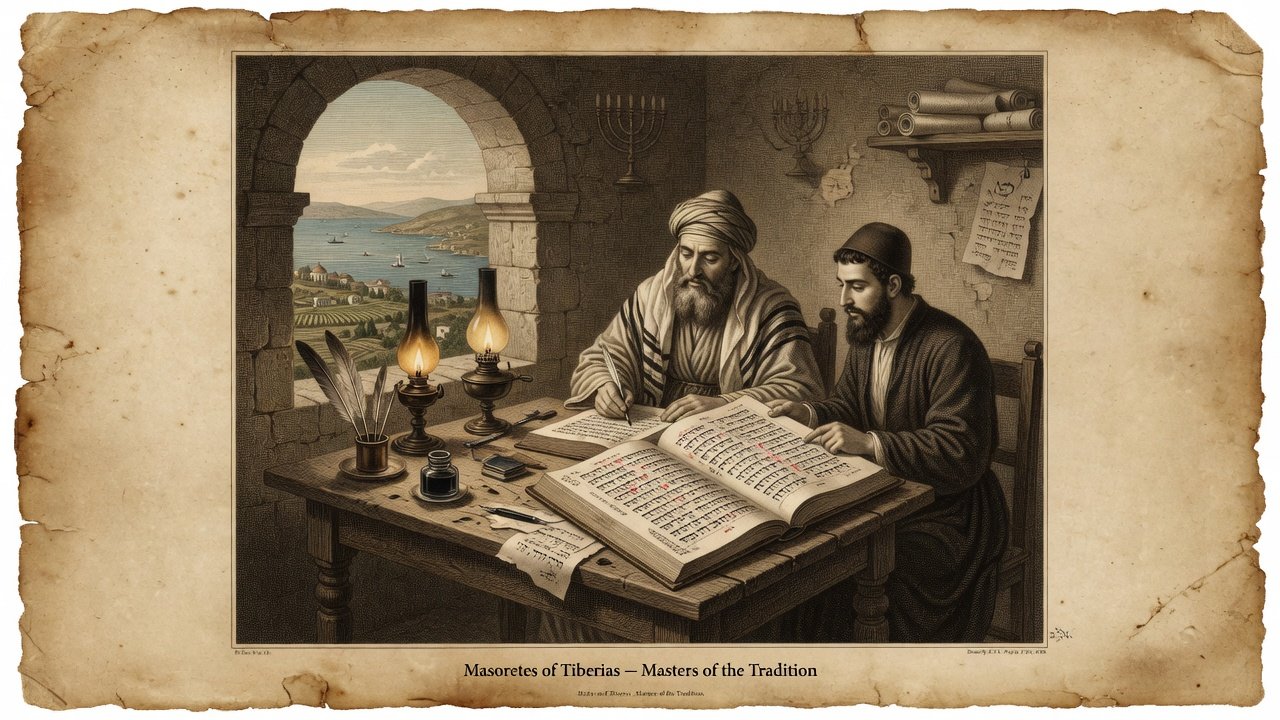
Tiberias (Galilee)
c. 650–950 CE
“A fence around the Torah”
I. The Short Answer
If you open a printed Hebrew Bible or a modern critical edition such as BHS or BHQ, you are reading a text shaped by the Masoretes. They inherited a nearly fixed string of consonants from earlier soferim and added three interlocking systems:
“They took the existing consonantal text and wrapped it in an unprecedented protective apparatus so that the text could never drift.”
II. Name and Title
English Masorete comes via medieval Latin and European scholarship from Hebrew מָסוֹרָה / מַסֹּרֶת (masorah / masoret), “tradition,” related to the verb “to hand over.” The practitioners called themselves Baʿalei ha-Masorah—masters or possessors of the tradition. Related craftsmen include the nakdanim (punctuators) who specialized in applying vowels and accents, often in dialogue with full Masoretic families.
The title stresses continuity. A Masorete’s authority rested not on prophetic inspiration but on accurate transmission of how Scripture was already read in their communities—especially the carefully guarded reading of Tiberias.
III. When and Where
The classic Masoretic project belongs to the early Islamic centuries, roughly the seventh through tenth centuries CE, with roots earlier and after-echoes later. The most influential school sat in Tiberias on the Sea of Galilee. Related activity is documented for Jerusalem and for Babylonia (Iraq), where a different pointing system once competed with the Tiberian.
| Center | Role | Legacy |
|---|---|---|
| Tiberias | Primary Tiberian school | Dominant vocalization; Ben Asher tradition |
| Jerusalem / Land of Israel | Palestinian pointing traditions | Partly absorbed or superseded by Tiberian |
| Babylonia (Iraq) | Babylonian pointing & Geonic culture | Important Genizah witnesses; later Tiberian win |
Political geography mattered. Tiberias under early Arabic rule remained a Jewish intellectual center even after the Temple’s long destruction; codices could be produced, corrected, and exported along Mediterranean and desert trade routes that also carried the culture of the Arab lands and the academies of Baghdad.
IV. What Came Before Them
The Masoretes stood on older foundations. Second Temple and late antique soferim had already fixed much of the consonantal text, paragraphing, and scroll rules. The Dead Sea Scrolls show both proto-Masoretic and non-Masoretic text-types centuries earlier; by the Masoretic age, the proto-Masoretic stream had largely won among rabbinic communities.
What was still oral—or only partially marked—was the full system of vowels and musical-syntactic accents. Communities knew how to read; the Masoretes made that knowledge graphic, teachable, and checkable on the page. That is why their work feels both conservative and revolutionary: conservative toward the consonants, revolutionary in the density of annotation.
V. Three Vocalization Traditions
Medieval evidence—especially from the Cairo Genizah—preserves three main pointing systems:
- Tiberian — the most elaborate system of vowels and accents; ultimately dominant in printed Bibles and critical editions.
- Palestinian — a Land-of-Israel system with fewer signs; largely displaced but historically important.
- Babylonian — superlinear pointing used in the east; survives in Genizah fragments and some later manuscripts.
Tiberian pointing “won” not by accident alone but because of its precision, its rich marginal Masorah, and the prestige of families such as Ben Asher. Modern readers of almost any synagogue ḥumash are still looking at a Tiberian page.
VI. Ben Asher, Ben Naphtali, and the Codices
Within the Tiberian school, later tradition contrasts the systems of Aaron ben Moses ben Asher and Ben Naphtali. Ben Asher’s tradition became the gold standard: Maimonides endorsed a Ben Asher codex for Torah-scroll norms, and modern editions privilege Ben Asher witnesses.
Great codices associated with this achievement include the Aleppo Codex (Crown of Aleppo), long the model Ben Asher Bible, and the complete Leningrad Codex (1008/9 CE), the base text of BHS. Related notes on this site cover the Crown of Aleppo, Damascus Crown, and other Oriental codices.
VII. What the Masorah Does
The Masorah is the annotation system that gave the Masoretes their name. Masorah parva (small Masorah) in the side margins flags unusual spellings and form counts; Masorah magna (large Masorah) in upper and lower margins lists fuller notes; final Masorah can summarize book-level statistics. Together they function as a built-in checksum: if a copyist invents a form, the notes often expose the anomaly.
This is textual criticism as craft piety. The same culture that forbade casual correction of consonants used obsessive counting to keep the tradition stable. For the technical layers of that craft, see also Masorah, Vocalization (Niqqud), and Cantillation (Teʿamim) on this hub.
VIII. Why They Matter for Bible Transmission
Without the Masoretes, Jewish communities would still have possessed Scripture—but modern readers, Christian and Jewish, would lack the standardized vocalized page that undergirds translations, grammars, and critical editions. The Septuagint, the Scrolls, and the Masoretic Text must be compared precisely because the Masoretic form is the best-documented Hebrew tradition of the Middle Ages.
This site exists largely because their work is still the default Hebrew Bible of synagogue, academy, and print. The slide deck Guardians of the Hebrew Biblical Text and the companion article Guardians of the Hebrew Biblical Text retell that story visually; this note answers the personal question behind the first hub module: who were they?
IX. How to Go Deeper on This Site
- Soferim — consonantal scribes before full vocalization.
- Nakdanim — specialists in pointing.
- Aleppo Codex and Leningrad Codex — premier Tiberian witnesses.
- Maimonides — legal reception of Ben Asher.
- Guardians presentation — 30-slide visual overview.
- Bible Since Jesus presentation — wider Jewish–Christian transmission arc.
Sources & Further Reading
| Work | Author / Source | Relevance |
|---|---|---|
| Masoretes | Encyclopedic survey | Overview of the schools and methods |
| Masoretic Text | Textual tradition | The received Hebrew Bible form |
| Aaron ben Moses ben Asher | Biography | Leading Tiberian authority |
| Tiberias | Geography | Primary Masoretic center |
| Niqqud | Technical article | Hebrew vowel pointing |
| Hebrew cantillation | Technical article | Teʿamim system |
| Aleppo Codex | Masoretes site | Ben Asher codex history |
| Soferim / Nakdanim | Masoretes site | Preceding and parallel crafts |
| Guardians presentation | Masoretes site | Visual 30-slide introduction |
| Sefaria | Digital library | Primary texts and commentaries |