Medieval Iberia–21st c. CE
Spain & Portugal; Ottoman lands; Maghreb; Western diaspora
Hebrew, Ladino, Spanish/Portuguese, Judeo-Arabic
Andalusian grammar; codices; Mediterranean print
I. Scope, Terms, and Historiography
Sephardi Jews (Hebrew Sepharadim) are the communities rooted in the medieval Jewish civilization of the Iberian Peninsula—Sepharad—and their descendants after the expulsions from Spain (1492) and Portugal (1496/97), together with communities that adopted Iberian rite, language, or identity through later contact. Sephardi history therefore spans the “Golden Age” and Christian kingdoms of Iberia, the Ottoman and Maghrebi refuges, the Western Sephardi diaspora of Amsterdam and London, and modern reconstitutions in the Americas and Israel.
Care is needed with labels. In Israeli and popular usage, “Sephardi” sometimes loosely includes all non-Ashkenazi Jews or all who pray in a Sephardi-type rite—including many Mizrahi families without Iberian ancestry. Historians distinguish Iberian origin, Sephardi rite, and Judeo-Spanish (Ladino) culture. This note emphasises biblical and textual culture: Andalusian grammar and lexicography, illuminated Hebrew Bibles, post-expulsion printing, and Ottoman–Maghrebi yeshivot. Companions include Spain, Golden Age of Spain, Expulsion of 1492, and Sephardim in the Ottoman Empire.
“Sepharad was a workshop of Hebrew grammar and Bible commentary under crescent and cross—and after 1492, a portable homeland of rite, language, and memory stretched from Fez to Salonica to the Caribbean.”
II. Iberian Foundations
Jewish presence in Roman and Visigothic Hispania preceded the Muslim conquest of 711. Under Umayyad and successor Islamic polities in al-Andalus, Jewish courtiers, physicians, poets, and scholars participated in Arabic high culture while cultivating Hebrew poetry and biblical philology. Figures such as Menahem ibn Saruq, Dunash ibn Labrat, Jonah ibn Janah, and later Abraham ibn Ezra and David Kimhi (Provençal but heir to Andalusian method) made systematic grammar and lexicography tools for reading the Masoretic text.
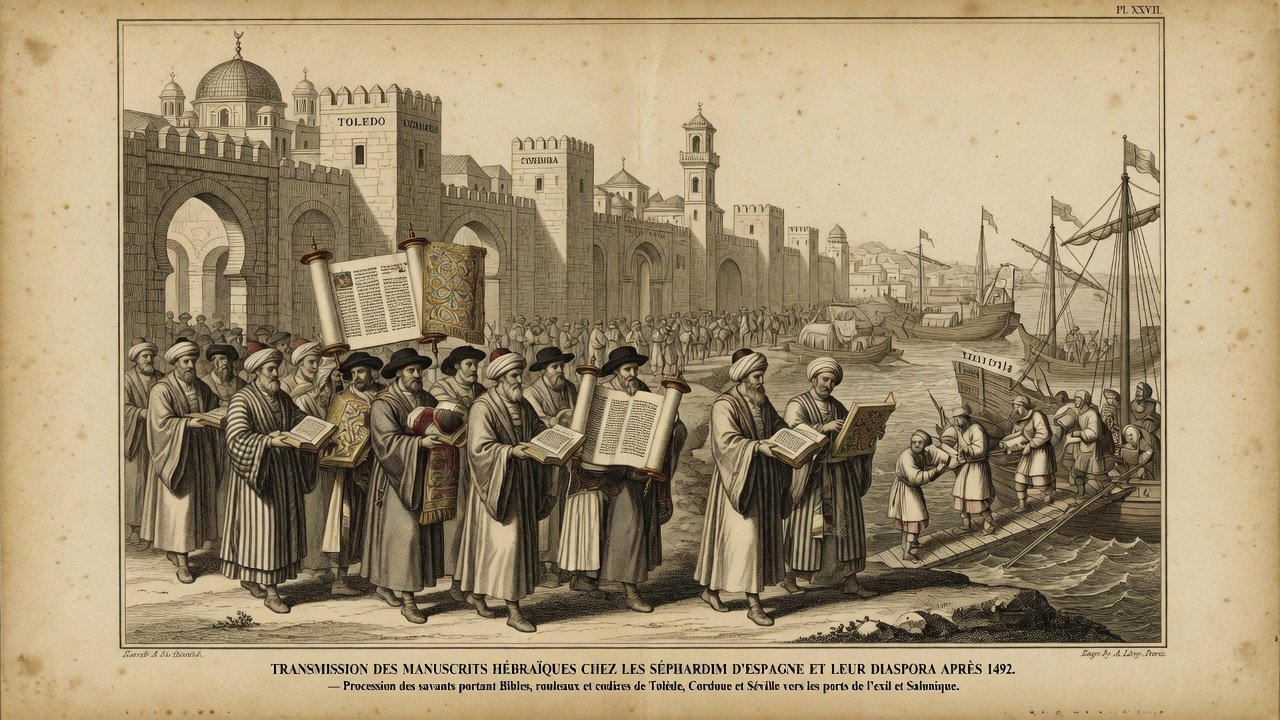
In the Christian kingdoms of the north—Castile, Aragon, Navarre, Portugal—Jewish communities (aljamas) produced monumental Bible codices, some lavishly illuminated (see the Golden Haggadah tradition and related Iberian book arts). Cities such as Toledo, Córdoba, Seville, and Granada appear throughout this site’s Iberian notes. The Reconquista, pogroms of 1391, forced conversions, and the Inquisition progressively narrowed Jewish public life until the expulsions.
| Period | Frame | Textual landmark |
|---|---|---|
| Al-Andalus “Golden Age” | Islamic polities in Iberia | Hebrew poetry; Arabic-informed grammar; court culture |
| Christian Iberia (to 1492) | Castile, Aragon, Portugal, Navarre | Illuminated Bibles; aljama regulation; rising coercion |
| Expulsion & refuge (1492–17th c.) | Ottoman Empire, Maghreb, Italy, later NW Europe | Hebrew printing; Ladino; yeshivot of Salonica & Safed |
| Western Sephardi & modern | Amsterdam, London, Americas, Israel | Spanish-Portuguese rite; Emancipation; Zionist era |
III. Expulsion and the Two Main Refugee Streams
The Alhambra Decree (1492) and Portuguese expulsions forced open Jews to convert or leave. Refugees and their books moved primarily along two arcs:
- Eastern / Ottoman Sephardim — to North Africa, Italy, and especially the Ottoman Empire (Istanbul, Salonica, Izmir, the Balkans, and the Holy Land). Bayezid II’s reported welcome became part of communal memory; Salonica grew into a major Ladino-speaking Jewish city and printing center. See Sephardim in the Ottoman Empire.
- Western Sephardim (Spanish-Portuguese) — crypto-Jewish conversos later returned to open Judaism in places such as Amsterdam, Hamburg, London, and the Caribbean and North American colonies, forming the Spanish and Portuguese Jewish congregations with distinctive rite and elite commercial networks.
A third dynamic was local: in the Maghreb, Iberian megorashim (“expelled”) settled among indigenous toshavim, producing layered Moroccan, Algerian, and Tunisian Jewish cultures that are simultaneously Maghrebi and Sephardi in different senses.
IV. Major Subdivisions of Sephardi Jewry
| Subdivision | Core areas | Distinctive traits (summary) |
|---|---|---|
| Medieval Iberian (Sepharad proper) | al-Andalus & Christian Spain/Portugal | Grammar, poetry, codices; ends as open Jewish life in 1492–97 |
| Ottoman / Eastern Sephardim | Salonica, Istanbul, Balkans, Anatolia, Holy Land | Ladino (Judezmo); strong printing; Ottoman millet life |
| Maghrebi Sephardim (megorashim) | Morocco, Algeria, Tunisia, Libya | Iberian rite layered on local communities; rich piyyut |
| Italian Sephardim | Venice, Livorno, Rome, other ports | Printing & trade hubs; dialogue with Italian Jewish rites |
| Western Sephardim (Spanish-Portuguese) | Amsterdam, London, Hamburg, Curaçao, NY, etc. | Converso origins; Spanish-Portuguese liturgy; Atlantic commerce |
| Safed & Land of Israel Sephardim | Safed, Jerusalem, later yishuv | Kabbalah (Luria circle); early modern Holy Land revival |
| Latin American & modern diasporas | Americas, France, Israel | Twentieth-century migrations; Israeli “Sephardi” politics |
Portuguese Jews, North African Sephardim, and Balkan Ladino speakers may share little daily culture yet still recognize a common Sepharad in liturgy, law (often following Joseph Karo’s Shulhan Arukh), and historical memory.
V. Grammar, Codices, and the Masoretic Page
Sephardi contribution to Bible study is foundational for the whole Jewish world. Andalusian and Provençal grammarians taught how the Tiberian signs encode morphology; their dictionaries and commentaries traveled into Ashkenaz through print. Illuminated Iberian Bibles staged the Masoretic text as a work of art and prestige. After expulsion, Hebrew presses in Istanbul, Salonica, and Italy issued humashim, haftarot, and full Tanakhs for refugee communities.
Isaac Abarbanel, statesman and commentator, exemplifies late Iberian biblical exegesis under catastrophe. In the sixteenth century, Sephardi and Romaniote scholars in the Ottoman orbit—together with printers—helped fix the educational canon that still surrounds the Masoretic page in Sephardi synagogues: Targum, classical commentators, and Karo’s legal synthesis.
VI. Language: Hebrew, Ladino, and Local Tongues
Liturgical and literary Hebrew remained central. Judeo-Spanish (Ladino / Judezmo) became the vernacular of many Eastern Sephardim, with a rich religious and popular literature including Bible translations and paraphrases. Western Sephardim long used Portuguese and Spanish in communal life. Maghrebi Sephardim often spoke Judeo-Arabic dialects while praying in Sephardi-type rites. Pronunciation of Hebrew among Sephardim influenced the standard adopted in modern Israeli Hebrew—another channel through which Sepharad shaped global Jewish sound.
VII. Early Modern Peak and Modern Transformations
Salonica’s Jewish majority city, Livorno’s free port, Amsterdam’s Spanish-Portuguese community, and Safed’s kabbalistic renaissance mark early modern Sephardi creativity. Emancipation, nationalism, and the Holocaust struck unevenly: Balkan Sephardim suffered catastrophic murder under Nazi occupation; North African communities faced Vichy and wartime pressures; Western Sephardi elites often integrated into host societies earlier.
Twentieth-century migrations to France, the Americas, and Israel reconfigured Sephardi demography. In Israel, “Sephardi” political and cultural movements sometimes allied with Mizrahi advocacy. Elsewhere, Spanish-Portuguese congregations preserve a distinct liturgical face of Sepharad even as numbers dwindle.
VIII. Sephardim and the Transmission of Scripture
Sephardi history matters for biblical transmission because it supplied:
- The classical grammatical toolkit for reading the Masoretic text;
- Luxury and study codices that modeled layout, Masorah, and beauty;
- Post-1492 printing networks that re-seeded Bibles across the Mediterranean;
- Synagogue rites and cantillation that perform Tiberian accents in Sephardi modes;
- Commentators still printed in standard Rabbinic Bibles worldwide.
Ashkenazi yeshivot that study ibn Ezra or Radak, and modern Israelis who speak with Sephardi-influenced vowels, inherit pieces of this chain—whether or not they call themselves Sephardi.
IX. Relation to Ashkenazi and Mizrahi Jewry
Medieval contact between Sepharad and Ashkenaz ran through Provence, Italy, and traveling scholars; early modern contact thickened via print and shared Ottoman space. Mizrahi communities hosted Sephardi refugees and sometimes adopted their rite, creating the overlapping identities discussed above. The three encyclopedic notes—Ashkenazi, Mizrahi, and this page—map the principal Common Era divisions without denying hybrids, converts, or smaller groups (Beta Israel, Karaite communities, Samaritans as related but distinct, and others) treated elsewhere on the site where relevant.
XI. Responsa, Codes, and the Biblical Verse in Law
Sephardi legal literature—from medieval Andalusian and Provençal authorities through Joseph Karo’s Shulhan Arukh—constantly cites biblical verses as prooftexts. Bible scholarship in the Sephardi world is therefore inseparable from halakhic reasoning: the pointed text supplies both liturgy and law. Karo’s synthesis, printed and disseminated widely, made Sephardi (and then pan-Jewish) legal culture a vehicle for standardized biblical citation even in Ashkenazi lands that adopted the Shulhan Arukh with glosses.
XII. Western Sephardim and Atlantic Bibles
Spanish-Portuguese communities in Amsterdam, London, Hamburg, and the Caribbean printed and imported Hebrew Bibles, Spanish vernacular Scriptures for former conversos returning to Judaism, and sophisticated grammatical works. Their libraries mediated between Iberian memory and Protestant Hebraist Europe. Atlantic trade routes carried not only sugar and silver but also sefarim—extending Sephardi biblical culture into the Western Hemisphere.
XIII. Music, Piyyut, and the Heard Verse
Sephardi and Maghrebi-Sephardi piyyutim elaborate biblical scenes in synagogue and paraliturgical settings. Maqam-based melodic systems shape how Torah and haftarah sound in many Middle Eastern Sephardi communities. The heard verse is part of scholarship broadly conceived: transmission is oral-musical as well as graphic.
XIV. Modern Sephardi Worlds
Post-Ottoman nation-states, the Holocaust in the Balkans, mid-century departures from Arab countries, and Israeli politics of ethnicity reshaped Sephardi demography. Today Spanish-Portuguese remnants, Balkan survivors’ descendants, Maghrebi-Sephardi majorities in France and Israel, and Latin American communities all teach the Masoretic page through different school systems—united by rite family and historical memory of Sepharad more than by a single vernacular.