Levi Yitzchok (d. 1809)
~80% by 1897
Hebrew printing & fairs
~80 batei midrash
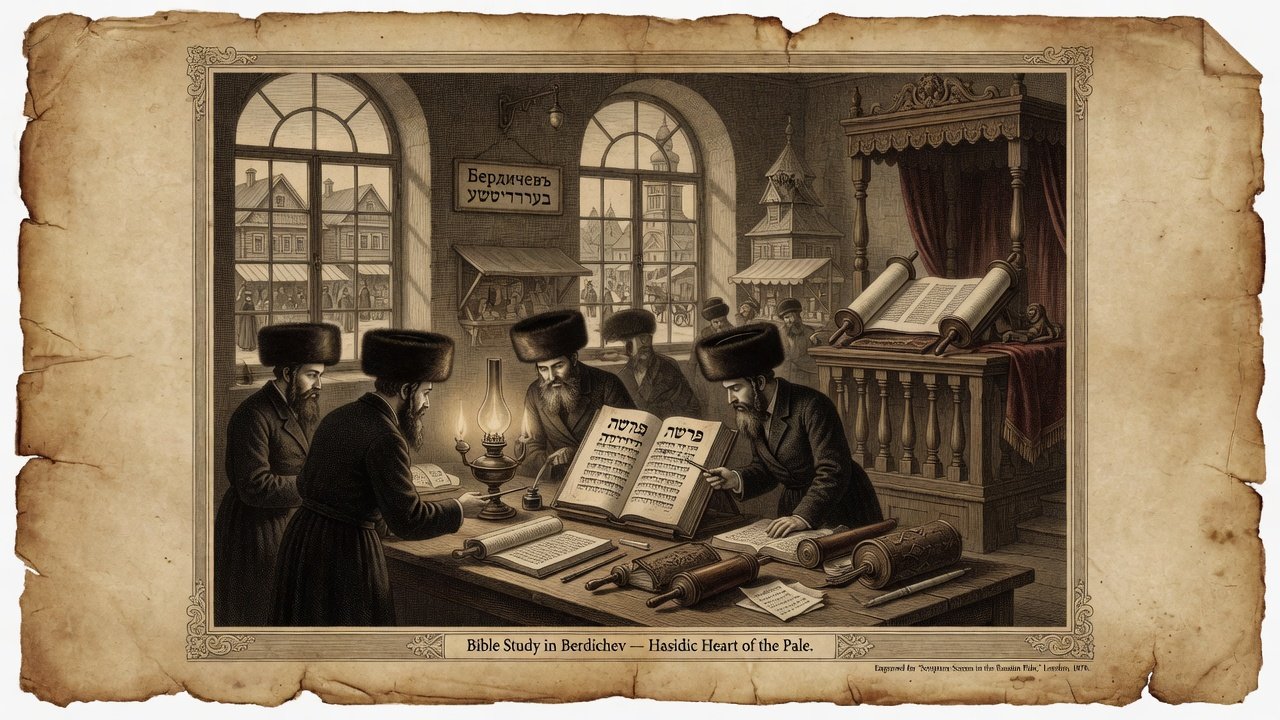
I. Names Across Centuries
Berdychiv (Ukrainian Бердичів) appears in Russian and older English as Berdichev, in Polish as Berdyczów, and in Yiddish as Berditchev / Barditshev (בערדיטשעוו). Hebrew and Hasidic literature immortalized the form linked to Kedushat Levi and the “Berditchever.”
For Bible scholarship the Yiddish and Hebrew names matter most: they mark the city as a pilgrimage and print node of Ukrainian Hasidism inside the Pale of Settlement, not merely a provincial market on the road between Kyiv and Volhynia.
| Form | Language / context | Relevance to Bible scholarship |
|---|---|---|
| Berdychiv | Ukrainian & modern English | Contemporary standard |
| Berdichev | Russian & older English | Imperial statistics; scholarly surveys |
| Berdyczów | Polish | Commonwealth fairs & privileges |
| Berditchev | Yiddish / Hasidic memory | Levi Yitzchok; pilgrimage culture |
| בערדיטשעוו | Hebrew/Yiddish orthography | Rabbinic letters & title pages |
II. Fair Town, Jewish Majority, and Literacy
Under Polish-Lithuanian rule Berdyczów won the right to hold numerous annual fairs; merchants from across Eastern Europe made it a postal and commercial hub. After the partitions it entered the Russian Empire’s Pale of Settlement. By 1897 Jews numbered about 41,600 of roughly 53,700 residents—around four-fifths of the city—one of the highest urban Jewish concentrations in the empire.
Demographic density shaped pedagogy. When most neighbors were Jewish, Torah reading, ḥeder schooling, and the weekly parashah were public culture. Literacy figures from the late imperial period show a substantial share of Jewish men able to read—a prerequisite for mass use of pointed ḥumashim printed in Vilna, Warsaw, and local houses.
“In Berdichev the Masoretic page was not a rare scholarly object. It was the common script of a city that prayed, traded, and argued in Hebrew and Yiddish.”
III. Levi Yitzchok and Hasidic Bible Culture
Levi Yitzchok ben Meir of Berditchev (c. 1740–1809), a disciple of the Maggid of Mezritch, made the city a Hasidic capital. His Kedushat Levi and the memory of his advocacy for ordinary Jews bound Hasidic devotion to the biblical text: weekly portions, festival readings, and the emotional performance of Scripture in public prayer.
Hasidism is sometimes caricatured as anti-philological. Berdichev’s reality was more complex. The same community that venerated a tzaddik maintained soferim, cantors famous across the Pale, and dozens of study houses where boys learned to chant from the pointed page. The Masoretic Text remained the shared scriptural ground of Hasidim and their Mitnagdic critics.
Pilgrimage to Levi Yitzchok’s ohel after his death reinforced Berdichev as sacred geography of Ukrainian Jewry—parallel, in communal memory, to how Lublin or Warsaw figured as book capitals.
IV. Hebrew Printing, Cantors, and the Book Market
Berdichev’s fairs and Jewish majority supported a lively market for Hebrew books. Local and regional printers issued liturgical and educational works; the city also consumed massive shipments of Vilna and Warsaw Bibles. Around the turn of the twentieth century observers counted on the order of eighty synagogues and batei midrash, and the town’s cantors were celebrated far beyond Volhynia.
For Masoretic history this ecology matters: every new ḥumash with Rashi, every tikkun for soferim, every children’s primer with nikkud trained eyes and ears on the same Tiberian system that Tiberias had fixed a millennium earlier.
V. Haskalah, Orthodoxy, and Shared Scripture
From the 1820s a substantial Haskalah circle formed in Berdichev. Maskilim promoted Hebrew style, biblical poetry, and modern schooling, yet even reformers typically started from the pointed Masoretic page rather than free emendation. Traditionalists answered with denser yeshiva and Hasidic study—again on the same weekly lectionary.
The city’s later literary fame (Joseph Conrad was born here in 1857; Vasily Grossman later wrote of its wartime destruction) should not obscure this quieter fact: before catastrophe, Berdichev was a machine for reproducing biblical literacy at urban scale.
VI. Twentieth Century and the End of a Text City
War, revolution, Soviet secularization, and the Holocaust ended Berdichev’s role as a Jewish text capital. Nazi occupation from 1941 brought ghettoization and mass murder; tens of thousands of Jews from the city and region were killed. Postwar remnants and diaspora memory preserve melodies, family Bibles, and the cult of Levi Yitzchok, but the dense ecosystem of print, cantors, and ḥederim was gone.
On this site Berdychiv stands as a case study in how a Pale city could make Masoretic reading a majority culture—and how fragile that achievement proved under modern violence.
VII. Place on the Masoretic Map
Read Berdychiv with Kiev (press metropolis), Poltava (organized provincial schooling), Chernihiv (northern corridor), and the regional notes on Eastern Europe and the Pale of Settlement.
On the scholarship map, Berdychiv anchors Right-Bank Ukraine’s Hasidic-and-print belt west of the Dnieper.
Sources & Further Reading
| Work | Author / Source | Relevance |
|---|---|---|
| Berdychiv | Encyclopedic survey | City history, Jewish majority, Hasidism |
| Levi Yitzchok of Berditchev | Biographical entry | Hasidic leadership & Kedushat Levi |
| History of the Jews in Ukraine | Survey | Ukrainian Jewish context |
| Pale of Settlement | Reference | Legal frame of residence |
| Berdichev (JGuide Europe) | Heritage guide | Synagogues, print, memory |
| Pale of Settlement note | Masoretes site | Regional Bible pedagogy |
| Eastern Europe note | Masoretes site | Ashkenazi curriculum frame |
| Kiev city study | Masoretes site | Neighboring press hub |
| Soferim | Masoretes site | Scroll culture & tikkun |