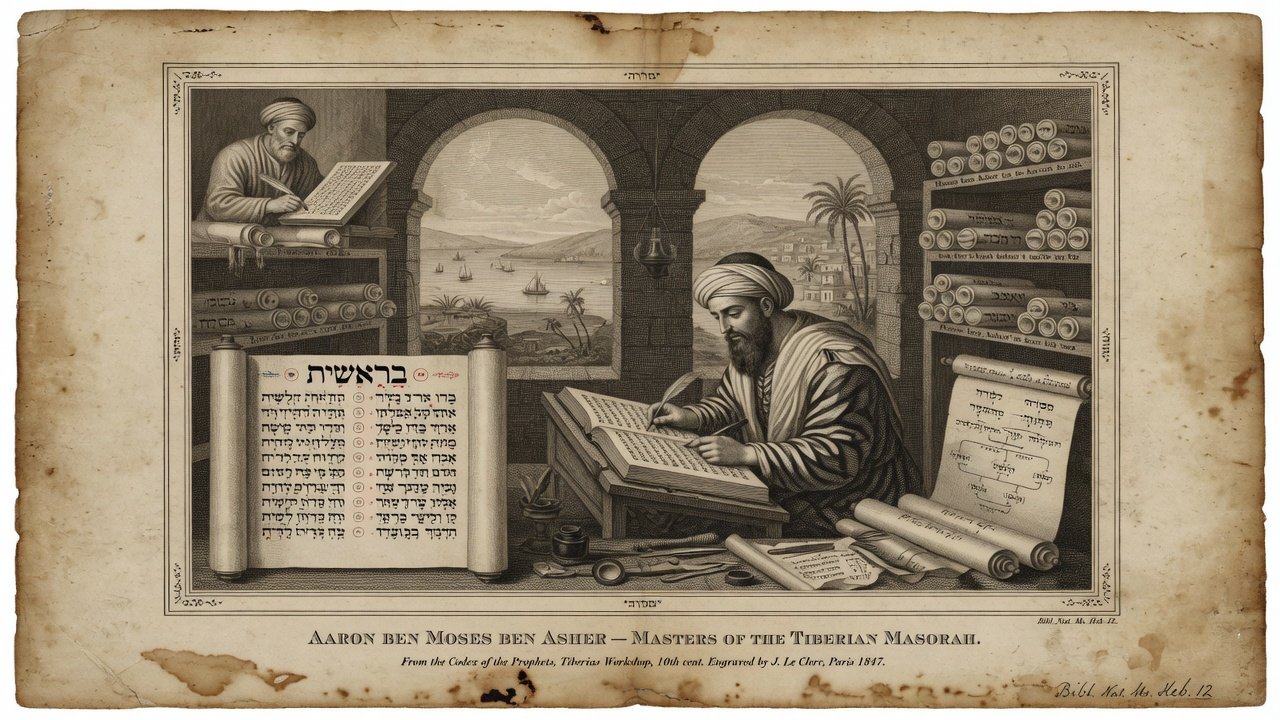
I. Why “Ben Asher” Became a Standard
When later scribes wanted to advertise accuracy, they said they had copied “from the books vocalized by Aaron ben Moses ben Asher.” That formula, attested already in a 989 CE colophon, shows how quickly one family’s craft became a brand of reliability. Aaron did not invent the Tiberian system from nothing; he inherited, refined, and closed a school that had been active in Tiberias for generations. With him, in the judgment of classic reference works, “the Masora may, in a certain sense, be considered as closed.”
This note treats both the person and the family: the chain of names from Asher the Elder through Moses ben Asher to Aaron, the works and manuscripts associated with them, their debated religious affiliation, and the rivalry—or sibling subsystem—with the Ben Naphtali tradition.
II. A Dynasty in Tiberias
The Ben Asher family can be traced, by traditional lists, through five or six generations of Masoretes beginning in the eighth century. Only the later names emerge into full historical light; the earliest are often little more than links in a chain. A widely cited sequence runs:
| Generation (approx.) | Name | Notes |
|---|---|---|
| 1 | Asher the Elder / “Asher the Great Sage” | Founder figure, mid–late 8th c. |
| 2–3 | Nehemiah ben Asher; Asher ben Nehemiah | Names preserved in family lists |
| 4–5 | Intermediate links (varies by source) | Masoretic activity continues in Tiberias |
| 5 | Moses ben Asher | Credited with Cairo Codex of the Prophets (895) |
| 6 | Aaron ben Moses ben Asher | Apogee; Aleppo Codex apparatus (~930) |
Tiberias on the western shore of the Sea of Galilee was the right laboratory: a Jewish intellectual center under early Islamic rule, close to older Palestinian reading traditions yet open to the wider Arabic-speaking world of grammar and book culture. The family’s long residence there made “Tiberian” and “Ben Asher” nearly synonymous for later readers.
III. Moses ben Asher
Aaron’s father, Moses (Moshe) ben Asher, is credited with writing the Cairo Codex of the Prophets (Codex Cairensis) in 895 CE—dated in its colophon “827 years after the destruction of the Second Temple.” If authentic in all its layers (modern debate continues over parts of the manuscript’s history), it is among the oldest large prophetic codices with full Tiberian apparatus and a crucial witness to the generation before Aaron.
Moses also appears in poetic and list materials that show a family self-conscious about tradition. Whether or not every ascription holds, the scholarly consensus that Aaron stood on his father’s shoulders is secure: the Ben Asher name was already a credential before the son’s masterwork.
IV. Aaron’s Achievement
Aaron’s work has three interlocking faces:
- Vocalization (niqqud) — the refined Tiberian vowel system that still undergirds printed Hebrew Bibles and grammatical analysis.
- Accentuation (teʿamim) — cantillation marks that encode musical performance and syntactic structure.
- Masorah — parva and magna notes that count forms, flag rarities, and lock the text against drift.
His crowning association is the Aleppo Codex: consonants by Shlomo ben Buyaʾa, verification and full apparatus by Aaron about 930. Many specialists regard that codex as the purest representative of Aaron’s system. The complete Leningrad Codex (1008/9), though slightly later and not identical in every reading, stands in the same Ben Asher stream and became the base of BHS.
Aaron is also linked to grammatical and didactic writing in the Ben Asher orbit (including materials transmitted under titles such as Diqduqe ha-Teʿamim / related grammatical tradition). Even where authorship attributions are debated, the family’s role in turning reading practice into explicit grammatical awareness is clear: the Masoretes were among the first systematic Hebrew grammarians.
“With him the Masora may, in a certain sense, be considered as closed.” — classic judgment on Aaron ben Moses ben Asher
V. Maimonides and Legal Authority
Maimonides, writing in Egypt, declared that he relied on a codex corrected by Ben Asher for the rules governing Torah-scroll orthography. That endorsement, more than any academic footnote, locked Ben Asher prestige into rabbinic law. From then on, disputes about open and closed paragraphs, defective and plene spellings, and related scribal norms often gestured toward the Crown associated with Aaron’s care.
Legal reception matters for transmission history: a Masoretic system becomes “the” text not only by philological elegance but by communal trust. Ben Asher won both.
VI. Karaite Debate
Genizah and literary evidence has led many scholars to argue that Aaron—and perhaps his family—had Karaite affiliations; others (including important studies by Dotan and Zucker) contest a simple sectarian label. The debate is historically serious and still open in details. What is not open to doubt is the reception: Rabbanite authorities, including Maimonides, adopted Ben Asher textual authority regardless of the family’s private theological politics. Scripture’s fence outlived the faction fight.
VII. Ben Asher versus Ben Naphtali
Medieval lists record some eight to nine hundred differences between the Ben Asher and Ben Naphtali systems—mostly in vowels and accents, not in the consonants. About nine-tenths of those differences are said to favor Ben Asher in the later standard. Some modern scholars, following M. H. Goshen-Gottstein, even speak of “subsystems inside the Ben Asher family” rather than two sealed camps. Either framing is useful: the Tiberian school was rich enough to debate fine points while sharing one overall architecture of pointing.
The existence of the rivalry proves the maturity of the craft. Only a tradition that has already fixed the big questions can afford to argue about beyisrael versus biysrael.
VIII. Legacy in Print and Critical Editions
From medieval model codices to the Second Rabbinic Bible and on to BHK, BHS, and BHQ, editors have oriented themselves—directly or indirectly—to Ben Asher excellence. Yemenite and other communities preserved related memories of careful Tiberian copying. Digital facsimiles of Aleppo and Leningrad now let any student see what “Ben Asher quality” looks like on the page.
On this site, Aaron and his family are the human center of the hub’s origin story: the reason Who Were the Masoretes? is not an abstraction, and the reason codex notes keep returning to Tiberias.
Sources & Further Reading
| Work | Source | Relevance |
|---|---|---|
| Aaron ben Moses ben Asher | Wikipedia | Biography & Tiberian system |
| Aaron ben Moses ben Asher | Jewish Encyclopedia | Family generations; Masora “closed” |
| Ben-Asher, Aaron | Encyclopedia.com / EJ | Five generations; Karaite debate |
| Aleppo Codex | Britannica / Wikipedia | Ben Asher apparatus on Ben Buyaʾa consonants |
| Masoretes | Masoretes site | School context |
| Ben Naphtali | Masoretes site | Rival / sibling system |
| Shlomo ben Buyaʾa | Masoretes site | Consonantal partner |
| Maimonides | Masoretes site | Halakhic endorsement |