Medieval settlement–modern remnant & revival interest
Kaifeng (Henan), China
Chinese; historical Hebrew/Persian Jewish layers
Synagogue scrolls historically; inscriptions; later documentation
I. A Community at the Edge of the Jewish Map
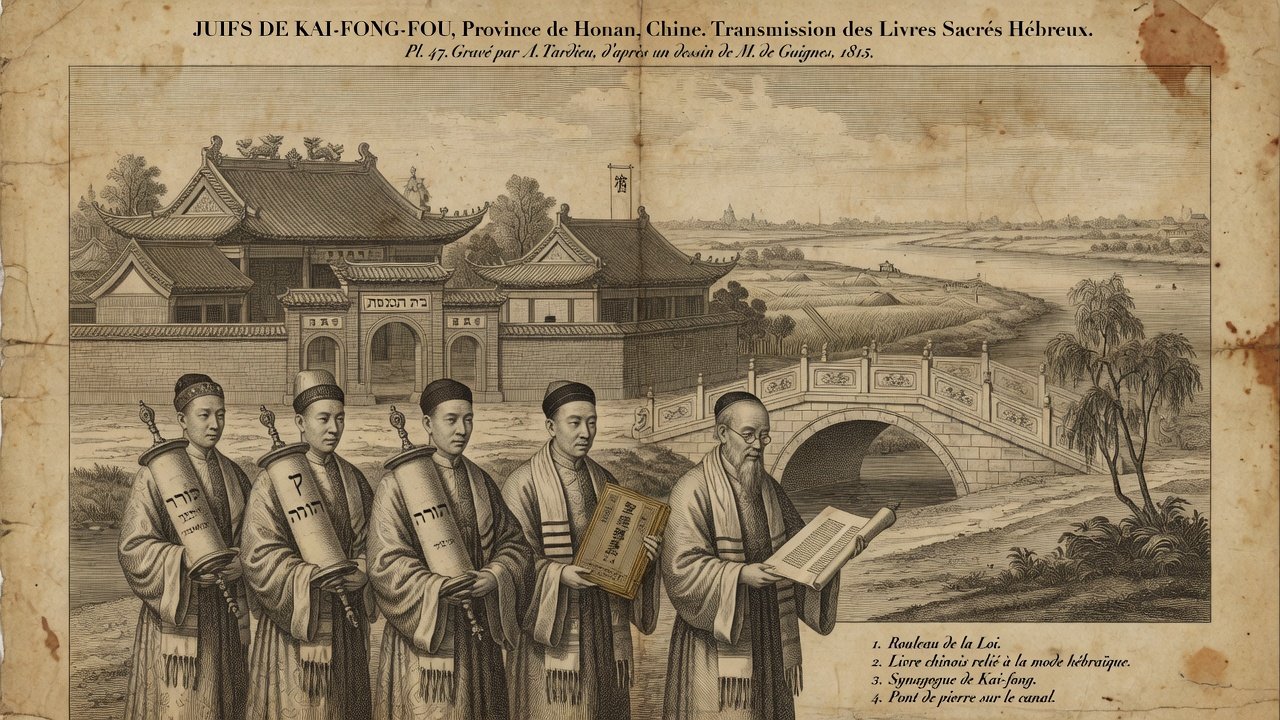
The Kaifeng Jews are the best-documented historic Jewish community of inland China—settled on the Yellow River plain in Henan, with a synagogue tradition recorded on Chinese steles and in outsider descriptions. Origin stories point to merchants along Central Asian routes bringing Jewish practice into Song-dynasty and later Chinese society. For the history of Bible transmission, Kaifeng shows Scripture’s reach into a Chinese literary empire—and the fragility of Hebrew literacy without continuous external book supply and large population inflows.
“Kaifeng’s stones and steles remember a Torah that arrived by caravan and slowly spoke Chinese—until visitors copied what remained of the Hebrew page.”
II. Synagogue, Steles, and Chinese Context
Chinese inscriptions from the community record rebuilding of the synagogue and claims of fidelity to scriptural tradition, using Chinese literary idioms to express Jewish commitment. The synagogue complex—described by visitors—stood within Kaifeng’s urban landscape under successive dynasties. Jews adopted Chinese surnames, dress, and examination-culture aspirations while retaining lineage memory and ritual distinctions for centuries.
III. Scrolls, Books, and the Problem of Isolation
Jesuit and later Western visitors described Torah scrolls and ritual objects. Some manuscripts left China for Western libraries, becoming sources for scholars of Jewish diaspora and of Chinese religion. Over generations of isolation from other Jewish centers, Hebrew knowledge declined; Chinese became the sole vernacular. Lineage identity could persist after full fluency in Hebrew liturgy faded—a pattern opposite to Yemenite dense literacy, and instructive for how biblical religion depends on institutions of teaching.
What survives in outsider copies and descriptions becomes primary evidence when local production of pointed Hebrew books ceases. Kaifeng is therefore both a story of presence and a story of textual attrition.
IV. Bible Scholarship Perspectives
Modern scholarship uses Kaifeng materials to study:
- how Jewish books and people may have traveled the Silk Roads;
- how communities maintain identity when vernacular and literary culture shift entirely to Chinese;
- how Christian and Jewish outsiders’ reports become archives of last-generation practice;
- how the Masoretic tradition’s global reach has limits set by demography and schools.
V. Modern Descendants and Revival Interest
Individuals and families in China and abroad claiming Kaifeng ancestry have sought recognition and Jewish education. Some study Hebrew and rabbinic Judaism in Israel or elsewhere; Chinese and international media periodically rediscover the community. Contemporary projects reintroduce Hebrew Bible study to people reclaiming Kaifeng roots—closing a long arc from medieval synagogue to modern classroom, even if continuity was interrupted.
VI. Comparative Notes
Compared with Cochin, Kaifeng lacked monsoon-renewed Middle Eastern book traffic. Compared with Bukharan Jews, it was more isolated from large Persianate Jewish populations. Its encyclopedic value is precisely that edge-case status: the farthest well-documented inland reach of Jewish scriptural community in East Asia.
VII. Lineage without Letters
As Hebrew literacy faded, Chinese Jewish identity increasingly rested on descent, surname groups, and residual customs. That trajectory forces biblical historians to distinguish textual transmission from peoplehood transmission. Kaifeng retained the second longer than the first—until modern revival efforts tried to restore the first for descendants of the second.
VIII. Western Libraries and the Ethics of Taking Books
Removal of Kaifeng Torah scrolls and manuscripts to Western collections preserved texts and stripped a community of ritual objects. Contemporary discussion of cultural property and Jewish diaspora archives must include this episode. Digitization now allows wider study even when originals remain far from Henan.
IX. Chinese Literary Idioms for Jewish Scripture
Kaifeng steles and memorial texts use Chinese classical phrasing to praise adherence to scriptural commandments, sometimes analogizing Jewish law to Confucian categories of ritual and virtue. That translation of self-description is itself a historical document: it shows how a Jewish minority explained Bible-centered religion inside imperial China’s moral vocabulary. Scholars of comparative religion read these inscriptions as bilingual (conceptually, if not always linguistically) theology.
X. Visitors’ Descriptions as Accidental Ethnography
Jesuit letters, nineteenth-century Protestant reports, and Jewish travelers’ notes describe synagogue layout, residual Hebrew knowledge, and ritual objects with varying accuracy and bias. Critical reading extracts usable detail—presence of Torah scrolls, number of literate men, festival observance—while discounting missionary agendas. These sources, however imperfect, are often our only window onto late-stage Kaifeng practice.
XI. Lessons for the Theory of Transmission
Kaifeng teaches that peoplehood can outlast full textual fluency; that isolation starves scribal guilds; that outsider collecting can both preserve and alienate heritage; and that modern revival can restart Hebrew Bible study without unbroken teacher-chains. Those lessons refine how this site narrates Masoretic success elsewhere: success was never automatic; it required schools, soferim, and demography that Kaifeng eventually lacked.