Medieval–21st c.
Bukhara, Samarkand, Central Asia; Israel & USA
Bukhori (Judeo-Tajik), Russian, Hebrew
Synagogue humash; local melamedim; Persianate Jewish learning
I. Scope and Self-Name
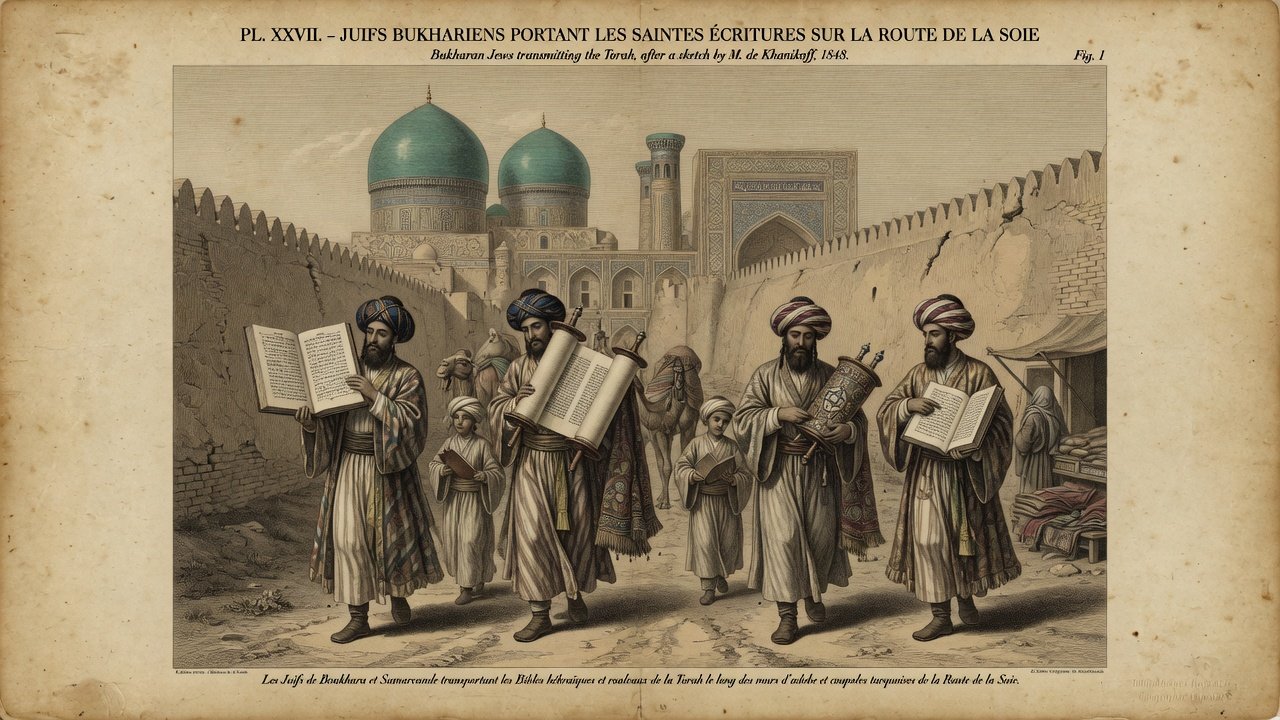
Bukharan Jews are the Jewish communities of Central Asia historically centered on the Emirate of Bukhara and neighboring regions (including Samarkand and other cities). They are culturally Persianate, speaking Bukhori (Judeo-Tajik), and are often classified with Mizrahi Jewry in modern Israel while retaining distinct language, music, cuisine, and synagogue customs. This note surveys their history with emphasis on Hebrew Bible education along Silk Road routes of merchants and books.
“On the Silk Road the weekly portion traveled with caravans and wedding musicians—Hebrew on the scroll, Bukhori in the courtyard explanation.”
II. Medieval and Early Modern Central Asia
Jews appear in medieval Islamic geographies of Transoxiana and in later Persian and Russian sources. Under Muslim emirates they lived with dhimmi constraints, special taxes, and residential rules, while maintaining internal communal leadership (including rabbinic and lay notables). Economic niches included dyeing, trade, and crafts. Synagogues and religious schools taught boys to read the pointed prayerbook and humash.
Book supply depended on manuscript copying and intermittent imports from Persian, Ottoman, and later Russian markets. Isolation relative to European print centers meant oral pedagogy and local teachers remained decisive for biblical literacy.
III. Language: Bukhori and Hebrew
Bukhori (Judeo-Tajik) is a Jewish variety of Tajik Persian, historically written in Hebrew script. It carried domestic religion, folk literature, and oral biblical storytelling. Hebrew structured liturgy and Torah reading; Aramaic entered via Talmudic study for advanced students. Russian became important under imperial and Soviet rule; Israeli Hebrew now dominates among younger Israeli Bukharans.
IV. Bible Pedagogy and Synagogue Life
Traditional education emphasized decoding pointed Hebrew, fluent prayer, and the weekly portion. Melamedim operated in courtyard schools; synagogues staged public reading with local melodies. Judeo-Tajik explanation bridged sense. Contact with Sephardi printed books in the modern period introduced standard commentarial layouts (Rashi and others) familiar across the Jewish world.
Festivals structured communal hearing of megillot and special readings. Music—wedding songs, liturgical piyyut—wove biblical language into lifecycle events, reinforcing memory beyond the formal classroom.
V. Russian Conquest and Soviet Modernity
Russian conquest of Central Asia incorporated Bukharan Jews into imperial legal and educational systems. Some pursued Russian schooling and commerce; traditional heders continued. Soviet rule promoted secularization, redefined nationalities, and restricted religious institutions. Hebrew and religious teaching were driven underground in harsh periods. Late Soviet emigration policies eventually allowed exit.
VI. Emigration: Israel and the United States
Large Bukharan communities reconstituted in Israel (with visible cultural centers and synagogues) and in New York. Heritage organizations teach Bukhori, cuisine, and liturgical melodies; Israeli schools teach standard Tanakh. The pointed Hebrew page thus survives in a new bilingual ecology: Israeli Hebrew public life and Bukharan heritage spaces.
VII. Comparative Persianate Jewish Worlds
Comparison with Mountain Jews and Iranian Jews shows a family of Iranian-language Jewish societies that implemented the Masoretic text far from Yiddish Europe. Comparison with Maghrebi Judeo-Arabic culture shows parallel vernacular bridges to the same pointed text. Bukharan Jewry is essential to an Asian map of biblical transmission.
VIII. Music, Lifecycle, and Biblical Memory
Bukharan wedding music, Shabbat table songs, and liturgical pieces weave biblical phrases into communal emotion. Lifecycle events become informal schools of Scripture: children hear verses and allusions long before they can decode a humash. Heritage ensembles in Israel and New York keep that oral-biblical layer audible.
IX. Manuscripts, Genizot, and Research Desiderata
Compared with the Cairo Genizah, Central Asian Jewish book remains are sparsely published. Synagogue genizot, family libraries, and colonial-era reports still promise discoveries about which biblical editions and commentaries circulated in Bukhara and Samarkand. Documenting Bukhori biblical glosses remains a scholarly priority.
X. The Pointed Page after Atheism
Soviet secularization interrupted formal heder chains; post-Soviet and Israeli rebirth rebuilt them with modern textbooks. The continuity is not unbroken manuscript descent but renewed commitment to the same Tiberian text—proof that Masoretic culture can restart when people and printed humashim reunite.
XI. Neighborhood Synagogues in Israel and Queens
Dense Bukharan neighborhoods created after emigration rebuilt synagogue networks quickly. Morning and evening prayer, children’s classes, and festival readings re-centered the weekly portion in new cities. Rabbis trained in Israeli yeshivot serve alongside heritage cantors who remember Central Asian melodies. The result is a hybrid: Israeli Tanakh curriculum on weekdays, Bukharan sound on Shabbat.
XII. Foodways, Calendar, and Embodied Bible
Festival foods and wine customs encode biblical calendar in smell and taste—Passover, Sukkot, Purim. Embodied practice is not a substitute for literacy; it is a parallel track of memory that keeps agrarian biblical festivals alive among urban emigrants. Encyclopedic accounts of Bible culture should include the table as well as the desk.
XIII. Research Frontiers
Priorities include: systematic recording of Bukhori biblical glosses; cataloguing of family sefarim brought on aliyah; oral histories of Soviet-era clandestine prayer; and comparison of cantillation with Iranian and Afghan Jewish remnants. Each frontier would thicken the Central Asian cell on the global Masoretic map.