Roman antiquity–21st c.
Rome, northern & central Italian cities, islands
Italian, Judeo-Italian varieties, Hebrew
Italian rite; Hebrew printing; Renaissance scholarship
I. Scope: Italkim among the Jews of Italy
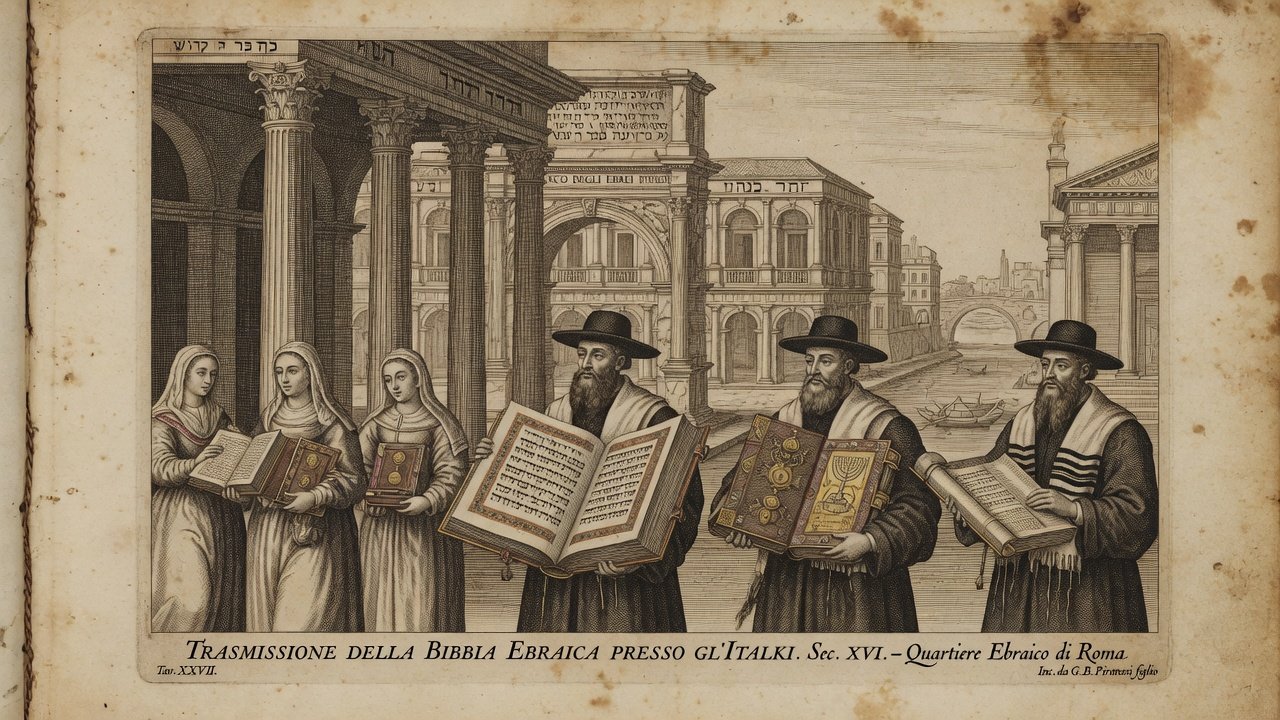
Italki Jews (Italkim) are Jews of native Italian tradition—distinct from later Ashkenazi and Sephardi arrivals who also settled in Italy. Their rite (minhag Italiani) and communal history center on Rome—the oldest continuous Jewish community in Europe—as well as cities such as Ferrara, Mantua, Venice, Florence, and others. Livorno and other ports developed strong Sephardi layers; the Italian peninsula is therefore a mosaic. This note focuses on Italki biblical culture: scrolls, print, commentary, Christian Hebraist exchange, and modern continuity. See also Italy.
“Italy bound the Hebrew page to the print shop and the bank, the ghetto street and the Christian Hebraist’s desk—without surrendering the synagogue’s public reading of Torah.”
II. Antiquity: Rome and the Mediterranean
Jewish Rome predates the medieval ghetto by a millennium. Catacomb inscriptions, classical literary sources, and early Christian texts attest Greek- and Latin-speaking Jews who also used Hebrew in sacred contexts. The destruction of the Second Temple and the presence of a Jewish community under the emperors made Rome a symbolic and actual node of diaspora life. Late antique Italian Jews participated in Mediterranean book and trade networks that would later carry Tiberian-pointed codices westward.
III. Medieval Learning, Poetry, and Manuscripts
Medieval Italian communities hosted poets, physicians, Talmudists, and translators. Hebrew manuscript production and illumination flourished in various centers; Italian Jewish scribes and patrons linked Ashkenaz, Provence, Spain, and the East. Biblical commentary and grammatical interest traveled with those books. Local piyyut and Italian-rite liturgy structured how the yearly cycle of Torah and haftarah was heard.
Economic roles in moneylending, trade, and medicine under papal and princely charters funded communal education—cheder-like schooling for boys and advanced study for elites—always anchored in the ability to read the pointed humash and prayerbook.
IV. Print Revolution: Venice and the Global Masoretic Page
Italy was a capital of early Hebrew printing. Above all, Venice—with Daniel Bomberg’s Rabbinic Bibles—fixed the layout of Masoretic text plus classical commentators (Rashi, ibn Ezra, and others) for global Jewry. Italian Jewish proofreaders, typesetters, financiers, and customers were essential to that industry. The printed Mikraot Gedolot-type page became a shared classroom across Ashkenazi and Sephardi worlds; Italki participation in its production is a central fact of biblical transmission history.
Other Italian presses and later centers continued to supply mahzorim, humashim, and grammatical works. Ghettoization (from the sixteenth century in Venice and elsewhere) constrained residence but did not end book culture; if anything, print intensified standardized biblical text even under segregation.
V. Italian Rite, Cantillation, and Schooling
The Italian rite preserves distinctive prayer orders and piyyut. Torah reading melodies form an oral branch distinct from Ashkenazi and Sephardi norms. Schools taught pointing and the weekly portion; yeshivot and private tutors advanced Talmud. Judeo-Italian vernaculars historically aided explanation. As Italian replaced Judeo-Italian, vernacular sermons and modern textbooks adapted, while Hebrew remained liturgical.
VI. Renaissance Christian Hebraism
Renaissance and early modern Christian scholars studied Hebrew Bible and Kabbalah with Jewish teachers in Italian cities. That exchange moved Masoretic and grammatical knowledge into European universities and into Christian biblical philology—while Jewish communities continued their own humash pedagogy under increasingly harsh restrictions. Figures and networks documented in Christian Hebraist scholarship often lead back to Italian Jewish households and libraries.
VII. Emancipation, Unification, Fascism, and the Holocaust
Nineteenth-century emancipation and Italian unification opened professions and civic life. Many Jews integrated into Italian national culture while maintaining synagogues. Fascist racial laws (1938) and the German occupation brought persecution and deportation. The Holocaust murdered a significant portion of Italian Jewry; survivors rebuilt small communities. Roman and other synagogues today maintain Italian-rite services and museums of Jewish heritage that display scrolls, printed Bibles, and educational history.
VIII. Comparative Place
Italkim stand with Romaniotes as non-Ashkenazi, non-Sephardi European Jewish cultures, and with Sephardi Livornese and Ashkenazi immigrants as cohabitants of the Italian Jewish mosaic. Their decisive gift to world Jewry is inseparable from the printed Masoretic page that still structures biblical study globally.
IX. Ghetto, Bank, and Bible
Mandatory ghettos constrained residence yet concentrated Jewish book artisans, tutors, and synagogues. Economic niches in finance and trade funded dowries, teachers, and scroll donation. The social history of Italian Jewish wealth and poverty is inseparable from who could sponsor a humash edition or maintain a synagogue bimah.
X. Italian Jewish Thought and the Biblical Verse
From medieval philosophers to modern Italian Jewish writers, biblical citation structures ethical and political argument. Emancipation-era sermons in Italian explained the weekly portion to citizens who lived between Torah and Risorgimento. That vernacular preaching is a modern chapter of Italian biblical pedagogy.
XI. Rome’s Continuous Community as Archive
Rome’s Jewish community offers exceptional diachronic depth: ancient catacombs, medieval statutes, ghetto centuries, emancipation, Fascist persecution, and today’s Italian-rite synagogue life. Biblical pedagogy is one thread through that depth—scroll donation records, teacher contracts, and printed sefarim lists in communal archives. Studying Rome is studying European Jewish Bible culture without reducing Europe to Ashkenaz alone.
XII. Italian Print Legacy beyond Italy
Bomberg’s Venice editions traveled to Krakow, Amsterdam, Istanbul, and Fez. Italki and other Italian Jewish labor in the print shop thus shaped Ashkenazi and Sephardi classrooms worldwide. The encyclopedic claim is causal, not ornamental: without Italian Hebrew printing, the early modern Masoretic page would look different everywhere.