Medieval roots–21st c.
Dagestan, Azerbaijan, North Caucasus; Israel & diaspora
Judeo-Tat (Juhuri), Russian, Hebrew, Azeri
Synagogue Torah reading; local melamedim; modern Hebrew schools
I. Identity, Names, and Self-Designation
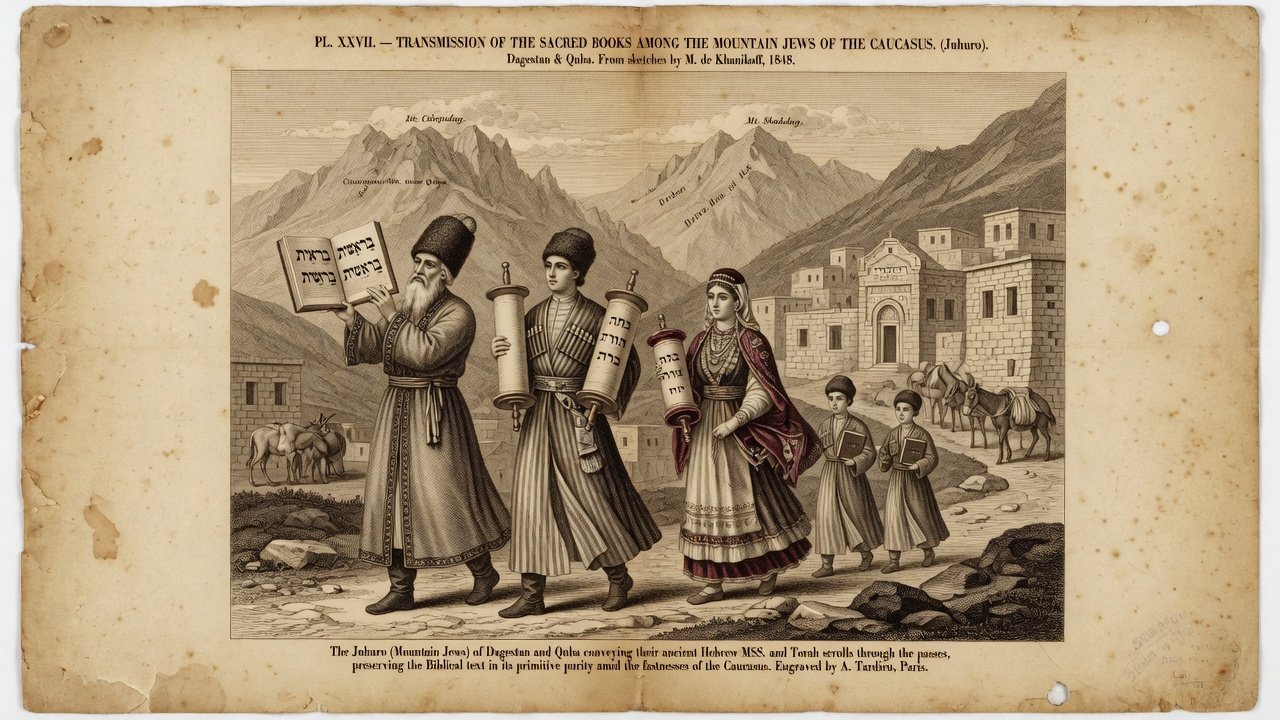
Mountain Jews call themselves Juhuro (and related forms) and speak Judeo-Tat (Juhuri), an Iranian Jewish language of the eastern Caucasus. Outsider labels such as “Mountain Jews” (Russian Gorskie yevrei) describe their historic settlement in highland and foothill zones of Dagestan, Azerbaijan, and neighboring areas. In Israeli sociology they are often grouped under the broad Mizrahi umbrella, yet their language, music, kinship patterns, and synagogue culture form a distinct Caucasus civilization. This note emphasises biblical transmission: how Juhuro communities taught the pointed Hebrew Bible, chanted the weekly portion, and maintained soferim and melamedim under successive empires.
“In the Caucasus the scroll was carried between mountain air and market town—read in Hebrew, explained in Juhuri, guarded by families who measured honor by keeping the commandments.”
II. Historical Geography and Political Frames
Major centers included towns and villages in Dagestan and northern Azerbaijan—among them the renowned Jewish town of Qırmızı Qəsəbə (Krasnaya Sloboda), often described as one of the world’s most densely Jewish settlements outside Israel in certain periods. Mountain Jews negotiated life under Persian, Ottoman, local Caucasian, Russian imperial, and Soviet regimes. Military reputation, trade, and craft occupations appear in ethnographic sources. Legal status shifted from dhimmi-like arrangements under Muslim rulers to imperial subjecthood and then Soviet nationality policy.
Russian conquest integrated the Caucasus into imperial educational and military systems. Some Mountain Jews entered Russian-language schools while traditional heders continued. Soviet power promoted secularization, closed many religious schools, and redefined ethnicity in passport categories—pressuring Hebrew study underground or in domestic settings. Late Soviet and post-Soviet emigration rebuilt large communities in Israel, Moscow, and parts of the United States (notably the New York area).
III. Language Ecology around Scripture
Judeo-Tat served as the vernacular of home, market, and oral storytelling, including biblical narratives and moral teaching. Hebrew (and Aramaic for advanced texts) structured prayer and Torah reading. Russian later became a language of secular education and interethnic communication; Azeri and other local languages mattered in some districts. Israeli Hebrew now dominates for younger generations in Israel, while heritage programs document Juhuri.
As with Judeo-Arabic or Yiddish, vernacular explanation made the Masoretic page socially accessible. Melamedim taught boys to decode pointed Hebrew; household elders retold biblical stories in Juhuri. That bilingual pattern is a classic diaspora structure of Jewish Bible culture.
IV. Synagogue, Cantillation, and Schools
Synagogue Torah reading structured the week. Local melodies for the portion and for festival readings form a Caucasus branch of Jewish oral tradition, less globally famous than Yemenite or Moroccan styles but no less historically real. Traditional education emphasized fluent reading of the prayerbook and humash; advanced students pursued Talmud and codes when teachers were available. Soferim supplied scrolls; ritual slaughterers and other religious functionaries completed communal infrastructure.
Printed humashim from Russian Empire and later Israeli presses entered classrooms. Contact with Ashkenazi and Georgian Jewish neighbors exchanged books and sometimes teachers, while Mountain Jewish distinctiveness remained marked in speech and custom.
V. Soviet Suppression and Domestic Transmission
Anti-religious campaigns closed synagogues and criminalized Hebrew teaching in periods of Soviet history. Families preserved Passover, circumcision, and fragments of literacy privately. The pointed page survived in hidden prayerbooks and in memory of melodies. When religious life reopened in late Soviet years, surviving elders became crucial transmitters for youth rediscovering public Judaism.
VI. Emigration and Israeli-American Reconstitution
From the 1970s onward, and especially after 1991, Mountain Jews emigrated in large numbers. In Israel they built synagogues, cultural associations, and educational frameworks that teach both Israeli Tanakh curriculum and heritage customs. In the United States, concentrated communities sustain communal institutions and Juhuri cultural events. For Masoretic history, this reconstitution shows how a Persianate-language Jewish society carried the Tiberian text through empire, atheism, and migration.
VII. Comparative Notes
Comparison with Bukharan Jews illuminates shared Iranian-language Jewish worlds of Central Asia and the Caucasus. Comparison with Ashkenazi neighbors in the Russian Empire highlights different vernaculars around the same pointed text. Mountain Jews belong on any map of biblical cultures that refuses to stop at the Pale of Settlement’s western edge.
VIII. Honor, Gender, and Religious Knowledge
Ethnographies describe Mountain Jewish codes of honor, hospitality, and gender roles that structured who studied publicly and who transmitted domestic religious knowledge. Women’s songs and foodways carried biblical calendar into the home; men’s synagogue reading carried the formal Masoretic performance. Both are part of transmission history.
IX. Military Service and Imperial Schools
Russian imperial and later Soviet military and schooling channels exposed Mountain Jews to Russian literacy and secular ideologies, competing with heder time. Some families became vectors of modernization; others doubled down on traditional education. The pointed humash survived in both patterns, with different accents of fluency.
X. Krasnaya Sloboda and Urban Concentration
Highly concentrated Jewish towns enabled dense synagogue life and peer enforcement of literacy norms—boys expected to read, public reading a mark of adult male competence. Urban concentration also made communities visible targets in times of unrest. The sociology of the “Jewish town” in the Caucasus parallels shtetl studies in Eastern Europe without identical language or legal history.
XI. Post-Soviet Revival Curricula
After 1991, imported Israeli teachers, Chabad and other outreach networks, and local rabbis introduced modern Jewish curricula into Caucasus and immigrant settings. Heritage Juhuri classes sometimes run parallel to Hebrew schools. The Masoretic text arrives both as Israeli standard Tanakh and as remembered grandfather’s melody—two channels that educators try to braid.