Matti Friedman (b. 1977)
2012 (Algonquin Books)
The Aleppo Codex and its fate
Investigative history / memoir
I. The Book and Its Quest
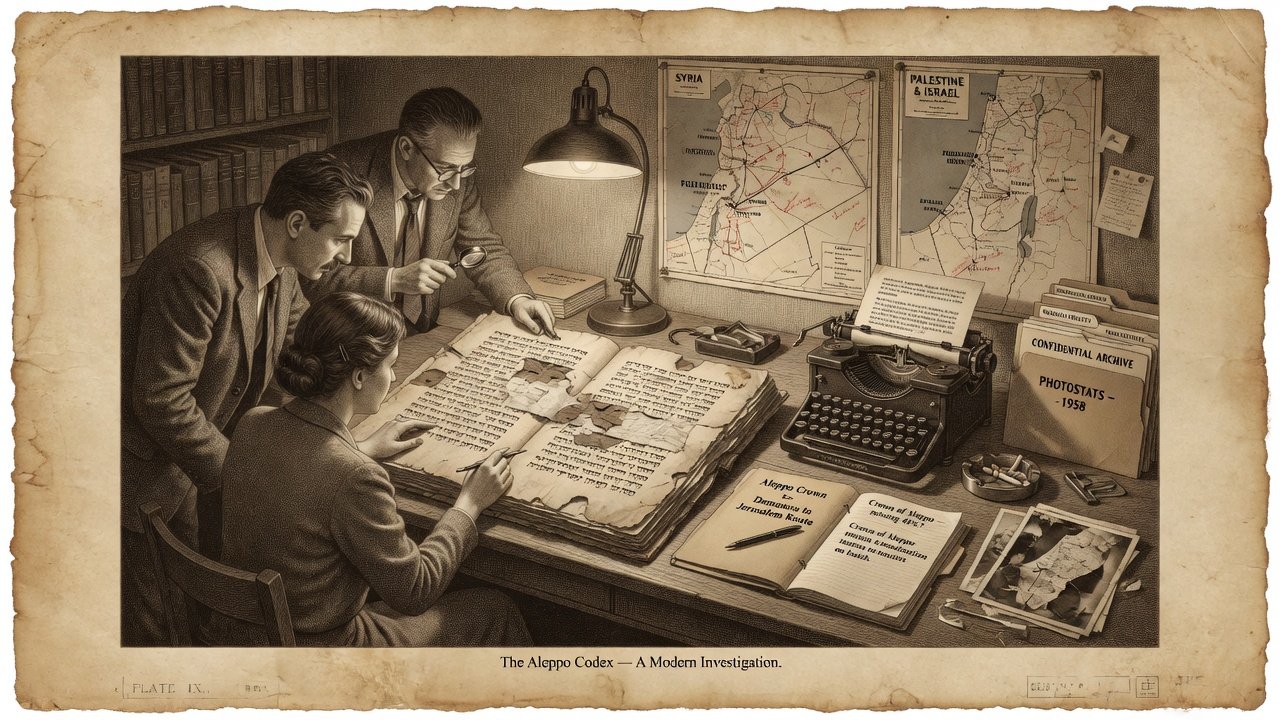
Friedman’s first book is not a technical catalogue of variants or a paleographical monograph. It is a reporter’s reconstruction of how a single medieval Bible became the most revered witness to the Masoretic Text, and how, after surviving Crusaders, Mamluk politics, and Ottoman centuries, it arrived in the young State of Israel with roughly two hundred of its original pages unaccounted for. The narrative moves between archives, synagogues, and the guarded climate-controlled rooms where the remnant is kept today.
The book’s subtitle signals its method: obsession, faith, and pursuit. Friedman follows scholars, custodians, and collectors who treated the codex as more than parchment. For Maimonides it was the standard for Torah scrolls; for Aleppine Jews it was the Keter, the crown of their synagogue; for modern Israeli institutions it became a national treasure whose provenance and losses raise uncomfortable questions. Friedman writes as an outsider admitted into that world, and the tension between reverence and forensic curiosity drives the story.
II. What the Aleppo Codex Is
The Aleppo Codex is a tenth-century Hebrew Bible codex written in the square Aramaic script Jews adopted for Scripture, furnished with the sublinear Tiberian pointing and the elaborate Masorah that made the nakdanim and masoretes famous. Copied in Tiberias around 925 CE, it represents the culmination of the Ben Asher school, the same tradition praised in the colophon traditions and endorsed by Maimonides when he legislated the rules for Torah scrolls in the Mishneh Torah.
When complete, the codex contained the full twenty-four books of the Hebrew Bible. Today only about three-fifths survives. The missing material includes nearly the entire Pentateuch and portions of other books. What remains, chiefly the Prophets and Writings, still ranks among the oldest and most authoritative witnesses to the Tiberian text-type that underlies modern editions such as the Biblia Hebraica Stuttgartensia, even though BHS itself is based on the complete Leningrad Codex of 1008 CE.
Copied in Tiberias; Ben Asher vocalization
Maimonides cites it as authoritative
Guarded in Aleppo’s synagogue
Riots and fire; pages vanish
III. From Tiberias to Aleppo
Friedman reconstructs the manuscript’s journey across a millennium. After its creation in the Galilean center where the Masoretes perfected their notation, the codex traveled through Cairo, where Maimonides is thought to have consulted it, and eventually to the Jewish community of Aleppo in northern Syria. There it was stored in a sealed chest in the Great Synagogue, shown only on rare occasions, and wrapped in the aura of sanctity that Friedman compares to the custodianship of a relic.
The Aleppo years are central to the book’s emotional architecture. Generations of Jews regarded the codex as proof that their community guarded the authentic Bible. Friedman shows how that devotion coexisted with secrecy, restricted access, and, in the twentieth century, the pressures of colonial collapse, Arab nationalism, and Zionism. When Syria’s Jewish population dwindled after 1948, the codex became both a spiritual anchor and a political liability.
“A book that had been hidden for centuries was now at the center of a modern story about nationhood, loss, and the price of survival.” , Paraphrase of Friedman’s framing theme
IV. The 1947 Fire and the Missing Pages
The book’s dramatic hinge is the anti-Jewish riot in Aleppo in December 1947, following the United Nations partition vote. The Great Synagogue was attacked and burned. Sometime in the chaos the codex was damaged, and a large portion of the manuscript disappeared. Friedman investigates what happened in the days and years afterward: who rescued the surviving pages, how the remnant was smuggled to Israel in the 1950s, and why the official story leaves so many gaps.
The missing Pentateuch is the great puzzle. Some pages may have been destroyed in the fire; others, Friedman suggests, may have been removed, sold, or hidden before or after the riot. The Israeli authorities’ handling of the evidence, the reluctance of Aleppine families to speak openly, and the passage of decades have turned the loss into a cold case as much as a scholarly problem. For students of textual transmission, the gap is acute: the very book Maimonides trusted as a Torah standard lacks the Torah itself in surviving form.
- The condition of the codex when it reached Israel in 1957–58
- Discrepancies between community memory and institutional records
- Whether missing leaves circulated privately in Syria or abroad
- How the remnant was conserved at the Israel Museum
V. Faith, Politics, and Custody
Friedman is attentive to the religious stakes. The Aleppo Codex was never merely a museum piece; it was a sefer whose consonants and vowels encoded divine speech as the community understood it. Its transfer from Syria to Israel involved rabbis, government officials, and scholars who disagreed about ownership, photography, and publication rights. Friedman’s account therefore intersects with the broader history traced in Bible Scholarship in the Middle East and Jewish Biblical Scholarship Across the Diaspora.
The book also raises comparative questions familiar on this site. Just as Greek Bible scholars debate the provenance of Codex Sinaiticus or the leaves of early papyri, Hebrew Bible scholars must weigh how institutional custody shapes access and narrative. Friedman’s journalism makes those debates legible to readers who may never open a critical apparatus.
VI. Textual Significance for Masoretic Studies
Beneath the thriller-like surface, Friedman’s book matters for Masoretic scholarship because it keeps the Aleppo Codex visible as a living object rather than an abstract siglum in apparatus critics. The surviving portion confirms readings championed by the Ben Asher tradition against rival vocalizers such as Moses ben Naphtali. Facsimile editions and digital imaging projects depend on the remnant now in Jerusalem; the lost portion, if ever recovered, would reshape editorial practice overnight.
Readers pursuing technical analysis should pair Friedman with the scholarly literature cited on the hub, including Menachem Cohen on the codex and its Masorah and the facsimile work associated with Moshe Goshen-Gottstein. For a complementary illustrated introduction written by Hebraists, see the companion note on Crown of Aleppo by Hayim Tawil and Bernard Schneider.
VII. Reception and Place on This Site
The Aleppo Codex was widely reviewed in the general press and translated into Hebrew. Critics praised Friedman’s storytelling and his ability to explain Masoretic concepts without jargon; some scholars wished for deeper engagement with codicology and the finer points of the Ben Asher–Ben Naphtali debate. The book nonetheless remains the standard popular entry point for the manuscript’s modern history, the human chapter that technical monographs often omit.
On this site it sits alongside notes on the soferim, the nakdanim, Codex Sassoon, and the Cairo Genizah as a bridge between devotional custodianship and critical scholarship. Where those pages explain how the text was stabilized, Friedman asks who carried the codex through the twentieth century’s fires, and what we still do not know.