Antiquity–21st c. CE
Yemen (Sanaa, Aden, highlands)
Hebrew, Judeo-Yemeni Arabic
Distinct pronunciation; scribal tradition; Midrash ha-Gadol
I. Scope, Names, and Why Teimani Bible Culture Matters
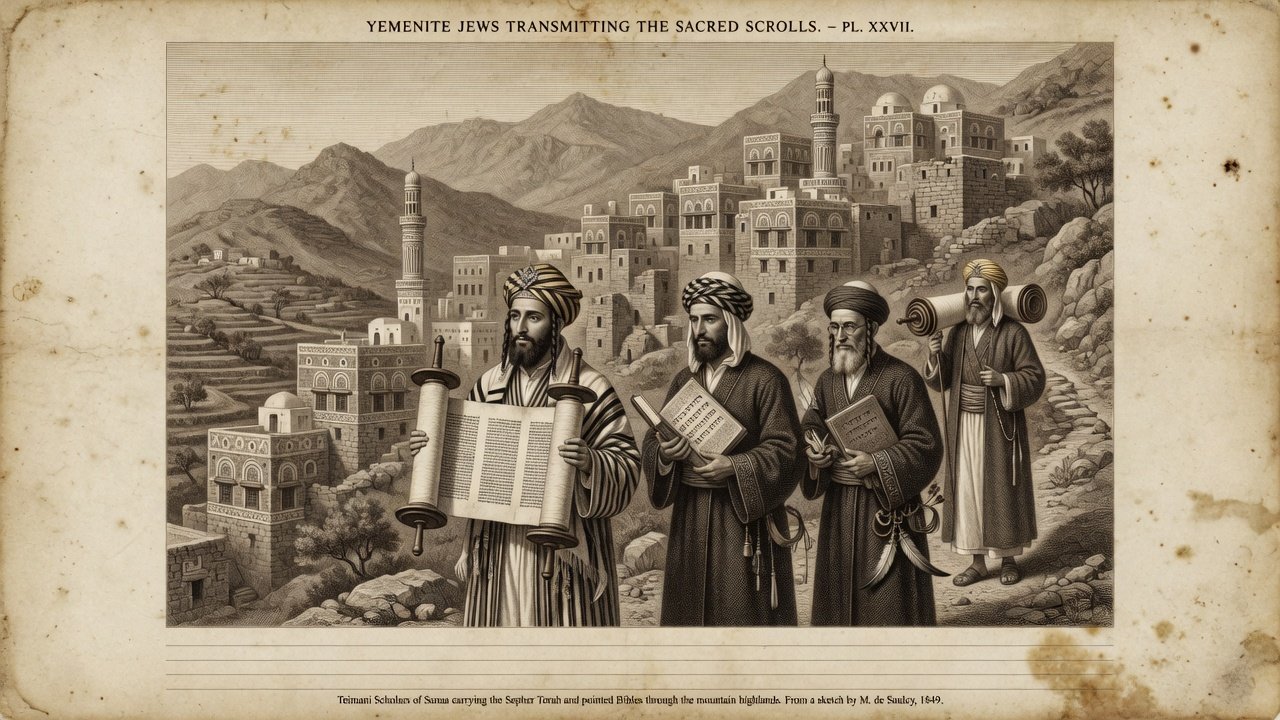
Teimani Jews (Yemenite Jews; Hebrew Teimanim) are the Jewish communities of Yemen and their descendants, especially in Israel after twentieth-century aliyah. For the history of the Masoretic Text, Yemenite tradition is uniquely important: it preserves a carefully transmitted oral performance of Hebrew—pronunciation, cantillation, and pedagogical discipline—that philologists and cantors have long compared with Tiberian theory and with other living reading traditions. This note is an encyclopedic survey of Teimani biblical culture: history, scribal craft, midrash, school methods, internal diversity, and modern continuity.
Companion pages include Sanaa, Mizrahi Jews, Middle East, and Who Were the Masoretes?. Teimani Jewry should not be collapsed into a generic “Eastern” category; its oral and scribal profile is specific.
“For Yemenite readers, the Tiberian signs were not abstract school marks. They were a map of the mouth—kept precise because the public reading of Torah demanded it.”
II. Historical Outline: From South Arabia to Modern Aliyah
Jewish life in South Arabia reaches into late antiquity. Epigraphy, Islamic historiographical traditions, and later Jewish memory place Jews in the Himyarite sphere and subsequent Islamic Yemen. Under Zaydi imams and other regimes, Jews lived as a protected yet subordinated minority, often in artisan trades (silversmithing, weaving, masonry), with internal autonomy for family law and synagogue life. Periodic decrees, messianic movements, and forced relocations (including the seventeenth-century Mawza exile) punctuated centuries of local continuity centered on towns such as Sanaa, Sa’dah, and later Aden under British influence.
Despite political vulnerability, Yemenite communities maintained high levels of male Hebrew literacy for prayer and Torah reading. Isolation from European print culture until relatively late meant that manuscript habits and oral transmission remained central longer than in many Mediterranean communities. In the nineteenth and early twentieth centuries, contact with Ottoman reform, British Aden, and emissaries from the Land of Israel increased movement of books and people. Mass aliyah—especially Operation Magic Carpet (1949–50) and earlier waves—brought most of the community to Israel, where Teimani tradition became a major stream of Israeli Jewish culture and of academic interest in biblical Hebrew phonology.
III. Pronunciation as Masoretic Evidence
Yemenite Hebrew pronunciation retains features—treatment of gutturals (ʾalef, ʿayin, ḥet, he), emphatics, and certain vowels—that many other communities simplified or merged. Torah and haftarah reading implement the Masoretic accents with melodies that encode syntactic and musical tradition. Scholars of Tiberian Hebrew (and of medieval grammatical literature) have used Yemenite oral data as comparative evidence when reconstructing how the pointed text may have been realized, while correctly insisting that Yemenite practice is a living system of its own, not a frozen recording of tenth-century Tiberias.
For this site’s purposes, the lesson is dual: (1) the Masoretic signs are a shared written standard; (2) authentic Jewish communities realize those signs in multiple oral systems. Teimani reading stands among the best-documented non-European realizations. Recordings, linguistic monographs, and yeshiva pedagogy in Israel continue to transmit that oral standard even as Israeli Hebrew pronunciation dominates everyday speech.
IV. Cantillation, Public Reading, and the Synagogue
Public Torah reading is the performance core of Teimani biblical culture. The reader’s precision is a communal value; mistakes are socially and religiously meaningful. Cantillation (teʿamim) structures the verse for listeners and links synagogue sound to the written accents of the codex and printed humash. Festival readings, Esther, Lamentations, and other megillot carry additional melodic systems. Women and households participate as listeners and as teachers of basic literacy and domestic religious knowledge, even when formal public reading remains male in traditional settings.
Compared with Ashkenazi and many Sephardi melodies, Yemenite cantillation is often described as closely bound to the graphic accents—a reputation that reflects both musical aesthetics and pedagogical ideology. Ethnomusicologists and cantorial schools in Israel document regional Yemenite substyles (e.g., central highland vs. other locales) rather than a single monolithic “Yemenite tune.”
V. Scribal Culture and the Physical Scroll
Yemenite soferim maintained exacting standards for Torah scrolls. Scribal manuals, local custom, and halakhic authorities regulated letter forms, spacing, and the writing of divine names. Because printed Bibles arrived later and less densely than in Europe, manuscript production retained prestige. Families of scribes and ritual-object craftsmen supported synagogue life. When communities emigrated, scrolls and scribal knowledge traveled with them; Israeli soferim of Yemenite descent remain prominent in scroll production and repair.
Biblical codices for study—humashim with Targum Onkelos, often highly valued in Yemenite pedagogy—structured private and school reading. The pairing of Hebrew text with Aramaic Targum in education is a hallmark of Teimani biblical schooling and links Yemen to older Near Eastern patterns of bilingual Scripture study.
VI. Midrash, Grammar, and the Curriculum
Beyond the weekly portion, Yemenite learning included midrashic corpora—most famously Midrash ha-Gadol, a major anthology preserving midrashic traditions—and later kabbalistic and legal works. Children learned the alphabet, pointing, and fluent reading early; advanced students moved into Targum, midrash, and halakhah. Grammar was taught in service of accurate reading and interpretation, sometimes through medieval works that circulated in manuscript.
Contact with Sephardi printed books in the modern period introduced standard Mikraot Gedolot layouts and European-style commentaries without erasing Targum-centered pedagogy. In Israel, Teimani yeshivot and schools negotiate Israeli national curriculum and traditional methods side by side.
VII. Internal Diversity: Baladi, Shami, and Related Labels
Teimani Jewry is not uniform. Labels such as Baladi (more “local” custom) and Shami (reflecting greater Sephardi/Syrian influence on rite and some practices) mark historical negotiations with outside books and authorities. These labels affect prayer rites and some customs more than the underlying commitment to precise biblical reading, but they matter for liturgy and for how communities positioned themselves toward printed Sephardi norms. Other geographic distinctions (north vs. south, highland vs. Aden) further diversify practice.
| Stream | Tendency | Biblical/pedagogical note |
|---|---|---|
| Baladi | Older Yemenite custom | Strong continuity of local liturgy and reading habits |
| Shami | Greater Sephardi influence | More open to Sephardi printed forms; still Yemenite oral core |
| Aden / port communities | British and commercial contact | Earlier exposure to print and modern schools |
| Israeli Teimani societies | Post-aliyah reconstitution | Recordings, schools, heritage cantillation; academic study |
VIII. Modern Scholarship and Cultural Revival
From the late nineteenth century, European and later Israeli scholars collected Yemenite manuscripts, recorded pronunciation, and edited texts. Yemenite Jews themselves became professors, rabbis, poets, and public intellectuals who reframed Teimani heritage inside Israeli culture. Heritage organizations teach children Torah melodies; academic projects digitize manuscripts; popular media amplify Yemenite music, including piyyutim built on biblical language.
Controversies over historical treatment of Yemenite immigrants in early Israel (including the Yemenite Children Affair) are part of modern communal memory and historiography; they belong to social history, while this note keeps focus on scriptural transmission—even as trauma and revival shape who teaches the next generation to read.
IX. Comparative Place in World Jewry
Compared with Ashkenazi yeshiva dialectics, Sephardi grammatical humanism, and Maghrebi Judeo-Arabic piyyut culture, Teimani tradition stands out for oral-phonetic conservatism and Targum-rich schooling. It is a cornerstone of any serious map of how the Masoretic text is lived, not only edited.
X. Recordings, Linguistics, and the Future of Oral Masorah
Audio archives of Yemenite Torah readers are now primary sources for phonology and cantillation studies. As everyday Israeli Hebrew dominates, deliberate pedagogy—schools, synagogue practice, family transmission—must carry oral Masorah forward. Teimani tradition may be the best-documented case of a community consciously preserving a non-standard (relative to Israeli speech) biblical pronunciation as heritage and as religious ideal.
XI. Manuscript Diaspora of Yemenite Books
Yemenite manuscripts in Jerusalem, New York, and European libraries include biblical books, Targum, and midrash. Cataloguing and digitization projects continue. Each codex is a data point in how the Masoretic text and its companions were copied at the edge of the Arabian world.