c. 9th–21st c. CE
Rhineland, Poland–Lithuania, Pale of Settlement, Americas, Israel
Hebrew alphabet (with Yiddish orthography)
Taytsh, Tsene-rene, cheder & yeshiva pedagogy
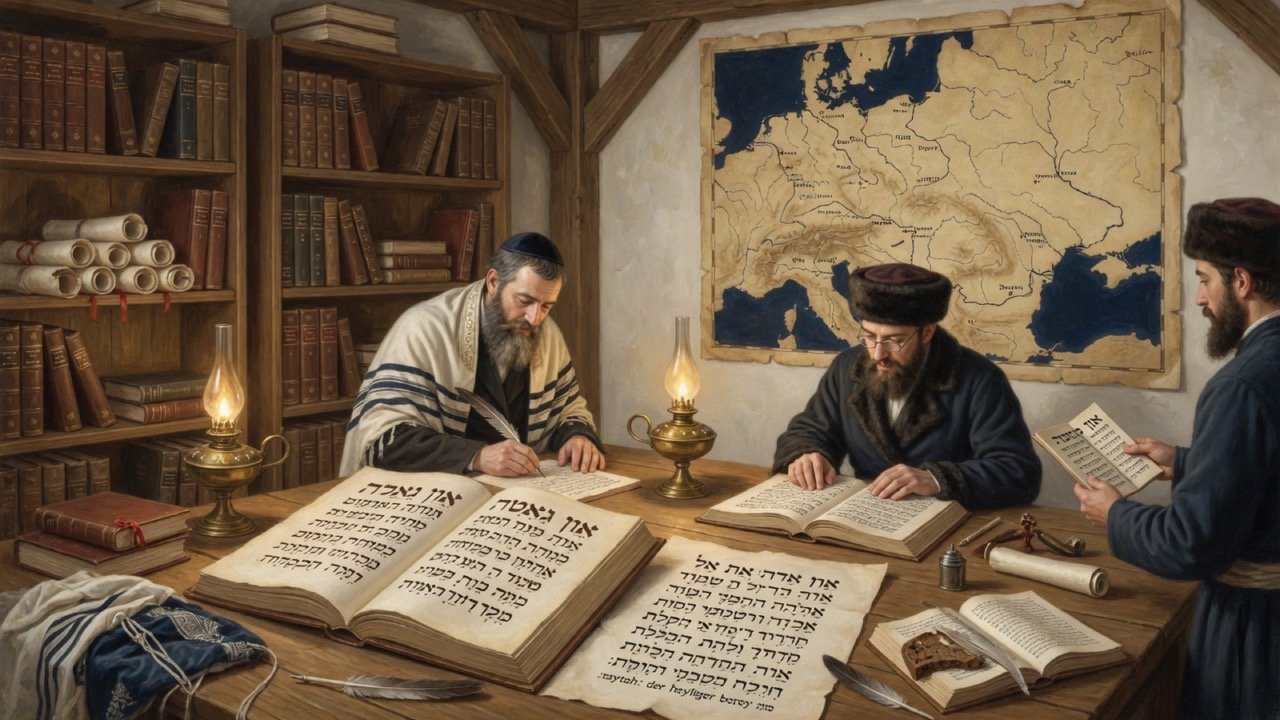
I. Scope, Terms, and Why Yiddish Matters for Bible Transmission
“Yiddish” (ייִדיש, yidish, “Jewish”) names the historical vernacular of Ashkenazi Jewry: a High German–based Jewish language written in the Hebrew alphabet, enriched by Hebrew–Aramaic (loshn-koydesh) vocabulary and, over centuries, by Slavic and other contact elements. It is not a “corrupt German,” nor merely a folk dialect. Linguists treat it as a full Jewish language with its own dialects, literature, and orthographic traditions—Western Yiddish in Central Europe and Eastern Yiddish (Litvish, Poylish, Ukrainish/Galitsyaner clusters) east of the German speech area.
This note situates Yiddish inside the site’s larger story of how Jews transmitted the Hebrew Bible. The Masoretes of Tiberias fixed consonants, vowels, and cantillation for a sacred text that Ashkenazim continued to copy, print, and chant in Hebrew. Yiddish did not replace that text. It surrounded it: in women’s Bible digests, in schoolroom word-for-word translation, in sermons, responsa digests, and popular ethical books that quoted verses and explained them. Companion pages include the encyclopedic note on Ashkenazi Jews, regional studies of Eastern Europe and the Pale of Settlement, and the comparative language notes on Hebrew & Aramaic and Ladino.
Historiography has swung between romantic “folk genius” portraits and harsh modernizing dismissals (maskilim and Zionists who preferred German or Hebrew). Contemporary scholarship—philology, book history, gender history, and diaspora studies—treats Yiddish as a primary archive of how ordinary and learned Jews lived with Scripture under Christian rule, imperial census, and mass migration.
“Hebrew was the language of the verse; Yiddish was the language in which the verse entered the kitchen, the market stall, and the child’s first lessons—without ever ceasing to be Hebrew on the scroll.”
II. Origins: From Loter to Early Ashkenaz
The earliest strata of Yiddish form in the medieval Jewish communities of the Rhineland and adjacent regions sometimes called Loter (Lotharingia) and, later, Ashkenaz. Jewish merchants and scholars moving along Rhine and Main routes adopted local German speech as their vernacular while retaining Hebrew for liturgy, legal writing, and Bible study. By the High Middle Ages, distinctive Jewish phonological and lexical features—and the habit of writing the vernacular in Hebrew letters—were already visible in glosses and documentary fragments.
Contact with Romance-speaking Jews (Zarfat/France) and with Hebrew–Aramaic sacred registers produced a mixed lexicon: everyday words from German stock; kinship, ritual, and textual terms from loshn-koydesh; occasional Romance leftovers in Western Yiddish. The same communities that produced Rashi’s classroom Bible culture in northern France and the Rhineland were incubating the speech that would become Yiddish as Jews migrated eastward under pressure of expulsions, economic opportunity, and the rise of the Polish–Lithuanian Commonwealth as a major Jewish center.
Crucially for biblical culture, early Ashkenaz already practiced laʿaz—vernacular glossing of difficult Hebrew words—in the school. Rashi’s French glosses are the famous case; German-Jewish teachers did analogous work. Yiddish inherited that pedagogical impulse and, over centuries, standardized it into full verse-by-verse taytsh.
III. Dialects, Geography, and Demography
By the early modern period, Western Yiddish (spoken in German lands, parts of the Netherlands, Alsace, and related zones) and Eastern Yiddish (the dialects of Poland, Lithuania, Ukraine, Romania, and neighboring regions) had diverged. Eastern Yiddish became demographically dominant as the Jewish population of the Commonwealth and later the Russian Empire’s Pale expanded into the millions. Litvish (Northeastern), Poylish (Central/Mideastern), and Southeastern clusters differed in vowels, lexicon, and prestige hierarchies that still shape Hasidic courts and theater traditions.
Yiddish was never the only Jewish language of Europe—Sephardim spoke Ladino and local tongues; Italian, Greek, and other Jewish languages thrived elsewhere—but by 1900 it was the mother tongue of the majority of world Jewry. That demographic weight made Yiddish print culture a mass medium for biblical knowledge: humashim with Yiddish, women’s Bibles, and newspapers that quoted Scripture in both languages.
| Zone | Rough geography | Notes for Bible culture |
|---|---|---|
| Western Yiddish | German lands, Alsace, Dutch zones | Earlier print; gradual language shift to German |
| Litvish (NE) | Lithuania, Belarus, parts of Latvia | Yeshiva prestige; mitnagdic learning centers |
| Poylish / Central | Poland, Galicia, parts of Hungary | Hasidic courts; rich folk and theatrical culture |
| Southeastern | Ukraine, Romania, Bessarabia | Hasidic dynasties; Slavic contact features |
IV. Script, Orthography, and the Look of the Page
Yiddish is written in the Hebrew alphabet, historically in styles related to Ashkenazi cursive and to the square letters of the printed page. Unlike pure Hebrew Bibles, Yiddish texts often mark vowels more explicitly (using ayin, alef, vav, yud as vowel letters) and developed conventions for Germanic sounds absent from classical Hebrew. Printing standardized typefaces—from early Christian and Jewish presses in Italy and Germany to the great Eastern European houses of the nineteenth century.
The visual ecology of an Ashkenazi household book might include: a pointed Hebrew humash with Rashi; a Yiddish paraphrase (Tsene-rene or similar); a siddur with Yiddish instructions; and ethical tracts in Yiddish that open with biblical mottoes. The Masoretic apparatus (niqqud, teʿamim) remained on the Hebrew column. Yiddish lived in the margins, facing pages, and separate volumes that taught what the pointed text “said.”
Modern orthographies split among YIVO academic norms, Soviet spelling reforms, Hasidic conventions, and Israeli practices. For historians of the Bible in Ashkenaz, the important constant is continuity of Hebrew script: a child who learned to sound Yiddish already possessed the letter shapes of the sacred page.
V. Taytsh: Word-for-Word Bible in the Vernacular
Taytsh (from Middle High German diutsch, “German/vernacular”) denotes the traditional Ashkenazi practice of rendering each Hebrew (or Aramaic) word of the Bible—and often of the prayerbook—into a fixed Yiddish equivalent, typically in classroom chant. It is not free literary translation. It is a pedagogical chain: Hebrew lemma → traditional Yiddish gloss, drilled until the verse can be “said in taytsh.”
This system made the Masoretic text socially portable. Boys in cheder learned to map the pointed Hebrew of Genesis onto Yiddish before they could follow Rashi’s French-tinged medieval Hebrew. Girls and women, often excluded from full yeshiva tracks, absorbed biblical narrative through Yiddish digests that still pointed back to the weekly parasha. The authority of the verse remained Hebrew; the language of first understanding was Yiddish.
Taytsh also constrained innovation. Because glosses were traditional, they preserved older Germanic and Hebrew–Aramaic calques long after spoken Yiddish had shifted. Philologists use old taytsh lists as evidence for both Yiddish history and Ashkenazi exegetical habit. For this site’s concerns, taytsh is the vernacular twin of Masoretic vocalization: one marks how the Hebrew is read; the other marks how it is understood in daily speech.
VI. The Tsene-rene and Women’s Bible Culture
No Yiddish book rivals the cultural reach of the Tsene-rene (צאנה וראינה), the early modern Yiddish “women’s Bible” that retells the Torah and selected haftarot and megillot with midrashic expansions, ethical digressions, and homiletic warmth. First printed in the early seventeenth century and reissued in countless editions, it became a staple of Ashkenazi homes from Amsterdam to the Pale.
Though marketed toward women, men read it too. Its Yiddish prose carried biblical plot, rabbinic legend, and seasonal piety into domestic space. It did not claim to replace the Hebrew sefer Torah or the pointed humash; it mediated them. In that sense it parallels Judeo-Arabic and Ladino Bible digests elsewhere in the diaspora: vernacular bridges to a Hebrew core.
Gendered literacy matters for textual history. Communities that kept women close to the weekly cycle through Yiddish ensured that biblical narrative was not only a male scholarly possession. Domestic transmission—mothers teaching blessings, stories, and verse mottos—supported the same calendar that yeshivot elaborated with dialectic.
VII. Print, Publishing Centers, and the Mass Humash
Print multiplied Yiddish biblical culture. Sixteenth- and seventeenth-century presses in Italy, Prague, Basel, and elsewhere issued Yiddish biblical books alongside Hebrew. In the eighteenth and nineteenth centuries, Eastern European centers—Warsaw, Vilna, Lemberg/Lviv, Odessa, and others—produced enormous runs of humashim, siddurim, and Yiddish religious literature. Christian Hebraist and Jewish printers alike participated in markets that stretched across imperial borders.
City notes on this site—such as Warsaw, Krakow, Lviv, Odessa, Prague, and Vilnius (where present)—map the urban infrastructure of that print world. The same cities hosted yeshivot, maskilic circles, and, later, secular Yiddish newspapers that still quoted Tanakh in editorial battles over modernity.
The mass humash with Yiddish aids democratized access to the parasha. Accuracy of the Hebrew text remained a rabbinic and scribal concern (soferim, proofreaders, prestige editions); Yiddish apparatus expanded the audience that could follow the cycle week by week.

VIII. Hasidism, Mitnagdism, and the Heard Verse
Hasidic courts elevated Yiddish as a language of teaching: rebbes delivered toyre and tales in Yiddish, saturated with biblical phrases and reworked midrash. The heard verse—chanted, quoted, playfully reinterpreted—moved through courts from Medzhybizh to later dynasties in Poland, Galicia, and Hungary. Song (nigun) and story carried biblical motifs into emotional registers that pure legal Hebrew did not always reach.
Mitnagdic and Litvish yeshivot prized Hebrew–Aramaic dialectic (Gemara) yet still lived in Yiddish daily speech. The dual regime is essential: loshn-koydesh for the page of Talmud and the cantillated Torah reading; Yiddish for explanation, debate outside the formal phrase, and life. Both camps presupposed the Masoretic Torah reading in the synagogue. Yiddish was the sea; the pointed Hebrew lection was the island of public ritual.
IX. Haskalah, Language Politics, and Modern Hebrew
The Jewish Enlightenment (Haskalah) often attacked Yiddish as jargon and promoted German, Russian, or revived Hebrew. Maskilic satire in Yiddish itself became a weapon. Later, Labor Zionism and Israeli nation-building elevated modern Hebrew and, for a time, marginalized Yiddish as diaspora baggage—even as Yiddish writers created a modern secular literature of world stature (the classical triad and their successors).
These politics reshaped biblical culture. School systems that taught Tanakh in modern Hebrew reduced the social need for taytsh. Yet Hasidic and some haredi communities retained Yiddish as a vernacular, preserving older pedagogical patterns. In America, Yiddish newspapers and schools mediated immigrant Judaism, including serialized Bible and midrash, before English took over. The decline of everyday Yiddish did not erase its historical role as the main Ashkenazi bridge to Scripture for centuries.
X. Catastrophe, Survivors, and Postwar Geographies
The Holocaust destroyed the demographic heartland of Yiddish in Eastern Europe—the speakers, the presses, the cheders, the libraries. Surviving centers shifted to North America, the young State of Israel, Latin America, Australia, and residual European communities. Hasidic neighborhoods rebuilt Yiddish-speaking worlds in Brooklyn, Jerusalem, Antwerp, London, and elsewhere. Secular Yiddishism continued in cultural institutions, academia, and theater.
For Bible transmission, the rupture was double: loss of people and of a vernacular pedagogy. Postwar Ashkenazi Orthodoxy often rebuilt learning in modern Hebrew or local languages; Hasidic courts kept Yiddish. Academic Yiddish studies recovered texts that document how earlier generations read the Bible at home. The pointed Hebrew text remained; the dominant vernacular frame changed.
XI. Yiddish, the Masorah, and Comparative Jewish Languages
Yiddish never developed a rival Masorah. It did not re-point the Torah. Its contribution was sociolinguistic and pedagogical: it made a fixed Hebrew text livable for a diaspora that spoke another Jewish language every day. In that role it pairs with Ladino for Sephardim, Judeo-Arabic for many Mizrahi communities, and other Jewish languages mapped across this site’s Diaspora Hub.
Comparative questions clarify the Masoretic story. Why did Tiberian vocalization become the prestige system for printed Bibles while vernaculars carried meaning? How did print standardize both Hebrew Bibles and Yiddish digests? What happens to biblical literacy when a Jewish vernacular collapses in two generations? Yiddish is a central case for each question.
| Language | Primary communities | Relation to Hebrew Bible |
|---|---|---|
| Hebrew (loshn-koydesh) | All Jewries (liturgy, scrolls) | Language of the Masoretic page and public reading |
| Yiddish | Ashkenazim | Taytsh, digests, sermons; Hebrew remains sacred core |
| Ladino / Judezmo | Sephardim | Coplas, calques, Me’am Lo’ez; Hebrew core retained |
| Judeo-Arabic | MENA Jewries | Tafsir, sharḥ; see Arabic & Hebrew |
XII. Literature Beyond the Parasha
Modern Yiddish literature—Mendele Moykher-Sforim, Sholem Aleichem, I. L. Peretz, and later poets and novelists—constantly reworks biblical cadence, names, and irony. Even secular stories sit inside a world where a verse can settle an argument. Folklore (mayse-bikhlekh), Purim plays, and workers’ songs quote and parody Scripture. This literary ocean is not “Masorah” in the technical sense, but it is evidence of how deeply the biblical repertoire saturated Ashkenazi speech.
Theater and film in Yiddish carried biblical and pseudo-biblical drama to mass audiences. Translation projects rendered world literature into Yiddish and Yiddish into other languages, changing what “Jewish Bible culture” meant in modernity: not only the humash, but a vernacular canon in dialogue with it.
XIII. Institutions of Memory and Study Today
YIVO, university programs, summer institutes, Hasidic schools, and digital archives (scanned humashim, audio of native speakers, oral history) now sustain Yiddish after the destruction of its heartland. For students of the Hebrew Bible’s reception, these resources open schoolbooks, women’s Bibles, and sermons that critical editions of the Masoretic Text do not reprint.
This site’s map and city notes are designed to be used with language pages like this one: click from Eastern European map filters into urban Bible-scholarship histories, then return here for the vernacular frame that made those classrooms run.
XIV. Method: How to Read Yiddish Sources for Biblical History
A practical method for historians and students: (1) keep the pointed Hebrew lectionary cycle as the spine; (2) read Yiddish digests and taytsh as reception, not as textual witnesses to ancient variants; (3) watch gender and class—who owned which books; (4) track print centers and bans; (5) compare with Ladino and Judeo-Arabic analogues before generalizing about “the Jewish vernacular Bible.”
Yiddish sources rarely overturn Masoretic readings; they show how stable readings were taught. That stability is itself a historical fact: the Ashkenazi world trusted a vocalized Hebrew text even when every explanation of it came out in another Jewish language.
XV. Why It Matters
Without Yiddish, the social history of the Masoretic Bible in Ashkenaz is incomplete. Scrolls and codices tell us what was written; yeshiva volumes tell us how elites argued; Yiddish tells us how millions first understood the words they heard on Shabbat. The language’s devastation in the twentieth century makes that record precious. Preserving and studying it is part of understanding how the Hebrew Bible was lived—not only how it was copied.
XVI. Case Studies: Vilna, Warsaw, and New York
Vilna (Vilnius), the “Jerusalem of Lithuania,” concentrated mitnagdic learning, printing, and a Yiddish street speech that framed elite Hebrew–Aramaic study. Warsaw combined Hasidic courts, mass publishing, and later secular Yiddish culture in one urban field. Both cities—mapped in this site’s Eastern European notes—show how yeshiva and vernacular cohabited until destruction and migration emptied the streets.
New York’s Lower East Side and later boroughs rebuilt Yiddish newspapers, theaters, and schools that taught immigrant children Bible stories in a new political world. English eventually dominated, but for decades American Yiddish print carried serialized midrash, weekly parasha columns, and debates over Zionism and socialism that still quoted verses. The geography of Yiddish Bible culture is therefore not only the Pale; it is also the Atlantic crossing.
Follow related city notes such as Warsaw, Odessa, and New York, and the regional surveys of Eastern Europe and the Pale of Settlement.
XVII. Synthesis: Yiddish in the Architecture of Transmission
Yiddish is a load-bearing wall in the social architecture of Ashkenazi Bible transmission. Remove it, and we are left with elites and artifacts but not with the mass pedagogy that made the pointed text a people’s book. Together with Ladino and Judeo-Arabic, it shows that the Masoretic project succeeded not only because scribes were careful, but because communities invented Jewish languages that could teach care.
Readers of this site should move among three layers: the technical Masorah (niqqud, teʿamim, notes), the geographic diaspora (cities and empires), and the vernaculars (Yiddish, Ladino, Judeo-Arabic). This page is the Yiddish gate into that third layer.