חַלֶּב (Ḥaleb)
Aram Tsova (2 Sam. 8)
1947 riots; mass emigration
I. Antiquity and Aram Tsova
Aleppo stands among the oldest continuously inhabited cities in the world. Jewish settlement in northern Syria reaches back into antiquity, when the region formed part of Aram and lay on caravan routes linking Anatolia, Mesopotamia, and the Levant. The Bible associates the area with Aram Tsova (2 Samuel 8:3), a kingdom David subdued, embedding Aleppo in the sacred geography of Israel’s Scriptures.
Under Roman and Byzantine rule, Jews lived alongside Greek-speaking Christians in a plural city. After the Arab conquests of the seventh century, Aleppo became a major Islamic commercial hub. Its Jewish quarter developed its own liturgical customs, eventually classified among the minhagei Aram Tsova, the rites of Aram Tsova, while remaining tied to the wider Babylonian and Palestinian legal traditions that shaped how the Bible was read across the Middle East.
II. The Great Synagogue and the Crown
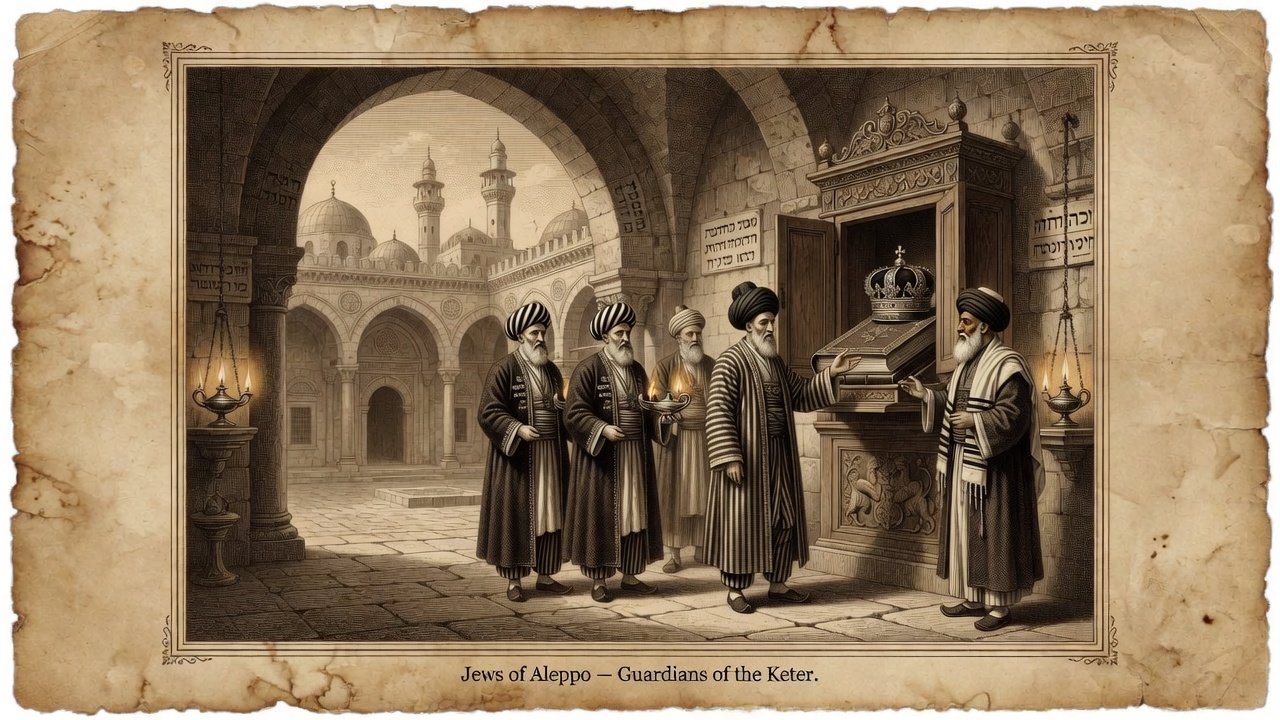
The spiritual center of Aleppine Jewry was the Great Synagogue (כְּנִיסַת הַחַלָּבִים), traditionally said to date to the era of Joab or to the return from Babylonian exile, claims that express how deeply the community rooted itself in biblical memory. For most of the second millennium CE its greatest treasure was the Aleppo Codex, copied in Tiberias around 925 and vocalized by Aaron ben Moses ben Asher.
The codex was kept in a locked chest, shown only on rare occasions. Community members called it the Keter (crown), a title that captured both its beauty and its authority. Scribes and rabbis treated it as the standard against which Torah scrolls and liturgical codices were corrected. When Maimonides ruled that Torah scrolls should follow the Ben Asher text, Aleppo’s possession of the codex gave the city unique prestige in the world of Masoretic scholarship. See Crown of Aleppo and The Aleppo Codex (Friedman) for the manuscript’s modern history.
“Aleppo did not merely hold a famous Bible; its community saw itself as the codex’s appointed guardian, a responsibility that outlasted dynasties and empires.”
III. Medieval and Early Modern Life
Medieval Aleppine Jews traded in spices, textiles, and manuscripts, connecting the city to Damascus, Baghdad, Cairo, and the ports of the eastern Mediterranean. Rabbinic scholars issued responsa on biblical readings, marriage contracts stipulating corrected scrolls, and communal regulations governing scribes. Benjamin of Tudela, traveling in the 1170s, mapped a dense network of Jewish communities across Syria; Aleppo belonged to that commercial and scholarly world even if his itinerary highlights larger centers.
Under Ottoman rule (1516–1918) the community enjoyed periods of prosperity and suffered occasional violence. Aleppine Jews spoke Arabic in daily life, used Hebrew for prayer and study, and produced liturgical poetry (piyyutim) in both languages. Their biblical culture blended Syrian melody traditions with the pointed Masoretic text imported from Palestine and Iraq, the same plural vocalization landscape documented in the Cairo Genizah.
IV. Modern Era and the 1947 Catastrophe
In the nineteenth and early twentieth centuries Aleppine Jews participated in the same modernizing currents as other Middle Eastern communities: Alliance schools, commercial ties with Europe, and Zionist emigration. After the First World War and the fall of the Ottoman Empire, French Mandate rule brought new political uncertainties. The establishment of the State of Israel in 1948 intensified pressures on Syrian Jewry.
In December 1947, amid anti-Jewish riots following the UN partition vote, the Great Synagogue was attacked and burned. The Aleppo Codex was damaged and a large portion, including nearly the entire Pentateuch, disappeared. Survivors eventually smuggled the remnant to Israel, where it is housed today at the Israel Museum. The human community followed a similar arc: most Aleppine Jews emigrated to Israel, North America, and Latin America during the 1950s and after, so that only a handful remained in Syria by the end of the twentieth century.
V. Legacy for Biblical Studies
Aleppo matters to Masoretic studies because its Jews preserved and transmitted the most celebrated Ben Asher codex, a manuscript Maimonides treated as normative. Their scribal culture, liturgical melodies, and communal discipline embodied the conviction that the pointed Hebrew Bible was too sacred to treat as a mere antiquity. Diaspora descendants continue to maintain Syrian synagogues and chant traditions, keeping alive a soundscape shaped by the same niqqud and teʿamim the Masoretes fixed in Tiberias.
For the wider map of Jewish learning, Aleppo was a Syrian anchor in a network that included Baghdad’s Geonic world and the manuscript traffic of northern Iraq. Together these communities carried the Masoretic Text across the Arabic-speaking diaspora until modern migration reshaped the map.