Medieval Crimea–21st c. remnant
Crimean Peninsula; small diaspora
Krymchak (Turkic Jewish), Russian, Hebrew
Rabbanite Torah reading; local schools; print in modern era
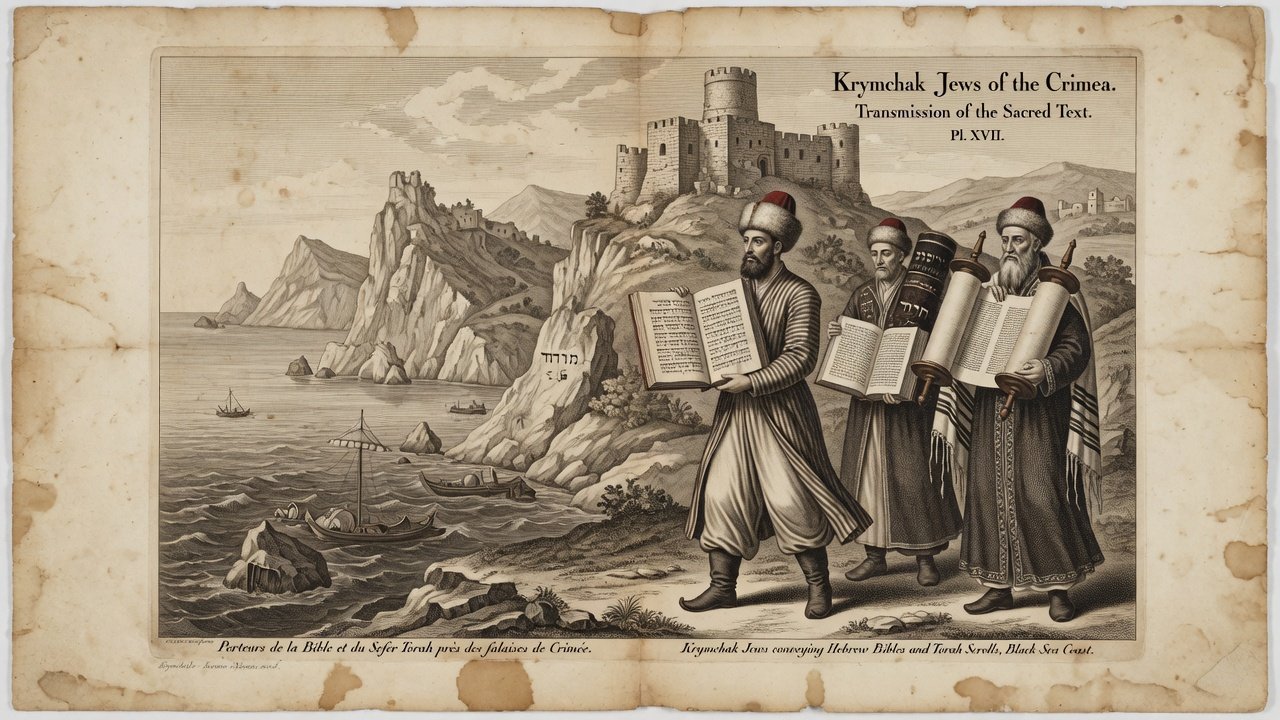
I. Who Are the Krymchaks?
The Krymchaks are the historic Turkic-speaking Rabbanite Jews of Crimea—distinct from Crimean Karaites, who rejected the Talmud while sharing the peninsula. Krymchaks followed Rabbanite law, read the Torah as part of that mainstream, and developed a Turkic Jewish language and culture under Khazar-era memories, Crimean Tatar rule, Ottoman influence, and the Russian Empire. This note surveys their history with emphasis on Hebrew Bible education and the near-destruction of the community in the twentieth century.
“On the Black Sea the Rabbanite scroll had a Turkic accent—until the twentieth century nearly erased both the accent and the people who kept it.”
II. Crimean Setting and Neighboring Karaites
Crimea hosted multiple Jewish and Judaic groups. Karaites developed a distinct identity and, under Russian rule, sometimes obtained different legal status from Rabbanite Jews. Krymchaks remained Rabbanite: Talmudic law, rabbinic authorities, and standard festival Torah readings. Shared geography produced comparison and occasional confusion in outsider sources; careful historiography keeps the groups distinct. Abraham Firkovich and Karaite manuscript collecting are part of Crimea’s Jewish book history, even when Krymchak-specific archives are thinner.
III. Language and Bible Pedagogy
The Krymchak language is a Jewish variety of Crimean Tatar Turkic historically used in daily life. Hebrew structured liturgy and Torah reading; Russian entered through imperial schools. Traditional education taught boys to read the pointed prayerbook and humash; synagogue reading used local melodies. As Rabbanites, Krymchaks participated in the same Masoretic textual standard as Ashkenazi neighbors in the Russian Empire, while explaining Scripture through a Turkic vernacular—another instance of the classic bilingual structure of diaspora Bible culture.
IV. Russian Empire and Modernization
Nineteenth-century print, Russian education, and contact with Ashkenazi Jews of the Pale brought new books and ideologies (Haskalah currents, later Zionism and socialism). Some Krymchaks entered modern professions; traditional religious life continued in Crimean towns. Demographic smallness made the community vulnerable to any catastrophe.
V. Genocide and Soviet Aftermath
German occupation during World War II murdered the vast majority of Krymchaks; the community was devastated on a scale that left only fragments. Soviet silence and assimilation pressures further eroded language and institutions. Post-Soviet and Israeli/diaspora remnants document what can still be recovered: words of the language, melodies, family humashim, and names of the dead.
VI. Memory, Documentation, and Why It Matters for Biblical History
Linguists, ethnographers, and Jewish museums work to record Krymchak heritage. For this site’s encyclopedia of biblical cultures, Krymchaks represent a Black Sea Rabbanite path—parallel to Ashkenazi neighbors yet linguistically Turkic—cut short by genocide. Their absence from many popular maps of Jewry is itself a historiographical failure this note seeks to correct.
VII. Comparative Notes
Unlike Karaites, Krymchaks held the Oral Law. Unlike Mountain Jews, their Turkic speech was Crimean rather than Iranian Tat. Unlike large Maghrebi or Yemenite populations, they lacked demographic depth to recover after mass murder. Remembering their Bible culture is part of remembering the full human range of Masoretic reception.
VIII. Small Demography and Cultural Fragility
Unlike Maghrebi or Ashkenazi populations counted in hundreds of thousands or millions, Krymchaks were always demographically small. Smallness magnifies the effect of war: murdering a few thousand can end a language. Biblical cultures depend on critical mass of teachers and children; Krymchak history is a tragic demonstration of that sociological fact.
IX. Archives, Ethnography, and Reconstruction
What we know of Krymchak cantillation and schooling often comes from sparse ethnographies, survivor testimony, and comparison with neighboring Turkic and Jewish cultures. Reconstruction must be humble: not every melody is recoverable. Naming the loss is itself part of encyclopedia ethics.
X. Crimea as Crossroads of Biblical Cultures
Crimea hosted Rabbanite Krymchaks, Karaites, Ashkenazi migrants, and earlier layers of Jewish presence. The peninsula is a laboratory of coexistence and distinction: two communities can share markets and still read Scripture through different legal canons. Mapping Krymchak Bible culture requires mapping that crowded sacred geography.
XI. After the Murder: What Transmission Remains
Post-genocide transmission cannot mean normal heder chains. It means: linguistic salvage; memorial books; rare synagogue revivals; DNA and genealogy projects that reconnect descendants; and scholarly insistence on including Krymchaks in histories of Russian-imperial Jewry. The pointed page survives here primarily as a remembered obligation and as text in museums—not as a mass living classroom. That too must be written down, lest encyclopedia silence complete what violence began.