c. 15th–21st c. CE (Iberian roots earlier)
Ottoman Balkans & Anatolia, North Africa, Land of Israel, Americas
Hebrew (Rashi/solitreo); later Latin letters
Calque tradition, Meʿam Loʿez, coplas, print
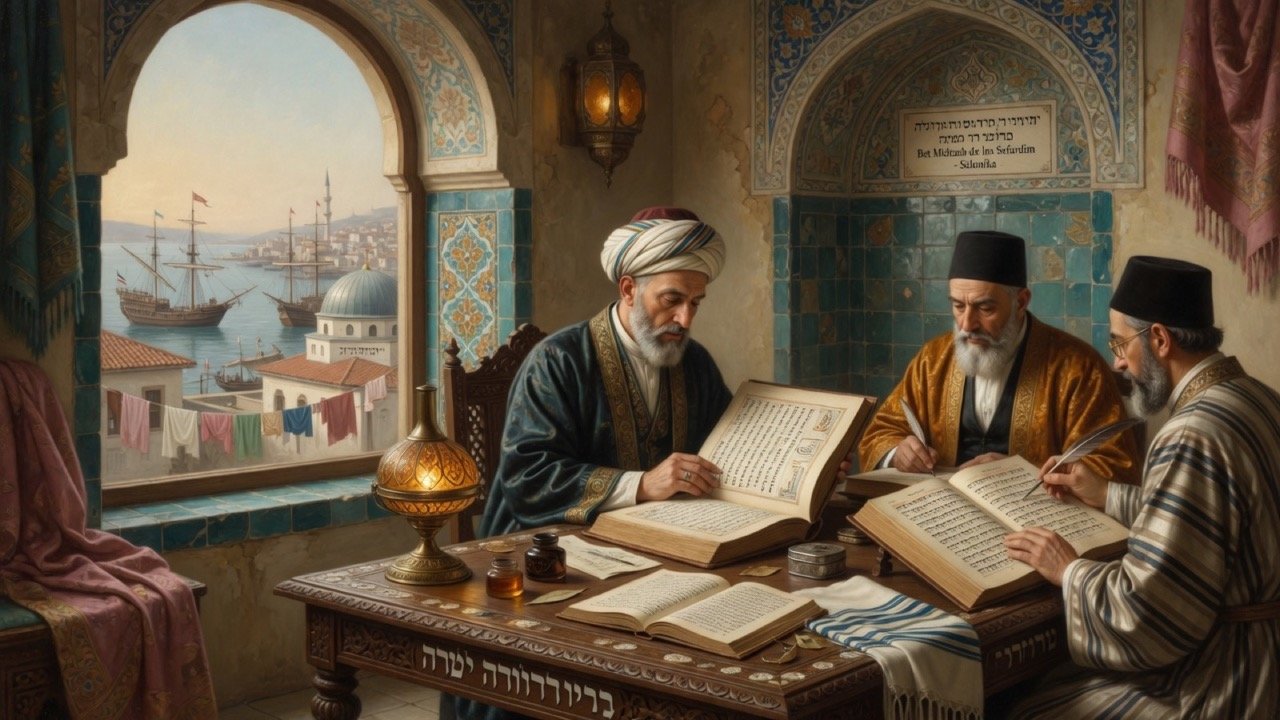
I. Scope, Names, and Historiography
“Ladino” is a popular and scholarly name with contested boundaries. Strictly, some linguists reserve Ladino for the calque (word-for-word) register used to render Hebrew/Aramaic sacred texts into Hispanic Jewish language, and prefer Judezmo or Judeo-Spanish for the everyday spoken language. In communal speech, “Ladino” often covers both. This note uses Ladino/Judezmo inclusively while flagging the calque tradition as especially important for Bible transmission.
Other labels—Spanyolit, Haketia (North African Judeo-Spanish with Arabic contact), Western Sephardi Spanish/Portuguese among Spanish-Portuguese Jews—mark regional paths after the 1492 expulsion and the Portuguese persecutions that followed. Companion pages: Sephardi Jews, Sephardim in the Ottoman Empire, Golden Age of Spain, and the vernacular counterpart Yiddish.
Scholarship draws on Ottoman archives, communal pinkasim, rabbinic responsa, printed Bibles and Meʿam Loʿez volumes, ballad (romancero) fieldwork, and modern language revival projects. Romantic portraits of “Spanish Jews who never forgot Castile” must be balanced with local Balkan, Turkish, Greek, and Maghrebi histories—and with the primacy of Hebrew liturgy and Masoretic Scripture in synagogue life.
“Judezmo was the ship; the Hebrew Bible was the cargo that could not be thrown overboard. Calque Ladino was the rigging that tied verse to vernacular without cutting the sacred tongue loose.”
II. Iberian Roots: Before and Beside 1492
Jews in medieval Iberia spoke varieties of Ibero-Romance and wrote Hebrew, Arabic, and Romance in Hebrew letters (aljamiado). The Golden Age of Hebrew grammar and poetry unfolded in an Arabic and Romance bilingual world; Christian kingdoms later made Castilian and other Romance tongues dominant. Expulsion from Spain (1492) and forced conversions and flight from Portugal uprooted communities that already possessed Hispanic speech and Hebrew book culture.
What left Iberia was not a single “Ladino nation” but networks of families, rites (Spanish and Portuguese minhagim), and languages. In Ottoman cities, Hispanic Jewish speech consolidated as a communal vernacular distinct from surrounding Greek, Turkish, Slavic, and Arabic. In Amsterdam, London, and the Atlantic world, Western Sephardim often shifted toward Portuguese and Spanish in Latin letters while keeping Hebrew for synagogue and study—another path, parallel rather than identical to Eastern Judezmo.
III. Ottoman and Mediterranean Geographies
Salonika (Thessaloniki), Istanbul, Izmir, Edirne, Sarajevo, Monastir, Rhodes, and other Ottoman nodes became famous Judezmo centers. Sephardi refugees rebuilt printing, commerce, and rabbinic courts; indigenous Romaniote and other Jews sometimes adopted Sephardi rites and speech. North African Haketia communities linked Maghrebi Arabic contact with Hispanic Jewish language. The Land of Israel—especially Jerusalem, Hebron, Tiberias, and Safed—hosted Sephardi scholars and, later, printing and educational projects in Ladino and Hebrew.
These geographies matter for Bible culture because they hosted the presses and rabbinic authors who produced Ladino biblical literature at scale. The same ports that traded cloth and fish traded humashim, ethical works, and the multi-volume Meʿam Loʿez. See also Sephardim in the Ottoman Empire and the site’s scholarship map for Mediterranean and Iberian layers.
| Region | Language notes | Biblical culture highlights |
|---|---|---|
| Ottoman Balkans & Anatolia | Judezmo core; Turkish/Greek contact | Print; Meʿam Loʿez; synagogue Spanish rite |
| Maghreb (Haketia zones) | Judeo-Spanish + Arabic contact | Shared Sephardi liturgy; local custom |
| Western Sephardi (Amsterdam, London, Atlantic) | Spanish/Portuguese; Latin scripts | Prestigious Hebrew printing; different vernacular path |
| Land of Israel | Ladino + Hebrew + Arabic | Yeshivot; later modern Hebrew ascendancy |
IV. Scripts: Rashi Type, Solitreo, and Latin Letters
For centuries, Judezmo was written in Hebrew characters—often in a Rashi-style typeface in print and in solitreo cursive in handwriting. That choice tied vernacular literacy to the same alphabet as the humash and siddur. Readers who learned solitreo for business letters already had the keys to Hebrew square print.
From the late nineteenth century, secularizing and educational reforms, Alliance schools, and nationalist contexts pushed Latin-letter Ladino (and French, Italian, Turkish, Greek, English). Hebrew remained for liturgy; the vernacular’s script identity fractured. Historians must therefore read across script systems when tracing biblical glosses and newspapers that quote verses.
V. The Calque Tradition: Ladino as a Mirror of Hebrew
Calque Ladino renders Hebrew (or Aramaic) sacred syntax into Hispanic Jewish words as literally as possible—sometimes at the cost of ordinary Judezmo idiom. The goal is pedagogical and reverent: each Hebrew word should “show through.” This is the Sephardi cousin of Ashkenazi taytsh. It trains the ear to the order of the Hebrew verse while speaking a Hispanic Jewish lexicon.
Calque Bibles and liturgical translations made the Masoretic text teachable without abandoning it. They are reception documents, not independent ancient versions like the Septuagint. Their historical value lies in how Sephardim understood morphology, names, and legal phrases—and in how print standardized those understandings across the Ottoman world.
VI. Meʿam Loʿez and Mass Sephardi Bible Reading
The Meʿam Loʿez, begun by Rabbi Yaakov Culi in eighteenth-century Constantinople and continued by successors, is the monumental Judeo-Spanish commentary-paraphrase on the Bible. Mixing peshat, midrash, law, and ethical exhortation, it became a household library for Eastern Sephardim—comparable in social function to the Yiddish Tsene-rene, though different in form and rabbinic density.
Meʿam Loʿez assumed a community that heard the Hebrew Torah in synagogue and wanted expansive understanding at home. It reinforced the weekly cycle, prestige of rabbinic interpretation, and the normality of Judezmo as a language of serious Torah. Women and men both appear in its historical readership; its volumes traveled with migrants to the Americas in the late Ottoman and post-Ottoman eras.
VII. Coplas, Romancero, and the Heard Bible
Sephardi song preserved biblical and post-biblical stories in Judezmo verse—coplas for Purim, kinot-inflected laments, and a rich romancero with medieval Iberian roots reworked in Ottoman mouths. Music made Scripture memorable for people who might not own multi-volume commentaries. The synagogue’s Hebrew cantillation remained authoritative; the home’s song stitched narrative emotion to the calendar.
Field recordings of the twentieth century captured last generations of native singers just as language shift accelerated. Those archives are now essential for historians of biblical reception in the Sephardi vernacular.
VIII. Print, Newspapers, and Modernity
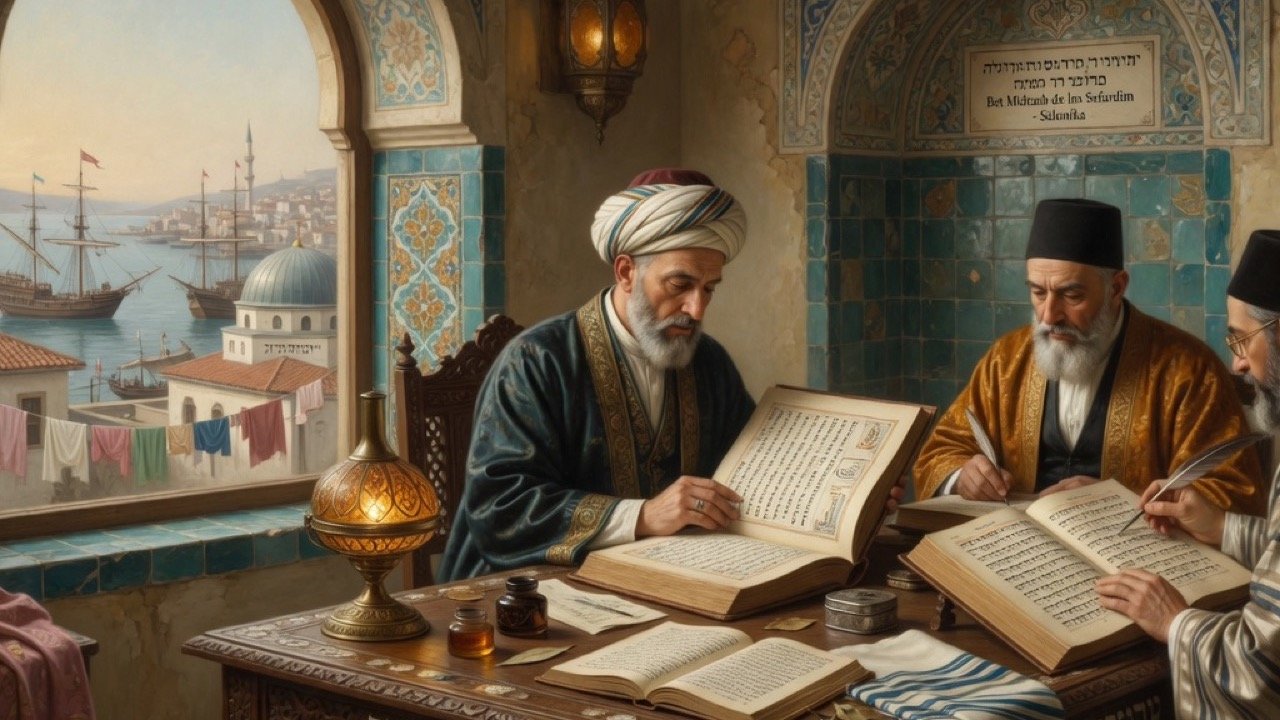
Nineteenth- and early twentieth-century Judezmo newspapers in Salonika, Istanbul, Izmir, and elsewhere discussed politics, feuilleton novels, and, frequently, biblical and ethical topics in a modern key. Secularization, Young Turk politics, Balkan wars, and migration reconfigured readership. Alliance Israélite Universelle schools elevated French; nation-states elevated Turkish, Greek, Serbian, and other tongues.
Rabbinic authors continued to publish in Judezmo even as elites shifted languages. The dual pattern resembles Yiddish modernity: a vernacular high culture blooming at the same moment demographic and political forces undermined its base.
IX. Western Sephardim and Atlantic Paths
Spanish-Portuguese communities in Amsterdam, London, Hamburg, the Caribbean, and the Americas often used Portuguese and Spanish in Latin letters rather than Ottoman Judezmo, while building some of the most important Hebrew printing and synagogue music traditions in the West. Their Bible culture—prestige scrolls, printed Hebrew Bibles, sermon languages—belongs to Sephardi history without being identical to Eastern Ladino literary culture.
Links to this site’s notes on Atlantic and Western scholarship (where present) and to Sephardi Jews help keep these streams distinct but related.
X. Catastrophe, Migration, and Language Shift
The Holocaust destroyed major Judezmo centers in Greece and the Balkans—most notoriously Salonika. Earlier and later migrations to France, the Americas, and Israel dispersed speakers. In Israel, modern Hebrew became the national vernacular; Judezmo survived in homes, clubs, and revival circles. In Turkey and residual Balkan communities, twentieth-century nationalism and assimilation reduced intergenerational transmission.
As with Yiddish, the sacred Hebrew text outlived the demographic peak of the Jewish vernacular that had explained it. What remains are books, songs, proverbs, and academic programs racing to document a language whose native base shrank within a few generations.
XI. Ladino and the Masoretic Inheritance
Sephardi communities were among the great guardians and transmitters of accurate Hebrew Bibles—from Iberian grammarians and codex prestige to Ottoman printing. Ladino did not rewrite the Masorah; it popularized the Bible’s meaning. Maimonidean and later Sephardi legal norms about Torah scrolls still pointed to Ben Asher–type textual ideals discussed elsewhere on this site (Aaron ben Asher, Aleppo Codex, Soferim).
Comparing Ladino with Yiddish shows a shared diaspora structure: Hebrew for the public sacred reading; Jewish vernacular for explanation; print for scale; modernity for rupture. Comparing both with Judeo-Arabic ties the story back to the Arab lands and MENA notes.
| Vernacular | Classic mass Bible medium | Synagogue core |
|---|---|---|
| Yiddish | Tsene-rene; taytsh | Pointed Hebrew lection |
| Ladino / Judezmo | Meʿam Loʿez; calque Bibles | Pointed Hebrew lection |
| Judeo-Arabic | Tafsir / sharḥ traditions | Pointed Hebrew lection |
XII. Gender, Home, and Education
Judezmo religious literature addressed women and men with ethical and narrative Bible teaching; schooling patterns varied by class and city. Mothers transmitted songs, foodways tied to festivals, and proverbial verses. Formal yeshiva learning stayed in Hebrew–Aramaic, but the home’s Ladino made the parasha a family event. Alliance and later state schools rewired that balance toward European languages and, in Israel, Hebrew.
XIII. Revival, Academia, and Digital Memory
Universities, cultural associations, online dictionaries, and music projects now sustain Ladino as heritage and, for some, as a learned second language. Critical editions of Meʿam Loʿez, digitized newspapers, and oral-history archives allow new research on biblical reception. For this site, Ladino is a permanent module in the language and diaspora layer of Bible transmission history.
XIV. Method: Reading Ladino for the History of the Hebrew Bible
Recommended method: (1) separate calque Ladino from everyday Judezmo; (2) always collate with the Hebrew verse of the parasha; (3) locate printings (Constantinople, Salonika, Livorno, Vienna, etc.); (4) note script (Hebrew vs Latin); (5) compare women’s and men’s books; (6) avoid treating Ladino paraphrases as evidence for pre-Masoretic textual variants—they are witnesses to early modern and modern Sephardi understanding.
XV. Why It Matters
Ladino is one of the primary languages in which Sephardi Jews lived with the Hebrew Bible after Iberia. It links Spanish linguistic history to Ottoman Jewish society and to the global Sephardi diaspora. Together with Yiddish and Judeo-Arabic, it completes a triad of vernaculars that carried Masoretic Scripture into everyday speech without dethroning Hebrew. To study Ladino is to study how a sacred text stays fixed while the languages of explanation move with exile and return.
XVI. Case Studies: Salonika, Istanbul, and the Maghreb
Salonika before 1943 was often called a Judezmo metropolis: a city where port labor, rabbinic courts, and newspapers shared a Hispanic Jewish speech under successive Ottoman and Greek regimes. Biblical culture there meant not only synagogue lection but also Ladino ethical tracts sold in the markets and school primers that taught Hebrew letters through vernacular sentences. Istanbul, as imperial capital, hosted early and ongoing printing—including works that fed the Meʿam Loʿez tradition—and a layered Jewish population in which Judezmo, Turkish, French, and Hebrew competed and coexisted.
Maghrebi Haketia communities illustrate contact without erasure: Arabic loanwords and local custom entered Hispanic Jewish speech while Sephardi liturgical norms and Hebrew Bible reading continued. Comparing Salonika’s destruction with Maghrebi migration to Israel and France shows different endings for the same vernacular story—genocide in one theater, language shift after migration in another—both of which reassigned the work of biblical explanation to Hebrew or to French, Spanish, and English.
These case studies caution against a single “Ladino decline” narrative. Political violence, schooling, and prestige languages struck at different times. What remained constant across cases was the synagogue’s Hebrew reading and the memory that Judezmo had once been the sea in which that reading was explained.
XVII. Proverbs, Names, and the Texture of Everyday Scripture
Judezmo proverbs and blessings pack biblical allusions into daily speech: weather, commerce, family conflict, and hospitality. Personal names and shop signs carried Hebrew and Hispanic Jewish forms side by side. This “low” archive—easy to dismiss next to codices—shows how a Masoretic culture feels on the street. When a merchant swears with a verse fragment in Ladino calque order, the Hebrew Bible is not only in the ark; it is in the bargaining.
Onomastics and proverb collections, many gathered by fieldworkers in the twentieth century, thus belong in the same research program as Meʿam Loʿez and printed humashim. They document oral reception parallel to Ashkenazi Yiddish sayings that quote Tanakh. Comparative proverb study is one of the most human ways to see Jewish vernaculars as biblical languages without confusing them with the sacred tongue itself.
XVIII. Synthesis: Vernaculars and the Fixed Text
Place Ladino beside Yiddish and Judeo-Arabic and a structural lesson emerges for the entire Masoretic story told on this site. Jewish communities could change empires, scripts of daily life, and even mother tongues, yet still gather to hear a vocalized Hebrew Torah whose consonants and vowels were treated as inherited trust. Vernacular Bibles and commentaries were technologies of access and emotion, not replacements for the scroll.
That is why language pages belong with codex pages and city pages. The Aleppo Codex and the Leningrad tradition secure the text; Salonika presses and Polish cheders secured the people who would care. Ladino is one of the great securing languages of the Sephardi half of that history—and its study is unfinished as long as archives, songs, and speakers still have more to teach.